
The AI job market in Q2 2026 looks materially different from Q2 2025. Headcount is concentrated more heavily at AI labs and AI-native scale-ups. Pay bands have widened. Junior hiring has compressed, and senior hiring has accelerated.
Here's what AI Pulse data shows from 22,000+ tracked job postings, plus what's likely to shape the second half of 2026.
The Big Picture
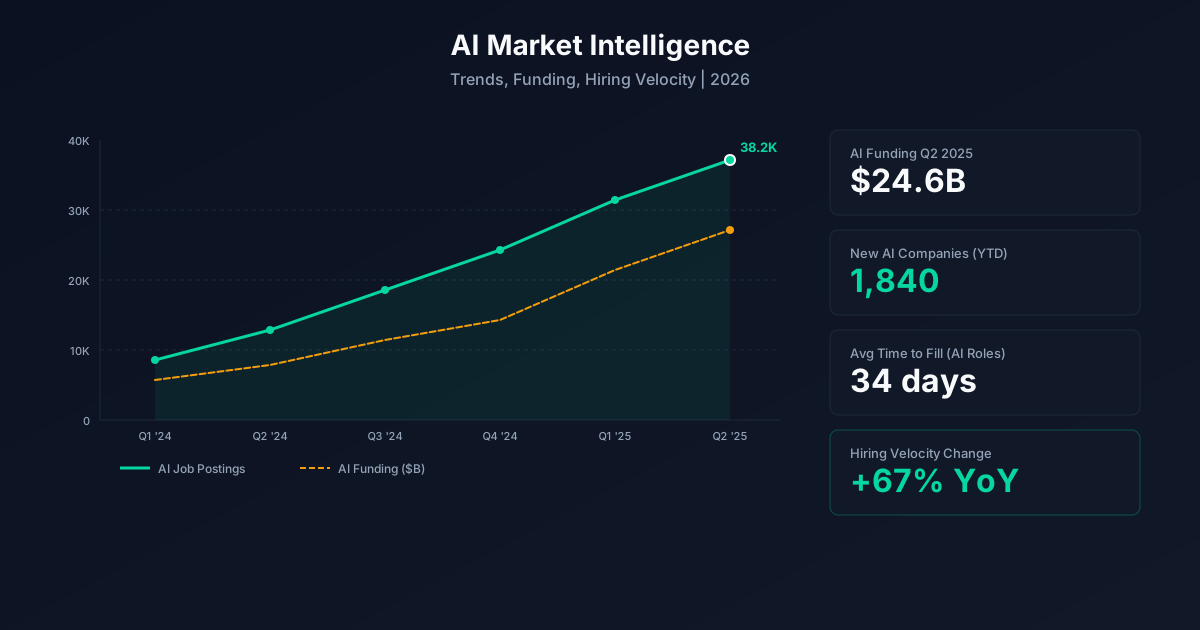
Total AI-skilled job postings grew 38% year-over-year heading into Q2 2026. That growth is uneven.
Senior IC roles (5+ years experience) grew 52% year-over-year. The bidding war for experienced AI talent at AI labs and AI-native scale-ups continues.
Junior IC roles (0-2 years experience) grew only 11%. The compression at the entry level is real. AI is automating routine work, which is the work junior engineers used to do. Companies are hiring fewer juniors and asking the seniors they have to do more.
Mid-level IC roles (3-5 years experience) grew 28%. Slower than seniors, faster than juniors. The mid-level market is healthy but not exuberant.
Manager and director-level AI roles grew 41% year-over-year. The supply of AI-fluent managers is well below demand. Companies that can't hire externally are promoting internally faster than usual, which creates promotion opportunities for senior ICs willing to manage.
Where the Hiring Is
Four employer types are doing most of the AI hiring.
AI labs (Anthropic, OpenAI, Google DeepMind, Meta AI) are hiring aggressively across research, applied engineering, and increasingly across go-to-market and operations. Anthropic and OpenAI in particular have grown headcount 60-100% year-over-year heading into Q2 2026. Comp is at the top of the market.
AI-native scale-ups (Glean, Hex, Writer, Cursor, Perplexity, Cresta, Harvey, Decagon and dozens of others) are hiring across functions. The hiring pace varies by company but most are growing 50-100% per year. Equity is the primary comp lever.
Big tech AI orgs (Google Cloud AI, AWS Bedrock, Microsoft AI, Apple AIML) are hiring steadily but with somewhat tighter approval cycles than 12 months ago. Total hiring is up but the pace has cooled. Comp is competitive but not leading.
AI-forward public companies (Stripe, Salesforce, Notion, Linear, Vercel, ServiceNow) are hiring AI-skilled professionals across functions. The pace varies but the trend is steady growth. Comp is below AI labs but above traditional public companies for similar roles.
Geographic Distribution
The geographic concentration of AI hiring has tightened in 2026.
San Francisco and the Bay Area still lead with 38% of senior AI roles. Down from 45% in 2024 but still dominant. The compression of remote-first AI hiring during 2024-2025 has reversed somewhat as labs and scale-ups push for in-office collaboration.
New York is the second-largest hub at 14% of senior AI roles. Strong concentration in financial services AI, applied AI engineering at finance companies, and AI sales/GTM roles at NYC-based scale-ups.
Seattle holds at 9% of senior AI roles. AWS Bedrock and Microsoft AI drive most of the volume. Apple's local AI presence is growing.
London is the largest non-US hub at 8% of senior AI roles. Google DeepMind, Anthropic London, and a healthy AI scale-up scene drive the volume.
Remote roles at AI-native companies hold at 18% of senior roles. Most AI-native companies are hybrid, not fully remote, which is different from 2022-2023.
What's Hot
Three role categories are seeing the most aggressive hiring.
Senior AI Engineer (production AI features). Demand is at all-time high. Comp at AI-native scale-ups for senior engineers with 5+ years and shipped AI features runs $300K-$450K base, with total comp $500K-$800K including equity. The hiring bar is high but the volume is large.
Research Scientist and Research Engineer. The labs have been hiring aggressively. Anthropic, OpenAI, Google DeepMind, and Meta AI are all open for senior research talent. Comp at this level is the highest in tech, with senior researchers earning $700K-$1.5M+ in total comp.
AI Product Manager. The role grew faster than any other PM specialization in 2025-2026. AI-native scale-ups need experienced PMs who can ship AI features. Comp runs $250K-$400K base with significant equity at scale-ups, $400K-$600K total comp at big tech AI orgs.
What's Cooling
A few areas have softened.
Pure Prompt Engineer roles are growing slower than the broader AI market. The role is being absorbed into AI Systems Engineering, with prompt engineering as one skill within a broader role. Pure Prompt Engineer titles still exist but the title is becoming less common.
Junior AI Engineer roles are growing slower than experienced roles. The compression at the entry level reflects AI automating the work juniors used to do. Companies are hiring fewer juniors and asking the seniors they have to do more. This is a real challenge for new graduates.
Standalone Conversation Designer roles are growing slowly. The work is essential but increasingly merged with broader AI Product or AI UX roles. Pure Conversation Designer titles are stable but not growing as fast as roles that combine conversation design with broader responsibilities.
What's New
Three role categories that didn't meaningfully exist 18 months ago.
GTM Engineer at AI-native scale-ups. The hybrid sales-engineering role is one of the fastest-growing in the AI ecosystem. Compensation runs $180K-$300K base with strong equity. Strong demand from AI-native scale-ups selling enterprise.
AI Eval Engineer or AI QA Engineer. The dedicated role for designing and operating eval frameworks for AI products. Compensation runs $200K-$350K base. Demand is high and supply is well below it.
AI Reliability Engineer. The role focused on AI system uptime, monitoring, and incident response specifically for AI-driven features. SRE plus AI specialization. Compensation runs $250K-$400K base.
What's Likely in H2 2026
Three predictions for the second half of 2026, anchored to current data.
First, the senior IC bidding war continues. Supply at the senior level remains tight. Comp will keep rising at AI labs and AI-native scale-ups. Big tech AI orgs will respond with refresh grants and retention bonuses for top talent.
Second, junior hiring stays compressed. Companies will continue to hire fewer juniors per senior than the historical ratio. The path from new graduate to mid-level engineer will lengthen. New grads will need to demonstrate AI fluency to compete for the smaller pool of junior roles.
Third, function-specialist roles in non-engineering areas keep growing. AI for Sales, AI for Marketing, AI for Finance, AI for Legal will all continue adding senior roles as more incumbent companies build out their AI playbooks. These roles will be a major growth area for non-engineering candidates.
What This Means for Your Job Search
Three concrete moves heading into H2 2026.
First, if you're senior, the market is good. Comp is at peak. Multiple offers at the senior level are common for candidates with shipped AI work. Push for the top of your band.
Second, if you're mid-level, focus on AI-native companies. The comp gap between AI-native and legacy companies for the same seniority is widening. The career trajectory at AI-native is faster.
Third, if you're junior, prioritize AI fluency over title. A "Junior Engineer" role at an AI-native scale-up is a faster path to senior than a more senior title at a non-AI company. The compounding effect over 4-5 years is significant.
For the role-specific job page with current listings and hiring trends, see the jobs spoke pages for your function on AI Pulse.
How AI Pulse data is built
Every number in this article comes from a continuously updated dataset of 4,317 weekly job postings across 42 roles and 14 industries. Salary figures are derived from postings that disclose compensation. AI penetration percentages reflect the share of postings in each function that explicitly require or prefer AI skills. Premium calculations compare median compensation for AI-skilled postings against same-function, same-seniority postings without AI requirements.
Sources & notes. AI Pulse weekly job posting index (n=4,317). Salary disclosure rate: 6.4%. Premium calculations require minimum n=20 postings per role-seniority cell. Updated weekly.
Last updated: 2026-08-20.
How this fits into the bigger career picture
Every article on AI Pulse connects back to the same dataset on AI adoption, salary premiums, and role trajectories. If you're early in your career thinking, the research index covers the full set of insights articles. If you're closer to a job move, the AI by role grid maps the adoption rate and salary premium for every function we track.
The pages that combine the data into a strategic read are the ai-for-* role hubs. Each one synthesizes the adoption story, salary thesis, displacement risk, and the strategic move for that function. If this article is about a specific role, browse the matching hub for the full picture: AI for engineering, marketing, sales, data and analytics, product management, and 19 more.