
The AI hiring market in Q1 2026 is strong but selective. Companies are hiring fewer, more senior engineers compared to the 2023-2024 hiring surge. Here's who's actively recruiting and what they're looking for.
Market Overview
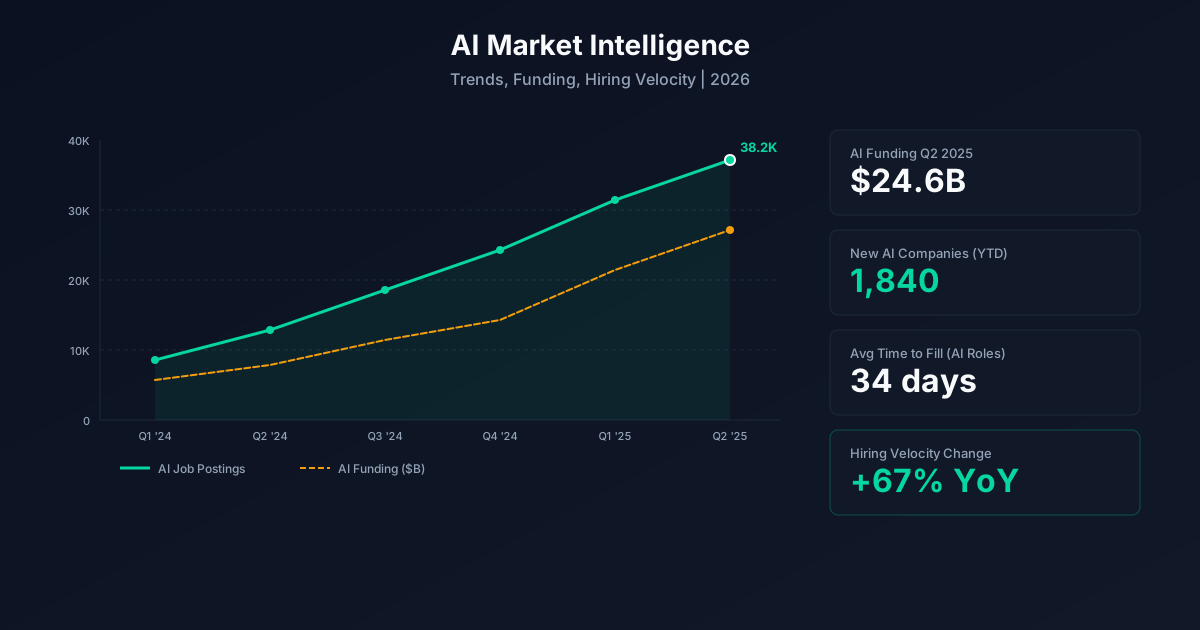
Based on our tracking of AI job postings in January 2026:
- Total AI engineering roles: 1,969 active postings
- Month-over-month change: +8%
- Remote-eligible roles: 34%
- Senior+ roles: 62%
Top Hiring Companies by Category
AI-Native Companies
Anthropic- Roles: AI Engineer, Research Engineer, Trust & Safety
- Focus: Claude development, safety research
- Compensation: Top of market ($200K-400K+)
- What they want: Deep LLM understanding, safety mindset
- Roles: Applied AI Engineer, Platform Engineer
- Focus: ChatGPT, API products, enterprise
- Compensation: Highly competitive + equity
- What they want: Product engineering + AI intersection
- Roles: ML Engineer, Solutions Engineer
- Focus: Enterprise LLM deployment
- Compensation: $170K-280K
- What they want: Production experience, enterprise sales support
- Roles: Research Engineer, Applied ML
- Focus: Open-source models, European market
- Compensation: Competitive, equity upside
- What they want: Strong ML fundamentals
Big Tech AI Teams
Google DeepMind- Roles: Research Scientist, AI Engineer
- Focus: Frontier research, Gemini
- Compensation: $250K-500K+ total comp
- What they want: Research publications or equivalent impact
- Roles: Research Scientist, ML Engineer
- Focus: Llama models, AI infrastructure
- Compensation: $220K-400K total comp
- What they want: Open-source contributions, scale experience
- Roles: AI Engineer, Applied Scientist
- Focus: Copilot products, Azure AI
- Compensation: $180K-350K total comp
- What they want: Product integration experience
- Roles: Applied Scientist, AI Engineer
- Focus: Bedrock, SageMaker, internal AI
- Compensation: $180K-320K total comp
- What they want: AWS experience, production focus
High-Growth AI Startups
Scale AI- Roles: ML Engineer, Data Operations
- Focus: Training data, evaluation
- Compensation: $170K-280K
- What they want: Data pipeline experience
- Roles: AI Engineer, Solutions Engineer
- Focus: MLOps tooling
- Compensation: $160K-250K
- What they want: Developer experience focus
- Roles: ML Engineer, Open Source
- Focus: Model hub, transformers library
- Compensation: $150K-240K
- What they want: Open-source contributions
- Roles: ML Engineer, Platform Engineer
- Focus: Ray, distributed computing
- Compensation: $180K-280K
- What they want: Distributed systems background
Enterprise AI Adopters
Stripe- Roles: ML Engineer, AI Product Engineer
- Focus: Fraud detection, payment optimization
- Compensation: $200K-320K
- What they want: Fintech experience a plus
- Roles: ML Engineer, AI Platform
- Focus: Observability AI features
- Compensation: $180K-280K
- What they want: Infrastructure background
- Roles: AI Engineer
- Focus: AI-powered productivity features
- Compensation: $190K-290K
- What they want: Product sensibility
- Roles: AI/ML Engineer
- Focus: Design AI, creative tools
- Compensation: $200K-300K
- What they want: Creative tool experience
What Q1 2026 Hiring Looks Like
Shift Toward Senior Hires
Companies are consolidating teams and hiring experienced engineers:
- 62% of roles are Senior, Staff, or Principal level
- Junior AI roles are increasingly rare
- Mid-level requires demonstrable production experience
- "AI-curious" engineers are less attractive than before
Specialization Over Generalists
Specific expertise is valued:
- RAG specialists: High demand for complex retrieval systems
- Fine-tuning experts: Companies moving beyond prompt engineering
- AI safety/evals: Growing need for quality assurance
- Multi-modal: Image, video, audio AI expanding
Remote Policy Tightening
Trends in location flexibility:
- Fully remote roles decreased 12% from Q4 2025
- Hybrid (2-3 days) is the most common policy
- Return-to-office mandates affecting some big tech roles
- Remote-first companies gaining competitive advantage
Getting Hired in Q1 2026
What's Working
Strong portfolios: GitHub projects with RAG systems, evaluation frameworks, or production-quality code Specific expertise: Deep knowledge in one area (retrieval, fine-tuning, agents) beats shallow breadth Production stories: "I built X that served Y users with Z results" Open-source presence: Contributions to LangChain, LlamaIndex, or similar projectsWhat's Not Working
Tutorial projects only: Everyone has built a chatbot with LangChain Vague experience: "Worked with LLMs" without specifics Pure research background: Companies want engineers who can ship AI hype without substance: Buzzword-heavy resumes with unclear impactCompanies to Watch
Growing Teams
Companies we expect to increase AI hiring in Q2:
- Perplexity: Search AI, rapidly scaling
- Character.ai: Consumer AI applications
- Glean: Enterprise search and RAG
- Writer: Enterprise content AI
- Harvey: Legal AI, well-funded
Stable Employers
Consistent hiring, good reputation:
- Databricks: ML platform and LLM applications
- Snowflake: Data + AI integration
- MongoDB: Vector search expansion
- Elastic: Search + AI convergence
Caution Areas
Companies with recent layoffs or uncertain funding should be researched carefully. AI hiring can be volatile.
Salary Benchmarks Q1 2026
Current market rates for AI engineering roles:
| Level | Base | Total Comp | |-------|------|------------| | Junior (0-2 yrs) | $125K-160K | $140K-180K | | Mid (2-5 yrs) | $160K-210K | $190K-260K | | Senior (5-8 yrs) | $200K-260K | $250K-340K | | Staff (8+ yrs) | $250K-320K | $320K-450K |
Equity varies dramatically by company stage. Big tech RSUs are reliable; startup equity is speculative.
How to Stand Out
Before Applying
- Research the company's AI products/features
- Identify how your skills map to their needs
- Have a project that demonstrates relevant experience
- Prepare specific stories about production AI work
In Interviews
- Lead with impact, not technology
- Discuss tradeoffs you've navigated
- Show you understand evaluation and iteration
- Demonstrate cost and latency awareness
Negotiation
- Have competing offers if possible
- Understand the equity component deeply
- Research the company's compensation philosophy
- Don't accept the first offer
The Bottom Line
Q1 2026 AI hiring favors experienced engineers with production credentials. The companies above are actively hiring, but competition is fierce for the best roles. Focus on demonstrable expertise, specific skills, and clear impact stories. The market rewards depth over breadth and shipping over studying.
Start with companies whose products excite you. enthusiasm and domain knowledge show in interviews.
How AI Pulse data is built
Every number in this article comes from a continuously updated dataset of 4,317 weekly job postings across 42 roles and 14 industries. Salary figures are derived from postings that disclose compensation. AI penetration percentages reflect the share of postings in each function that explicitly require or prefer AI skills. Premium calculations compare median compensation for AI-skilled postings against same-function, same-seniority postings without AI requirements.
Sources & notes. AI Pulse weekly job posting index (n=4,317). Salary disclosure rate: 6.4%. Premium calculations require minimum n=20 postings per role-seniority cell. Updated weekly.
Last updated: 2026-08-20.
How this fits into the bigger career picture
Every article on AI Pulse connects back to the same dataset on AI adoption, salary premiums, and role trajectories. If you're early in your career thinking, the research index covers the full set of insights articles. If you're closer to a job move, the AI by role grid maps the adoption rate and salary premium for every function we track.
The pages that combine the data into a strategic read are the ai-for-* role hubs. Each one synthesizes the adoption story, salary thesis, displacement risk, and the strategic move for that function. If this article is about a specific role, browse the matching hub for the full picture: AI for engineering, marketing, sales, data and analytics, product management, and 19 more.