
Prompt engineering emerged as one of the hottest jobs in AI, but the role is evolving rapidly. Here's what the career path looks like in 2026 and where it's headed.
The Prompt Engineering Reality Check
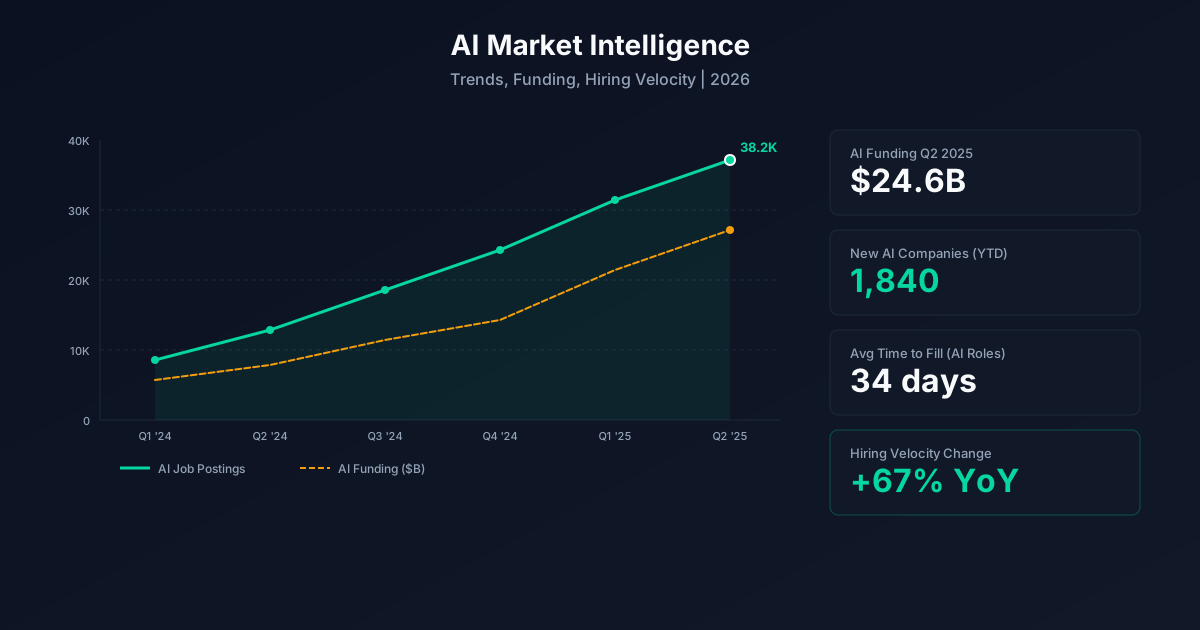
Let's be direct: "prompt engineer" as a standalone job title is declining. Based on our analysis of 1,969 AI job postings, dedicated prompt engineer roles dropped 23% from 2025, while "AI engineer" roles requiring prompt engineering skills grew 45%.
What's happening? Prompt engineering is being absorbed into broader roles rather than disappearing. The skill is more valuable than ever. but it's becoming table stakes for AI engineers rather than a specialty in itself.
Current Prompt Engineering Salary Ranges
Despite the shifting landscape, compensation remains strong:
- Junior Prompt Engineer: $90K - $130K
- Mid-level Prompt Engineer: $130K - $170K
- Senior Prompt Engineer: $160K - $210K
- Staff/Lead: $190K - $250K
The Evolution of Prompt Engineering Roles
Phase 1: Pure Prompt Engineering (2022-2024)
Early roles focused primarily on:
- Writing and optimizing prompts
- Iterating on outputs for quality
- Creating prompt templates
- Basic testing and evaluation
Phase 2: Technical Prompt Engineering (2024-2025)
Roles expanded to include:
- Prompt chains and workflows
- Function calling and tool use
- Integration with retrieval systems
- Systematic evaluation frameworks
Phase 3: AI Engineering Integration (2025+)
Modern expectations include:
- End-to-end system design
- RAG implementation
- Fine-tuning when prompting isn't enough
- Production deployment and monitoring
- Cost optimization
Career Paths From Prompt Engineering
Path 1: AI Engineer
The most common progression. You expand into:
- RAG system development
- LLM application architecture
- MLOps and deployment
- Evaluation and testing infrastructure
Path 2: AI Product Manager
Use your understanding of LLM capabilities to:
- Define AI-powered product features
- Set realistic expectations with stakeholders
- Write technical specs for AI systems
- Evaluate AI vendor solutions
Path 3: Domain Specialist
Deep expertise in a vertical:
- Legal AI (contract analysis, discovery)
- Healthcare AI (clinical documentation, diagnosis support)
- Financial AI (analysis, compliance)
- Creative AI (content, marketing)
Path 4: AI Trainer / RLHF Specialist
Focus on improving model outputs through:
- Creating training datasets
- RLHF and preference tuning
- Red teaming and safety evaluation
- Model behavior analysis
Path 5: Developer Relations / Education
If you enjoy teaching:
- Creating AI tutorials and documentation
- Developer advocacy for AI platforms
- AI training and workshops
- Technical content creation
Skills to Add for Career Growth
Technical Skills (High Priority)
Python programming: You need it for AI engineering roles. Focus on:- Working with APIs and data
- Basic software engineering practices
- Testing and evaluation frameworks
- Vector databases (Pinecone, Weaviate)
- Embedding models and retrieval
- Chunking and optimization strategies
- Building test datasets
- Automated evaluation pipelines
- Metrics that matter (accuracy, latency, cost)
Business Skills (Differentiators)
Communication: Explaining AI capabilities and limitations to non-technical stakeholders Product thinking: Understanding user needs and translating them to AI features Cost analysis: LLM APIs are expensive. Quantifying ROI matters.What Employers Look For
Based on job posting analysis, here's what differentiates candidates:
Entry-level prompt engineering:- Strong writing skills
- Understanding of LLM behavior
- Basic testing and iteration
- Production system experience
- Evaluation framework development
- Cross-functional collaboration
- Multiple model experience (GPT-4, Claude, open-source)
- Team mentorship
- Strategic AI roadmap input
- Vendor evaluation and selection
Building Your Portfolio
Projects that demonstrate career readiness:
- Evaluation framework: Build tooling to systematically test prompt quality. Include metrics, edge cases, and regression testing.
- Complex workflow: Create a multi-step AI system with tool use, branching logic, and error handling.
- Domain application: Apply prompt engineering to a specific industry problem. Show you understand the domain, not just the technology.
- Open-source contribution: Contribute to LangChain, LlamaIndex, or other AI frameworks. Even documentation improvements show engagement.
The Job Market Reality
Where prompt engineering skills are most valued:
Hot sectors:- AI startups (always need prompt optimization)
- Enterprise AI teams (scaling AI adoption)
- Consulting firms (AI implementation projects)
- AI tooling companies (building for other developers)
- Pure "prompt engineer" titles at large companies
- Roles focused only on ChatGPT/consumer AI
- Positions without technical growth path
Making the Transition
If you're currently a prompt engineer looking to grow:
Immediate (0-3 months):- Start learning Python if you haven't
- Build one RAG project end-to-end
- Create an evaluation framework for your current work
- Take on projects with more technical scope
- Learn a vector database deeply
- Contribute to open-source AI tools
- Transition title to AI Engineer if possible
- Build production systems, not just prompts
- Develop domain expertise in one vertical
The Bottom Line
Prompt engineering is evolving. The skill remains valuable, but it's becoming one competency among many for AI engineers rather than a standalone specialty. The best prompt engineers are using this moment to expand into broader AI engineering, building on their understanding of LLM behavior while adding technical depth.
If you're starting in prompt engineering, view it as an entry point rather than a destination. The career path leads to AI engineering, product management, or domain specialization. all of which offer stronger long-term prospects and compensation.
How AI Pulse data is built
Every number in this article comes from a continuously updated dataset of 4,317 weekly job postings across 42 roles and 14 industries. Salary figures are derived from postings that disclose compensation. AI penetration percentages reflect the share of postings in each function that explicitly require or prefer AI skills. Premium calculations compare median compensation for AI-skilled postings against same-function, same-seniority postings without AI requirements.
Sources & notes. AI Pulse weekly job posting index (n=4,317). Salary disclosure rate: 6.4%. Premium calculations require minimum n=20 postings per role-seniority cell. Updated weekly.
Last updated: 2026-08-20.
How this fits into the bigger career picture
Every article on AI Pulse connects back to the same dataset on AI adoption, salary premiums, and role trajectories. If you're early in your career thinking, the research index covers the full set of insights articles. If you're closer to a job move, the AI by role grid maps the adoption rate and salary premium for every function we track.
The pages that combine the data into a strategic read are the ai-for-* role hubs. Each one synthesizes the adoption story, salary thesis, displacement risk, and the strategic move for that function. If this article is about a specific role, browse the matching hub for the full picture: AI for engineering, marketing, sales, data and analytics, product management, and 19 more.