
Remote AI jobs have exploded since 2020, but compensation varies wildly depending on company policy, your location, and how you negotiate. Here's what the data shows about remote AI salaries in 2026.
The Remote AI Job Landscape
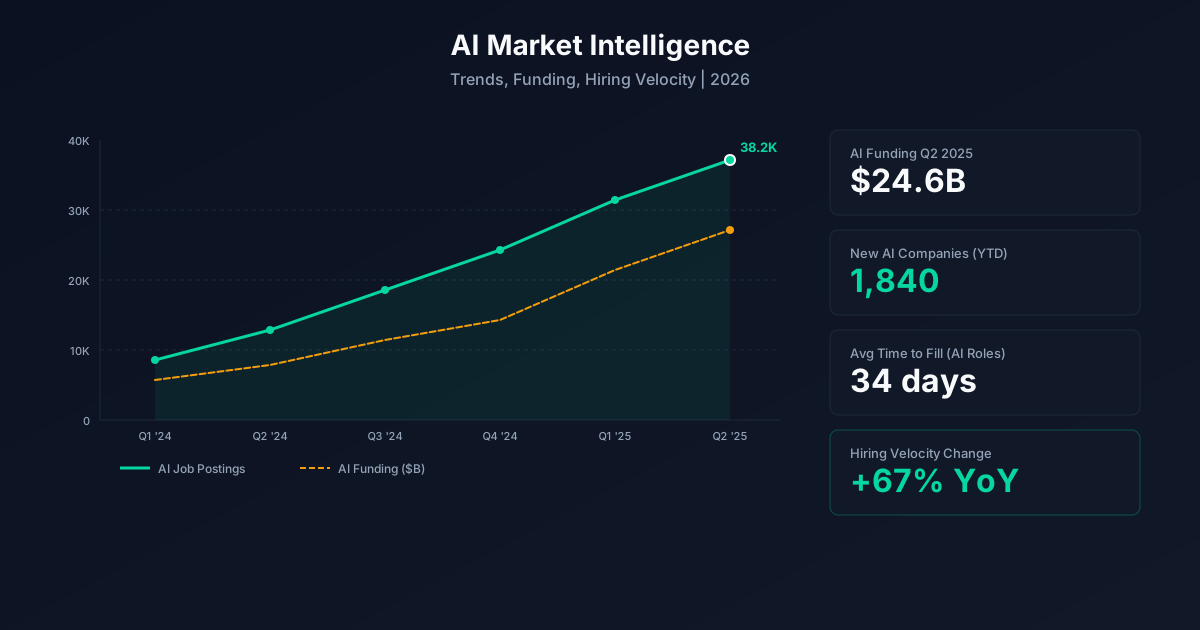
Based on our analysis of 1,969 AI job postings, 34% now offer fully remote options. up from just 12% in 2019. Another 28% offer hybrid arrangements. The shift is permanent, but compensation strategies differ significantly.
Remote-friendly companies fall into three categories:- Location-agnostic pay - Same salary regardless of where you live (rare, but growing)
- Geographic pay bands - Salary adjusted by region or city tier
- Cost-of-living adjusted - Salary scaled to local market rates
Remote AI Salary Ranges by Model
Location-Agnostic Companies
Companies like GitLab, Zapier, and some AI startups pay the same base regardless of location:
- AI Engineer: $160K - $220K
- Senior AI Engineer: $200K - $280K
- Staff AI Engineer: $250K - $320K
Geographic Pay Band Companies
Most large tech companies (Google, Meta, Microsoft) use tiered systems:
- Tier 1 (SF, NYC, Seattle): 100% of base range
- Tier 2 (Austin, Denver, Boston): 85-95% of base
- Tier 3 (Other metros): 75-85% of base
- Tier 4 (Rural/low-cost areas): 65-80% of base
- NYC: $200K
- Austin: $170-190K
- Nashville: $150-170K
- Rural areas: $130-160K
Startup Remote Compensation
AI startups often offer more flexibility but less consistency:
- Seed stage: Wide variation, often 10-20% below market but higher equity
- Series A/B: Competitive base, significant equity upside
- Series C+: Approaching large company rates
The Real Cost of Geographic Arbitrage
Living in a low-cost area while earning Bay Area wages sounds ideal, but consider:
Advantages:- 30-50% more purchasing power in many markets
- Lower state income taxes in some locations (Texas, Florida, Washington)
- Better housing, more space, lower stress
- Career networking is harder remotely
- Some companies won't hire in certain states
- Visa/work authorization complications
- Fewer local AI community events
- Time zone challenges for some roles
How Companies Determine Remote Pay
When a company makes you a remote offer, they typically consider:
- Your current location - Starting point for geographic adjustment
- Where you can legally work - Some states have complex tax implications
- Role seniority - Senior roles get more location flexibility
- Market scarcity - Rare skills (RLHF, multimodal) command premiums anywhere
- Competing offers - Companies will match if you have alternatives
Negotiating Remote Compensation
Key strategies for maximizing remote AI pay:
If you're in a high-cost area:
- Emphasize you could relocate but prefer not to
- Use in-office competing offers as leverage
- Negotiate location-agnostic pay if you might move
If you're in a low-cost area:
- Lead with your skills, not your location
- Apply to location-agnostic companies first
- Negotiate as if you were in a higher tier
- Consider not disclosing location until offer stage
For everyone:
- Ask directly: "What is your remote compensation philosophy?"
- Get the pay band in writing before accepting
- Ask about relocation adjustments. some companies reduce pay if you move
- Negotiate signing bonuses to offset any geographic discount
Remote-First AI Companies Worth Watching
Companies known for competitive remote AI compensation:
Location-agnostic or premium remote pay:- Anthropic (AI safety)
- Hugging Face (ML infrastructure)
- Scale AI (data labeling)
- Weights & Biases (MLOps)
- Anyscale (distributed computing)
- Google (competitive tiers)
- Meta (generous remote policy)
- Stripe (transparent bands)
- Figma (design + AI)
The Tax Angle
Remote work adds tax complexity. Key considerations:
- State income tax: California (13.3%) vs Texas (0%) is a $20K+ difference on a $200K salary
- Nexus rules: Some companies won't hire in certain states due to tax complexity
- International remote: Usually requires contractor status, different comp structure
- Tax equalization: Some companies gross up for high-tax states
The Bottom Line
Remote AI jobs offer real opportunities for geographic arbitrage, but the landscape is fragmented. Location-agnostic companies offer the best deal for those outside major metros, while geographic bands can still be negotiated. Know the company's compensation philosophy before you apply, and negotiate based on your skills and market data. not just where you happen to live.
The companies paying location-agnostic rates are betting that top AI talent is worth the same regardless of zip code. They're often right.
How AI Pulse data is built
Every number in this article comes from a continuously updated dataset of 4,317 weekly job postings across 42 roles and 14 industries. Salary figures are derived from postings that disclose compensation. AI penetration percentages reflect the share of postings in each function that explicitly require or prefer AI skills. Premium calculations compare median compensation for AI-skilled postings against same-function, same-seniority postings without AI requirements.
Sources & notes. AI Pulse weekly job posting index (n=4,317). Salary disclosure rate: 6.4%. Premium calculations require minimum n=20 postings per role-seniority cell. Updated weekly.
Last updated: 2026-08-20.
How this fits into the bigger career picture
Every article on AI Pulse connects back to the same dataset on AI adoption, salary premiums, and role trajectories. If you're early in your career thinking, the research index covers the full set of insights articles. If you're closer to a job move, the AI by role grid maps the adoption rate and salary premium for every function we track.
The pages that combine the data into a strategic read are the ai-for-* role hubs. Each one synthesizes the adoption story, salary thesis, displacement risk, and the strategic move for that function. If this article is about a specific role, browse the matching hub for the full picture: AI for engineering, marketing, sales, data and analytics, product management, and 19 more.