
Interested in this AI/ML Engineer role at Acceleration Partners?
Apply Now →Skills & Technologies
About This Role
Director of Applied AI Product:
===================================
The Director of AI Product role at Acceleration Partners is a remote, work\-from\-home position, as are all roles at AP, a structure central to our culture and our vision for a better balance of work and life. Some travel may be required for internal meetings, conferences, and events.
The Role:
-------------
Something just changed about what a single person can build, and we intend to be the agency that puts it to work first. Acceleration Partners is the recognized leader in partnership marketing, built on more than a decade of proprietary data and technology our industry cannot match, and we are now putting applied AI at the center of how we turn that advantage into measurable outcomes for our clients.
We are looking for a Director of AI Product to own how we build. We have a clear thesis about where this is going and what our clients need, and a working, data\-connected platform that already proves part of it. What we want now is a peer who is deeper in this technology than we are, someone who can pressure\-test that thesis, tell us where it is wrong, and drive how we bring it to life. This is not a role that manages AI features from a distance. You will be in the tools every day, prototyping, building agentic workflows, and shipping against real client data in weeks rather than quarters, and you will help decide what we build ourselves and what we stop outsourcing. You will own the technical approach and the build from day one, and the product roadmap and vision increasingly as the platform matures. We are among the first to apply AI at this depth in partnership marketing, and this role sits at the center of that work.
This is a highly cross\-functional role. You will work closely with engineering, data, client services, agency operations, and strategy teams to translate the needs of our clients and our teams into product that delivers measurable value, while keeping our people focused on the judgment and strategy that technology cannot replace. This role reports to and partners directly with the Chief Strategy Officer.
Top 5 Responsibilities:
---------------------------
Product Direction and Judgment
- Pressure\-test and help shape the product thesis, bringing enough depth in AI and modern build practices to tell us what is real, what is not yet, and what we are missing.
- Execute the established direction, turning it into shipped product that delivers measurable value, and take on increasing ownership of roadmap and vision as the platform matures.
Hands\-On Product Creation
- Move concepts into working software quickly, prototyping and shipping in weeks rather than quarters, building the tools and agentic workflows that do real work against real client data rather than handing specifications to others and waiting.
- Bring AI fluency to every part of the product lifecycle, not just what gets built, but how you discover, prioritize, prototype, and validate. AI is your working method, not a feature category you manage.
- Partner with engineering and data teams to take prototypes from early build to secure, reliable production, holding a high bar for what is ready to put in front of a client.
Product Discovery and User Understanding
- Maintain a deep, continuously updated understanding of the user landscape across client teams and internal users, including how they work today, where current tools fall short, and what a better experience looks like in practice.
- Validate assumptions before committing to build. Identify where a solution will not work for a segment of users before it ships, whether due to customization needs, workflow constraints, or adoption barriers, and have a plan to address those gaps in the product itself or in how it gets rolled out.
- Continuously gather feedback from client teams and internal users after shipping, and feed those signals back into how the roadmap evolves. Discovery does not stop at launch.
Technical Authority and Build Strategy
- Serve as a genuine technical peer to engineering and data, owning the technical approach, making the architecture and build\-versus\-buy calls, and holding the line on what is and is not production\-ready.
- Own how we build, what we develop in\-house versus what we source from partners, and drive that mix toward speed, quality, and cost as our own capability grows.
- Keep the work coherent from end to end, so that what is prototyped carries cleanly into production.
Outcome Ownership and Measurement
- Define and own success in terms of client outcomes, such as retention, revenue per account, and win rates, rather than internal usage metrics.
- Continuously measure, iterate, and improve the real business impact of what ships.
Adoption and Enablement
- Design and drive adoption so the platform integrates naturally into how client services, strategy, and agency operations teams already work, not as a separate tool they have to remember to use, but as a capability woven into their daily workflows.
Operationalization and Rollout Communication
- Own the operationalization of what ships. That means clear rollout communication, documentation, and enablement materials that set client services and operations teams up for success, not just an announcement that a feature is live. The detail work of a rollout is not someone else’s job.
- Run a disciplined communication rhythm around rollouts and changes: what is changing, when it lands, who is affected, and what teams need to do differently, shared early enough that ops and enablement teams can prepare rather than react.
- Keep leadership and cross\-functional teams current on the roadmap, priorities, and an honest view of what is ready versus what is still in build, so no one is surprised by a launch.
What Success Looks Like:
----------------------------
By 6 Months:
- You will have shipped meaningful new functionality into the hands of client teams, built on real data, and earned the trust of our engineering and data teams as a technical peer.
- You will have delivered at least one measurable, client\-facing outcome, and given us a sharper, verified read on what is real in our roadmap and what is not.
- Your rollouts will have set the standard for operational communication: client services, operations, and enablement teams will have known what was changing, when, and what it meant for them, with documentation and enablement in place before launch, not after.
By 1 Year:
- You will have taken on increasing ownership of the platform roadmap and the build, with clear business impact across client strategy, insight, and internal efficiency.
- The platform will be embedded in how AP teams work every day, not a separate tool they visit, but a capability woven into client delivery, strategy, and operations. We will build more of it ourselves, depend less on outside vendors, and the path from idea to production will no longer rest on any single person.
Qualities of the Ideal Candidate:
-------------------------------------
*Let us be direct about who this is for. The best product people right now are the ones who have realized their job fundamentally changed, and are more energized than threatened by it. But the change is not just about building faster. It is about bringing rigorous discovery, sharp user understanding, and real organizational follow\-through to a platform that has to work for the people using it every day. This role is not for a vibe coder who thinks in features, or a visionary who hands off execution. It is for a director\-level operator who is fluent in AI, serious about product craft, and knows how to make things stick inside a real organization.*
- You have a track record of shipping product that people actually use. You understand that the distance between a working prototype and a workflow people rely on every day is where most product work actually lives, and you know how to close it.
- You are as comfortable with a stakeholder conversation and a discovery interview as you are with a prototype. You know shipping something real takes both vision and the unglamorous work of making it stick, and you are energized by both.
- You treat the operational side of shipping as part of the product. The rollout plan, the release note, the documentation, and the enablement session are work you own, not chores you hand off, and the teams on the receiving end of your launches are never surprised.
- You go deep on the user landscape before you build. You know how to identify where a solution will break down for a segment of users before it ships, and you have a plan for that gap, whether it gets solved in the product or in how it gets rolled out.
- Speed energizes you rather than worrying you. You prototype fast, get something real in front of users, and refine from there. Long planning phases and multi\-quarter release cycles are not how you think.
- You live in AI tools and use them every day, not because it is on trend, but because you have seen what they make possible and you intend to work that way. You build in Claude Code, you move fast, and you ship in weeks what used to take a team a quarter.
- You have built agents and agentic systems yourself, not just read about them, and you understand the technology well enough to tell a good bet from a bad one.
- Technically fearless, at home in data and modern software, deep enough to own the architecture and the build\-versus\-buy calls even without a traditional engineering title.
- Real conviction about where this is going, paired with the candor to tell us when we are wrong. We are hiring you partly to be the person who can.
Minimum Qualifications and Skills:
--------------------------------------
- Demonstrated experience building products with modern AI tools, including hands\-on work with AI agents and agentic frameworks. Be prepared to show what you have personally built, not only describe it.
- A director\-level track record in product, with real ownership of roadmap, discovery, and delivery end to end. You have shipped products that people adopted and that drove measurable business outcomes, not just features that got launched.
- Working fluency with data (SQL and modern data warehouses) and contemporary web technologies, deep enough to build prototypes and make real technical tradeoffs, not only evaluate them.
- A history of owning measurable business outcomes, not only shipping features.
- Demonstrated experience operationalizing product rollouts: communication plans, release notes, documentation, and enablement materials that set operations and client\-facing teams up for success. Be prepared to show examples you personally produced.
- Excellent communication skills, with the standing to influence executives and engineers alike.
Preferred Qualifications:
-----------------------------
- Experience in affiliate, influencer, partnership, retail media, or marketing technology.
- Founder, early\-stage, or technical\-leadership background.
- Experience with data platforms, analytics tooling, or BI products (for example Power BI, data warehouses, reporting pipelines).
- Built or contributed to open\-source AI or agent tooling.
- Have stood up production software or driven a build in\-house, not only managed vendors who do.
Why Acceleration Partners?
------------------------------
Acceleration Partners is the world’s largest and first\-to\-market Partnership Marketing Agency creating and nurturing partnerships that drive exceptional measurable outcomes for their clients. Managing clients in 40\+ countries, AP’s global team of 300\+ focuses on data\-driven strategies that connect brands to the right consumers through affiliate and influencer All of our work is supported by APVision, our proprietary technology suite which leverages the largest dataset of any agency in the Partnership Marketing agency ecosystem. Serving over 200 brands—including household names like Amazon, Apple, Target, Google, Marriott, Coinbase, and Burberry—AP’s diversified team is creating what’s next in the industry by building high\-performing partnership marketing programs. As the only truly integrated global partnerships agency, AP prides itself on being at the cutting edge of industry developments and leveraging proven expertise to deliver unique solutions for brands seeking sustainable growth..
AP Perks and Benefits:
--------------------------
- 100% remote work for everyone
- Group medical, dental, and vision coverage insurance (with opt\-out benefits)
- 401K with matching
- Open Paid Time Off
- Summer and Holiday company\-wide shutdown days in July and December
- Volunteer and Birthday Time Off
- Focus Fridays
- Paid Parental Leave Benefits
- Wellness, Technology, and Education Allowances
- Paid sabbatical leaves, donation matching, and more
Salary: The target base salary range is $120\-160K depending on location and experience.
*Benefits may vary based on employment status or country location.*
*Acceleration Partners is committed to a diverse workforce and we are an equal opportunity employer. We evaluate applicants regardless of an individual’s age, race, color, gender, religion, national origin, sexual orientation, disability, or veteran status.*
\#LI\-REMOTE
- *GLSDR*
\#LI\-MG1
Salary Context
This $120K-$160K range is below the median for AI/ML Engineer roles in our dataset (median: $180K across 1841 roles with salary data).
View full AI/ML Engineer salary data →Role Details
About This Role
AI/ML Engineers build and deploy machine learning models in production. They work across the full ML lifecycle: data pipelines, model training, evaluation, and serving infrastructure. The role has evolved significantly over the past two years. Where ML Engineers once spent most of their time on model architecture, the job now tilts heavily toward inference optimization, cost management, and integrating LLM capabilities into existing systems. Companies want engineers who can ship production systems, and the experimenter-only role is fading fast.
Day-to-day, you're writing training pipelines, debugging data quality issues, setting up evaluation frameworks, and figuring out why your model performs differently in staging than it did on your dev set. The best ML engineers are obsessive about reproducibility and measurement. They instrument everything. They know that a model is only as good as the data feeding it and the infrastructure serving it.
Across the 3,708 AI roles we're tracking, AI/ML Engineer positions make up 70% of the market. At Acceleration Partners, this role fits into their broader AI and engineering organization.
Demand for AI/ML Engineers has been strong and consistent. Unlike some AI roles that spike with hype cycles, ML engineering is a foundational need. Every company deploying AI models needs people who can keep them running, and the gap between research prototypes and production systems keeps growing.
What the Work Looks Like
A typical week might include: debugging a data pipeline that's silently dropping 3% of training examples, running A/B tests on a new model version, writing documentation for a feature flag system that lets you roll back model deployments, and reviewing a junior engineer's PR for a new evaluation metric. Meetings tend to be cross-functional since ML touches product, engineering, and data teams.
Demand for AI/ML Engineers has been strong and consistent. Unlike some AI roles that spike with hype cycles, ML engineering is a foundational need. Every company deploying AI models needs people who can keep them running, and the gap between research prototypes and production systems keeps growing.
Skills Required
Python and PyTorch dominate the requirements. Most roles expect experience with cloud platforms (AWS, GCP, or Azure) and familiarity with ML frameworks like TensorFlow or JAX. RAG (Retrieval-Augmented Generation) has become a top-3 skill requirement as companies integrate LLMs into their products. Docker and Kubernetes show up in about a third of postings, reflecting the production focus of the role.
Beyond the core stack, employers increasingly want experience with experiment tracking tools (MLflow, Weights & Biases), feature stores, and vector databases. Fine-tuning experience is valuable but less common than you'd think from reading Twitter. Most production LLM work is RAG and prompt engineering, not fine-tuning. If you have both, you're in a strong position.
Companies that are serious about AI/ML hiring tend to post specific infrastructure details in the job description: the frameworks they use, their model serving stack, their data pipeline tools. Vague postings that just say 'ML experience required' without specifics are often companies that haven't figured out what they need yet.
Compensation Benchmarks
AI/ML Engineer roles pay a median of $218,750 based on 3,817 positions with disclosed compensation. Director-level AI roles across all categories have a median of $272,150. This role's midpoint ($140K) sits 36% below the category median. Disclosed range: $120K to $160K.
Across all AI roles, the market median is $217,500. Top-quartile compensation starts at $272,100. The 90th percentile reaches $325,000. For comparison, the highest-paying categories include AI Safety ($300,000) and Research Engineer ($280,000). By seniority level: Entry: $120,000; Mid: $200,000; Senior: $230,000; Director: $272,150; VP: $250,000.
Acceleration Partners AI Hiring
Acceleration Partners has 1 open AI role right now. They're hiring across AI/ML Engineer. Based in Austin, TX, US. Compensation range: $160K - $160K.
Location Context
AI roles in Austin pay a median of $214,343 across 87 tracked positions.
Career Path
Common paths into AI/ML Engineer roles include Data Scientist, Software Engineer, Research Engineer.
From here, career progression typically leads toward ML Architect, AI Engineering Manager, Principal ML Engineer.
The fastest path into ML engineering is through software engineering with a self-directed ML education. A CS degree helps, but production engineering skills matter more than academic credentials. Build something that works, deploy it, and measure it. That portfolio project is worth more than a Coursera certificate. For career growth, the fork comes around the senior level: go deep on technical complexity (staff/principal track) or move into managing ML teams.
What to Expect in Interviews
Expect system design questions around ML pipelines: how you'd build a training pipeline for a specific use case, handle data drift, or design A/B testing infrastructure for model deployments. Coding rounds typically involve Python, with emphasis on data manipulation (pandas, numpy) and algorithm implementation. Take-home assignments often ask you to build an end-to-end ML pipeline from raw data to deployed model.
When evaluating opportunities: Companies that are serious about AI/ML hiring tend to post specific infrastructure details in the job description: the frameworks they use, their model serving stack, their data pipeline tools. Vague postings that just say 'ML experience required' without specifics are often companies that haven't figured out what they need yet.
AI Hiring Overview
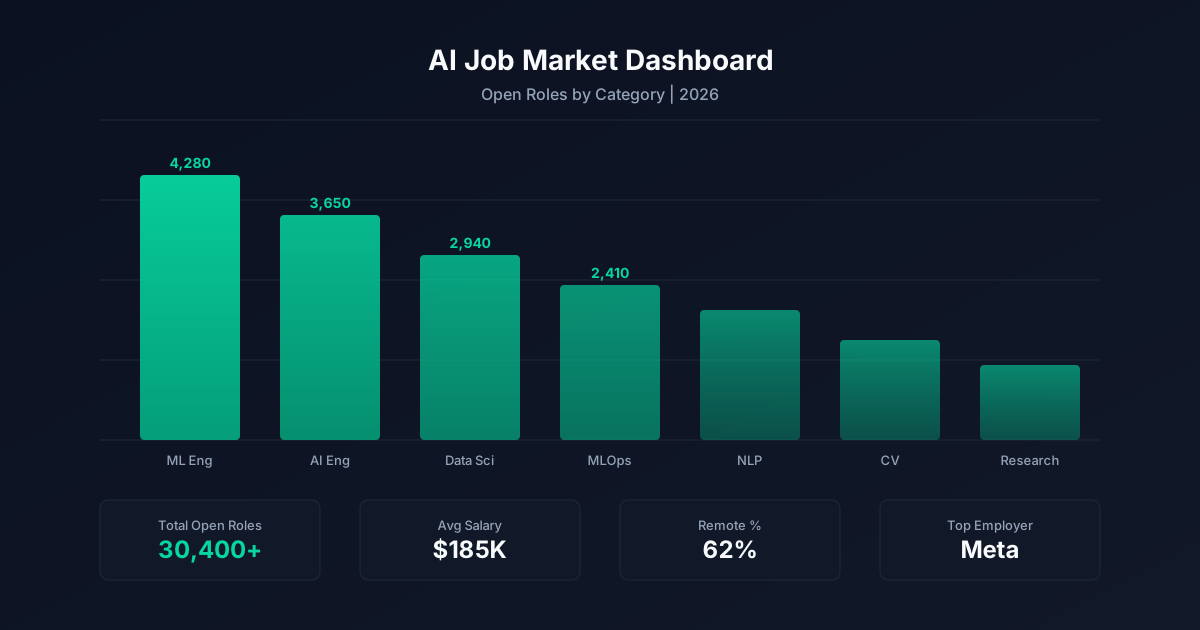
The AI job market has 3,708 open positions tracked in our dataset. By seniority: 102 entry-level, 1,705 mid-level, 1,469 senior, and 432 leadership roles (Director, VP, C-Level). Remote roles make up 14% of the market (508 positions). The remaining 3,180 roles require on-site or hybrid attendance.
The market median for AI roles is $217,500. Top-quartile compensation starts at $272,100. The 90th percentile reaches $325,000. Highest-paying categories: AI Safety ($300,000 median, 21 roles); Research Engineer ($280,000 median, 147 roles); AI Architect ($254,798 median, 67 roles).
Demand for AI/ML Engineers has been strong and consistent. Unlike some AI roles that spike with hype cycles, ML engineering is a foundational need. Every company deploying AI models needs people who can keep them running, and the gap between research prototypes and production systems keeps growing.
The AI Job Market Today
The AI job market spans 3,708 open positions across 16 role categories. The largest categories by volume: AI/ML Engineer (2,605), Data Scientist (310), AI Software Engineer (259). These three account for the majority of open positions, though smaller categories often have higher per-role compensation because of specialized skill requirements.
The seniority mix tells a story about where AI teams are in their maturity. Entry-level roles (102) are outnumbered by mid-level (1,705) and senior (1,469) positions, reflecting that most companies are past the 'build a team from scratch' phase and need experienced engineers who can ship production systems. Leadership roles (Director, VP, C-Level) total 432 positions, representing the bottleneck between technical execution and organizational strategy.
Remote work availability sits at 14% of all AI roles (508 positions), with 3,180 requiring on-site or hybrid attendance. The remote share has stabilized after the post-pandemic correction. Senior and specialized roles (Research Scientist, ML Architect) are more likely to be remote-eligible than entry-level positions, partly because experienced hires have more negotiating power and partly because these roles require less hands-on mentorship.
AI compensation is structured in clear tiers. The market median sits at $217,500. Top-quartile roles start at $272,100, and the 90th percentile reaches $325,000. These figures include base salary with disclosed compensation. Total compensation (including equity, bonuses, and sign-on) runs 20-40% higher at companies that offer those components.
Category matters for compensation. AI Safety roles lead at $300,000 median, while Prompt Engineer roles sit at $140,000. The spread between highest and lowest-paying categories reflects the premium on specialized technical skills versus broader analytical roles.
The most in-demand skills across all AI postings: Python (1,890 postings), Aws (1,103 postings), Azure (877 postings), Rag (855 postings), Gcp (631 postings), Prompt Engineering (560 postings), Pytorch (545 postings), Claude (498 postings). Python dominates, appearing in the vast majority of role descriptions regardless of category. Cloud platform experience (AWS, GCP, Azure) is the second most common requirement. The newer entrants to the top skills list (RAG, vector databases, LLM APIs) reflect the shift from traditional ML toward generative AI applications.
Frequently Asked Questions
Get Weekly AI Career Intelligence
Salary data, skills demand, and market signals from 16,000+ AI job postings. Every Monday.