
Interested in this AI/ML Engineer role at Accenture?
Apply Now →Skills & Technologies
About This Role
We Are:
The Global AI Infrastructure team is at the center of enabling infrastructure reinvention for the next era of digital solutions powered by AI, accelerated computing, and high\-performance workloads. We bring together deep technical expertise across cloud, on\-premises, and hybrid environments to design, build, and operate advanced infrastructure that powers AI platforms, GPU\-accelerated workloads, large\-scale models, simulations, and emerging agentic AI solutions at scale. Our solutions enable some of our most strategic and mission\-critical clients to unlock new levels of performance, efficiency, governance, and innovation. Our remit spans the full lifecycle\-from strategy and architecture through implementation and operations\-driving modernization across the entire infrastructure stack. We collaborate across the ecosystem to harness emerging technologies, fuel growth, and transform industries. In this rapidly growing market, our team is leading the way in shaping how enterprises leverage AI infrastructure to drive breakthrough innovation and reimagine what is possible.
Key Responsibilities:
- Design and implement AI infrastructure and accelerated computing solutions, aligning system architecture and deployment roadmaps to industry\-specific performance, scalability, resiliency, and governance needs
- Deploy, configure, and manage XPU\-based clusters (GPU, DPU, LPU, CPU) across bare\-metal and containerized environments using workload schedulers (Slurm, Run:ai), Kubernetes orchestration, and container platforms to deliver scalable AI infrastructure services including Bare\-Metal\-aaS, GPUaaS, AIaaS, Token\-aaS, model serving, and agentic AI frameworks
- Integrate AI infrastructure platforms with existing IT systems, data pipelines, security frameworks, model\-serving endpoints, and enterprise governance controls
- Design and implement agentic AI infrastructure by integrating platform services, model endpoints, tool and function calling, retrieval patterns, and workflow orchestration with observability, identity, and policy controls through secure, deterministic APIs to support governed enterprise use cases
- Build and integrate MCP servers, tools, connectors, and adapters that allows agents to monitor, troubleshoot, and tune infrastructure to ensure high availability, low\-latency networking, and workload resiliency
- Architect and deploy with NVIDIA platform tools including Base Command Manager (BCM), NGC, NCCL, NVLink, and CUDA along with LLM inference engines (TensorRT\-LLM), production serving frameworks (vLLM, SGLang), inference orchestration (Triton Inference Server, NVIDIA Dynamo, llm\-d), and GPU benchmarking and validation tools (MLPerf, NCCL tests, fio, iperf) to deploy, tune, profile, and validate AI cluster performance across compute and networking layers including multi\-node training and inference workloads
- Develop and maintain documentation including architecture diagrams, configuration baselines, and operational runbooks
- Provide technical guidance, troubleshooting, and optimization across AI workloads including large\-scale training, inference, multi\-node simulations, and agentic pipelines while leveraging digital twins to validate infrastructure and drive performance, scalability, energy efficiency, and token cost optimization
Travel may be required for this role. The amount of travel will vary from 25% to 100% depending on business need and client requirements.
Required Skills and Qualifications:
- Minimum of 5\+ years of experience designing, deploying, and managing AI infrastructure and accelerated computing environments across on\-premises, cloud, and hybrid environments for hyperscaler, neocloud, large enterprise, Telco/Mobile, Financial Services, Life Sciences, Manufacturing, and/or Retail clients.
- Minimum of 5\+ years of hands\-on experience with accelerated computing platforms, including GPUs, DPUs, LPUs, CPUs, high\-speed interconnects such as InfiniBand or Ethernet, data center networking such as SONiC, and AI storage architectures including NVMe, NVMe\-oF, parallel file systems, VAST, Weka, or DDN.
- Minimum of 5\+ years of experience with cluster management, workload scheduling, orchestration, observability, and infrastructure automation using platforms and tools such as Kubernetes, Slurm, Run:ai, AWS, Azure, GCP, VMware, Nutanix, Python, Terraform, and Ansible.
- Bachelor's degree or equivalent (minimum 12 years) work experience. If Associate's Degree, must have minimum 6 years work experience.
Preferred Skills and Qualifications:
- 2\+ years of experience implementing MLOps, LLMOps, agentic AI, and DevSecOps frameworks to enable secure, automated, governed, and reproducible AI workflows.
- 2\+ years of experience developing APIs, integration services, automation workflows, or platform services using Python and modern API patterns such as REST, OpenAPI, JSON/YAML schemas, webhooks, and event\-driven integrations.
- Experience designing and implementing agentic AI infrastructure, including LLM inference, tool/function calling, retrieval\-augmented generation (RAG), agent orchestration, secure API integration, policy\-based governance, and deterministic platform APIs.
- Experience building and integrating MCP servers, tools, connectors, and adapters that allow agents to monitor, troubleshoot, and tune infrastructure for high availability, low\-latency networking, workload resiliency, and intelligent observability.
- Experience using NVIDIA platform tools including Base Command Manager (BCM), NGC, NCCL, NVLink, CUDA, TensorRT\-LLM, Triton Inference Server, NVIDIA Dynamo, llm\-d, vLLM, SGLang, MLPerf, NCCL tests, fio, and iperf to deploy, tune, profile, and validate AI cluster performance.
- Experience managing the deployment of 1,000\+ GPU clusters for AI, HPC, and agentic AI workloads with infrastructure services enabled.
- Design and build experience in AI Cloud platforms from CoreWeave, Nebius, and other specialty cloud providers.
- Knowledge of machine learning and AI frameworks such as TensorFlow, PyTorch, JAX, Jupyter notebooks, and Google Colab environments.
- Industry certifications in NVIDIA infrastructure, public cloud providers, data science, infrastructure automation, networking, or security are a plus.
Compensation at Accenture varies depending on a wide array of factors, which may include but are not limited to the specific office location, role, skill set, and level of experience. As required by local law, Accenture provides a reasonable range of compensation for roles that may be hired as set forth below.
We anticipate this job posting will be posted until 08/15/2026\.
Accenture offers a market competitive suite of benefits including medical, dental, vision, life, and long\-term disability coverage, a 401(k) plan, bonus opportunities, paid holidays, and paid time off. See more information on our benefits here:
U.S. Employee Benefits \| Accenture
Role Location Annual Salary Range
California $94,400 to $266,300
Cleveland $87,400 to $213,000
Colorado $94,400 to $230,000
District of Columbia $100,500 to $245,000
Illinois $87,400 to $230,000
Maine $80,400 to $196,000
Maryland $94,400 to $230,000
Massachusetts $94,400 to $245,000
Minnesota $94,400 to $230,000
New York $87,400 to $266,300
New Jersey $100,500 to $266,300
Virginia $87,400 to $245,000
Washington $100,500 to $245,000
Requesting an Accommodation
Accenture is committed to providing equal employment opportunities for persons with disabilities or religious observances, including reasonable accommodation when needed. If you are hired by Accenture and require accommodation to perform the essential functions of your role, you will be asked to participate in our reasonable accommodation process. Accommodations made to facilitate the recruiting process are not a guarantee of future or continued accommodations once hired.
If you would like to be considered for employment opportunities with Accenture and have accommodation needs such as for a disability or religious observance, please call us toll free at 1 (877\) 889\-9009 or send us an email or speak with your recruiter.
Equal Employment Opportunity Statement
We believe that no one should be discriminated against because of their differences. All employment decisions shall be made without regard to age, race, creed, color, religion, sex, national origin, ancestry, disability status, veteran status, sexual orientation, gender identity or expression, genetic information, marital status, citizenship status or any other basis as protected by federal, state, or local law. Our rich diversity makes us more innovative, more competitive, and more creative, which helps us better serve our clients and our communities.
For details, view a copy of the Accenture Equal Opportunity Statement
Accenture is an EEO and Affirmative Action Employer of Veterans/Individuals with Disabilities.
Accenture is committed to providing veteran employment opportunities to our service men and women.
Other Employment Statements
Applicants for employment in the US must have work authorization that does not now or in the future require sponsorship of a visa for employment authorization in the United States.
Candidates who are currently employed by a client of Accenture or an affiliated Accenture business may not be eligible for consideration.
Job candidates will not be obligated to disclose sealed or expunged records of conviction or arrest as part of the hiring process. Further, at Accenture a criminal conviction history is not an absolute bar to employment.
The Company will not discharge or in any other manner discriminate against employees or applicants because they have inquired about, discussed, or disclosed their own pay or the pay of another employee or applicant. Additionally, employees who have access to the compensation information of other employees or applicants as a part of their essential job functions cannot disclose the pay of other employees or applicants to individuals who do not otherwise have access to compensation information, unless the disclosure is (a) in response to a formal complaint or charge, (b) in furtherance of an investigation, proceeding, hearing, or action, including an investigation conducted by the employer, or (c) consistent with the Company's legal duty to furnish information.
California requires additional notifications for applicants and employees. If you are a California resident, live in or plan to work from Los Angeles County upon being hired for this position, please click here for additional important information.
Please read Accenture’s Recruiting and Hiring Statement for more information on how we process your data during the Recruiting and Hiring process.
Salary Context
This $87K-$266K range is below the median for AI/ML Engineer roles in our dataset (median: $180K across 1841 roles with salary data).
View full AI/ML Engineer salary data →Role Details
About This Role
AI/ML Engineers build and deploy machine learning models in production. They work across the full ML lifecycle: data pipelines, model training, evaluation, and serving infrastructure. The role has evolved significantly over the past two years. Where ML Engineers once spent most of their time on model architecture, the job now tilts heavily toward inference optimization, cost management, and integrating LLM capabilities into existing systems. Companies want engineers who can ship production systems, and the experimenter-only role is fading fast.
Day-to-day, you're writing training pipelines, debugging data quality issues, setting up evaluation frameworks, and figuring out why your model performs differently in staging than it did on your dev set. The best ML engineers are obsessive about reproducibility and measurement. They instrument everything. They know that a model is only as good as the data feeding it and the infrastructure serving it.
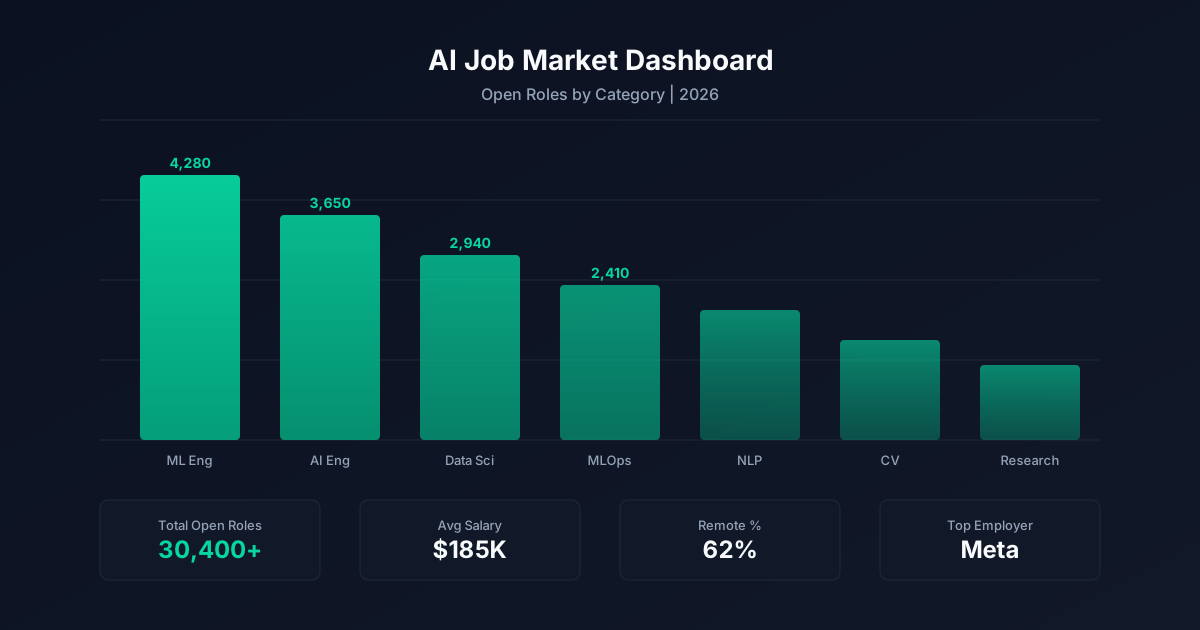
Across the 3,708 AI roles we're tracking, AI/ML Engineer positions make up 70% of the market. At Accenture, this role fits into their broader AI and engineering organization.
Demand for AI/ML Engineers has been strong and consistent. Unlike some AI roles that spike with hype cycles, ML engineering is a foundational need. Every company deploying AI models needs people who can keep them running, and the gap between research prototypes and production systems keeps growing.
What the Work Looks Like
A typical week might include: debugging a data pipeline that's silently dropping 3% of training examples, running A/B tests on a new model version, writing documentation for a feature flag system that lets you roll back model deployments, and reviewing a junior engineer's PR for a new evaluation metric. Meetings tend to be cross-functional since ML touches product, engineering, and data teams.
Demand for AI/ML Engineers has been strong and consistent. Unlike some AI roles that spike with hype cycles, ML engineering is a foundational need. Every company deploying AI models needs people who can keep them running, and the gap between research prototypes and production systems keeps growing.
Skills Required
Python and PyTorch dominate the requirements. Most roles expect experience with cloud platforms (AWS, GCP, or Azure) and familiarity with ML frameworks like TensorFlow or JAX. RAG (Retrieval-Augmented Generation) has become a top-3 skill requirement as companies integrate LLMs into their products. Docker and Kubernetes show up in about a third of postings, reflecting the production focus of the role.
Beyond the core stack, employers increasingly want experience with experiment tracking tools (MLflow, Weights & Biases), feature stores, and vector databases. Fine-tuning experience is valuable but less common than you'd think from reading Twitter. Most production LLM work is RAG and prompt engineering, not fine-tuning. If you have both, you're in a strong position.
Companies that are serious about AI/ML hiring tend to post specific infrastructure details in the job description: the frameworks they use, their model serving stack, their data pipeline tools. Vague postings that just say 'ML experience required' without specifics are often companies that haven't figured out what they need yet.
Compensation Benchmarks
AI/ML Engineer roles pay a median of $218,750 based on 3,817 positions with disclosed compensation. Mid-level AI roles across all categories have a median of $200,000. This role's midpoint ($176K) sits 19% below the category median. Disclosed range: $87K to $266K.
Across all AI roles, the market median is $217,500. Top-quartile compensation starts at $272,100. The 90th percentile reaches $325,000. For comparison, the highest-paying categories include AI Safety ($300,000) and Research Engineer ($280,000). By seniority level: Entry: $120,000; Mid: $200,000; Senior: $230,000; Director: $272,150; VP: $250,000.
Accenture AI Hiring
Accenture has 19 open AI roles right now. They're hiring across AI/ML Engineer, AI Architect. Positions span New York, NY, US, Columbus, OH, US, Morristown, NJ, US. Compensation range: $205K - $387K.
Location Context
Across all AI roles, 14% (508 positions) offer remote work, while 3,180 require on-site attendance. Top AI hiring metros: New York (1,045 roles, $220,000 median); San Francisco (810 roles, $277,088 median); Los Angeles (397 roles, $215,000 median).
Career Path
Common paths into AI/ML Engineer roles include Data Scientist, Software Engineer, Research Engineer.
From here, career progression typically leads toward ML Architect, AI Engineering Manager, Principal ML Engineer.
The fastest path into ML engineering is through software engineering with a self-directed ML education. A CS degree helps, but production engineering skills matter more than academic credentials. Build something that works, deploy it, and measure it. That portfolio project is worth more than a Coursera certificate. For career growth, the fork comes around the senior level: go deep on technical complexity (staff/principal track) or move into managing ML teams.
What to Expect in Interviews
Expect system design questions around ML pipelines: how you'd build a training pipeline for a specific use case, handle data drift, or design A/B testing infrastructure for model deployments. Coding rounds typically involve Python, with emphasis on data manipulation (pandas, numpy) and algorithm implementation. Take-home assignments often ask you to build an end-to-end ML pipeline from raw data to deployed model.
When evaluating opportunities: Companies that are serious about AI/ML hiring tend to post specific infrastructure details in the job description: the frameworks they use, their model serving stack, their data pipeline tools. Vague postings that just say 'ML experience required' without specifics are often companies that haven't figured out what they need yet.
AI Hiring Overview
The AI job market has 3,708 open positions tracked in our dataset. By seniority: 102 entry-level, 1,705 mid-level, 1,469 senior, and 432 leadership roles (Director, VP, C-Level). Remote roles make up 14% of the market (508 positions). The remaining 3,180 roles require on-site or hybrid attendance.
The market median for AI roles is $217,500. Top-quartile compensation starts at $272,100. The 90th percentile reaches $325,000. Highest-paying categories: AI Safety ($300,000 median, 21 roles); Research Engineer ($280,000 median, 147 roles); AI Architect ($254,798 median, 67 roles).
Demand for AI/ML Engineers has been strong and consistent. Unlike some AI roles that spike with hype cycles, ML engineering is a foundational need. Every company deploying AI models needs people who can keep them running, and the gap between research prototypes and production systems keeps growing.
The AI Job Market Today
The AI job market spans 3,708 open positions across 16 role categories. The largest categories by volume: AI/ML Engineer (2,605), Data Scientist (310), AI Software Engineer (259). These three account for the majority of open positions, though smaller categories often have higher per-role compensation because of specialized skill requirements.
The seniority mix tells a story about where AI teams are in their maturity. Entry-level roles (102) are outnumbered by mid-level (1,705) and senior (1,469) positions, reflecting that most companies are past the 'build a team from scratch' phase and need experienced engineers who can ship production systems. Leadership roles (Director, VP, C-Level) total 432 positions, representing the bottleneck between technical execution and organizational strategy.
Remote work availability sits at 14% of all AI roles (508 positions), with 3,180 requiring on-site or hybrid attendance. The remote share has stabilized after the post-pandemic correction. Senior and specialized roles (Research Scientist, ML Architect) are more likely to be remote-eligible than entry-level positions, partly because experienced hires have more negotiating power and partly because these roles require less hands-on mentorship.
AI compensation is structured in clear tiers. The market median sits at $217,500. Top-quartile roles start at $272,100, and the 90th percentile reaches $325,000. These figures include base salary with disclosed compensation. Total compensation (including equity, bonuses, and sign-on) runs 20-40% higher at companies that offer those components.
Category matters for compensation. AI Safety roles lead at $300,000 median, while Prompt Engineer roles sit at $140,000. The spread between highest and lowest-paying categories reflects the premium on specialized technical skills versus broader analytical roles.
The most in-demand skills across all AI postings: Python (1,890 postings), Aws (1,103 postings), Azure (877 postings), Rag (855 postings), Gcp (631 postings), Prompt Engineering (560 postings), Pytorch (545 postings), Claude (498 postings). Python dominates, appearing in the vast majority of role descriptions regardless of category. Cloud platform experience (AWS, GCP, Azure) is the second most common requirement. The newer entrants to the top skills list (RAG, vector databases, LLM APIs) reflect the shift from traditional ML toward generative AI applications.
Frequently Asked Questions
Get Weekly AI Career Intelligence
Salary data, skills demand, and market signals from 16,000+ AI job postings. Every Monday.