
Interested in this AI/ML Engineer role at Amazon Web Services?
Apply Now →Skills & Technologies
About This Role
DESCRIPTION
---------------
As part of the AWS Applied AI Solutions organization, we have a vision to provide business applications, leveraging Amazon’s unique experience and expertise, that are used by millions of companies worldwide to manage day\-to\-day operations. We will accomplish this by accelerating our customers’ businesses through delivery of intuitive and differentiated technology solutions that solve enduring business challenges. We blend vision with curiosity and Amazon’s real\-world experience to build opinionated, turnkey solutions. Where customers prefer to buy over build, we become their trusted partner with solutions that are no\-brainers to buy and easy to use.
Amazon WorkSpaces has protected and empowered enterprise work for over a decade. Now we are reimagining what a workspace is. We are building Agentic WorkSpaces: a platform where the workspace itself is an active partner in how you work, not just infrastructure that delivers applications.
Today, over one million users rely on WorkSpaces daily. Tomorrow, those workspaces will host AI agents alongside humans — agents that code, troubleshoot, analyze, and act on behalf of their users, governed by the same identity and security policies as the people they serve. We are building the platform that makes this possible: a new identity architecture that treats humans and agents as first\-class citizens, a unified cross\-platform agent that ships features to Windows and Linux simultaneously, a next\-generation client (Springboard) that communicates intelligently with users, and AI\-powered admin experiences that replace 300 configuration choices with a single conversation.
This is not incremental. We are rethinking the desktop from the silicon up — from GPU\-powered workstations for builders and AI workloads, to conversational setup experiences, to autonomous troubleshooting that resolves issues before users notice them. We compete with Microsoft, Citrix, and Omnissa — and we intend to leapfrog them by building the workspace that was designed for the agentic era, not retrofitted for it.
The Role
We are looking for a Principal Technical Program Manager who wants to be the connective tissue of this transformation. This is a cross\-functional IC role at the center of everything we ship. You will own end\-to\-end program execution across the Agentic WorkSpaces portfolio — driving delivery across 6\+ engineering teams, 3\+ platform dependencies, 19 production regions, and multiple partner motions. You will operate at the intersection of engineering, product, and GTM, translating bold product vision into sequenced milestones that land on time and at quality.
You are self\-driven, comfortable with ambiguity, and biased toward action. You think big about what the workspace of the future looks like — and then you build the plan to get there. You influence across Amazon without authority, make hard trade\-off decisions with incomplete information, and turn "Won" into "Done." You want to solve challenging problems in identity, AI, and desktop infrastructure at a scale that matters.
We offer a unique opportunity to solve some of the most interesting problems associated with providing secure, reliable, fast, and highly scalable solutions at the intersection of cloud computing and agentic AI. In the process you will have the opportunity to work on a number of industry\-leading AWS services. Our team is innovating in multiple areas to give our customers the best\-in\-class interactive streaming platform while pioneering the next generation of human\-AI collaborative workspaces. We are looking for people who believe in providing world\-class application streaming experience for AWS Enterprise and ISV customers, and who are energized by the challenge of building the future where every workspace is an intelligent partner that drives smarter decisions, greater creativity, and faster innovation with confidence.
Key job responsibilities
Key Job Responsibilities
- Own programs with significant complexity and broad cross\-organizational impact. You will drive the identity modernization strategy — ensuring it lands as a coherent platform, not disconnected features.
- Drive large engineering efforts that solve significantly difficult problems with complete independence. Translate an 18\-month, 3\-phase identity strategy and multi\-year platform roadmap into detailed execution plans with clear milestones, owners, and decision points.
- Identify risks and opportunities in technical strategies, architectures, and organizational structures. See around corners — flagging dependency conflicts with IAM Identity Center, Bedrock AgentCore, EC2, and DCV teams before they become blockers.
- Drive projects cross\-functionally and build partnerships across AWS. Work with field sales (PROPEL/Nexus), ISV partners (Citrix, Omnissa), and GTM teams to ensure what we build translates into customer adoption. Ensure security and identity objectives are met without imposing a performance tax on agent workflows.
- Establish metrics, mechanisms, and reporting cadences that give leadership confidence in delivery health. From weekly execution reviews to S\-Team goal reporting, you build the operating rhythm that keeps a complex organization aligned.
- Manage launch coordination for multi\-region, multi\-platform releases across 6 OS variants. Ensure features ship simultaneously across Windows and Linux via the unified agent architecture — no more "Windows first, Linux later."
- Deliver findings, recommendations, and remediation steps when programs go off\-track. Support deep\-dive assessments and ad\-hoc analysis. You are the person who turns ambiguity into action.
- Lead large programs across internal and external stakeholder to deliver Agentic Workspaces authorization, trust hierarchy, and governance framework that makes autonomous agent action safe in enterprise environments, including audit trails, rollback mechanisms, and human\-in\-the\-loop controls.
About the team
Diverse Experiences
Amazon values diverse experiences. Even if you do not meet all of the preferred qualifications and skills listed in the job description, we encourage candidates to apply. If your career is just starting, hasn’t followed a traditional path, or includes alternative experiences, don’t let it stop you from applying.
Why AWS
Amazon Web Services (AWS) is the world’s most comprehensive and broadly adopted cloud platform. We pioneered cloud computing and never stopped innovating — that’s why customers from the most successful startups to Global 500 companies trust our robust suite of products and services to power their businesses.
Work/Life Balance
We value work\-life harmony. Achieving success at work should never come at the expense of sacrifices at home, which is why flexible work hours and arrangements are part of our culture. When we feel supported in the workplace and at home, there’s nothing we can’t achieve in the cloud.
Inclusive Team Culture
Here at AWS, it’s in our nature to learn and be curious. Our employee\-led affinity groups foster a culture of inclusion that empower us to be proud of our differences. Ongoing events and learning experiences, including our Conversations on Race and Ethnicity and AmazeCon conferences, inspire us to never stop embracing our uniqueness.
Mentorship and Career Growth
We’re continuously raising our performance bar as we strive to become Earth’s Best Employer. That’s why you’ll find endless knowledge\-sharing, mentorship and other career\-advancing resources here to help you develop into a better\-rounded professional.
BASIC QUALIFICATIONS
------------------------
- 7\+ years of technical product or program management experience
- 10\+ years of working directly with engineering teams experience
- 5\+ years of software development experience
- Experience managing programs across cross functional teams, building processes and coordinating release schedules
- 4\+ years of working with Enterprise Application Modernization and Migration technologies, including, but not limited to, Mainframe, Serverless, Containers, or Cloud Operations experience
- Experience delivering products against plan in a fast\-paced, multi\-disciplined, distributed\-responsibility and often ambiguous environment
- Bachelor's degree in Computer Science, Engineering, a related field, or equivalent experience
- Strong technical depth — ability to engage on architecture decisions involving identity protocols (SAML, OIDC), networking, and OS\-level systems
- Excellent verbal and written communication skills; ability to present to VP/SVP audiences
PREFERRED QUALIFICATIONS
----------------------------
- 8\+ years of hands\-on work managing complex technology projects experience
- Experience managing projects across cross functional teams, building sustainable processes and coordinating release schedules
- MBA, or Advanced degree
- Experience driving partner\-dependent programs (ISVs, GSIs, or technology partners)
- Familiarity with AI/ML agent architectures, agentic workflows, or AI\-powered product experiences
- Experience with S\-Team or VP\-level goal reporting and mechanisms at Amazon
Amazon is an equal opportunity employer and does not discriminate on the basis of protected veteran status, disability, or other legally protected status.
Our inclusive culture empowers Amazonians to deliver the best results for our customers. If you have a disability and need a workplace accommodation or adjustment during the application and hiring process, including support for the interview or onboarding process, please visit https://amazon.jobs/content/en/how\-we\-hire/accommodations for more information. If the country/region you’re applying in isn’t listed, please contact your Recruiting Partner.
The base salary range for this position is listed below. Your Amazon package will include sign\-on payments and restricted stock units (RSUs). Final compensation will be determined based on factors including experience, qualifications, and location. Amazon also offers comprehensive benefits including health insurance (medical, dental, vision, prescription, Basic Life \& AD\&D insurance and option for Supplemental life plans, EAP, Mental Health Support, Medical Advice Line, Flexible Spending Accounts, Adoption and Surrogacy Reimbursement coverage), 401(k) matching, paid time off, and parental leave. Learn more about our benefits at https://amazon.jobs/en/benefits.
USA, WA, Seattle \- 177,000\.00 \- 239,400\.00 USD annually
Salary Context
This $177K-$239K range is above the median for AI/ML Engineer roles in our dataset (median: $180K across 1841 roles with salary data).
View full AI/ML Engineer salary data →Role Details
About This Role
AI/ML Engineers build and deploy machine learning models in production. They work across the full ML lifecycle: data pipelines, model training, evaluation, and serving infrastructure. The role has evolved significantly over the past two years. Where ML Engineers once spent most of their time on model architecture, the job now tilts heavily toward inference optimization, cost management, and integrating LLM capabilities into existing systems. Companies want engineers who can ship production systems, and the experimenter-only role is fading fast.
Day-to-day, you're writing training pipelines, debugging data quality issues, setting up evaluation frameworks, and figuring out why your model performs differently in staging than it did on your dev set. The best ML engineers are obsessive about reproducibility and measurement. They instrument everything. They know that a model is only as good as the data feeding it and the infrastructure serving it.
Across the 3,708 AI roles we're tracking, AI/ML Engineer positions make up 70% of the market. At Amazon Web Services, this role fits into their broader AI and engineering organization.
Demand for AI/ML Engineers has been strong and consistent. Unlike some AI roles that spike with hype cycles, ML engineering is a foundational need. Every company deploying AI models needs people who can keep them running, and the gap between research prototypes and production systems keeps growing.
What the Work Looks Like
A typical week might include: debugging a data pipeline that's silently dropping 3% of training examples, running A/B tests on a new model version, writing documentation for a feature flag system that lets you roll back model deployments, and reviewing a junior engineer's PR for a new evaluation metric. Meetings tend to be cross-functional since ML touches product, engineering, and data teams.
Demand for AI/ML Engineers has been strong and consistent. Unlike some AI roles that spike with hype cycles, ML engineering is a foundational need. Every company deploying AI models needs people who can keep them running, and the gap between research prototypes and production systems keeps growing.
Skills Required
Python and PyTorch dominate the requirements. Most roles expect experience with cloud platforms (AWS, GCP, or Azure) and familiarity with ML frameworks like TensorFlow or JAX. RAG (Retrieval-Augmented Generation) has become a top-3 skill requirement as companies integrate LLMs into their products. Docker and Kubernetes show up in about a third of postings, reflecting the production focus of the role.
Beyond the core stack, employers increasingly want experience with experiment tracking tools (MLflow, Weights & Biases), feature stores, and vector databases. Fine-tuning experience is valuable but less common than you'd think from reading Twitter. Most production LLM work is RAG and prompt engineering, not fine-tuning. If you have both, you're in a strong position.
Companies that are serious about AI/ML hiring tend to post specific infrastructure details in the job description: the frameworks they use, their model serving stack, their data pipeline tools. Vague postings that just say 'ML experience required' without specifics are often companies that haven't figured out what they need yet.
Compensation Benchmarks
AI/ML Engineer roles pay a median of $218,750 based on 3,817 positions with disclosed compensation. Senior-level AI roles across all categories have a median of $230,000. This role's midpoint ($208K) sits 5% below the category median. Disclosed range: $177K to $239K.
Across all AI roles, the market median is $217,500. Top-quartile compensation starts at $272,100. The 90th percentile reaches $325,000. For comparison, the highest-paying categories include AI Safety ($300,000) and Research Engineer ($280,000). By seniority level: Entry: $120,000; Mid: $200,000; Senior: $230,000; Director: $272,150; VP: $250,000.
Amazon Web Services AI Hiring
Amazon Web Services has 73 open AI roles right now. They're hiring across AI/ML Engineer, AI Product Manager, Research Scientist, Data Scientist. Positions span New York, NY, US, Austin, TX, US, Jersey City, NJ, US. Compensation range: $129K - $342K.
Location Context
AI roles in Seattle pay a median of $236,900 across 267 tracked positions. That's 9% above the national median.
Career Path
Common paths into AI/ML Engineer roles include Data Scientist, Software Engineer, Research Engineer.
From here, career progression typically leads toward ML Architect, AI Engineering Manager, Principal ML Engineer.
The fastest path into ML engineering is through software engineering with a self-directed ML education. A CS degree helps, but production engineering skills matter more than academic credentials. Build something that works, deploy it, and measure it. That portfolio project is worth more than a Coursera certificate. For career growth, the fork comes around the senior level: go deep on technical complexity (staff/principal track) or move into managing ML teams.
What to Expect in Interviews
Expect system design questions around ML pipelines: how you'd build a training pipeline for a specific use case, handle data drift, or design A/B testing infrastructure for model deployments. Coding rounds typically involve Python, with emphasis on data manipulation (pandas, numpy) and algorithm implementation. Take-home assignments often ask you to build an end-to-end ML pipeline from raw data to deployed model.
When evaluating opportunities: Companies that are serious about AI/ML hiring tend to post specific infrastructure details in the job description: the frameworks they use, their model serving stack, their data pipeline tools. Vague postings that just say 'ML experience required' without specifics are often companies that haven't figured out what they need yet.
AI Hiring Overview
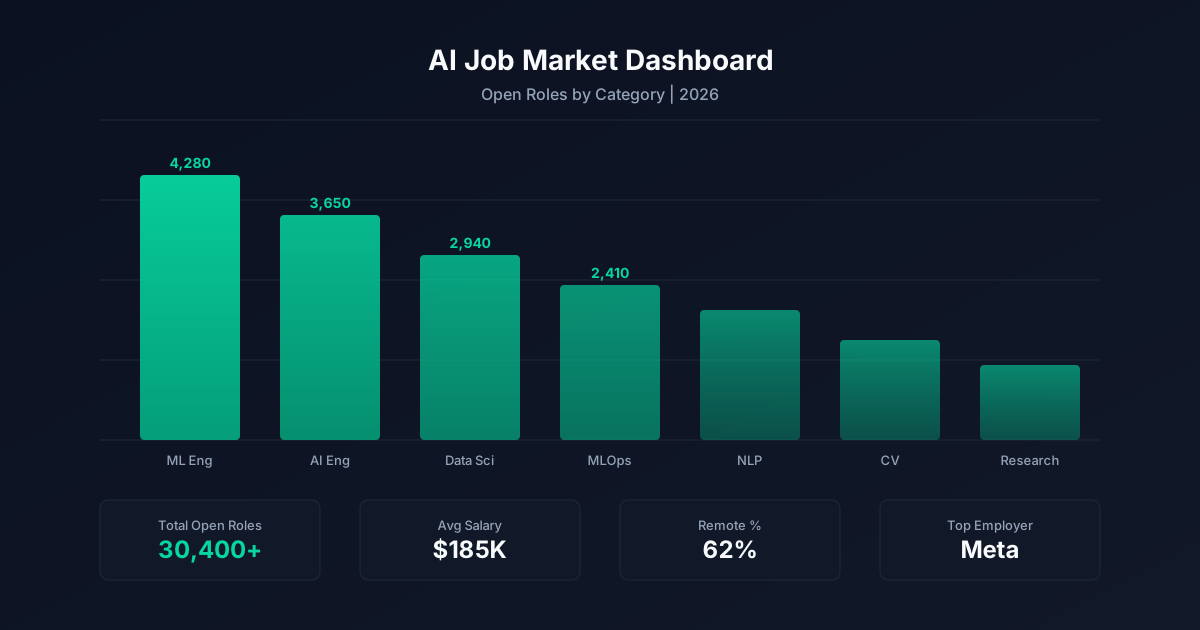
The AI job market has 3,708 open positions tracked in our dataset. By seniority: 102 entry-level, 1,705 mid-level, 1,469 senior, and 432 leadership roles (Director, VP, C-Level). Remote roles make up 14% of the market (508 positions). The remaining 3,180 roles require on-site or hybrid attendance.
The market median for AI roles is $217,500. Top-quartile compensation starts at $272,100. The 90th percentile reaches $325,000. Highest-paying categories: AI Safety ($300,000 median, 21 roles); Research Engineer ($280,000 median, 147 roles); AI Architect ($254,798 median, 67 roles).
Demand for AI/ML Engineers has been strong and consistent. Unlike some AI roles that spike with hype cycles, ML engineering is a foundational need. Every company deploying AI models needs people who can keep them running, and the gap between research prototypes and production systems keeps growing.
The AI Job Market Today
The AI job market spans 3,708 open positions across 16 role categories. The largest categories by volume: AI/ML Engineer (2,605), Data Scientist (310), AI Software Engineer (259). These three account for the majority of open positions, though smaller categories often have higher per-role compensation because of specialized skill requirements.
The seniority mix tells a story about where AI teams are in their maturity. Entry-level roles (102) are outnumbered by mid-level (1,705) and senior (1,469) positions, reflecting that most companies are past the 'build a team from scratch' phase and need experienced engineers who can ship production systems. Leadership roles (Director, VP, C-Level) total 432 positions, representing the bottleneck between technical execution and organizational strategy.
Remote work availability sits at 14% of all AI roles (508 positions), with 3,180 requiring on-site or hybrid attendance. The remote share has stabilized after the post-pandemic correction. Senior and specialized roles (Research Scientist, ML Architect) are more likely to be remote-eligible than entry-level positions, partly because experienced hires have more negotiating power and partly because these roles require less hands-on mentorship.
AI compensation is structured in clear tiers. The market median sits at $217,500. Top-quartile roles start at $272,100, and the 90th percentile reaches $325,000. These figures include base salary with disclosed compensation. Total compensation (including equity, bonuses, and sign-on) runs 20-40% higher at companies that offer those components.
Category matters for compensation. AI Safety roles lead at $300,000 median, while Prompt Engineer roles sit at $140,000. The spread between highest and lowest-paying categories reflects the premium on specialized technical skills versus broader analytical roles.
The most in-demand skills across all AI postings: Python (1,890 postings), Aws (1,103 postings), Azure (877 postings), Rag (855 postings), Gcp (631 postings), Prompt Engineering (560 postings), Pytorch (545 postings), Claude (498 postings). Python dominates, appearing in the vast majority of role descriptions regardless of category. Cloud platform experience (AWS, GCP, Azure) is the second most common requirement. The newer entrants to the top skills list (RAG, vector databases, LLM APIs) reflect the shift from traditional ML toward generative AI applications.
Frequently Asked Questions
Get Weekly AI Career Intelligence
Salary data, skills demand, and market signals from 16,000+ AI job postings. Every Monday.