
Interested in this Research Scientist role at Amazon Web Services?
Apply Now →Skills & Technologies
About This Role
DESCRIPTION
---------------
Are you passionate about using data science to transform how businesses understand and optimize customer interactions at scale? Do you want to build the models and analytics that power the next generation of AI\-driven customer experiences while working directly with customers to accelerate production deployments?
As a Senior Applied Scientist within the Applied AI Solutions team, you will collaborate across AI Velocity Teams (AIVT), enabling multiple customer engagements simultaneously. You will lead data science initiatives that span the full lifecycle — from identifying high\-value business problems and formulating hypotheses, through rigorous experimentation and modeling, to deploying production\-grade solutions that serve thousands of customers. You will bring deep expertise in statistical inference, machine learning, and experimental design to drive measurable impact across Amazon Connect's analytics products and broader Connect AI initiatives.
A critical dimension of this role is working directly with customers during production pilots to accelerate time\-to\-value. You will partner with Applied AI Solutions Architects and Customer Success Specialists to design, build, and deploy AI solutions in customer environments during fixed deployment cycles. You will enable field teams with data\-driven insights, reusable analytical assets, ROI tools, and scalable tooling that accelerate customer engagements and solution delivery. Your work will directly influence customer decisions to adopt Connect Customer AI by quantifying business outcomes and demonstrating measurable value.
You will operate with significant autonomy, owning the scientific direction of your projects while collaborating with applied scientists, software engineers, product managers, technical, and business stakeholders. You will be expected to identify the right methodology for each problem — whether that's a classical statistical approach, a modern deep learning technique, or a novel combination — and communicate your findings clearly to both technical and non\-technical audiences. This role spans Connect AI initiatives including conversational analytics and agentic AI capabilities, offering the opportunity to pioneer data science approaches that scale intelligent analytics worldwide.
Key job responsibilities
- Design, develop, and deploy statistical models and machine learning pipelines to drive product improvements and business decisions
- Work directly with customers during production pilots to design, build, and deploy AI solutions that demonstrate measurable business value
- Design and execute A/B experiments and causal inference analyses to measure the impact of new features and model changes on customer outcomes
- Build ROI models and business case tools that quantify the value of Connect Customer AI for existing customers transitioning from Connect Customer Basic
- Develop and maintain forecasting systems for demand prediction, capacity planning, and workforce optimization
- Develop and apply NLP and generative AI techniques to extract insights from structured and unstructured data at scale
- Partner with applied scientists and software engineers to productionize models, ensuring reliability, monitoring, and operational excellence
- Enable AI Velocity teams with reusable analytical assets, diagnostic notebooks, and scalable tooling that accelerate customer engagements
- Build benchmarking studies and optimization frameworks that demonstrate value across customer cohorts
- Own success metrics and create mechanisms to measure model performance, adoption, and business impact
- Communicate findings and technical trade\-offs to senior leadership and customer executives through written documents (6\-pagers, science reviews) and presentations
- Operate as a shared resource across 2\-3 AIVT teams simultaneously, providing data science expertise across multiple customer engagements
A day in the life
- Start the morning on a call with the AI Velocity Teams preparing for a strategic customer engagement — reviewing the analytical assets and dashboards you've built, walking through how to interpret model outputs, and tailoring recommendations to the customer's contact center environment
- Join a customer working session where you're deploying a production pilot — analyzing their historical contact data, building demand forecasting models, and demonstrating how AI optimizations will reduce their cost per serviced contact while improving customer experience metrics
- Dive into a deep analysis triggered by AIVT field feedback — a large enterprise customer is seeing unexpected patterns in their contact data, and you're pulling together multi\-source data to isolate root cause and build a reusable diagnostic notebook the AIVT team can leverage for similar cases
- Participate in a Conversational Analtyics science review, presenting your A/B test results on a new sentiment classification approach and discussing trade\-offs between model accuracy and inference latency with the engineering team
- Spend the afternoon building a reusable ROI calculator that field teams can use across customer engagements — packaging your economic models with configurable parameters so teams can quickly quantify the value of Connect Customer AI for different customer profiles and usage patterns
- Collaborate with AI Architects and Customer Success Specialists across your three active AIVT engagements, providing data science guidance on model selection, evaluation frameworks, and success metrics for each customer's unique use cases
- Wrap up by reviewing a design document for an agentic AI feature that will use conversation analytics to automatically surface coaching recommendations for contact center supervisors, providing feedback on the evaluation methodology and success metrics
About the team
Why AWS?
Amazon Web Services (AWS) is the world’s most comprehensive and broadly adopted cloud platform. We pioneered cloud computing and never stopped innovating — that’s why customers from the most successful startups to Global 500 companies trust our robust suite of products and services to power their businesses.
Inclusive Team Culture
AWS values curiosity and connection. Our employee\-led and company\-sponsored affinity groups promote inclusion and empower our people to take pride in what makes us unique. Our inclusion events foster stronger, more collaborative teams. Our continual innovation is fueled by the bold ideas, fresh perspectives, and passionate voices our teams bring to everything we do.
Mentorship \& Career Growth
We’re continuously raising our performance bar as we strive to become Earth’s Best Employer. That’s why you’ll find endless knowledge\-sharing, mentorship and other career\-advancing resources here to help you develop into a better\-rounded professional.
Work/Life Balance
We value work\-life harmony. Achieving success at work should never come at the expense of sacrifices at home, which is why we strive for flexibility as part of our working culture. When we feel supported in the workplace and at home, there’s nothing we can’t achieve.
BASIC QUALIFICATIONS
------------------------
- Master's degree in engineering, statistics, computer science, mathematics, or a related quantitative field
- 5\+ years of quantitative and qualitative data science/business intelligence with significant business impact experience
- 3\+ years of machine learning, statistical modeling, data mining, and analytics techniques experience
- PhD, or PhD and 4\+ years of designing experiments and statistical analysis of results experience
- Experience in A/B testing
- Proficiency in Python and SQL; experience with ML frameworks such as scikit\-learn, PyTorch, TensorFlow, or XGBoost
- Track record of delivering end\-to\-end data science solutions from problem definition through production deployment
PREFERRED QUALIFICATIONS
----------------------------
- PhD in a quantitative field such as statistics, mathematics, data science, business analytics, economics, finance, engineering, or computer science
- Experience with AI/ML technologies
- Knowledge of AWS platforms such as S3, Glue, Athena, Sagemaker
- Experience working directly in customer implementations
- Experience building and managing financial models for business forecasting and problem solving, or experience in Excel (macros, index, conditional list, arrays, pivots, lookups)
- Experience building MLOps workflows (CI/CD for models, feature stores, model registries) or real\-time inference systems
- Publications at peer\-reviewed conferences or journals (NeurIPS, ICML, KDD, ACL, EMNLP, etc.)
- Experience with contact center, customer experience, or telecommunications data
- Proven ability to influence without authority and communicate effectively across organizational boundaries
Amazon is an equal opportunity employer and does not discriminate on the basis of protected veteran status, disability, or other legally protected status.
Our inclusive culture empowers Amazonians to deliver the best results for our customers. If you have a disability and need a workplace accommodation or adjustment during the application and hiring process, including support for the interview or onboarding process, please visit https://amazon.jobs/content/en/how\-we\-hire/accommodations for more information. If the country/region you’re applying in isn’t listed, please contact your Recruiting Partner.
The base salary range for this position is listed below. Your Amazon package will include sign\-on payments and restricted stock units (RSUs). Final compensation will be determined based on factors including experience, qualifications, and location. Amazon also offers comprehensive benefits including health insurance (medical, dental, vision, prescription, Basic Life \& AD\&D insurance and option for Supplemental life plans, EAP, Mental Health Support, Medical Advice Line, Flexible Spending Accounts, Adoption and Surrogacy Reimbursement coverage), 401(k) matching, paid time off, and parental leave. Learn more about our benefits at https://amazon.jobs/en/benefits.
USA, NY, New York \- 183,800\.00 \- 248,700\.00 USD annually
USA, WA, Seattle \- 167,100\.00 \- 226,100\.00 USD annually
Salary Context
This $167K-$226K range is above the median for Research Scientist roles in our dataset (median: $183K across 83 roles with salary data).
Role Details
About This Role
Research Scientists push the boundaries of what AI can do. They design experiments, develop novel architectures, publish papers, and translate research breakthroughs into production capabilities. This is where the fundamental advances happen, from attention mechanisms to diffusion models to reasoning chains.
The work is intellectually demanding and often ambiguous. You might spend months on an approach that doesn't pan out. The best research scientists combine deep mathematical intuition with engineering pragmatism. They know when to go deep on theory and when to run experiments. They read papers voraciously and can spot incremental contributions from genuine breakthroughs.
Across the 3,708 AI roles we're tracking, Research Scientist positions make up 3% of the market. At Amazon Web Services, this role fits into their broader AI and engineering organization.
Research Scientist roles are concentrated at major AI labs (OpenAI, Anthropic, Google DeepMind, Meta FAIR) and well-funded AI startups. The competition is intense. PhD is effectively required for most positions, and publication track record matters. Compensation is among the highest in AI, reflecting both the scarcity of talent and the strategic importance of research breakthroughs.
What the Work Looks Like
A typical week includes: reading and discussing recent papers with your team, designing and running experiments on multi-GPU clusters, analyzing results and iterating on hypotheses, writing up findings for internal review or publication, and collaborating with engineering teams to productionize promising results. The ratio of thinking to coding is higher than in engineering roles.
Research Scientist roles are concentrated at major AI labs (OpenAI, Anthropic, Google DeepMind, Meta FAIR) and well-funded AI startups. The competition is intense. PhD is effectively required for most positions, and publication track record matters. Compensation is among the highest in AI, reflecting both the scarcity of talent and the strategic importance of research breakthroughs.
Skills Required
PhD strongly preferred for most roles. Deep expertise in a specific area (NLP, computer vision, reinforcement learning, multimodal) is expected. PyTorch is the standard. Publication track record matters. Strong mathematical foundations in linear algebra, probability, optimization, and information theory are assumed.
Beyond the fundamentals, companies value experience with large-scale distributed training, novel architecture design, and the ability to bridge theory and practice. Understanding of current frontier topics (reasoning, multimodal, long-context, alignment) is essential. Code quality matters more than many researchers expect. Labs want researchers who can implement their ideas cleanly.
Strong research postings specify the research area, mention the team you'd join, and describe the problems they're working on. They often list recent publications from the team. Vague 'AI research' postings without specifics usually mean the company wants to sound impressive but doesn't have a real research agenda.
Compensation Benchmarks
Research Scientist roles pay a median of $222,200 based on 197 positions with disclosed compensation. Senior-level AI roles across all categories have a median of $230,000. This role's midpoint ($196K) sits 12% below the category median. Disclosed range: $167K to $226K.
Across all AI roles, the market median is $217,500. Top-quartile compensation starts at $272,100. The 90th percentile reaches $325,000. For comparison, the highest-paying categories include AI Safety ($300,000) and Research Engineer ($280,000). By seniority level: Entry: $120,000; Mid: $200,000; Senior: $230,000; Director: $272,150; VP: $250,000.
Amazon Web Services AI Hiring
Amazon Web Services has 73 open AI roles right now. They're hiring across AI/ML Engineer, AI Product Manager, Research Scientist, Data Scientist. Positions span New York, NY, US, Austin, TX, US, Jersey City, NJ, US. Compensation range: $129K - $342K.
Location Context
AI roles in San Francisco pay a median of $277,088 across 810 tracked positions. That's 27% above the national median.
Career Path
Common paths into Research Scientist roles include PhD Student, Research Engineer, Postdoc.
From here, career progression typically leads toward Research Lead, Distinguished Scientist, VP of Research.
The PhD is the entry point for most paths. Choose your advisor and research area carefully since they'll define your first industry position. Publish consistently, contribute to open-source projects in your area, and build relationships at conferences. Industry research offers better compensation and compute resources than academia, but the pressure to show product impact is real.
What to Expect in Interviews
Research interviews are multi-stage: a research talk (present your best paper), technical deep-dives on your methodology, and often a 'research proposal' exercise where you design an experiment to test a hypothesis. Coding rounds test implementation ability alongside theoretical knowledge. Be prepared to implement a paper from scratch and discuss the design choices the authors made. Strong candidates can critique papers constructively and identify gaps in experimental methodology.
When evaluating opportunities: Strong research postings specify the research area, mention the team you'd join, and describe the problems they're working on. They often list recent publications from the team. Vague 'AI research' postings without specifics usually mean the company wants to sound impressive but doesn't have a real research agenda.
AI Hiring Overview
The AI job market has 3,708 open positions tracked in our dataset. By seniority: 102 entry-level, 1,705 mid-level, 1,469 senior, and 432 leadership roles (Director, VP, C-Level). Remote roles make up 14% of the market (508 positions). The remaining 3,180 roles require on-site or hybrid attendance.
The market median for AI roles is $217,500. Top-quartile compensation starts at $272,100. The 90th percentile reaches $325,000. Highest-paying categories: AI Safety ($300,000 median, 21 roles); Research Engineer ($280,000 median, 147 roles); AI Architect ($254,798 median, 67 roles).
Research Scientist roles are concentrated at major AI labs (OpenAI, Anthropic, Google DeepMind, Meta FAIR) and well-funded AI startups. The competition is intense. PhD is effectively required for most positions, and publication track record matters. Compensation is among the highest in AI, reflecting both the scarcity of talent and the strategic importance of research breakthroughs.
The AI Job Market Today
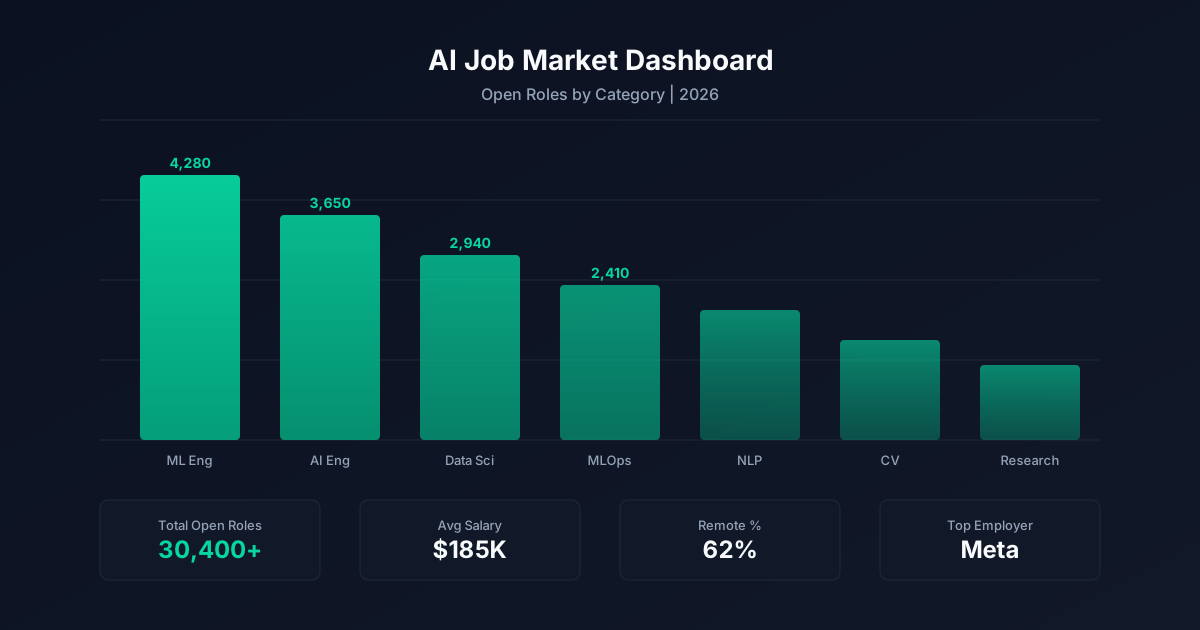
The AI job market spans 3,708 open positions across 16 role categories. The largest categories by volume: AI/ML Engineer (2,605), Data Scientist (310), AI Software Engineer (259). These three account for the majority of open positions, though smaller categories often have higher per-role compensation because of specialized skill requirements.
The seniority mix tells a story about where AI teams are in their maturity. Entry-level roles (102) are outnumbered by mid-level (1,705) and senior (1,469) positions, reflecting that most companies are past the 'build a team from scratch' phase and need experienced engineers who can ship production systems. Leadership roles (Director, VP, C-Level) total 432 positions, representing the bottleneck between technical execution and organizational strategy.
Remote work availability sits at 14% of all AI roles (508 positions), with 3,180 requiring on-site or hybrid attendance. The remote share has stabilized after the post-pandemic correction. Senior and specialized roles (Research Scientist, ML Architect) are more likely to be remote-eligible than entry-level positions, partly because experienced hires have more negotiating power and partly because these roles require less hands-on mentorship.
AI compensation is structured in clear tiers. The market median sits at $217,500. Top-quartile roles start at $272,100, and the 90th percentile reaches $325,000. These figures include base salary with disclosed compensation. Total compensation (including equity, bonuses, and sign-on) runs 20-40% higher at companies that offer those components.
Category matters for compensation. AI Safety roles lead at $300,000 median, while Prompt Engineer roles sit at $140,000. The spread between highest and lowest-paying categories reflects the premium on specialized technical skills versus broader analytical roles.
The most in-demand skills across all AI postings: Python (1,890 postings), Aws (1,103 postings), Azure (877 postings), Rag (855 postings), Gcp (631 postings), Prompt Engineering (560 postings), Pytorch (545 postings), Claude (498 postings). Python dominates, appearing in the vast majority of role descriptions regardless of category. Cloud platform experience (AWS, GCP, Azure) is the second most common requirement. The newer entrants to the top skills list (RAG, vector databases, LLM APIs) reflect the shift from traditional ML toward generative AI applications.
Frequently Asked Questions
Get Weekly AI Career Intelligence
Salary data, skills demand, and market signals from 16,000+ AI job postings. Every Monday.