
Interested in this Research Scientist role at Amazon.com?
Apply Now →Skills & Technologies
About This Role
DESCRIPTION
---------------
Amazon's Worldwide Grocery Stores (WWGS), Data \& Science team is seeking an Applied Scientist to join our under the roof (UTR) Science team, focused on improving outbound pick efficiencies across the Amazon Grocery Network. In this role, you will build optimization and simulation models that directly reduce operational costs and improve associate productivity in warehouse picking operations.
This role owns the development and deployment of mathematical optimization models for pick planning, inventory placement, and warehouse layout design. You will formulate ambiguous business problems as concrete scientific models, develop and deploy production\-grade solutions, and work closely with engineering partners, product owners, and business stakeholders to deliver measurable impact.
Because UTR operations are complex and inter\-connected (e.g., inbound stow vs. outbound pick), this role requires a strong understanding of these relationships and the ability to make trade\-offs at the system level. You will interface directly with non\-technical product owners and business leaders, manage expectations, and take an active part in influencing the feature roadmap.
Key job responsibilities
- Design, develop, and deploy mathematical optimization models (e.g., Mixed Integer Programming, meta\-heuristics) to improve outbound picking efficiency, including pick planning and inventory placement.
- Build simulation models to evaluate warehouse layout designs, test optimization solutions offline, and answer strategic what\-if questions.
- Formulate complex, ambiguous business problems into well\-defined scientific solutions with clear objectives and constraints.
- Collaborate with engineering teams to productionize models, establish data pipelines, and create scalable architectures.
- Track solution performance post\-deployment, identify issues through deep dives, and iteratively improve model quality.
- Communicate technical concepts clearly to diverse stakeholders — scientists, engineers, product managers, and business leaders — through documentation, presentations, and design reviews.
- Author peer\-reviewed research papers on developed models and contribute to the internal scientific community.
BASIC QUALIFICATIONS
------------------------
- PhD, or Master's degree and 4\+ years of CS, CE, ML or related field experience
- 3\+ years of building models for business application experience
- Knowledge of programming languages such as C/C\+\+, Python, Java or Perl
- Knowledge of agile development and best coding practices including peer code reviews, and unit testing
- Experience deploying machine learning or optimization models into production systems.
PREFERRED QUALIFICATIONS
----------------------------
- Experience in program management, logistics, operations, supply chain, transportation, or a related field
- Experience with AWS Services including EC2, Lambda, S3, DynamoDB, SQS
- Experience communicating technical concepts to non\-technical audiences
- Familiarity with simulation\-based optimization and discrete\-event simulation
- Experience with causal inference, econometrics, or machine learning (e.g., neural networks, reinforcement learning)
- Track record of publishing research at peer\-reviewed conferences or journals
- Demonstrated ability to work semi\-autonomously, gathering business requirements and translating them into scientific solutions
Amazon is an equal opportunity employer and does not discriminate on the basis of protected veteran status, disability, or other legally protected status.
Our inclusive culture empowers Amazonians to deliver the best results for our customers. If you have a disability and need a workplace accommodation or adjustment during the application and hiring process, including support for the interview or onboarding process, please visit https://amazon.jobs/content/en/how\-we\-hire/accommodations for more information. If the country/region you’re applying in isn’t listed, please contact your Recruiting Partner.
The base salary range for this position is listed below. Your Amazon package will include sign\-on payments and restricted stock units (RSUs). Final compensation will be determined based on factors including experience, qualifications, and location. Amazon also offers comprehensive benefits including health insurance (medical, dental, vision, prescription, Basic Life \& AD\&D insurance and option for Supplemental life plans, EAP, Mental Health Support, Medical Advice Line, Flexible Spending Accounts, Adoption and Surrogacy Reimbursement coverage), 401(k) matching, paid time off, and parental leave. Learn more about our benefits at https://amazon.jobs/en/benefits.
USA, WA, Seattle \- 142,800\.00 \- 193,200\.00 USD annually
Salary Context
This $142K-$193K range is below the median for Research Scientist roles in our dataset (median: $183K across 83 roles with salary data).
Role Details
About This Role
Research Scientists push the boundaries of what AI can do. They design experiments, develop novel architectures, publish papers, and translate research breakthroughs into production capabilities. This is where the fundamental advances happen, from attention mechanisms to diffusion models to reasoning chains.
The work is intellectually demanding and often ambiguous. You might spend months on an approach that doesn't pan out. The best research scientists combine deep mathematical intuition with engineering pragmatism. They know when to go deep on theory and when to run experiments. They read papers voraciously and can spot incremental contributions from genuine breakthroughs.
Across the 3,708 AI roles we're tracking, Research Scientist positions make up 3% of the market. At Amazon.com, this role fits into their broader AI and engineering organization.
Research Scientist roles are concentrated at major AI labs (OpenAI, Anthropic, Google DeepMind, Meta FAIR) and well-funded AI startups. The competition is intense. PhD is effectively required for most positions, and publication track record matters. Compensation is among the highest in AI, reflecting both the scarcity of talent and the strategic importance of research breakthroughs.
What the Work Looks Like
A typical week includes: reading and discussing recent papers with your team, designing and running experiments on multi-GPU clusters, analyzing results and iterating on hypotheses, writing up findings for internal review or publication, and collaborating with engineering teams to productionize promising results. The ratio of thinking to coding is higher than in engineering roles.
Research Scientist roles are concentrated at major AI labs (OpenAI, Anthropic, Google DeepMind, Meta FAIR) and well-funded AI startups. The competition is intense. PhD is effectively required for most positions, and publication track record matters. Compensation is among the highest in AI, reflecting both the scarcity of talent and the strategic importance of research breakthroughs.
Skills Required
PhD strongly preferred for most roles. Deep expertise in a specific area (NLP, computer vision, reinforcement learning, multimodal) is expected. PyTorch is the standard. Publication track record matters. Strong mathematical foundations in linear algebra, probability, optimization, and information theory are assumed.
Beyond the fundamentals, companies value experience with large-scale distributed training, novel architecture design, and the ability to bridge theory and practice. Understanding of current frontier topics (reasoning, multimodal, long-context, alignment) is essential. Code quality matters more than many researchers expect. Labs want researchers who can implement their ideas cleanly.
Strong research postings specify the research area, mention the team you'd join, and describe the problems they're working on. They often list recent publications from the team. Vague 'AI research' postings without specifics usually mean the company wants to sound impressive but doesn't have a real research agenda.
Compensation Benchmarks
Research Scientist roles pay a median of $222,200 based on 197 positions with disclosed compensation. Mid-level AI roles across all categories have a median of $200,000. This role's midpoint ($168K) sits 24% below the category median. Disclosed range: $142K to $193K.
Across all AI roles, the market median is $217,500. Top-quartile compensation starts at $272,100. The 90th percentile reaches $325,000. For comparison, the highest-paying categories include AI Safety ($300,000) and Research Engineer ($280,000). By seniority level: Entry: $120,000; Mid: $200,000; Senior: $230,000; Director: $272,150; VP: $250,000.
Amazon.com AI Hiring
Amazon.com has 97 open AI roles right now. They're hiring across Research Scientist, AI/ML Engineer, Data Scientist, AI Product Manager. Positions span Sunnyvale, CA, US, Culver City, CA, US, San Francisco, CA, US. Compensation range: $97K - $327K.
Location Context
AI roles in Seattle pay a median of $236,900 across 267 tracked positions. That's 9% above the national median.
Career Path
Common paths into Research Scientist roles include PhD Student, Research Engineer, Postdoc.
From here, career progression typically leads toward Research Lead, Distinguished Scientist, VP of Research.
The PhD is the entry point for most paths. Choose your advisor and research area carefully since they'll define your first industry position. Publish consistently, contribute to open-source projects in your area, and build relationships at conferences. Industry research offers better compensation and compute resources than academia, but the pressure to show product impact is real.
What to Expect in Interviews
Research interviews are multi-stage: a research talk (present your best paper), technical deep-dives on your methodology, and often a 'research proposal' exercise where you design an experiment to test a hypothesis. Coding rounds test implementation ability alongside theoretical knowledge. Be prepared to implement a paper from scratch and discuss the design choices the authors made. Strong candidates can critique papers constructively and identify gaps in experimental methodology.
When evaluating opportunities: Strong research postings specify the research area, mention the team you'd join, and describe the problems they're working on. They often list recent publications from the team. Vague 'AI research' postings without specifics usually mean the company wants to sound impressive but doesn't have a real research agenda.
AI Hiring Overview
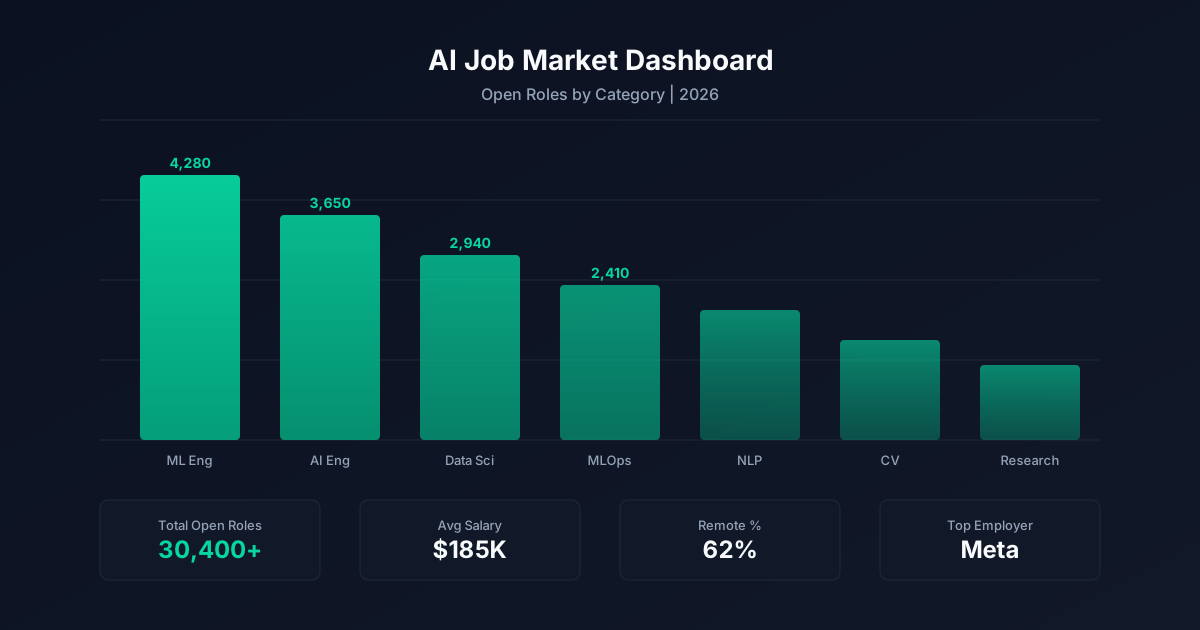
The AI job market has 3,708 open positions tracked in our dataset. By seniority: 102 entry-level, 1,705 mid-level, 1,469 senior, and 432 leadership roles (Director, VP, C-Level). Remote roles make up 14% of the market (508 positions). The remaining 3,180 roles require on-site or hybrid attendance.
The market median for AI roles is $217,500. Top-quartile compensation starts at $272,100. The 90th percentile reaches $325,000. Highest-paying categories: AI Safety ($300,000 median, 21 roles); Research Engineer ($280,000 median, 147 roles); AI Architect ($254,798 median, 67 roles).
Research Scientist roles are concentrated at major AI labs (OpenAI, Anthropic, Google DeepMind, Meta FAIR) and well-funded AI startups. The competition is intense. PhD is effectively required for most positions, and publication track record matters. Compensation is among the highest in AI, reflecting both the scarcity of talent and the strategic importance of research breakthroughs.
The AI Job Market Today
The AI job market spans 3,708 open positions across 16 role categories. The largest categories by volume: AI/ML Engineer (2,605), Data Scientist (310), AI Software Engineer (259). These three account for the majority of open positions, though smaller categories often have higher per-role compensation because of specialized skill requirements.
The seniority mix tells a story about where AI teams are in their maturity. Entry-level roles (102) are outnumbered by mid-level (1,705) and senior (1,469) positions, reflecting that most companies are past the 'build a team from scratch' phase and need experienced engineers who can ship production systems. Leadership roles (Director, VP, C-Level) total 432 positions, representing the bottleneck between technical execution and organizational strategy.
Remote work availability sits at 14% of all AI roles (508 positions), with 3,180 requiring on-site or hybrid attendance. The remote share has stabilized after the post-pandemic correction. Senior and specialized roles (Research Scientist, ML Architect) are more likely to be remote-eligible than entry-level positions, partly because experienced hires have more negotiating power and partly because these roles require less hands-on mentorship.
AI compensation is structured in clear tiers. The market median sits at $217,500. Top-quartile roles start at $272,100, and the 90th percentile reaches $325,000. These figures include base salary with disclosed compensation. Total compensation (including equity, bonuses, and sign-on) runs 20-40% higher at companies that offer those components.
Category matters for compensation. AI Safety roles lead at $300,000 median, while Prompt Engineer roles sit at $140,000. The spread between highest and lowest-paying categories reflects the premium on specialized technical skills versus broader analytical roles.
The most in-demand skills across all AI postings: Python (1,890 postings), Aws (1,103 postings), Azure (877 postings), Rag (855 postings), Gcp (631 postings), Prompt Engineering (560 postings), Pytorch (545 postings), Claude (498 postings). Python dominates, appearing in the vast majority of role descriptions regardless of category. Cloud platform experience (AWS, GCP, Azure) is the second most common requirement. The newer entrants to the top skills list (RAG, vector databases, LLM APIs) reflect the shift from traditional ML toward generative AI applications.
Frequently Asked Questions
Get Weekly AI Career Intelligence
Salary data, skills demand, and market signals from 16,000+ AI job postings. Every Monday.