
Interested in this AI/ML Engineer role at Boston Scientific?
Apply Now →About This Role
Additional Location(s): US\-MA\-Marlborough
Diversity \- Innovation \- Caring \- Global Collaboration \- Winning Spirit \- High Performance
At Boston Scientific, we’ll give you the opportunity to harness all that’s within you by working in teams of diverse and high\-performing employees, tackling some of the most important health industry challenges. With access to the latest tools, information and training, we’ll help you in advancing your skills and career. Here, you’ll be supported in progressing – whatever your ambitions.
About the role:
Boston Scientific is embarking on a multiyear enterprise AI transformation to responsibly and effectively integrate artificial intelligence across the organization. We are seeking an HR Principal, AI Organization Transformation, to serve as a senior individual contributor and subject matter expert driving the design and implementation of AI\-driven organization, work and role transformation across the enterprise.
This is, fundamentally, an organization and work design role. What sets it apart from traditional organization design is deep, current AI fluency: the ability to understand how generative AI and agentic AI change roles, work and the way an organization is structured, and to translate those changes for the technical and change partners who build and embed them. The Principal pairs that fluency with strong organization design expertise and the judgment to connect the two into one coherent plan.
Reporting to the HR Director, AI Organization Transformation, the Principal operates as a hands\-on practitioner within an intact, cross\-functional pod that includes an AI Technical Team, an AI Change Enablement and Upskilling lead, business subject matter experts and HR business partners. The Principal owns the design and its implementation end to end, translates requirements to pod partners and sets the standard for rigor in the team’s outputs. Because this is a newly established capability, the role suits someone comfortable building in ambiguity and ready to take engagements from diagnosis through lasting change. It is an ideal fit for someone who has led this type of work in consulting or a large enterprise and is ready to own and deliver it in a complex, global medtech environment.
*Boston Scientific was recognized as a Glassdoor Best Place to Work in 2026, ranking No. 15 on the Top 100 list, reflecting the culture our employees experience every day.*
*At Boston Scientific, we value collaboration and synergy. This role follows a hybrid work model requiring employees to be in our MA or MN office at least three days per week. Boston Scientific will not offer sponsorship or take over sponsorship of an employment visa for this position at this time.*
Your responsibilities will include:
- Lead organizational redesign analyses and design efforts for functions undergoing AI\-driven transformation, including research, stakeholder interviews, design option development and recommendations.
- Apply task\-level decomposition methodology to break roles into discrete tasks, assess each task’s suitability for AI augmentation or automation, and redesign roles around the resulting human\-AI boundary.
- Design new AI\-era roles and job families, including human\-AI teaming roles, AI workflow orchestrators, and AI governance and oversight roles, with clear accountabilities and competency profiles.
- Ensure job architecture, competency frameworks, skills and career paths are updated to reflect the responsibilities and skills required in an AI\-augmented organization.
- Drive implementation by standing up new structures and roles, working through the transition, and ensuring designs hold in practice in partnership with the change lead.
- Partner with Talent Management and Total Rewards to connect job design outputs to workforce planning, hiring, performance management and compensation.
- Maintain deep, current fluency in AI, generative AI and agent\-based AI, and translate their capabilities into concrete implications for roles, skills, structures and workflows.
- Translate the AI Technical Team’s possibilities and constraints, and the change team’s requirements, into clear design decisions and actionable requirements for pod partners.
- Monitor external AI, generative AI and agentic AI trends and translate relevant developments into practical design recommendations.
- Use Reejig\-driven task decomposition to inform which work shifts to AI, stays human, or becomes human\+AI — then institutionalize those decisions through the work and career architecture (role design, leveling, skills, pathways)
- Contribute to the enterprise AI transformation strategy, roadmap and governance in support of the HR Director, including value cases that quantify anticipated efficiency gains, workforce impacts and return on investment.
- Map current\-state workflows for high\-priority processes in sufficient detail to identify automation opportunities and human\-AI handoff points.
- Translate workflow analysis into design decisions and requirements for the AI Technical Team and process owners, partnering on the redesign rather than independently running a Lean or Six Sigma program.
- Apply continuous\-improvement principles, such as Lean, Agile or equivalent methodologies, to help ensure future\-state designs are efficient, scalable and measurable.
- Build reusable tools, templates and methodologies that HR business partners and business teams can apply to scale the work beyond the core team.
- Partner with the AI Change Enablement and Upskilling lead, who owns change management, communications, training and adoption, by translating design changes into the role, skill and workforce requirements that shape their plans.
- Serve as a trusted adviser to leaders and HR business partners on the workforce, skills and role implications of AI change, helping teams prepare for new ways of working.
- Account for the human dimensions of AI adoption, including role evolution and workforce concerns, in how designs are shaped and sequenced.
- Operate as a connected member of an intact pod where success is measured by team movement as much as individual deliverables.
- Own organization, operating\-model, role, job and skills design and implementation, including translation of AI and workflow change into design and requirements.
- Partner with the AI Technical Team, AI Change Enablement and Upskilling lead, business subject matter experts and HR business partners to ensure technical solutions, adoption plans, business realities and people decisions are connected.
- Coordinate across HR, IT, Legal, Compliance and business teams to keep AI initiatives aligned, integrated and risk\-aware.
- Contribute to the team’s methodologies, tools and thought leadership, and provide guidance and informal mentorship to other contributors.
Required qualifications:
- Bachelor’s degree in business, organization development, human resources, industrial and organizational psychology, or a related field.
- Minimum of 8 years' experience in hands\-on enterprise transformation, organizational design, HR strategy or management consulting.
- Demonstrated depth in organization and operating\-model design and job, work and skills architecture.
- Strong integrative judgment, with the ability to connect organization design, AI, operating model and workflow into a single coherent, implementable plan rather than separate workstreams.
- Deep, current fluency in AI, generative AI and agentic AI, with the ability to translate these capabilities into role and workforce implications and keep pace as technology evolves without needing to build the technology.
- Proven track record of taking organization and work\-design engagements from diagnosis through design to implementation and lasting change, not solely producing recommendations.
- Demonstrated experience with job or role redesign in a major business or technology transformation, including task\-level analysis to identify automation opportunities.
- Ability to map workflows in sufficient detail to partner with technical and process experts and translate requirements through process\-design fluency rather than Lean or Six Sigma ownership.
- Comfort operating in a newly established, ambiguous and fast\-moving capability, bringing structure where little exists.
- Strong collaboration, translation and stakeholder\-influence skills, including the ability to influence without authority across a matrixed, global environment.
Preferred qualifications:
- Master’s degree in business, organization development, human resources, industrial and organizational psychology, or a related field.
- Management consulting experience in organization design, operating\-model or workforce transformation with large, global clients, with readiness to move from advising to owning and delivering the work inside an enterprise.
- Experience in a regulated industry, such as medical technology, health care, financial services or life sciences.
- Familiarity with organizational design methodologies and frameworks, such as the Galbraith Star Model or Kates Kesler, and digital organization design tools such as OrgVue.
- Familiarity with task decomposition or work design methodologies and platforms, such as Mercer Work Design, Gloat, Reejig or equivalent tools.
- Familiarity with workflow automation platforms, such as Microsoft Power Automate or Copilot Studio, sufficient to brief and partner with technical teams on automation design and human\-AI handoff points.
- Demonstrated experience executing change initiatives involving organizational transformation and technology adoption.
- Demonstrated competency in organization and operating\-model design, AI\-era role design, task\-level work analysis, human\-AI work allocation, business process mapping, workflow redesign and implementation of organization design.
- Ability to collaborate, translate complex concepts and influence without authority in matrixed, global environments.
- Comfort with ambiguity and building new capabilities.
Requisition ID: 631105
Minimum Salary: $106800
Maximum Salary: $202900
The anticipated compensation listed above and the value of core and optional employee benefits offered by Boston Scientific (BSC) – see www.bscbenefitsconnect.com—will vary based on actual location of the position and other pertinent factors considered in determining actual compensation for the role. Compensation will be commensurate with demonstrable level of experience and training, pertinent education including licensure and certifications, among other relevant business or organizational needs. At BSC, it is not typical for an individual to be hired near the bottom or top of the anticipated salary range listed above.
Compensation for non\-exempt (hourly), non\-sales roles may also include variable compensation from time to time (e.g., any overtime and shift differential) and annual bonus target (subject to plan eligibility and other requirements).
Compensation for exempt, non\-sales roles may also include variable compensation, i.e., annual bonus target and long\-term incentives (subject to plan eligibility and other requirements).
For MA positions: It is unlawful to require or administer a lie detector test for employment. Violators are subject to criminal penalties and civil liability.
Boston Scientific transforms lives through innovative medical technologies that improve the health of patients around the world. As a global medical technology leader for more than 45 years, we advance science for life by providing a broad range of high\-performance solutions that address unmet patient needs and reduce the cost of healthcare. Our portfolio of devices and therapies helps physicians diagnose and treat complex cardiovascular, respiratory, digestive, oncological, neurological and urological diseases and conditions. Learn more at www.bostonscientific.com and follow us on LinkedIn.
Boston Scientific Corporation has been and will continue to be an equal opportunity employer. To ensure full implementation of its equal employment policy, the Company will continue to take steps to assure that recruitment, hiring, assignment, promotion, compensation, and all other personnel decisions are made and administered without regard to race, religion, color, national origin, citizenship, sex, sexual orientation, gender identity, gender expression, veteran status, age, mental or physical disability, genetic information or any other protected class.
Please be advised that certain US based positions, including without limitation field sales and service positions that call on hospitals and/or health care centers, require acceptable proof of COVID\-19 vaccination status. Candidates will be notified during the interview and selection process if the role(s) for which they have applied require proof of vaccination as a condition of employment. Boston Scientific continues to evaluate its policies and protocols regarding the COVID\-19 vaccine and will comply with all applicable state and federal law and healthcare credentialing requirements. As employees of the Company, you will be expected to meet the ongoing requirements for your roles, including any new requirements, should the Company’s policies or protocols change with regard to COVID\-19 vaccination.
Salary Context
This $106K-$202K range is below the median for AI/ML Engineer roles in our dataset (median: $180K across 1841 roles with salary data).
View full AI/ML Engineer salary data →Role Details
About This Role
AI/ML Engineers build and deploy machine learning models in production. They work across the full ML lifecycle: data pipelines, model training, evaluation, and serving infrastructure. The role has evolved significantly over the past two years. Where ML Engineers once spent most of their time on model architecture, the job now tilts heavily toward inference optimization, cost management, and integrating LLM capabilities into existing systems. Companies want engineers who can ship production systems, and the experimenter-only role is fading fast.
Day-to-day, you're writing training pipelines, debugging data quality issues, setting up evaluation frameworks, and figuring out why your model performs differently in staging than it did on your dev set. The best ML engineers are obsessive about reproducibility and measurement. They instrument everything. They know that a model is only as good as the data feeding it and the infrastructure serving it.
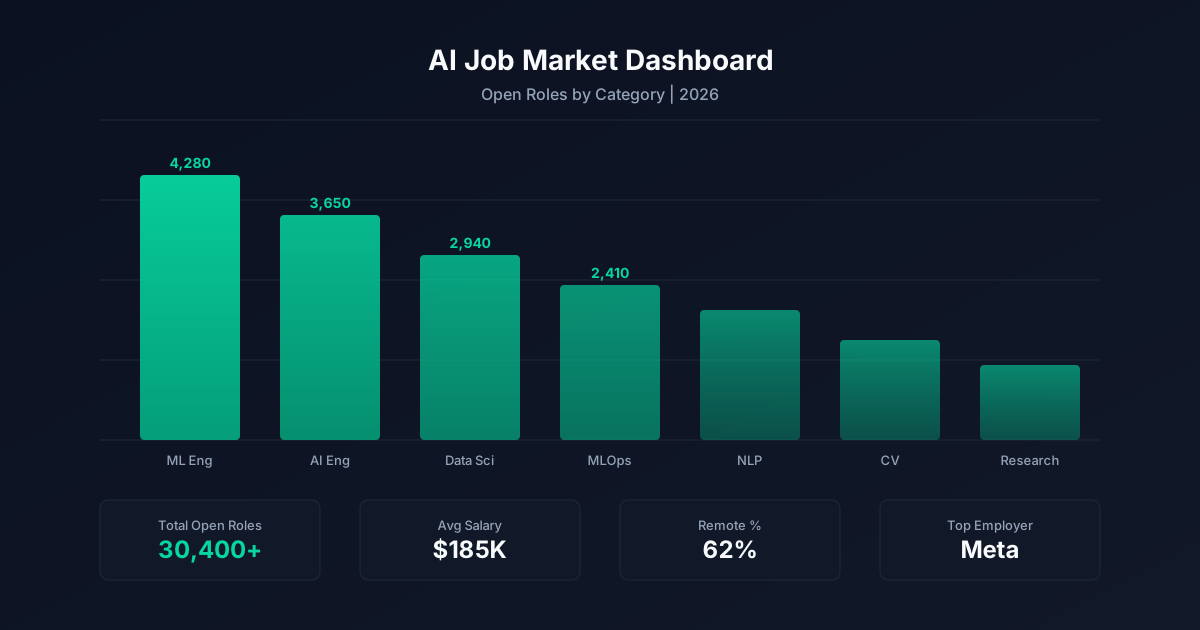
Across the 3,708 AI roles we're tracking, AI/ML Engineer positions make up 70% of the market. At Boston Scientific, this role fits into their broader AI and engineering organization.
Demand for AI/ML Engineers has been strong and consistent. Unlike some AI roles that spike with hype cycles, ML engineering is a foundational need. Every company deploying AI models needs people who can keep them running, and the gap between research prototypes and production systems keeps growing.
What the Work Looks Like
A typical week might include: debugging a data pipeline that's silently dropping 3% of training examples, running A/B tests on a new model version, writing documentation for a feature flag system that lets you roll back model deployments, and reviewing a junior engineer's PR for a new evaluation metric. Meetings tend to be cross-functional since ML touches product, engineering, and data teams.
Demand for AI/ML Engineers has been strong and consistent. Unlike some AI roles that spike with hype cycles, ML engineering is a foundational need. Every company deploying AI models needs people who can keep them running, and the gap between research prototypes and production systems keeps growing.
Skills in Demand for This Role
Python and PyTorch dominate the requirements. Most roles expect experience with cloud platforms (AWS, GCP, or Azure) and familiarity with ML frameworks like TensorFlow or JAX. RAG (Retrieval-Augmented Generation) has become a top-3 skill requirement as companies integrate LLMs into their products. Docker and Kubernetes show up in about a third of postings, reflecting the production focus of the role.
Beyond the core stack, employers increasingly want experience with experiment tracking tools (MLflow, Weights & Biases), feature stores, and vector databases. Fine-tuning experience is valuable but less common than you'd think from reading Twitter. Most production LLM work is RAG and prompt engineering, not fine-tuning. If you have both, you're in a strong position.
Companies that are serious about AI/ML hiring tend to post specific infrastructure details in the job description: the frameworks they use, their model serving stack, their data pipeline tools. Vague postings that just say 'ML experience required' without specifics are often companies that haven't figured out what they need yet.
Compensation Benchmarks
AI/ML Engineer roles pay a median of $218,750 based on 3,817 positions with disclosed compensation. Senior-level AI roles across all categories have a median of $230,000. This role's midpoint ($154K) sits 29% below the category median. Disclosed range: $106K to $202K.
Across all AI roles, the market median is $217,500. Top-quartile compensation starts at $272,100. The 90th percentile reaches $325,000. For comparison, the highest-paying categories include AI Safety ($300,000) and Research Engineer ($280,000). By seniority level: Entry: $120,000; Mid: $200,000; Senior: $230,000; Director: $272,150; VP: $250,000.
Boston Scientific AI Hiring
Boston Scientific has 3 open AI roles right now. They're hiring across Data Scientist, Research Engineer, AI/ML Engineer. Positions span Marlboro, MA, US, Santa Clarita, CA, US, Arden Hills, MN, US. Compensation range: $156K - $202K.
Location Context
Across all AI roles, 14% (508 positions) offer remote work, while 3,180 require on-site attendance. Top AI hiring metros: New York (1,045 roles, $220,000 median); San Francisco (810 roles, $277,088 median); Los Angeles (397 roles, $215,000 median).
Career Path
Common paths into AI/ML Engineer roles include Data Scientist, Software Engineer, Research Engineer.
From here, career progression typically leads toward ML Architect, AI Engineering Manager, Principal ML Engineer.
The fastest path into ML engineering is through software engineering with a self-directed ML education. A CS degree helps, but production engineering skills matter more than academic credentials. Build something that works, deploy it, and measure it. That portfolio project is worth more than a Coursera certificate. For career growth, the fork comes around the senior level: go deep on technical complexity (staff/principal track) or move into managing ML teams.
What to Expect in Interviews
Expect system design questions around ML pipelines: how you'd build a training pipeline for a specific use case, handle data drift, or design A/B testing infrastructure for model deployments. Coding rounds typically involve Python, with emphasis on data manipulation (pandas, numpy) and algorithm implementation. Take-home assignments often ask you to build an end-to-end ML pipeline from raw data to deployed model.
When evaluating opportunities: Companies that are serious about AI/ML hiring tend to post specific infrastructure details in the job description: the frameworks they use, their model serving stack, their data pipeline tools. Vague postings that just say 'ML experience required' without specifics are often companies that haven't figured out what they need yet.
AI Hiring Overview
The AI job market has 3,708 open positions tracked in our dataset. By seniority: 102 entry-level, 1,705 mid-level, 1,469 senior, and 432 leadership roles (Director, VP, C-Level). Remote roles make up 14% of the market (508 positions). The remaining 3,180 roles require on-site or hybrid attendance.
The market median for AI roles is $217,500. Top-quartile compensation starts at $272,100. The 90th percentile reaches $325,000. Highest-paying categories: AI Safety ($300,000 median, 21 roles); Research Engineer ($280,000 median, 147 roles); AI Architect ($254,798 median, 67 roles).
Demand for AI/ML Engineers has been strong and consistent. Unlike some AI roles that spike with hype cycles, ML engineering is a foundational need. Every company deploying AI models needs people who can keep them running, and the gap between research prototypes and production systems keeps growing.
The AI Job Market Today
The AI job market spans 3,708 open positions across 16 role categories. The largest categories by volume: AI/ML Engineer (2,605), Data Scientist (310), AI Software Engineer (259). These three account for the majority of open positions, though smaller categories often have higher per-role compensation because of specialized skill requirements.
The seniority mix tells a story about where AI teams are in their maturity. Entry-level roles (102) are outnumbered by mid-level (1,705) and senior (1,469) positions, reflecting that most companies are past the 'build a team from scratch' phase and need experienced engineers who can ship production systems. Leadership roles (Director, VP, C-Level) total 432 positions, representing the bottleneck between technical execution and organizational strategy.
Remote work availability sits at 14% of all AI roles (508 positions), with 3,180 requiring on-site or hybrid attendance. The remote share has stabilized after the post-pandemic correction. Senior and specialized roles (Research Scientist, ML Architect) are more likely to be remote-eligible than entry-level positions, partly because experienced hires have more negotiating power and partly because these roles require less hands-on mentorship.
AI compensation is structured in clear tiers. The market median sits at $217,500. Top-quartile roles start at $272,100, and the 90th percentile reaches $325,000. These figures include base salary with disclosed compensation. Total compensation (including equity, bonuses, and sign-on) runs 20-40% higher at companies that offer those components.
Category matters for compensation. AI Safety roles lead at $300,000 median, while Prompt Engineer roles sit at $140,000. The spread between highest and lowest-paying categories reflects the premium on specialized technical skills versus broader analytical roles.
The most in-demand skills across all AI postings: Python (1,890 postings), Aws (1,103 postings), Azure (877 postings), Rag (855 postings), Gcp (631 postings), Prompt Engineering (560 postings), Pytorch (545 postings), Claude (498 postings). Python dominates, appearing in the vast majority of role descriptions regardless of category. Cloud platform experience (AWS, GCP, Azure) is the second most common requirement. The newer entrants to the top skills list (RAG, vector databases, LLM APIs) reflect the shift from traditional ML toward generative AI applications.
Frequently Asked Questions
Get Weekly AI Career Intelligence
Salary data, skills demand, and market signals from 16,000+ AI job postings. Every Monday.