
Interested in this AI/ML Engineer role at Braze?
Apply Now →Skills & Technologies
About This Role
At Braze, we have found our people. We're a genuinely approachable, exceptionally kind, and intensely passionate crew.
We seek to ignite that passion by setting high standards, championing teamwork, and creating work\-life harmony as we collectively navigate rapid growth on a global scale while striving for greater equity and opportunity – inside and outside our organization.
To flourish here, you must be prepared to set a high bar for yourself and those around you. There is always a way to contribute: Acting with autonomy, having accountability and being open to new perspectives are essential to our continued success.
Our deep curiosity to learn and our eagerness to share diverse passions with others gives us balance and injects a one\-of\-a\-kind vibrancy into our culture.
If you are driven to solve exhilarating challenges and have a bias toward action in the face of change, you will be empowered to make a real impact here, with a sharp and passionate team at your back. If Braze sounds like a place where you can thrive, we can't wait to meet you.
Braze is building an internal AI Transformation function to change how every team at the company works. Not as a center of excellence that publishes best practices from a distance, but as a team of practitioners partnering directly with business units to make AI the default starting point for work.
Within that team, Forward Deployed AI Accelerators rotate across the company's non\-revenue functions — Marketing, Finance, People, Legal, Operations, and beyond — embedding with one function at a time to find the highest\-value workflows, rebuild them around AI alongside the people who own them, and leave each team able to keep going without us. A sibling team, Applied AI Architects, GTM, applies the same craft permanently attached to specific stages of the revenue lifecycle; this role is the broad\-coverage, rotational counterpart.
We are product\-minded and outcome\-driven. We treat the people we serve as users and their workflows as product surfaces, we build on shared infrastructure, and we tune what we ship based on adoption, output quality, and business impact. Braze employees are already building agents that compress multi\-day workflows into minutes and tools that transform processes like research, reporting, and operational escalations. This team exists to accelerate that impact and systematically scale it across Braze.
WHAT YOU'LL DO
------------------
As an Applied AI Architect, Core Business, you'll embed with a functional team or cross\-functional cohort of approximately 15–25 people, learn their work deeply, and rebuild their highest\-leverage workflows around AI alongside them. You'll operate across three modes: as the researcher who finds where the real friction and opportunity live, as the builder who designs and ships working agents on shared infrastructure, and as the coach who moves a team from its first contact with AI to self\-sufficiency — and then rotates to the next function.
Unlike your GTM counterparts, you are not permanently attached to one area. Your measure of success is durable business impact aligned to key financial and efficiency goals, adoption that persists after you rotate out, and cohorts that can build for themselves.
- Run enablement and discovery across your assigned functions. Lead enablement sessions and stakeholder research across the teams you cover (e.g., Marketing, Finance, People, Legal, Operations) to map where intelligence gaps, manual effort, workflow friction, and handoff failures are most acute. Translate findings into a structured, prioritized backlog of problems to solve — problem statements, impact, and feasibility scoring, dependencies, and stakeholders — and use it to decide where to dig in and rebuild the process first.
- Build alongside the team. Create custom tools, agents, automations, and prompts tailored to the highest\-value workflows, contributing directly to system architecture, retrieval logic, and output calibration on top of shared infrastructure. Ship working solutions on real deliverables, not theoretical demos.
- Coach toward self\-sufficiency. Move people through a progressive maturity model: from awareness to first win to regular AI integration to full workflow transformation to self\-sufficiency. Meet people where they are, and teach them to build and iterate on their own tools over time. The goal is independence, not dependence on you.
- Own quality during the engagement, then hand up the durable pieces. Monitor adoption, diagnose output failures, and tune continuously while you're embedded. As the engagement matures, transition the cohort's load\-bearing agents into the shared Platform layer so they run durably after you rotate out — you operate what you ship until it's productized, not before.
- Recognize patterns and scale what works. A tool built for one team should become reusable infrastructure for the next. Document every tool, playbook, and transformation pattern you create so the full team can compound each other's work.
- Build momentum. Share wins visibly within your cohort and with leadership to create pull demand and celebrate what's working. Track individual and cohort progress against the maturity model.
- Know when to rotate. An engagement is complete when a defined share of the cohort can build and modify their own tools, and their load\-bearing agents have been productized into the Platform layer. Then you move to the next function.
- Prepare cohorts for an agentic future. Not just prompt writing, but designing, building, and overseeing autonomous multi\-agent workflows that handle real business processes.
WHO YOU ARE
---------------
We're looking for people who have already lived the transformation they'll be driving for others. You've used AI to fundamentally change how you work, and you can show your work.
- You are a builder and a deep AI practitioner. You build agents, automations, and tools fluently. You don't just know what AI can do in theory; you've built things that changed how real work gets done, and you can build in real time alongside the people you support. You can scope and prioritize solutions, contribute to system architecture and retrieval design, evaluate outputs for quality, and diagnose why something was missed at the system level rather than just the content level.
- You are a researcher and systems thinker. You can walk into a function you don't know, run the interviews and sessions that surface where the real friction is, and turn what you hear into a prioritized, defensible backlog. When you build something that works for one person or team, you immediately see how it applies to ten others, and you think in reusable components and scalable playbooks.
- You are an exceptional coach and communicator. You can meet people wherever they are, from skeptical to enthusiastic. You create desire for progress and adapt your approach to each person. You know that adoption is a human problem, not a technology problem.
- You think like a product leader. When you identify a gap, you scope the problem, define the user, map the workflow, and build the solution. You treat the people you serve as your users and their workflows as your product surface, and you know the difference between shipping something and shipping something people actually use.
- You understand how business functions run. You've worked in or closely with the kinds of teams you'll be embedded in (marketing, finance, people, legal, operations). You know that understanding someone's work is a prerequisite to transforming it.
- You are biased toward action and speed. You'd rather show someone a working proof of concept on their actual deliverable today than present a polished deck on what's theoretically possible next quarter.
- You are comfortable with ambiguity. This is a new team building a new operating model at Braze. The playbook will be rewritten as we learn, and you thrive in that environment.
- 5\+ years of professional experience in a role requiring analytical thinking, problem\-solving, and cross\-functional collaboration
- Demonstrated, hands\-on experience building AI\-powered tools, agents, automations, or workflows that transformed real work processes (not just using AI as a chatbot), with concrete examples you can speak to in depth
- Experience running discovery or stakeholder research and translating it into a prioritized plan of work — problem statements, impact, and feasibility assessment, and clear next steps
- Technical fluency sufficient to engage credibly on integration architecture, evaluate agent outputs at the system level, and contribute to prompt design, retrieval logic, and data workflows (e.g., Python, APIs, integrations) without always requiring translation from an engineering counterpart
- Track record of coaching, teaching, or enabling others, with evidence that people you've worked with actually changed how they work
- Strong written and verbal communication skills, with the ability to explain technical concepts to non\-technical audiences and adapt your approach to different learners
- Comfort working across multiple workstreams and relationships simultaneously (you'll be supporting 15–25 people at varying stages of their AI journey)
- Product Management background or experience, with demonstrated ability to ship things people actually use
- Experience in marketing, finance, people/HR, legal, operations, or a closely adjacent business function
- Proficiency with AI development tools and platforms (e.g., Claude, Claude Code, Cursor, custom agent frameworks, API integrations, workflow automation tools)
- Experience with change management, organizational transformation, or large\-scale enablement programs
- Familiarity with enterprise SaaS technology and data stacks (e.g., Salesforce, Slack, and Snowflake)
- Experience building and scaling internal tools, templates, or playbooks that were adopted beyond your immediate team
- Background in consulting, solutions engineering, technical program management, or other roles that combine technical depth with business context
WHY THIS ROLE MATTERS
-------------------------
AI is transforming how every company operates. Most companies respond by buying tools and hoping adoption follows. Braze is taking a different approach: embedding practitioners directly with teams to build the muscle memory of AI\-first work from the inside out.
Doing that well across the business requires a rare intersection. An engineer without a business context builds a technically correct tool that the team ignores. A functional expert without build capability produces insight that doesn't scale. The person who is both — and who can coach a team to keep going after they leave — is exactly who this role is for. You'll move across the company, find the work that matters most, rebuild it alongside the people who own it, and leave each team more capable than you found it.
If you've already transformed your own work with AI and want to do it for an entire company, this is the role.
For candidates based in the United States, the pay range for this position at the start of employment is expected to be between $110,000 and $166,000/year, with an expected On Target Earnings (OTE) between $131,000 and $195,000/year (including bonus or commission). Your exact offer may vary depending on multiple individualized factors, including market location, job\-related knowledge, skills, and experience. In addition to cash compensation, this role qualifies for a comprehensive Total Rewards package that includes equity grants of restricted stock (RSUs) so that you will own a piece of our company.
\#LI\-Hybrid
WHAT WE OFFER
*Braze benefits vary by location, and we encourage you to review our specific benefits offerings for each country* *here**. More details on benefits plans will be provided if you receive an offer of employment.*
From offering comprehensive benefits to fostering hybrid ways of working, we've got you covered so you can prioritize work\-life harmony. Braze offers benefits such as:
- Competitive compensation that may include equity
- Retirement and Employee Stock Purchase Plans
- Flexible paid time off
- Comprehensive benefit plans covering medical, dental, vision, life, and disability
- Family services that include fertility benefits and equal paid parental leave
- Professional development supported by formal career pathing, learning platforms, and a yearly learning stipend
- A curated in\-office employee experience, designed to foster community, team connections, and innovation
- Opportunities to give back to your community, including an annual company\-wide Volunteer Week and donation matching
- Employee Resource Groups that provide supportive communities within Braze
- Collaborative, transparent, and fun culture recognized as a Great Place to Work®
ABOUT BRAZE
Braze is the leading customer engagement platform that empowers brands to Be Absolutely Engaging™. Braze helps brands deliver great customer experiences that drive value both for consumers and for their businesses. Built on a foundation of composable intelligence, BrazeAI™ allows marketers to combine and activate AI agents, models, and features at every touchpoint throughout the Braze Customer Engagement Platform for smarter, faster, and more meaningful customer engagement. From cross\-channel messaging and journey orchestration to Al\-powered decisioning and optimization, Braze enables companies to turn action into interaction through autonomous, 1:1 personalized experiences.
The company has been consistently recognized as a Leader in marketing technology by industry analysts, and was named a G2 "Best of Marketing and Digital Advertising Software Product" in 2026\. Braze was also named a 2026 Best Places to Work by Built In, a 2025 America's Greenest Companies by Newsweek, and a 2025 Fortune Best Workplace in Technology™ by Great Place To Work®. Braze is also proudly certified as a Great Place to Work® in the U.S., the UK, Australia, and Singapore.
The company is headquartered in New York with offices in Austin, Berlin, Bucharest, Chicago, Dubai, Jakarta, London, Paris, San Francisco, São Paulo, Singapore, Seoul, Sydney and Tokyo.
BRAZE IS AN EQUAL OPPORTUNITY EMPLOYER
At Braze, we strive to create equitable growth and opportunities inside and outside the organization.
Building meaningful connections is at the heart of everything we do, and that includes our recruiting practices. We're committed to offering all candidates a fair, accessible, and inclusive experience – regardless of age, color, disability, gender identity, marital status, maternity, national origin, pregnancy, race, religion, sex, sexual orientation, or status as a protected veteran. When applying and interviewing with Braze, we want you to feel comfortable showcasing what makes you *you*.
We know that sometimes different circumstances can lead talented people to hesitate to apply for a role unless they meet 100% of the criteria. If this sounds familiar, we encourage you to apply, as we'd love to meet you.
OUR AI\-POWERED BRAZE RECRUITMENT PROCESS
At Braze, we're committed to a fair and transparent candidate experience. To help our recruitment teams focus on what matters most — the person behind each application — we use AI\-assisted tools at certain stages of our recruitment process.
This includes using AI to analyze the experience, skills and qualifications in your application materials to help with screening and prioritizing candidates. Such screening may amount to a form of solely automated decision\-making. We also use AI for administrative support, like scheduling and recording interviews and summarizing interview notes. Our recruiting teams remain responsible for all hiring decisions and are involved throughout the process.
Depending on where you are located, you may have the right to request further information about how AI is used in our recruitment process, to opt out of AI\-assisted review, to request a manual review of any decision made or to contest a decision.
Please contact us at talentdata.privacy@braze.com for any requests or questions.To find out more about our hiring process, check out this page.
Notice Regarding Automated Employment Decision Tool (NYC Local Law 144\)
Our use of AI during the application review process may include the use of automated employment decision tools. Pursuant to New York City Local Law 144, for roles based in New York City, or if you reside in New York City, you have the right to request an alternative selection process or a reasonable accommodation instead of AI\-assisted review. Please submit any such request to our Talent Acquisition team at talentdata.privacy@braze.com promptly after applying. A summary of the most recent bias audit results for such tool is available here*.*
*Please see our* *Candidate Privacy Policy* *for more information on how Braze processes your personal information during the recruitment process and, if applicable based on your location, how you can exercise any privacy rights.*
Salary Context
This $110K-$195K range is below the median for AI/ML Engineer roles in our dataset (median: $180K across 1841 roles with salary data).
View full AI/ML Engineer salary data →Role Details
About This Role
AI/ML Engineers build and deploy machine learning models in production. They work across the full ML lifecycle: data pipelines, model training, evaluation, and serving infrastructure. The role has evolved significantly over the past two years. Where ML Engineers once spent most of their time on model architecture, the job now tilts heavily toward inference optimization, cost management, and integrating LLM capabilities into existing systems. Companies want engineers who can ship production systems, and the experimenter-only role is fading fast.
Day-to-day, you're writing training pipelines, debugging data quality issues, setting up evaluation frameworks, and figuring out why your model performs differently in staging than it did on your dev set. The best ML engineers are obsessive about reproducibility and measurement. They instrument everything. They know that a model is only as good as the data feeding it and the infrastructure serving it.
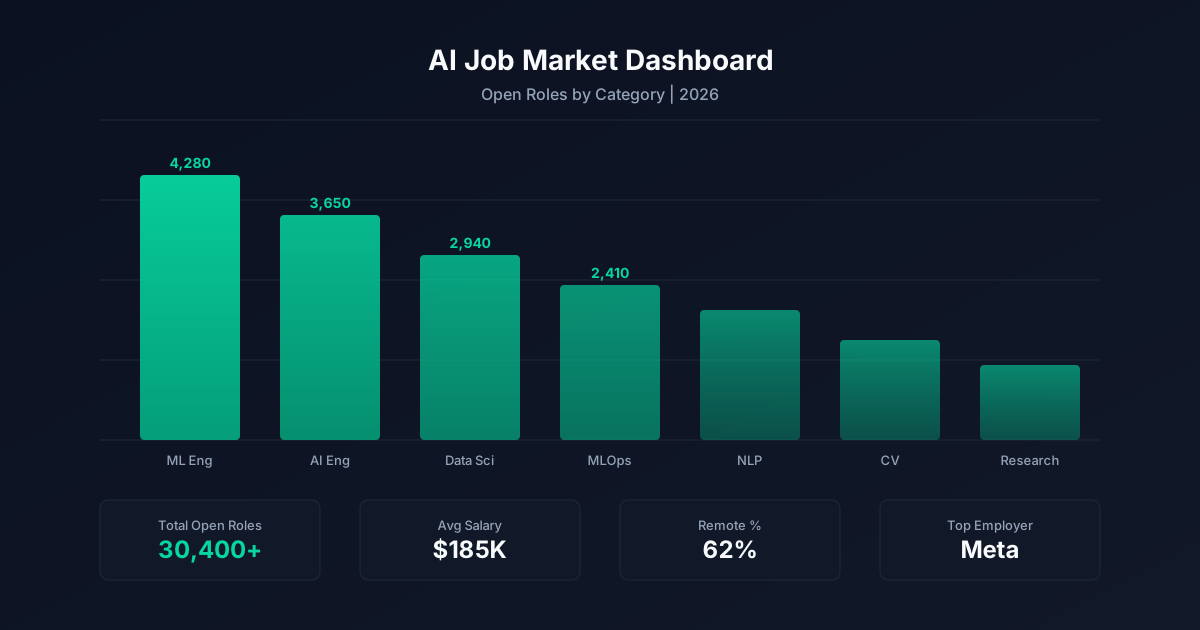
Across the 3,708 AI roles we're tracking, AI/ML Engineer positions make up 70% of the market. At Braze, this role fits into their broader AI and engineering organization.
Demand for AI/ML Engineers has been strong and consistent. Unlike some AI roles that spike with hype cycles, ML engineering is a foundational need. Every company deploying AI models needs people who can keep them running, and the gap between research prototypes and production systems keeps growing.
What the Work Looks Like
A typical week might include: debugging a data pipeline that's silently dropping 3% of training examples, running A/B tests on a new model version, writing documentation for a feature flag system that lets you roll back model deployments, and reviewing a junior engineer's PR for a new evaluation metric. Meetings tend to be cross-functional since ML touches product, engineering, and data teams.
Demand for AI/ML Engineers has been strong and consistent. Unlike some AI roles that spike with hype cycles, ML engineering is a foundational need. Every company deploying AI models needs people who can keep them running, and the gap between research prototypes and production systems keeps growing.
Skills Required
Python and PyTorch dominate the requirements. Most roles expect experience with cloud platforms (AWS, GCP, or Azure) and familiarity with ML frameworks like TensorFlow or JAX. RAG (Retrieval-Augmented Generation) has become a top-3 skill requirement as companies integrate LLMs into their products. Docker and Kubernetes show up in about a third of postings, reflecting the production focus of the role.
Beyond the core stack, employers increasingly want experience with experiment tracking tools (MLflow, Weights & Biases), feature stores, and vector databases. Fine-tuning experience is valuable but less common than you'd think from reading Twitter. Most production LLM work is RAG and prompt engineering, not fine-tuning. If you have both, you're in a strong position.
Companies that are serious about AI/ML hiring tend to post specific infrastructure details in the job description: the frameworks they use, their model serving stack, their data pipeline tools. Vague postings that just say 'ML experience required' without specifics are often companies that haven't figured out what they need yet.
Compensation Benchmarks
AI/ML Engineer roles pay a median of $218,750 based on 3,817 positions with disclosed compensation. Mid-level AI roles across all categories have a median of $200,000. This role's midpoint ($152K) sits 30% below the category median. Disclosed range: $110K to $195K.
Across all AI roles, the market median is $217,500. Top-quartile compensation starts at $272,100. The 90th percentile reaches $325,000. For comparison, the highest-paying categories include AI Safety ($300,000) and Research Engineer ($280,000). By seniority level: Entry: $120,000; Mid: $200,000; Senior: $230,000; Director: $272,150; VP: $250,000.
Braze AI Hiring
Braze has 2 open AI roles right now. They're hiring across AI/ML Engineer, AI Architect. Based in Austin, TX, US. Compensation range: $195K - $195K.
Location Context
AI roles in Austin pay a median of $214,343 across 87 tracked positions.
Career Path
Common paths into AI/ML Engineer roles include Data Scientist, Software Engineer, Research Engineer.
From here, career progression typically leads toward ML Architect, AI Engineering Manager, Principal ML Engineer.
The fastest path into ML engineering is through software engineering with a self-directed ML education. A CS degree helps, but production engineering skills matter more than academic credentials. Build something that works, deploy it, and measure it. That portfolio project is worth more than a Coursera certificate. For career growth, the fork comes around the senior level: go deep on technical complexity (staff/principal track) or move into managing ML teams.
What to Expect in Interviews
Expect system design questions around ML pipelines: how you'd build a training pipeline for a specific use case, handle data drift, or design A/B testing infrastructure for model deployments. Coding rounds typically involve Python, with emphasis on data manipulation (pandas, numpy) and algorithm implementation. Take-home assignments often ask you to build an end-to-end ML pipeline from raw data to deployed model.
When evaluating opportunities: Companies that are serious about AI/ML hiring tend to post specific infrastructure details in the job description: the frameworks they use, their model serving stack, their data pipeline tools. Vague postings that just say 'ML experience required' without specifics are often companies that haven't figured out what they need yet.
AI Hiring Overview
The AI job market has 3,708 open positions tracked in our dataset. By seniority: 102 entry-level, 1,705 mid-level, 1,469 senior, and 432 leadership roles (Director, VP, C-Level). Remote roles make up 14% of the market (508 positions). The remaining 3,180 roles require on-site or hybrid attendance.
The market median for AI roles is $217,500. Top-quartile compensation starts at $272,100. The 90th percentile reaches $325,000. Highest-paying categories: AI Safety ($300,000 median, 21 roles); Research Engineer ($280,000 median, 147 roles); AI Architect ($254,798 median, 67 roles).
Demand for AI/ML Engineers has been strong and consistent. Unlike some AI roles that spike with hype cycles, ML engineering is a foundational need. Every company deploying AI models needs people who can keep them running, and the gap between research prototypes and production systems keeps growing.
The AI Job Market Today
The AI job market spans 3,708 open positions across 16 role categories. The largest categories by volume: AI/ML Engineer (2,605), Data Scientist (310), AI Software Engineer (259). These three account for the majority of open positions, though smaller categories often have higher per-role compensation because of specialized skill requirements.
The seniority mix tells a story about where AI teams are in their maturity. Entry-level roles (102) are outnumbered by mid-level (1,705) and senior (1,469) positions, reflecting that most companies are past the 'build a team from scratch' phase and need experienced engineers who can ship production systems. Leadership roles (Director, VP, C-Level) total 432 positions, representing the bottleneck between technical execution and organizational strategy.
Remote work availability sits at 14% of all AI roles (508 positions), with 3,180 requiring on-site or hybrid attendance. The remote share has stabilized after the post-pandemic correction. Senior and specialized roles (Research Scientist, ML Architect) are more likely to be remote-eligible than entry-level positions, partly because experienced hires have more negotiating power and partly because these roles require less hands-on mentorship.
AI compensation is structured in clear tiers. The market median sits at $217,500. Top-quartile roles start at $272,100, and the 90th percentile reaches $325,000. These figures include base salary with disclosed compensation. Total compensation (including equity, bonuses, and sign-on) runs 20-40% higher at companies that offer those components.
Category matters for compensation. AI Safety roles lead at $300,000 median, while Prompt Engineer roles sit at $140,000. The spread between highest and lowest-paying categories reflects the premium on specialized technical skills versus broader analytical roles.
The most in-demand skills across all AI postings: Python (1,890 postings), Aws (1,103 postings), Azure (877 postings), Rag (855 postings), Gcp (631 postings), Prompt Engineering (560 postings), Pytorch (545 postings), Claude (498 postings). Python dominates, appearing in the vast majority of role descriptions regardless of category. Cloud platform experience (AWS, GCP, Azure) is the second most common requirement. The newer entrants to the top skills list (RAG, vector databases, LLM APIs) reflect the shift from traditional ML toward generative AI applications.
Frequently Asked Questions
Get Weekly AI Career Intelligence
Salary data, skills demand, and market signals from 16,000+ AI job postings. Every Monday.