
Interested in this Data Engineer role at BV Teck?
Apply Now →Skills & Technologies
About This Role
Machine Learning Data Engineer – Remote
Bright Vision Technologies is a technology consulting and software development company delivering cloud, AI, data, and enterprise solutions across the United States.
This is a fantastic opportunity to join an established and well\-respected organization offering tremendous career growth potential.
Job Title: Machine Learning Data Engineer
Location: 100% Remote (U.S.)
Position Type: Full\-time, Direct W2
Salary Range: $100,000–$150,000 Annually
Experience Required: 6\+ years
Sponsorship: U.S. Citizens, Green Card Holders, EAD Holders, and H\-1B transfer candidates are encouraged to apply. We are unable to sponsor new H\-1B visa petitions for this position.
Job Summary
We are seeking an Machine Learning Data Engineer to build and operate the large\-scale data systems that power modern AI training and evaluation pipelines. The role combines deep data engineering expertise with a strong understanding of AI workloads, focusing on ingestion, transformation, quality assurance, lineage, and high\-throughput delivery of data to training jobs across diverse modalities. The ideal candidate has experience operating petabyte\-scale data systems, strong software engineering fundamentals, and clear understanding of how data infrastructure choices propagate into model quality and training efficiency.
Key Responsibilities* Design and operate large\-scale data pipelines supporting AI training, evaluation, and continual improvement workflows.
- Build ingestion systems for diverse modalities including text, image, audio, video, and structured signals.
- Implement data cleaning, deduplication, filtering, and quality assurance at petabyte scale.
- Develop dataset versioning, lineage, and provenance tracking systems suitable for reproducible training.
- Build high\-throughput data loading systems that maximize GPU utilization during training.
- Implement labeling workflows, active learning pipelines, and human\-in\-the\-loop data improvement systems.
- Design storage architectures balancing cost, throughput, and latency across data tiers.
- Build evaluation dataset construction pipelines with strict integrity and contamination controls.
- Implement data privacy, redaction, and consent enforcement throughout the pipeline.
- Collaborate with ML researchers and engineers to align data systems with model development needs.
- Drive observability of data quality, drift, and pipeline health across the AI data estate.
- Optimize cost and performance through compression, format selection, and caching strategies.
- Document data systems, schemas, and operational procedures for broad internal use.
- Stay current with AI data infrastructure research and emerging open\-source tools.
Required Qualifications* Bachelor’s or Master’s degree in Computer Science or a related field.
- Six or more years of data engineering experience, with significant work supporting ML or AI workloads.
- Strong proficiency in Python and at least one JVM or systems language.
- Deep experience with modern data processing frameworks such as Spark, Ray, or Beam.
- Hands\-on experience operating petabyte\-scale storage and pipeline systems.
- Strong understanding of distributed systems, data modeling, and storage formats.
- Experience with dataset versioning, lineage, and reproducibility for ML workflows.
- Familiarity with high\-throughput data loading for accelerator\-based training.
- Strong software engineering practices including testing, CI/CD, and code review.
- Excellent communication and cross\-functional collaboration skills.
Preferred Qualifications* Experience with multimodal datasets at large scale.
- Familiarity with data quality tooling and dataset evaluation methodology.
- Exposure to privacy\-preserving data systems and regulated data handling.
- Open\-source contributions to data infrastructure projects.
- Experience supporting frontier model training pipelines.
How to Apply
Would you like to know more about this opportunity? For immediate consideration, please send your resume to hilda@bvteck.com.
Bright Vision Technologies is an Equal Opportunity Employer.
Equal Employment Opportunity (EEO) Statement
Bright Vision Technologies (BV Teck) is committed to equal employment opportunity (EEO) for all employees and applicants without regard to race, color, religion, sex, sexual orientation, gender identity or expression, national origin, age, genetic information, disability, veteran status, or any other protected status as defined by applicable federal, state, or local laws. This commitment extends to all aspects of employment, including recruitment, hiring, training, compensation, promotion, transfer, leaves of absence, termination, layoffs, and recall.
BV Teck expressly prohibits any form of workplace harassment or discrimination. Any improper interference with employees' ability to perform their job duties may result in disciplinary action up to and including termination of employment.
xAD9AuSQv1
Salary Context
This $100K-$150K range is below the median for Data Engineer roles in our dataset (median: $150K across 15 roles with salary data).
Role Details
About This Role
Data Engineers build the pipelines that feed AI models. They design ETL workflows, manage data lakes, and ensure training and inference data is clean, timely, and accessible. Without good data engineering, AI projects fail. It's that simple.
The AI era has expanded the data engineer's scope far beyond batch ETL jobs. You're building real-time embedding pipelines for RAG systems, managing vector databases, ensuring training data quality at scale, and building the infrastructure that lets ML teams iterate on data as fast as they iterate on models. Data quality is the biggest predictor of model quality, and you're the person responsible for it.
Across the 3,708 AI roles we're tracking, Data Engineer positions make up 1% of the market. At BV Teck, this role fits into their broader AI and engineering organization.
Data Engineer demand in AI contexts is strong and growing. Every company building AI needs clean, reliable data pipelines. The shift toward real-time AI applications (chatbots, recommendation engines, agent systems) means data engineering is more critical than ever. Companies are willing to pay premium salaries for data engineers with AI/ML pipeline experience.
What the Work Looks Like
A typical week includes: debugging a data pipeline that's producing stale embeddings for the RAG system, optimizing a Spark job that processes training data, building a data quality monitoring dashboard, meeting with the ML team to understand their next data requirements, and writing dbt models that transform raw event data into ML-ready features. The work is deeply technical and high-impact.
Data Engineer demand in AI contexts is strong and growing. Every company building AI needs clean, reliable data pipelines. The shift toward real-time AI applications (chatbots, recommendation engines, agent systems) means data engineering is more critical than ever. Companies are willing to pay premium salaries for data engineers with AI/ML pipeline experience.
Skills Required
SQL, Python, and distributed systems (Spark, Airflow, dbt) are core. Cloud data platforms (Snowflake, BigQuery, Redshift) are increasingly standard. Many AI-focused roles also want familiarity with vector databases and embedding pipelines. Understanding data modeling, pipeline orchestration, and data quality frameworks covers the essentials.
AI-specific data engineering skills include: building feature stores, managing training data versioning, implementing data lineage tracking, and building real-time embedding pipelines. Experience with streaming systems (Kafka, Flink) is valuable for real-time AI applications. Understanding ML data requirements (balanced datasets, data augmentation, evaluation set construction) makes you much more effective working with ML teams.
Strong postings specify the data stack, mention ML pipeline work, and describe the scale of data you'll be working with. Look for companies that understand the connection between data quality and model quality. Avoid roles that conflate data engineering with data analysis.
Compensation Benchmarks
Data Engineer roles pay a median of $178,800 based on 40 positions with disclosed compensation. Mid-level AI roles across all categories have a median of $200,000. This role's midpoint ($125K) sits 30% below the category median. Disclosed range: $100K to $150K.
Across all AI roles, the market median is $217,500. Top-quartile compensation starts at $272,100. The 90th percentile reaches $325,000. For comparison, the highest-paying categories include AI Safety ($300,000) and Research Engineer ($280,000). By seniority level: Entry: $120,000; Mid: $200,000; Senior: $230,000; Director: $272,150; VP: $250,000.
BV Teck AI Hiring
BV Teck has 40 open AI roles right now. They're hiring across AI/ML Engineer, MLOps Engineer, LLM Engineer, Research Engineer. Positions span Tempe, AZ, US, Hoboken, NJ, US, Remote, US. Compensation range: $150K - $175K.
Remote Work Context
Remote AI roles pay a median of $185,334 across 717 positions. About 14% of all AI roles offer remote work.
Career Path
Common paths into Data Engineer roles include Backend Engineer, Database Administrator, Analytics Engineer.
From here, career progression typically leads toward Senior Data Engineer, ML Engineer, Data Platform Lead.
Master SQL and Python first. Then learn a distributed processing framework (Spark or its modern alternatives) and a pipeline orchestrator (Airflow, Dagster, Prefect). Build a portfolio project that demonstrates end-to-end pipeline construction: ingest, transform, validate, serve. If you want to specialize in AI data engineering, add vector databases and embedding pipelines to your skill set.
What to Expect in Interviews
Expect SQL deep-dives (query optimization, partitioning strategies, data modeling), Python coding focused on data pipeline patterns, and system design questions about building scalable ETL workflows. Companies with ML teams will ask about feature stores, embedding pipelines, and training data management. Be ready to discuss data quality monitoring, pipeline orchestration, and how you'd handle schema evolution in a production data lake.
When evaluating opportunities: Strong postings specify the data stack, mention ML pipeline work, and describe the scale of data you'll be working with. Look for companies that understand the connection between data quality and model quality. Avoid roles that conflate data engineering with data analysis.
AI Hiring Overview
The AI job market has 3,708 open positions tracked in our dataset. By seniority: 102 entry-level, 1,705 mid-level, 1,469 senior, and 432 leadership roles (Director, VP, C-Level). Remote roles make up 14% of the market (508 positions). The remaining 3,180 roles require on-site or hybrid attendance.
The market median for AI roles is $217,500. Top-quartile compensation starts at $272,100. The 90th percentile reaches $325,000. Highest-paying categories: AI Safety ($300,000 median, 21 roles); Research Engineer ($280,000 median, 147 roles); AI Architect ($254,798 median, 67 roles).
Data Engineer demand in AI contexts is strong and growing. Every company building AI needs clean, reliable data pipelines. The shift toward real-time AI applications (chatbots, recommendation engines, agent systems) means data engineering is more critical than ever. Companies are willing to pay premium salaries for data engineers with AI/ML pipeline experience.
The AI Job Market Today
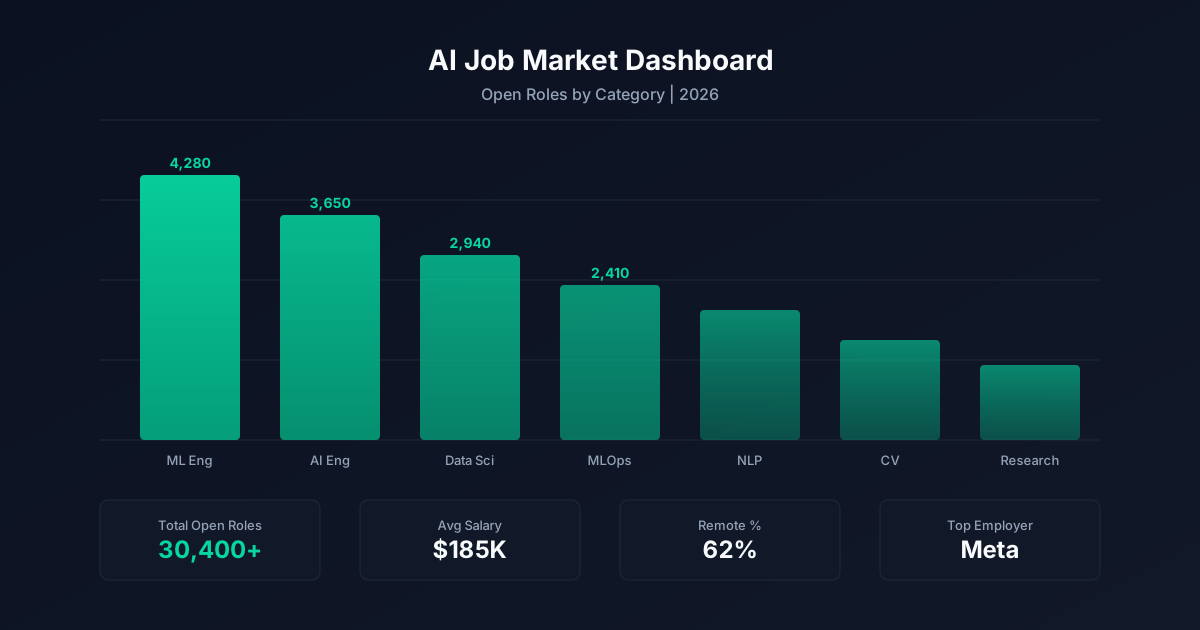
The AI job market spans 3,708 open positions across 16 role categories. The largest categories by volume: AI/ML Engineer (2,605), Data Scientist (310), AI Software Engineer (259). These three account for the majority of open positions, though smaller categories often have higher per-role compensation because of specialized skill requirements.
The seniority mix tells a story about where AI teams are in their maturity. Entry-level roles (102) are outnumbered by mid-level (1,705) and senior (1,469) positions, reflecting that most companies are past the 'build a team from scratch' phase and need experienced engineers who can ship production systems. Leadership roles (Director, VP, C-Level) total 432 positions, representing the bottleneck between technical execution and organizational strategy.
Remote work availability sits at 14% of all AI roles (508 positions), with 3,180 requiring on-site or hybrid attendance. The remote share has stabilized after the post-pandemic correction. Senior and specialized roles (Research Scientist, ML Architect) are more likely to be remote-eligible than entry-level positions, partly because experienced hires have more negotiating power and partly because these roles require less hands-on mentorship.
AI compensation is structured in clear tiers. The market median sits at $217,500. Top-quartile roles start at $272,100, and the 90th percentile reaches $325,000. These figures include base salary with disclosed compensation. Total compensation (including equity, bonuses, and sign-on) runs 20-40% higher at companies that offer those components.
Category matters for compensation. AI Safety roles lead at $300,000 median, while Prompt Engineer roles sit at $140,000. The spread between highest and lowest-paying categories reflects the premium on specialized technical skills versus broader analytical roles.
The most in-demand skills across all AI postings: Python (1,890 postings), Aws (1,103 postings), Azure (877 postings), Rag (855 postings), Gcp (631 postings), Prompt Engineering (560 postings), Pytorch (545 postings), Claude (498 postings). Python dominates, appearing in the vast majority of role descriptions regardless of category. Cloud platform experience (AWS, GCP, Azure) is the second most common requirement. The newer entrants to the top skills list (RAG, vector databases, LLM APIs) reflect the shift from traditional ML toward generative AI applications.
Frequently Asked Questions
Get Weekly AI Career Intelligence
Salary data, skills demand, and market signals from 16,000+ AI job postings. Every Monday.