
Interested in this AI Software Engineer role at Comcast?
Apply Now →Skills & Technologies
About This Role
FreeWheel, a Comcast company, provides comprehensive ad platforms for publishers, advertisers, and media buyers. Powered by premium video content, robust data, and advanced technology, we’re making it easier for buyers and sellers to transact across all screens, data types, and sales channels. As a global company, we have offices in nine countries and can insert advertisements around the world. Job Summary
This job leads the design and delivery of AI\-enabled product capabilities that bring agentic workflows, intelligent automation, and practical decision support into FreeWheel’s applications. It helps create reusable patterns and scalable solutions that allow teams to apply AI consistently across products, business workflows, and customer\-facing experiences while ensuring those capabilities are reliable, useful, and maintainable. The role is pivotal in driving product innovation, cross\-functional alignment, and the ongoing improvement of AI capabilities that support FreeWheel’s business and product objectives.Job Description
Preferred Qualifications
- 6\+ years of experience in software engineering, with strong focus on AI/ML systems in production
- Strong programming skills in Python (Go a plus)
- Experience building and deploying Agents or LLM\-based applications into production environments
- Experience with distributed systems and real\-time inference architectures
- Knowledge of core AI domains such as NLP, recommendation systems, or time series modeling
- Experience with model lifecycle practices (evaluation, monitoring, retraining, and iteration)
- Experience with cloud platforms (AWS, Azure, or GCP) and AI tooling ecosystems
- Ability to translate business problems into scalable AI solutions and drive implementation end\-to\-end
Job Description
- Creating, enabling, and driving innovation by bringing agentic workflows and AI capabilities into FreeWheel’s applications, helping teams unlock new ways to automate work, improve decision\-making, and deliver more intelligent product experiences.
- Leading the design and development of AI\-enabled product capabilities, including services and workflows that help teams deliver practical insights and automation.
- Ensuring AI features are reliable, useful, and maintainable as they move from development into customer\-facing products.
- Establishing reusable patterns that help teams apply AI capabilities consistently across applications and business workflows.
- Designing and delivering AI solutions that meet product and business requirements across modern cloud\-based environments.
- Understanding how AI capabilities connect across products and services so teams can troubleshoot issues, assess impact, and improve outcomes.
- Partnering with product, data, and other engineering teams to clarify business problems and turn them into scalable AI\-enabled solutions.
- Improving performance, responsiveness, cost, and scalability for AI\-powered features.
- Contributing to technical decisions that shape how AI capabilities are built, evaluated, and improved over time.
- Leading major technical initiatives and collaborating across teams to deliver high\-quality product outcomes.
- Mentoring engineers on practical AI development, system design, and production\-quality engineering practices.
- Consistent exercise of independent judgment and discretion in matters of significance.
- Regular, consistent and punctual attendance. Must be able to work nights and weekends, variable schedule(s) as necessary.
- Other duties and responsibilities as assigned.
Responsibilities:
- Leading the development and implementation of innovative software and web applications, ensuring they align with business objectives and user requirements
- Integrating new systems seamlessly with existing infrastructure, focusing on scalability, security, and continuous performance improvement
- Mentoring team members and providing technical training, fostering a collaborative environment for knowledge sharing and professional growth
- Collaborating with cross\-functional teams to ensure successful application integration, advocating for best practices in software development
- Participating in or leading peer programming sessions, design sprints, or prototyping sessions
- Driving the creation, maintenance, and accessibility of comprehensive documentation for all development activities
- Monitoring application performance metrics rigorously, utilizing data to guide enhancements and ensure delivery aligns with project goals
- Providing expert technical advice and support to internal stakeholders and external partners, effectively communicating complex concepts
- Collaborating with the Quality Assurance team to confirm applications meet rigorous testing standards and fulfil technical requirements
- Consistent exercise of independent judgment and discretion in matters of significance.
- Regular, consistent and punctual attendance. Must be able to work nights and weekends, variable schedule(s) as necessary.
- Other duties and responsibilities as assigned.
Employees at all levels are expected to:
- Understand our Operating Principles; make them the guidelines for how you do your job.
- Own the customer experience think and act in ways that put our customers first, give them seamless digital options at every touchpoint, and make them promoters of our products and services.
- Know your stuff be enthusiastic learners, users and advocates of our game\-changing technology, products and services, especially our digital tools and experiences.
- Win as a team make big things happen by working together and being open to new ideas.
- Be an active part of the Net Promoter System a way of working that brings more employee and customer feedback into the company by joining huddles, making call backs and helping us elevate opportunities to do better for our customers.
- Drive results and growth.
- Support a culture of inclusion in how you work and lead.
- Do what's right for each other, our customers, investors and our communities.
Disclaimer: This information has been designed to indicate the general nature and level of work performed by employees in this role. It is not designed to contain or be interpreted as a comprehensive inventory of all duties, responsibilities and qualifications.
Comcast is an equal opportunity workplace. We will consider all qualified applicants for employment without regard to race, color, religion, age, sex, sexual orientation, gender identity, national origin, disability, veteran status, genetic information, or any other basis protected by applicable law.
Skills:
Mentorship; Technical Requirements; Software Engineering; AI Agents
Base pay is one part of the Total Rewards that Comcast provides to compensate and recognize employees for their work. Most sales positions are eligible for a Commission under the terms of an applicable plan, while most non\-sales positions are eligible for a Bonus. Additionally, Comcast provides best\-in\-class Benefits to eligible employees. We believe that benefits should connect you to the support you need when it matters most, and should help you care for those who matter most. That’s why we provide an array of options, expert guidance and always\-on tools, that are personalized to meet the needs of your reality \- to help support you physically, financially and emotionally through the big milestones and in your everyday life. Please visit the compensation and benefits summary on our careers site for more details.
Education
Bachelor's Degree
While possessing the stated degree is preferred, Comcast also may consider applicants who hold some combination of coursework and experience, or who have extensive related professional experience.
Relevant Work Experience
10 Years \+
Role Details
About This Role
AI Software Engineers build the applications and systems that AI models run inside. They own the API layers, data pipelines, frontend integrations, and infrastructure that turn a model into a product users interact with. Every AI company needs engineers who can build the software around the AI.
The challenge is building reliable systems around inherently unreliable components. Models are probabilistic. They'll give different answers to the same question. They hallucinate. They're slow. They're expensive. Your job is to build an application layer that handles all of this gracefully while delivering a product that users trust and enjoy.
Across the 3,708 AI roles we're tracking, AI Software Engineer positions make up 7% of the market. At Comcast, this role fits into their broader AI and engineering organization.
AI Software Engineer roles are among the most numerous in the AI job market. Every company deploying AI needs software engineers who understand AI integration patterns. The demand is broad, spanning startups to enterprises, across every industry adopting AI capabilities.
What the Work Looks Like
A typical week includes: building API endpoints that serve model inference with caching and fallback logic, designing the data pipeline that feeds context to a RAG system, implementing streaming responses in the frontend, debugging a race condition in the async inference pipeline, and optimizing database queries for the vector search layer. It's full-stack engineering with AI at the center.
AI Software Engineer roles are among the most numerous in the AI job market. Every company deploying AI needs software engineers who understand AI integration patterns. The demand is broad, spanning startups to enterprises, across every industry adopting AI capabilities.
Skills Required
Full-stack engineering skills with AI integration experience. Python and TypeScript are the most common requirements. You'll need to understand API design, database architecture, and how to build reliable systems around probabilistic outputs. Experience with streaming, async processing, and caching patterns is increasingly important as real-time AI applications proliferate.
Knowledge of vector databases, embedding APIs, and LLM integration patterns (function calling, structured outputs, retry logic) differentiates AI software engineers from general software engineers. Understanding cost optimization (caching strategies, model routing, batched inference) is valuable since inference costs can dominate application economics.
Strong postings describe the product you'll be building, the AI integration patterns you'll work with, and the scale requirements. Look for companies that have existing AI features and need engineers to improve and expand them, not companies that are 'planning to add AI' someday.
Compensation Benchmarks
AI Software Engineer roles pay a median of $219,250 based on 424 positions with disclosed compensation. Senior-level AI roles across all categories have a median of $230,000.
Across all AI roles, the market median is $217,500. Top-quartile compensation starts at $272,100. The 90th percentile reaches $325,000. For comparison, the highest-paying categories include AI Safety ($300,000) and Research Engineer ($280,000). By seniority level: Entry: $120,000; Mid: $200,000; Senior: $230,000; Director: $272,150; VP: $250,000.
Comcast AI Hiring
Comcast has 5 open AI roles right now. They're hiring across AI/ML Engineer, AI Software Engineer. Positions span Mount Laurel, NJ, US, Philadelphia, PA, US, New York, NY, US. Compensation range: $157K - $242K.
Location Context
Across all AI roles, 14% (508 positions) offer remote work, while 3,180 require on-site attendance. Top AI hiring metros: New York (1,045 roles, $220,000 median); San Francisco (810 roles, $277,088 median); Los Angeles (397 roles, $215,000 median).
Career Path
Common paths into AI Software Engineer roles include Software Engineer, Full-Stack Developer, Backend Engineer.
From here, career progression typically leads toward Staff Engineer, AI Architect, Engineering Manager.
If you're a software engineer, you're already 80% there. Learn the AI integration patterns: RAG, streaming inference, function calling, structured outputs. Build a project that demonstrates you can wrap an AI model in a production-quality application with proper error handling, caching, and user experience. That's the portfolio piece that gets you hired.
What to Expect in Interviews
Technical screens look like standard software engineering interviews with an AI twist. Expect system design questions about building reliable applications around probabilistic models: handling streaming responses, implementing retry logic for API failures, and designing caching strategies for LLM outputs. Coding rounds test standard algorithms plus practical integration patterns like async processing and rate limiting.
When evaluating opportunities: Strong postings describe the product you'll be building, the AI integration patterns you'll work with, and the scale requirements. Look for companies that have existing AI features and need engineers to improve and expand them, not companies that are 'planning to add AI' someday.
AI Hiring Overview
The AI job market has 3,708 open positions tracked in our dataset. By seniority: 102 entry-level, 1,705 mid-level, 1,469 senior, and 432 leadership roles (Director, VP, C-Level). Remote roles make up 14% of the market (508 positions). The remaining 3,180 roles require on-site or hybrid attendance.
The market median for AI roles is $217,500. Top-quartile compensation starts at $272,100. The 90th percentile reaches $325,000. Highest-paying categories: AI Safety ($300,000 median, 21 roles); Research Engineer ($280,000 median, 147 roles); AI Architect ($254,798 median, 67 roles).
AI Software Engineer roles are among the most numerous in the AI job market. Every company deploying AI needs software engineers who understand AI integration patterns. The demand is broad, spanning startups to enterprises, across every industry adopting AI capabilities.
The AI Job Market Today
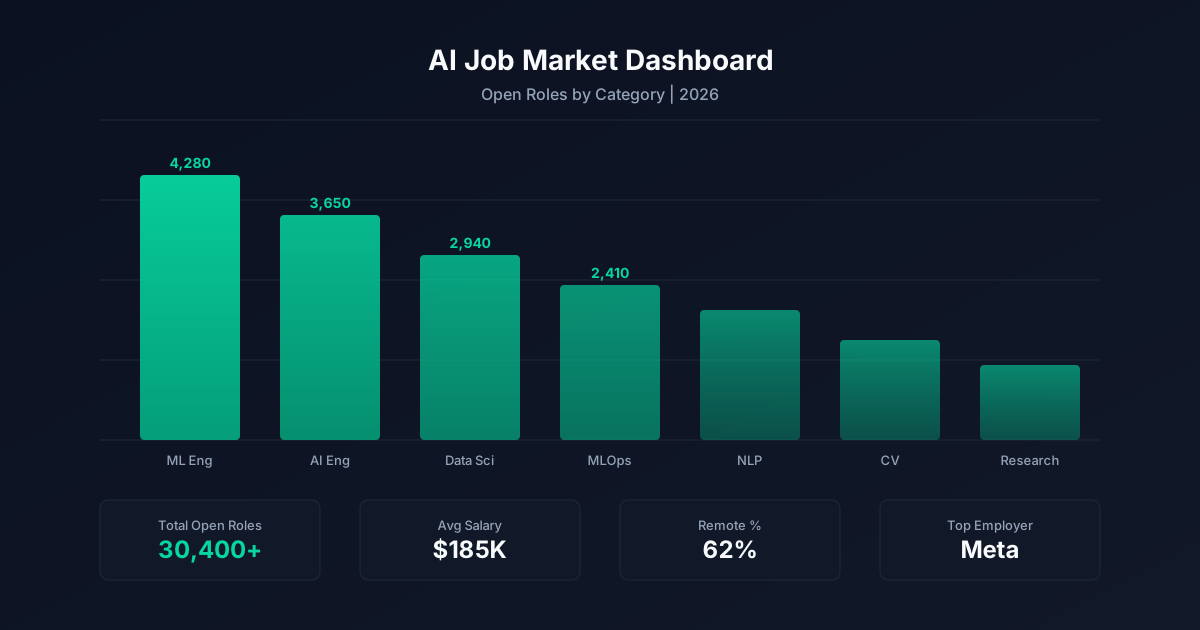
The AI job market spans 3,708 open positions across 16 role categories. The largest categories by volume: AI/ML Engineer (2,605), Data Scientist (310), AI Software Engineer (259). These three account for the majority of open positions, though smaller categories often have higher per-role compensation because of specialized skill requirements.
The seniority mix tells a story about where AI teams are in their maturity. Entry-level roles (102) are outnumbered by mid-level (1,705) and senior (1,469) positions, reflecting that most companies are past the 'build a team from scratch' phase and need experienced engineers who can ship production systems. Leadership roles (Director, VP, C-Level) total 432 positions, representing the bottleneck between technical execution and organizational strategy.
Remote work availability sits at 14% of all AI roles (508 positions), with 3,180 requiring on-site or hybrid attendance. The remote share has stabilized after the post-pandemic correction. Senior and specialized roles (Research Scientist, ML Architect) are more likely to be remote-eligible than entry-level positions, partly because experienced hires have more negotiating power and partly because these roles require less hands-on mentorship.
AI compensation is structured in clear tiers. The market median sits at $217,500. Top-quartile roles start at $272,100, and the 90th percentile reaches $325,000. These figures include base salary with disclosed compensation. Total compensation (including equity, bonuses, and sign-on) runs 20-40% higher at companies that offer those components.
Category matters for compensation. AI Safety roles lead at $300,000 median, while Prompt Engineer roles sit at $140,000. The spread between highest and lowest-paying categories reflects the premium on specialized technical skills versus broader analytical roles.
The most in-demand skills across all AI postings: Python (1,890 postings), Aws (1,103 postings), Azure (877 postings), Rag (855 postings), Gcp (631 postings), Prompt Engineering (560 postings), Pytorch (545 postings), Claude (498 postings). Python dominates, appearing in the vast majority of role descriptions regardless of category. Cloud platform experience (AWS, GCP, Azure) is the second most common requirement. The newer entrants to the top skills list (RAG, vector databases, LLM APIs) reflect the shift from traditional ML toward generative AI applications.
Frequently Asked Questions
Get Weekly AI Career Intelligence
Salary data, skills demand, and market signals from 16,000+ AI job postings. Every Monday.