
Interested in this AI/ML Engineer role at ConsumerAffairs?
Apply Now →Skills & Technologies
About This Role
We are looking for a Director of Corporate Development who can help deploy our meaningful cash flow into high ROI opportunities. Reporting to the Chief Operating Officer, the Director of Corporate Development is responsible for leading ConsumerAffairs' corporate development function. This role identifies, evaluates, diligences, negotiates, and supports the execution and integration of acquisitions, strategic investments, and other growth opportunities that align with the company's long\-term strategy.
ConsumerAffairs is an AI\-forward company and this individual is expected to leverage AI throughout the corporate development lifecycle. AI should be foundational to how work is performed—from sourcing acquisition targets and analyzing markets to accelerating due diligence, synthesizing complex information, and improving investment decision\-making. The Director will continuously evaluate and implement emerging AI tools and workflows to build a scalable, data\-driven corporate development function.
This role partners closely with the COO and collaborates across Legal, Product, Engineering, and Operations to assess strategic opportunities, manage transactions, and support successful post\-acquisition integration. The ideal candidate combines strong business judgment, financial acumen, and project management skills with the ability to influence stakeholders and drive cross\-functional execution.
Opportunity Sourcing* Build systems to continuously identify acquisition, partnership, and investment opportunities, utilizing AI tools.
- Monitor emerging startups, competitors, funding activity, hiring trends, and market signals
- Build relationships with founders, investment firms, investment bankers, and brokers.
Strategic Evaluation* Evaluate acquisition opportunities through financial, operational, technological, and strategic lenses.
- Develop investment theses supported by internal operations and market intelligence.
- Build financial models, valuation analyses, and scenario planning.
- Present recommendations to executive leadership.
Due Diligence* Lead comprehensive commercial, financial, legal, product, technology, and operational diligence.
- Use AI agents and automation to synthesize large volumes of information into actionable insights.
- Identify customer, revenue, technical, cybersecurity, and organizational risks.
- Coordinate cross\-functional diligence across Product, Engineering, Finance, Legal, Security, HR, and Operations.
Transaction Execution* Manage transactions from initial outreach through closing.
- Coordinate internal and external stakeholders including legal, accounting, tax, and consulting partners.
- Support negotiations, LOIs, purchase agreements, and transaction structures.
- Drive project management across multiple stakeholders and workstreams.
Integration \& Value Creation* Partner with business leaders to develop post\-acquisition integration plans.
- Identify operational synergies and AI automation opportunities.
- Measure acquisition performance against strategic objectives.
- Ensure successful Day One execution and long\-term value realization
Requirements Minimum Qualifications \& Credentials
- 7\+ years of experience in Corporate Development, Investment Banking, Private Equity, Venture Capital, Corporate Strategy, or Management Consulting. Search Fund experience will be considered.
- Demonstrated experience leading mergers, acquisitions, strategic investments, or complex strategic initiatives.
- Strong financial modeling, valuation, and analytical capabilities.
- Experience leading cross\-functional due diligence efforts.
- Excellent executive communication and presentation skills.
- Ability to influence leaders across multiple disciplines.
- Proven experience building AI\-assisted research, analysis, or workflow automations.
- Expert user of modern AI platforms such as ChatGPT, Claude, Gemini, Perplexity, and agentic workflows.
Preferred Qualifications
- Experience in SaaS, marketplaces, fintech, consumer technology, or consumer services companies.
- MBA, CFA, CPA, or equivalent advanced business education.
- Experience integrating acquired companies.
- Strong network within venture capital, private equity, investment banking, or founder ecosystems
Soft Skills
- Strong understanding of business operations, strategy, and organizational dynamics.
- Excellent leadership, communication, and interpersonal skills.
- Ability to manage multiple projects and navigate complex challenges.
- Strong analytical and problem\-solving abilities.
- High level of discretion and the ability to handle confidential information.
- Stands up for decisions, takes responsibility for results, and shares both good and bad outcomes transparently.
- Demonstrates a relentless focus on results with a commitment to deliver;
- Takes decisive action, and confidently changes course if unsuccessful.
Benefits
Why You’ll Love Working Here
At ConsumerAffairs, your voice matters. We foster a collaborative environment where you’re encouraged to take initiative, experiment boldly, and grow professionally. We're committed to work\-life harmony, career development, and celebrating wins together.
- Health Care Plan (Medical, Dental \& Vision)
- Retirement Plan (401k)
- Life Insurance (Basic, Voluntary \& AD\&D)
- Paid Time Off (Vacation, Sick \& Public Holidays)
- Family Leave (Maternity, Paternity)
- Short Term \& Long Term Disability
- Training \& Development
Role Details
About This Role
AI/ML Engineers build and deploy machine learning models in production. They work across the full ML lifecycle: data pipelines, model training, evaluation, and serving infrastructure. The role has evolved significantly over the past two years. Where ML Engineers once spent most of their time on model architecture, the job now tilts heavily toward inference optimization, cost management, and integrating LLM capabilities into existing systems. Companies want engineers who can ship production systems, and the experimenter-only role is fading fast.
Day-to-day, you're writing training pipelines, debugging data quality issues, setting up evaluation frameworks, and figuring out why your model performs differently in staging than it did on your dev set. The best ML engineers are obsessive about reproducibility and measurement. They instrument everything. They know that a model is only as good as the data feeding it and the infrastructure serving it.
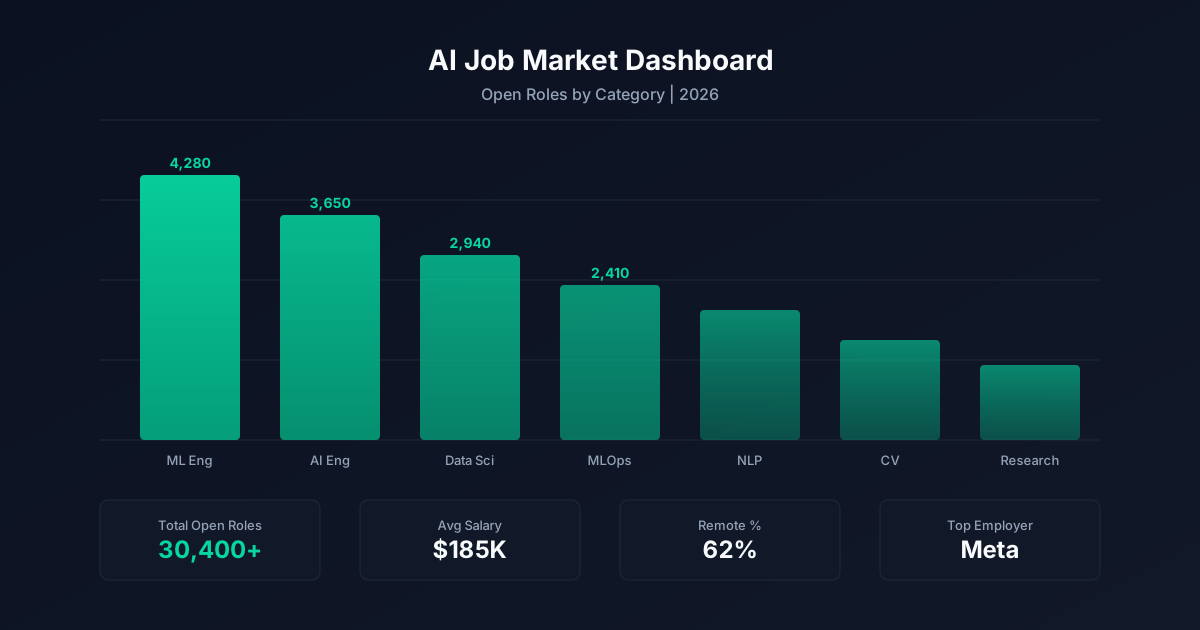
Across the 3,708 AI roles we're tracking, AI/ML Engineer positions make up 70% of the market. At ConsumerAffairs, this role fits into their broader AI and engineering organization.
Demand for AI/ML Engineers has been strong and consistent. Unlike some AI roles that spike with hype cycles, ML engineering is a foundational need. Every company deploying AI models needs people who can keep them running, and the gap between research prototypes and production systems keeps growing.
What the Work Looks Like
A typical week might include: debugging a data pipeline that's silently dropping 3% of training examples, running A/B tests on a new model version, writing documentation for a feature flag system that lets you roll back model deployments, and reviewing a junior engineer's PR for a new evaluation metric. Meetings tend to be cross-functional since ML touches product, engineering, and data teams.
Demand for AI/ML Engineers has been strong and consistent. Unlike some AI roles that spike with hype cycles, ML engineering is a foundational need. Every company deploying AI models needs people who can keep them running, and the gap between research prototypes and production systems keeps growing.
Skills Required
Python and PyTorch dominate the requirements. Most roles expect experience with cloud platforms (AWS, GCP, or Azure) and familiarity with ML frameworks like TensorFlow or JAX. RAG (Retrieval-Augmented Generation) has become a top-3 skill requirement as companies integrate LLMs into their products. Docker and Kubernetes show up in about a third of postings, reflecting the production focus of the role.
Beyond the core stack, employers increasingly want experience with experiment tracking tools (MLflow, Weights & Biases), feature stores, and vector databases. Fine-tuning experience is valuable but less common than you'd think from reading Twitter. Most production LLM work is RAG and prompt engineering, not fine-tuning. If you have both, you're in a strong position.
Companies that are serious about AI/ML hiring tend to post specific infrastructure details in the job description: the frameworks they use, their model serving stack, their data pipeline tools. Vague postings that just say 'ML experience required' without specifics are often companies that haven't figured out what they need yet.
Compensation Benchmarks
AI/ML Engineer roles pay a median of $218,750 based on 3,817 positions with disclosed compensation. Director-level AI roles across all categories have a median of $272,150.
Across all AI roles, the market median is $217,500. Top-quartile compensation starts at $272,100. The 90th percentile reaches $325,000. For comparison, the highest-paying categories include AI Safety ($300,000) and Research Engineer ($280,000). By seniority level: Entry: $120,000; Mid: $200,000; Senior: $230,000; Director: $272,150; VP: $250,000.
ConsumerAffairs AI Hiring
ConsumerAffairs has 1 open AI role right now. They're hiring across AI/ML Engineer. Based in US.
Location Context
AI roles in Austin pay a median of $214,343 across 87 tracked positions.
Career Path
Common paths into AI/ML Engineer roles include Data Scientist, Software Engineer, Research Engineer.
From here, career progression typically leads toward ML Architect, AI Engineering Manager, Principal ML Engineer.
The fastest path into ML engineering is through software engineering with a self-directed ML education. A CS degree helps, but production engineering skills matter more than academic credentials. Build something that works, deploy it, and measure it. That portfolio project is worth more than a Coursera certificate. For career growth, the fork comes around the senior level: go deep on technical complexity (staff/principal track) or move into managing ML teams.
What to Expect in Interviews
Expect system design questions around ML pipelines: how you'd build a training pipeline for a specific use case, handle data drift, or design A/B testing infrastructure for model deployments. Coding rounds typically involve Python, with emphasis on data manipulation (pandas, numpy) and algorithm implementation. Take-home assignments often ask you to build an end-to-end ML pipeline from raw data to deployed model.
When evaluating opportunities: Companies that are serious about AI/ML hiring tend to post specific infrastructure details in the job description: the frameworks they use, their model serving stack, their data pipeline tools. Vague postings that just say 'ML experience required' without specifics are often companies that haven't figured out what they need yet.
AI Hiring Overview
The AI job market has 3,708 open positions tracked in our dataset. By seniority: 102 entry-level, 1,705 mid-level, 1,469 senior, and 432 leadership roles (Director, VP, C-Level). Remote roles make up 14% of the market (508 positions). The remaining 3,180 roles require on-site or hybrid attendance.
The market median for AI roles is $217,500. Top-quartile compensation starts at $272,100. The 90th percentile reaches $325,000. Highest-paying categories: AI Safety ($300,000 median, 21 roles); Research Engineer ($280,000 median, 147 roles); AI Architect ($254,798 median, 67 roles).
Demand for AI/ML Engineers has been strong and consistent. Unlike some AI roles that spike with hype cycles, ML engineering is a foundational need. Every company deploying AI models needs people who can keep them running, and the gap between research prototypes and production systems keeps growing.
The AI Job Market Today
The AI job market spans 3,708 open positions across 16 role categories. The largest categories by volume: AI/ML Engineer (2,605), Data Scientist (310), AI Software Engineer (259). These three account for the majority of open positions, though smaller categories often have higher per-role compensation because of specialized skill requirements.
The seniority mix tells a story about where AI teams are in their maturity. Entry-level roles (102) are outnumbered by mid-level (1,705) and senior (1,469) positions, reflecting that most companies are past the 'build a team from scratch' phase and need experienced engineers who can ship production systems. Leadership roles (Director, VP, C-Level) total 432 positions, representing the bottleneck between technical execution and organizational strategy.
Remote work availability sits at 14% of all AI roles (508 positions), with 3,180 requiring on-site or hybrid attendance. The remote share has stabilized after the post-pandemic correction. Senior and specialized roles (Research Scientist, ML Architect) are more likely to be remote-eligible than entry-level positions, partly because experienced hires have more negotiating power and partly because these roles require less hands-on mentorship.
AI compensation is structured in clear tiers. The market median sits at $217,500. Top-quartile roles start at $272,100, and the 90th percentile reaches $325,000. These figures include base salary with disclosed compensation. Total compensation (including equity, bonuses, and sign-on) runs 20-40% higher at companies that offer those components.
Category matters for compensation. AI Safety roles lead at $300,000 median, while Prompt Engineer roles sit at $140,000. The spread between highest and lowest-paying categories reflects the premium on specialized technical skills versus broader analytical roles.
The most in-demand skills across all AI postings: Python (1,890 postings), Aws (1,103 postings), Azure (877 postings), Rag (855 postings), Gcp (631 postings), Prompt Engineering (560 postings), Pytorch (545 postings), Claude (498 postings). Python dominates, appearing in the vast majority of role descriptions regardless of category. Cloud platform experience (AWS, GCP, Azure) is the second most common requirement. The newer entrants to the top skills list (RAG, vector databases, LLM APIs) reflect the shift from traditional ML toward generative AI applications.
Frequently Asked Questions
Get Weekly AI Career Intelligence
Salary data, skills demand, and market signals from 16,000+ AI job postings. Every Monday.