
Interested in this AI/ML Engineer role at Corridor Capital?
Apply Now →About This Role
Mission — Why We Exist, What We Do and Why We Need You
Corridor Capital is a lower middle market private equity firm based in Los Angeles, founded in 2005 to back what we call little leaders — B2B services companies that have carved out a defensible niche but have not yet been built to scale. Across more than two decades and four funds, we have pursued a single idea: that smaller businesses produce outsized returns when an operational partner helps them professionalize people, process and systems before growing. The Corridor Operations \& Advisory Group (COAG) is the team inside the firm responsible for making that operational work happen, a team embedded with portfolio company leadership through building foundational infrastructure, scaling and exit.
We seek to become an AI\-first lower middle market private equity firm. Corridor has already made deep investments in transaction process automation and portfolio operating infrastructure, with more than thirty production AI tools in use across origination, diligence, documentation and portfolio support. The next chapter is both larger and harder: compounding the firm\-level gains and bringing that same discipline to every portfolio company we own.
The Senior Associate, AI \& Technology reports to the Managing Director, Operations (Cici Zheng) on COAG matters and to the CEO \& Founder (Craig Enenstein) on firm matters, in a clear shared reporting structure. At portfolio companies that have their own Head of AI \& Technology, this role partners with that counterpart as a peer and a value\-add resource, bringing cross\-portfolio learning, technical depth and execution capacity rather than serving as an oversight function.
Objectives — The Problems You Will Solve
This role has a deliberately sequenced mandate. In Year 1 your time splits roughly 50/50 between firm and portfolio, and within the firm half, efforts will focus on investing in automating the Corridor transaction process end to end, streamlining reporting, enhancing business development and investor relations functions and optimizing administration. As the firm\-level build matures, the mix shifts: by Year 2, you are spending approximately 20% of your time on Corridor and 80% on COAG engagements across the portfolio. The outcomes below are organized to reflect that arc.
*In Your First 30 Days: Listen, Learn and Establish Your Baseline*
- Conduct a comprehensive audit of Corridor's existing AI asset base: the existing production skills, supporting apps, Dynamo CRM integrations, document generation pipelines and firm\-level workflows. Understand what exists, what works, what is fragile and where the biggest leverage points are.
- Deeply learn the business. Shadow every stage of the Corridor investment process on live deals. Sit in on weekly pipeline meetings, attend portfolio company calls and read the recent deal memos.
- Meet with every member of the Investment and Operations teams. Understand where each person is stretched, where they are underutilized and what they wish they could stop doing.
- Spend time with Business Development, Investor Relations, Compliance and Administration functions to better understand the opportunity set.
- Embed for a minimum of one week with at least one portfolio company. Return with a written diagnostic of that company's data, systems and AI readiness and an initial hypothesis for a value creation engagement (within the first 60 days).
- Align with Craig and Cici on strategic priorities across the portfolio, the value creation plan and what success using AI and technology looks like at the end of year one.
*In Your First 3 Months: Build the Roadmap and Earn the Right to Lead*
- Produce a written assessment of the existing Corridor AI ecosystem including technical debt, single points of failure and integration gaps. Incorporate a sequenced execution plan for the next nine months covering the firm\-side investment process automation work.
- Identify the three to five highest\-impact AI and automation opportunities across the Corridor investment process (examples include: teaser review, CIM review, IOI drafting, LOI drafting, weekly pipeline synthesis, portfolio reporting) and score each by quality and throughput enhancement opportunities.
- Establish a lightweight AI governance and evaluation framework including model selection, data handling, confidentiality, quality control, versioning and rollback. This is infrastructure that should scale with us, not slow us down. Work closely with Compliance on these topics.
- Onboard more deeply with 2\-3 portfolio companies with highest opportunity for AI impact, then present an initial COAG AI \& Technology engagement framework. Present a COAG AI \& Technology engagement framework: how Corridor will diagnose, prioritize, scope, deliver and measure AI work at portfolio companies. This is the precursor to the Corridor AI Playbook.
- Establish measurable KPIs for firm\-level AI performance and adoption and propose the initial KPIs for portfolio engagements.
- Begin to build the tech vendor database and establish relationships for how to engage 3rd parties to help scale technology initiatives across the portfolio (i.e., ERP implementation vendors, AI consulting vendors, etc.).
- AI diligence is a standard line item in the Corridor investment process. For every new platform opportunity, a standardized AI opportunity and risk assessment feeds the IOI and LOI memos and informs the value creation plan.
*In Your First 6 Months: Start Transforming the Operating Model*
- Deliver measurable cycle\-time reduction on the Corridor investment process. Demonstrate at least a 3x improvement in throughput on two major stages without quality degradation.
- Ship a meaningful upgrade to the Gate Tool system (i.e., the Grid, Gate Memo templates and Industry Subsector classifier) so that Gate 1 and Gate 2 outputs are substantially more complete, better sourced and more comparable across deals.
- Launch the first two portfolio\-level AI engagements under the COAG banner. Each engagement should have a named management sponsor, a clearly stated business outcome (e.g., revenue lift, cost reduction, cycle\-time reduction, quality improvement) and a measurable baseline against which value will be reported within a specified timeframe with clear check\-in points to measure progress and make adjustments.
- Build the Corridor AI Playbook: a codified, repeatable intake and delivery framework for AI engagements at portfolio companies, including diligence templates, ninety\-day pilot structures, vendor and tooling decision trees and handoff documentation. This is how COAG scales beyond you.
- Stand up firm\-wide AI literacy. Every team member is using the core Corridor AI tools daily, and every investment team member can modify or extend a skill on their own for simple cases.
*By Month 12: Measurable Progress Toward an AI\-First Corridor*
- The Corridor investment process is operating at least 10x more automated than the 2025 baseline on the work that can be automated. By the end of Year 1, the Corridor share of your time is already meaningfully decreasing because the systems are running.
- At least four portfolio companies are in active AI engagement, with at least two having completed a first engagement cycle and demonstrated quantified EBITDA or enterprise value impact that can be underwritten in our financial model and referenced in exit positioning.
- The beginnings of a repeatable COAG AI \& Technology practice are in place (e.g., tooling, templates and vendor relationships).
- Corridor is recognized as a credible AI\-first lower middle market firm in the markets where credibility matters: in LP communications, in conversations with intermediaries and management teams and in peer forums.
How We Work — Our Core Values
Corridor describes itself as purpose\-driven and uses the phrase “servant capital” to describe how we engage with management teams. Financial returns are a byproduct of great businesses and living our values, not the other way around. A few principles matter especially in this role:
- Service\-minded. The job is to make investment teams, portfolio CEOs and their management teams measurably more effective. Ego belongs at the door.
- Quality output first, throughput capacity second, cost savings third. The primary purpose of AI at Corridor is to free our people for higher\-quality thinking. Throughput and cost efficiency follow.
- Ship. We value operators who put tools in users' hands and iterate based on real usage over architects who perfect in private.
- Accountability to measurable outcomes. Every AI investment, at the firm or at a portfolio company, is tied to a business outcome we can defend to an LP, to a board or to a buyer at exit.
- Collaborative. This role sits at the intersection of the investment team, COAG and every portfolio company. The people who succeed at Corridor make others better; they do not hoard information or credit.
Competencies — What We Look For
Below are the skills and personal values we seek in this role.
- Translates technology into business outcomes. You connect technology decisions directly to business performance. You do not lead with tools, rather you lead with the problem you are solving. You are equally comfortable in a conversation with an investment professional about EBITDA and a conversation with an engineer about system architecture, and you move fluidly between those two worlds.
- AI and automation practitioner. You understand AI and automation not just conceptually but practically. You have hands\-on experience identifying high\-value use cases, running pilots and scaling what works. You know which problems AI solves well and which it does not, and you do not oversell. You have built automation that real teams actually adopted and used.
- Builder, not just strategist. You have a track record of actually shipping technology — not just designing roadmaps that others execute. You can explain what you built, when, why, what went wrong and what impact it had. You can open a code editor today and have something working by the end of the day.
- Professional services intuition. You understand that Corridor's product is its people and their judgment. The goal of technology here is not to replace that judgment, rather it is to eliminate repetitive, low\-value work so that talented people can do more for LPs, management teams and the firm itself.
- Change agent who brings people along. Technology transformation fails when it gets ahead of the organization. You build trust with non\-technical stakeholders, communicate change in plain language and create adoption, not just installation. You are patient with skeptics and energized by winning them over.
- Comfortable with lower middle market reality. Our portfolio companies at initial purchase run on QuickBooks, not Snowflake. Data is messy, partial and often spread across spreadsheets and paper. You see this as the opportunity, not the obstacle, and you know the difference between elegant infrastructure and infrastructure that will actually get used.
- Communication. You are equally comfortable talking to investors, investment teams, portfolio executives and engineers. You translate complex technical concepts into clear business terms without condescension. You are board\-ready without being corporate.
- Gets stuff done. You are comfortable rolling up your sleeves, getting deep into the details and delivering on a short timeline with limited resources. You do not require a perfectly staffed team or a fully defined brief to make meaningful progress. You close loops.
- Accountable. You make mistakes and acknowledge them. You take responsibility for results and you know how to create healthy working relationships that deliver those results with minimal politics and high levels of trust.
- Humble. You share success widely but take the blame when things go wrong. You ask portfolio CEOs and management teams for their expertise before offering yours. You are highly self\-aware. You welcome feedback as an opportunity to improve.
- Growth mindset. You love a challenge. You are intellectually curious and love to figure out how things work. You are energized by a blank canvas and the chance to build something that has not existed before. Your edge is how fast you learn, not what you already know.
- Resilient. You have the capacity to withstand or adapt to adverse conditions, stress or change, and to improve despite challenges. You do not need certainty to move forward.
Must\-Haves
- Three to seven years of post\-undergraduate experience in software engineering, applied AI, product engineering, strategy and operations at a technology company or a consulting or operating role where you have demonstrably built and shipped technology.
- Direct, hands\-on experience with modern AI tooling (e.g., large language models, agentic systems, retrieval, evaluation) and the ability to build with them today.
- Evidence of business fluency, whether through a PE\-backed portfolio role, consulting or strategy work, an operating role at a company with strong business discipline or a top MBA program.
- Excellent writing and structured thinking. You will produce a meaningful volume of memos and documentation, and the quality of that output matters.
- Willingness to be consistently present in Los Angeles. Our strong preference is an LA\-based hire. A Salt Lake City\-based hire is acceptable with a clear commitment to be in our Los Angeles office regularly, particularly in Year 1, when embedding with the deal team and Operations team is highest leverage.
Nice\-to\-Haves
- Prior experience inside a PE\-backed operating environment, portfolio company or private equity firm.
- Direct familiarity with lower middle market B2B services including business process outsourcing, marketing services, corporate training, value\-added distribution or industrial services (Corridor's five leading subsectors).
- Experience building internal tooling at a services firm, consultancy, investment firm or other knowledge\-work environment.
- Comfort in Microsoft 365 and PC environments (Corridor is a PC shop).
Structure, Compensation and Location
- Full\-time. Reports to the Managing Director, Operations on COAG matters and to the CEO \& Founder on Corridor firm matters.
- Location: Los Angeles preferred (Corridor headquarters, 12400 Wilshire Blvd.). Greater Salt Lake City is an acceptable secondary market with a committed in\-person cadence at Corridor, particularly during Year 1\.
- Competitive compensation package including base salary, performance bonus and carried interest. Details discussed with qualified candidates.
Why This Role
If you are an early\-career technologist who wants to build an AI\-first private equity firm from the inside, work on the full lifecycle of real businesses rather than isolated software products, and have your work measured in EBITDA and exit multiples rather than feature releases, this is an unusually direct path to doing that. Corridor Capital is small enough that your work will be visible, supported and compounding and serious enough about AI that you will not be the only one pulling. The ceiling on this role is high.
Corridor Capital is an equal opportunity employer.
Pay: $135,000\.00 \- $200,000\.00 per year
Benefits:
- 401(k)
- Dental insurance
- Health insurance
- Life insurance
- Paid time off
- Parental leave
- Vision insurance
Work Location: Hybrid remote in Los Angeles, CA 90025
Salary Context
This $135K-$200K range is below the median for AI/ML Engineer roles in our dataset (median: $180K across 1841 roles with salary data).
View full AI/ML Engineer salary data →Role Details
About This Role
AI/ML Engineers build and deploy machine learning models in production. They work across the full ML lifecycle: data pipelines, model training, evaluation, and serving infrastructure. The role has evolved significantly over the past two years. Where ML Engineers once spent most of their time on model architecture, the job now tilts heavily toward inference optimization, cost management, and integrating LLM capabilities into existing systems. Companies want engineers who can ship production systems, and the experimenter-only role is fading fast.
Day-to-day, you're writing training pipelines, debugging data quality issues, setting up evaluation frameworks, and figuring out why your model performs differently in staging than it did on your dev set. The best ML engineers are obsessive about reproducibility and measurement. They instrument everything. They know that a model is only as good as the data feeding it and the infrastructure serving it.
Across the 3,708 AI roles we're tracking, AI/ML Engineer positions make up 70% of the market. At Corridor Capital, this role fits into their broader AI and engineering organization.
Demand for AI/ML Engineers has been strong and consistent. Unlike some AI roles that spike with hype cycles, ML engineering is a foundational need. Every company deploying AI models needs people who can keep them running, and the gap between research prototypes and production systems keeps growing.
What the Work Looks Like
A typical week might include: debugging a data pipeline that's silently dropping 3% of training examples, running A/B tests on a new model version, writing documentation for a feature flag system that lets you roll back model deployments, and reviewing a junior engineer's PR for a new evaluation metric. Meetings tend to be cross-functional since ML touches product, engineering, and data teams.
Demand for AI/ML Engineers has been strong and consistent. Unlike some AI roles that spike with hype cycles, ML engineering is a foundational need. Every company deploying AI models needs people who can keep them running, and the gap between research prototypes and production systems keeps growing.
Skills in Demand for This Role
Python and PyTorch dominate the requirements. Most roles expect experience with cloud platforms (AWS, GCP, or Azure) and familiarity with ML frameworks like TensorFlow or JAX. RAG (Retrieval-Augmented Generation) has become a top-3 skill requirement as companies integrate LLMs into their products. Docker and Kubernetes show up in about a third of postings, reflecting the production focus of the role.
Beyond the core stack, employers increasingly want experience with experiment tracking tools (MLflow, Weights & Biases), feature stores, and vector databases. Fine-tuning experience is valuable but less common than you'd think from reading Twitter. Most production LLM work is RAG and prompt engineering, not fine-tuning. If you have both, you're in a strong position.
Companies that are serious about AI/ML hiring tend to post specific infrastructure details in the job description: the frameworks they use, their model serving stack, their data pipeline tools. Vague postings that just say 'ML experience required' without specifics are often companies that haven't figured out what they need yet.
Compensation Benchmarks
AI/ML Engineer roles pay a median of $218,750 based on 3,817 positions with disclosed compensation. Senior-level AI roles across all categories have a median of $230,000. This role's midpoint ($167K) sits 23% below the category median. Disclosed range: $135K to $200K.
Across all AI roles, the market median is $217,500. Top-quartile compensation starts at $272,100. The 90th percentile reaches $325,000. For comparison, the highest-paying categories include AI Safety ($300,000) and Research Engineer ($280,000). By seniority level: Entry: $120,000; Mid: $200,000; Senior: $230,000; Director: $272,150; VP: $250,000.
Corridor Capital AI Hiring
Corridor Capital has 1 open AI role right now. They're hiring across AI/ML Engineer. Based in Los Angeles, CA, US. Compensation range: $200K - $200K.
Location Context
AI roles in Los Angeles pay a median of $215,000 across 397 tracked positions.
Career Path
Common paths into AI/ML Engineer roles include Data Scientist, Software Engineer, Research Engineer.
From here, career progression typically leads toward ML Architect, AI Engineering Manager, Principal ML Engineer.
The fastest path into ML engineering is through software engineering with a self-directed ML education. A CS degree helps, but production engineering skills matter more than academic credentials. Build something that works, deploy it, and measure it. That portfolio project is worth more than a Coursera certificate. For career growth, the fork comes around the senior level: go deep on technical complexity (staff/principal track) or move into managing ML teams.
What to Expect in Interviews
Expect system design questions around ML pipelines: how you'd build a training pipeline for a specific use case, handle data drift, or design A/B testing infrastructure for model deployments. Coding rounds typically involve Python, with emphasis on data manipulation (pandas, numpy) and algorithm implementation. Take-home assignments often ask you to build an end-to-end ML pipeline from raw data to deployed model.
When evaluating opportunities: Companies that are serious about AI/ML hiring tend to post specific infrastructure details in the job description: the frameworks they use, their model serving stack, their data pipeline tools. Vague postings that just say 'ML experience required' without specifics are often companies that haven't figured out what they need yet.
AI Hiring Overview
The AI job market has 3,708 open positions tracked in our dataset. By seniority: 102 entry-level, 1,705 mid-level, 1,469 senior, and 432 leadership roles (Director, VP, C-Level). Remote roles make up 14% of the market (508 positions). The remaining 3,180 roles require on-site or hybrid attendance.
The market median for AI roles is $217,500. Top-quartile compensation starts at $272,100. The 90th percentile reaches $325,000. Highest-paying categories: AI Safety ($300,000 median, 21 roles); Research Engineer ($280,000 median, 147 roles); AI Architect ($254,798 median, 67 roles).
Demand for AI/ML Engineers has been strong and consistent. Unlike some AI roles that spike with hype cycles, ML engineering is a foundational need. Every company deploying AI models needs people who can keep them running, and the gap between research prototypes and production systems keeps growing.
The AI Job Market Today
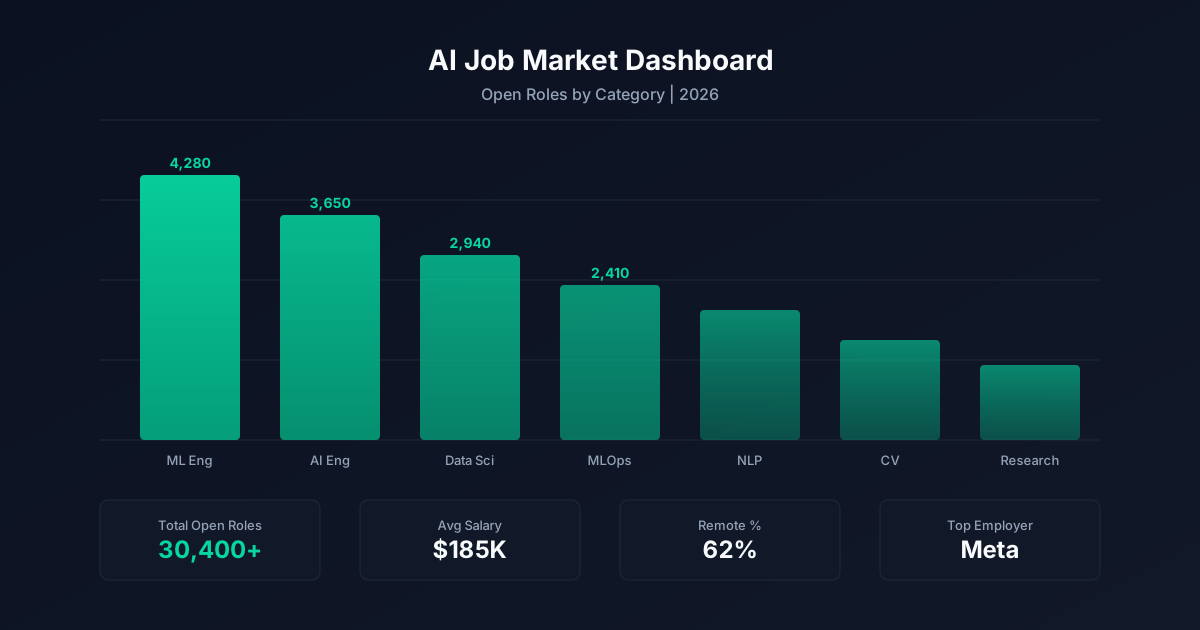
The AI job market spans 3,708 open positions across 16 role categories. The largest categories by volume: AI/ML Engineer (2,605), Data Scientist (310), AI Software Engineer (259). These three account for the majority of open positions, though smaller categories often have higher per-role compensation because of specialized skill requirements.
The seniority mix tells a story about where AI teams are in their maturity. Entry-level roles (102) are outnumbered by mid-level (1,705) and senior (1,469) positions, reflecting that most companies are past the 'build a team from scratch' phase and need experienced engineers who can ship production systems. Leadership roles (Director, VP, C-Level) total 432 positions, representing the bottleneck between technical execution and organizational strategy.
Remote work availability sits at 14% of all AI roles (508 positions), with 3,180 requiring on-site or hybrid attendance. The remote share has stabilized after the post-pandemic correction. Senior and specialized roles (Research Scientist, ML Architect) are more likely to be remote-eligible than entry-level positions, partly because experienced hires have more negotiating power and partly because these roles require less hands-on mentorship.
AI compensation is structured in clear tiers. The market median sits at $217,500. Top-quartile roles start at $272,100, and the 90th percentile reaches $325,000. These figures include base salary with disclosed compensation. Total compensation (including equity, bonuses, and sign-on) runs 20-40% higher at companies that offer those components.
Category matters for compensation. AI Safety roles lead at $300,000 median, while Prompt Engineer roles sit at $140,000. The spread between highest and lowest-paying categories reflects the premium on specialized technical skills versus broader analytical roles.
The most in-demand skills across all AI postings: Python (1,890 postings), Aws (1,103 postings), Azure (877 postings), Rag (855 postings), Gcp (631 postings), Prompt Engineering (560 postings), Pytorch (545 postings), Claude (498 postings). Python dominates, appearing in the vast majority of role descriptions regardless of category. Cloud platform experience (AWS, GCP, Azure) is the second most common requirement. The newer entrants to the top skills list (RAG, vector databases, LLM APIs) reflect the shift from traditional ML toward generative AI applications.
Frequently Asked Questions
Get Weekly AI Career Intelligence
Salary data, skills demand, and market signals from 16,000+ AI job postings. Every Monday.