
Interested in this AI/ML Engineer role at Crunchyroll?
Apply Now →Skills & Technologies
About This Role
About Crunchyroll
---------------------
Founded by fans, Crunchyroll delivers the art and culture of anime to a passionate community. We super\-serve over 100 million anime and manga fans across 200\+ countries and territories, and help them connect with the stories and characters they crave. Whether that experience is online or in\-person, streaming video, theatrical, games, merchandise, events and more, it’s powered by the anime content we all love.
Join our team, and help us shape the future of anime!
As a Senior AI Solutions Engineer in Crunchyroll's AI Enablement "Build \& Partner" layer, you are the dedicated AI partner for business functions like Content, Marketing, or Product. You embed within these teams to deliver tailored solutions based on their specific operational context.
This hands\-on role combines engineering with consulting, focusing on building production\-grade agentic systems. You design and implement systems that plan, use tools, and maintain state \- utilizing RAG pipelines and workflow automation, rather than just building simple chat interfaces. Your time in this role is split between stakeholder scoping and technical implementation.
You own the full lifecycle, from task decomposition and model selection to orchestration, evaluations, and production deployment. You build on the central AI Enablement team's shared technical standards, approved tooling list, and architectural playbook, and feed your own patterns, reusable components, and lessons learned back into them so the whole organization benefits from what you ship.
In this role, you will
--------------------------
- Embed deeply with your assigned business function \- attend their meetings, map their workflows end\-to\-end, and learn their pain points firsthand before proposing changes
- Ask the most important question first: "Should we use AI here at all?" \- be willing to say no, and when the answer is yes, choose the right kind of AI (agentic system, generative AI, classical ML, RAG, or simple automation) rather than defaulting to the most sophisticated option
- Spot which parts of a workflow are genuinely agent\-shaped \- multi\-step, tool\-using, decisioning tasks where autonomy adds value, versus where a deterministic automation or a single LLM call is the more honest answer
- Translate business problems into clear technical designs \- architecture diagrams, data flow maps, integration points, tool selection, and explicit build vs. buy vs. integrate decisions you can defend to both technical and non\-technical audiences
- Design agentic systems deliberately: decompose the task, define the agent's goals, tools, and action space, choose between single\-agent and multi\-agent orchestration, and specify how it plans, reasons, retains memory/state, escalates to a human, and stays within its guardrails
- Engineer agents for reliability rather than demos: handle failure modes, retries, tool errors, hallucination recovery, cost and latency budgets, human\-in\-the\-loop checkpoints, and graceful degradation when a step fails
- Build evaluation and observability from day one \- define task\-level success criteria and eval sets, and instrument tracing, logging, and monitoring so agent behavior, quality, cost, and drift are measurable in production rather than assumed
- Manage stakeholders proactively: act as the translator between business needs and technical reality, set honest expectations about what agents can and cannot reliably do, surface risks early, prevent scope creep, and never let a stakeholder be surprised
- Support post\-handoff sustainability \- what you build should still be operational and maintained well after you've moved to the next engagement
What We're Looking For
--------------------------
### Required
- 6\+ years of software engineering experience, with at least 3 years building applied AI/agentic solutions in a production environment.
- Demonstrated experience designing, building, and shipping reliable agentic systems to production: tool\-using agents that plan, call tools/APIs and MCP servers, and complete multi\-step tasks.
- You've owned the reliability engineering that keeps them running, including failure handling, human\-in\-the\-loop control, guardrails, and cost and latency management.
- Experience building internal platforms, SDKs, or tooling adopted by other teams, with the design, documentation, and usability that drive real adoption.
- Strong Python skills and deep command of the agentic stack: one or more agentic frameworks (LangChain/LangGraph, LlamaIndex, AutoGen, CrewAI, the OpenAI Agents SDK, or similar), tool/function calling, orchestration, and state/memory management. It also covers prompt and context engineering, RAG architectures, vector databases, LLM APIs, structured outputs, and integrations with internal and third\-party systems.
- Able to build AI solutions end\-to\-end \- you can go from problem statement through architecture and design to a working solution without relying on another engineer to execute your designs.
- Sound judgment on whether to use AI at all, and which kind to use (agent, RAG, classical ML, or simple automation), including the discipline to say no rather than default to the most sophisticated option.
- Proven ability to work directly with non\-technical stakeholders and manage expectations.
- Comfort operating in ambiguous, early\-stage environments where you define the problem as much as you solve it, starting from a vague complaint, working back to a crisp technical plan, and knowing when to prototype quickly versus when to build for the long term.
### Strongly Preferred
- Experience designing multi\-agent systems, coordinating multiple specialized agents, planner/executor patterns, and agent\-to\-agent or protocol\-based tool interoperability.
- Experience in an embedded, consultative, or cross\-functional role \- you understand what it means to serve another team's goals rather than your own backlog.
- Familiarity with workflow analysis and process mapping \- you've documented how work actually gets done before proposing how to change it.
- Experience evaluating and observing agent/LLM systems \- building eval sets, defining success criteria, and instrumenting tracing, monitoring, and drift detection (using tooling such as Datadog, LangSmith, or Langfuse) so you can point to numbers that show whether a system is actually working.
- Experience in media, entertainment, streaming, or consumer technology, with awareness of content workflows, localization pipelines, marketing operations, or rights management, is a genuine advantage.
- Exposure to AI governance and security review processes \- you know what questions IT, legal, and security will ask, including agent\-specific risks (tool/permission scope, prompt injection, data handling, autonomous\-action safety), and you design with those constraints in mind from the start.
Why you will love working at Crunchyroll
--------------------------------------------
In addition to getting to work with fun, passionate and inspired colleagues, you will also enjoy the following benefits and perks:
- Receive a great compensation package including salary plus performance bonus earning potential, paid annually.
- Flexible time off policies allowing you to take the time you need to be your whole self.
- Generous medical, dental, vision, STD, LTD, and life insurance
- Health Saving Account HSA program
- Health care and dependent care FSA
- 401(k) plan, with employer match
- Employer paid commuter benefit
- Support program for new parents
- Pet insurance and some of our offices are pet friendly!
\#LifeAtCrunchyroll \#LI\-Hybrid
The Pay Range for this position is listed. Actual pay will vary based on factors including, but not limited to location, experience, and performance. The range listed is just one component of Crunchyroll’s Total Rewards offerings for employees. Other rewards may include performance bonuses, employer matched retirement savings, time\-off programs, and progressive health benefits and perks.
Pay Transparency \- Los Angeles, CA
$183,400 \- $229,200 USD
### About our Values
We want to be everything for someone rather than something for everyone and we do this by living and modeling our values in all that we do. We value
- Courage. We believe that when we overcome fear, we enable our best selves.
- Curiosity. We are curious, which is the gateway to empathy, inclusion, and understanding.
- Kaizen. We have a growth mindset committed to constant forward progress.
- Service. We serve our community with humility, enabling joy and belonging for others.
### Our commitment to diversity and inclusion
Our mission of helping people belong reflects our commitment to diversity \& inclusion. It's just the way we do business.
We are an equal opportunity employer and value diversity at Crunchyroll. Pursuant to applicable law, we do not discriminate on the basis of race, religion, color, national origin, gender, sexual orientation, age, marital status, veteran status, or disability status.
Crunchyroll, LLC is an independently operated joint venture between US\-based Sony Pictures Entertainment, and Japan's Aniplex, a subsidiary of Sony Music Entertainment (Japan) Inc., both subsidiaries of Tokyo\-based Sony Group Corporation.
*Questions about Crunchyroll’s hiring process? Please check out our Hiring FAQs:* *https://help.crunchyroll.com/hc/en\-us/articles/360040471712\-Crunchyroll\-Hiring\-FAQs*
*Please refer to our Candidate Privacy Policy for more information about how we process your personal information, and your data protection rights:* *https://tbcdn.talentbrew.com/company/22978/v1\_0/docs/spe\-jobs\-privacy\-policy\-update\-for\-crpa\-dec\-21\-22\.pdf*
Please beware of recent scams to online job seekers. Those applying to our job openings will only be contacted directly from @crunchyroll.com email account.
Salary Context
This $183K-$229K range is above the median for AI/ML Engineer roles in our dataset (median: $180K across 1841 roles with salary data).
View full AI/ML Engineer salary data →Role Details
About This Role
AI/ML Engineers build and deploy machine learning models in production. They work across the full ML lifecycle: data pipelines, model training, evaluation, and serving infrastructure. The role has evolved significantly over the past two years. Where ML Engineers once spent most of their time on model architecture, the job now tilts heavily toward inference optimization, cost management, and integrating LLM capabilities into existing systems. Companies want engineers who can ship production systems, and the experimenter-only role is fading fast.
Day-to-day, you're writing training pipelines, debugging data quality issues, setting up evaluation frameworks, and figuring out why your model performs differently in staging than it did on your dev set. The best ML engineers are obsessive about reproducibility and measurement. They instrument everything. They know that a model is only as good as the data feeding it and the infrastructure serving it.
Across the 3,708 AI roles we're tracking, AI/ML Engineer positions make up 70% of the market. At Crunchyroll, this role fits into their broader AI and engineering organization.
Demand for AI/ML Engineers has been strong and consistent. Unlike some AI roles that spike with hype cycles, ML engineering is a foundational need. Every company deploying AI models needs people who can keep them running, and the gap between research prototypes and production systems keeps growing.
What the Work Looks Like
A typical week might include: debugging a data pipeline that's silently dropping 3% of training examples, running A/B tests on a new model version, writing documentation for a feature flag system that lets you roll back model deployments, and reviewing a junior engineer's PR for a new evaluation metric. Meetings tend to be cross-functional since ML touches product, engineering, and data teams.
Demand for AI/ML Engineers has been strong and consistent. Unlike some AI roles that spike with hype cycles, ML engineering is a foundational need. Every company deploying AI models needs people who can keep them running, and the gap between research prototypes and production systems keeps growing.
Skills Required
Python and PyTorch dominate the requirements. Most roles expect experience with cloud platforms (AWS, GCP, or Azure) and familiarity with ML frameworks like TensorFlow or JAX. RAG (Retrieval-Augmented Generation) has become a top-3 skill requirement as companies integrate LLMs into their products. Docker and Kubernetes show up in about a third of postings, reflecting the production focus of the role.
Beyond the core stack, employers increasingly want experience with experiment tracking tools (MLflow, Weights & Biases), feature stores, and vector databases. Fine-tuning experience is valuable but less common than you'd think from reading Twitter. Most production LLM work is RAG and prompt engineering, not fine-tuning. If you have both, you're in a strong position.
Companies that are serious about AI/ML hiring tend to post specific infrastructure details in the job description: the frameworks they use, their model serving stack, their data pipeline tools. Vague postings that just say 'ML experience required' without specifics are often companies that haven't figured out what they need yet.
Compensation Benchmarks
AI/ML Engineer roles pay a median of $218,750 based on 3,817 positions with disclosed compensation. Senior-level AI roles across all categories have a median of $230,000. This role's midpoint ($206K) sits 6% below the category median. Disclosed range: $183K to $229K.
Across all AI roles, the market median is $217,500. Top-quartile compensation starts at $272,100. The 90th percentile reaches $325,000. For comparison, the highest-paying categories include AI Safety ($300,000) and Research Engineer ($280,000). By seniority level: Entry: $120,000; Mid: $200,000; Senior: $230,000; Director: $272,150; VP: $250,000.
Crunchyroll AI Hiring
Crunchyroll has 3 open AI roles right now. They're hiring across AI/ML Engineer. Positions span Dallas, TX, US, Los Angeles, CA, US. Compensation range: $229K - $229K.
Location Context
AI roles in Los Angeles pay a median of $215,000 across 397 tracked positions.
Career Path
Common paths into AI/ML Engineer roles include Data Scientist, Software Engineer, Research Engineer.
From here, career progression typically leads toward ML Architect, AI Engineering Manager, Principal ML Engineer.
The fastest path into ML engineering is through software engineering with a self-directed ML education. A CS degree helps, but production engineering skills matter more than academic credentials. Build something that works, deploy it, and measure it. That portfolio project is worth more than a Coursera certificate. For career growth, the fork comes around the senior level: go deep on technical complexity (staff/principal track) or move into managing ML teams.
What to Expect in Interviews
Expect system design questions around ML pipelines: how you'd build a training pipeline for a specific use case, handle data drift, or design A/B testing infrastructure for model deployments. Coding rounds typically involve Python, with emphasis on data manipulation (pandas, numpy) and algorithm implementation. Take-home assignments often ask you to build an end-to-end ML pipeline from raw data to deployed model.
When evaluating opportunities: Companies that are serious about AI/ML hiring tend to post specific infrastructure details in the job description: the frameworks they use, their model serving stack, their data pipeline tools. Vague postings that just say 'ML experience required' without specifics are often companies that haven't figured out what they need yet.
AI Hiring Overview
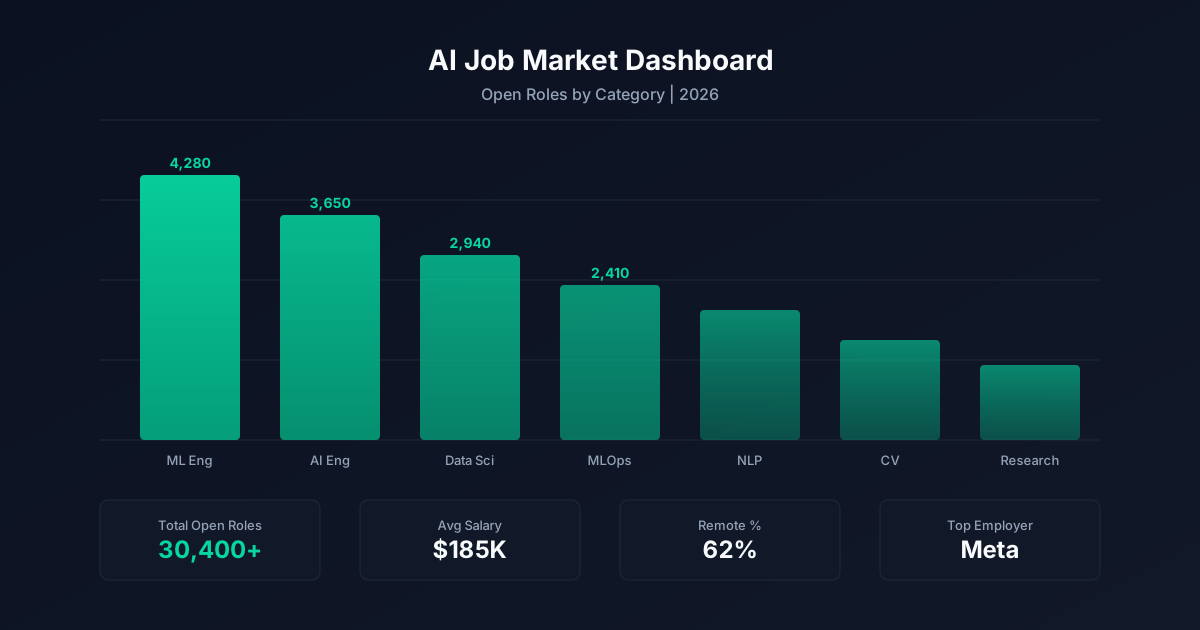
The AI job market has 3,708 open positions tracked in our dataset. By seniority: 102 entry-level, 1,705 mid-level, 1,469 senior, and 432 leadership roles (Director, VP, C-Level). Remote roles make up 14% of the market (508 positions). The remaining 3,180 roles require on-site or hybrid attendance.
The market median for AI roles is $217,500. Top-quartile compensation starts at $272,100. The 90th percentile reaches $325,000. Highest-paying categories: AI Safety ($300,000 median, 21 roles); Research Engineer ($280,000 median, 147 roles); AI Architect ($254,798 median, 67 roles).
Demand for AI/ML Engineers has been strong and consistent. Unlike some AI roles that spike with hype cycles, ML engineering is a foundational need. Every company deploying AI models needs people who can keep them running, and the gap between research prototypes and production systems keeps growing.
The AI Job Market Today
The AI job market spans 3,708 open positions across 16 role categories. The largest categories by volume: AI/ML Engineer (2,605), Data Scientist (310), AI Software Engineer (259). These three account for the majority of open positions, though smaller categories often have higher per-role compensation because of specialized skill requirements.
The seniority mix tells a story about where AI teams are in their maturity. Entry-level roles (102) are outnumbered by mid-level (1,705) and senior (1,469) positions, reflecting that most companies are past the 'build a team from scratch' phase and need experienced engineers who can ship production systems. Leadership roles (Director, VP, C-Level) total 432 positions, representing the bottleneck between technical execution and organizational strategy.
Remote work availability sits at 14% of all AI roles (508 positions), with 3,180 requiring on-site or hybrid attendance. The remote share has stabilized after the post-pandemic correction. Senior and specialized roles (Research Scientist, ML Architect) are more likely to be remote-eligible than entry-level positions, partly because experienced hires have more negotiating power and partly because these roles require less hands-on mentorship.
AI compensation is structured in clear tiers. The market median sits at $217,500. Top-quartile roles start at $272,100, and the 90th percentile reaches $325,000. These figures include base salary with disclosed compensation. Total compensation (including equity, bonuses, and sign-on) runs 20-40% higher at companies that offer those components.
Category matters for compensation. AI Safety roles lead at $300,000 median, while Prompt Engineer roles sit at $140,000. The spread between highest and lowest-paying categories reflects the premium on specialized technical skills versus broader analytical roles.
The most in-demand skills across all AI postings: Python (1,890 postings), Aws (1,103 postings), Azure (877 postings), Rag (855 postings), Gcp (631 postings), Prompt Engineering (560 postings), Pytorch (545 postings), Claude (498 postings). Python dominates, appearing in the vast majority of role descriptions regardless of category. Cloud platform experience (AWS, GCP, Azure) is the second most common requirement. The newer entrants to the top skills list (RAG, vector databases, LLM APIs) reflect the shift from traditional ML toward generative AI applications.
Frequently Asked Questions
Get Weekly AI Career Intelligence
Salary data, skills demand, and market signals from 16,000+ AI job postings. Every Monday.