
Interested in this AI/ML Engineer role at Data & Society Research Institute?
Apply Now →Skills & Technologies
About This Role
Data \& Society is an independent nonprofit research organization studying the social implications of data\-centric technologies and automation. We recognize that the same innovative technologies that may benefit society can also be abused to invade privacy, provide new tools of discrimination, foreclose opportunity, and harm individuals and communities. Through original research and inclusive engagement, we work to ensure that empirical evidence and respect for human dignity guide how technology is developed and governed.
About The Role
Data \& Society is seeking a seasoned Project Coordinator, AI Civics. This role is a project coordinator and community support role embedded within the AI Civics program at Data \& Society.
This position provides critical operational coordination and support to the AI Civics Program.
The AI Civics program is a newly\-launched effort planning to amplify the tools of civic participation to help the public to directly shape the role that AI plays in society, surfacing civic tools the public can use to exert political power over AI systems and tech platformsat the community level.The program co\-creates toolkits and training resources with anchor partner organizations, diffuses these resources through a train\-the\-trainer model, and builds towards a national civic coalition demanding democratic accountability over AI. This program also contributes to Data \& Society's strategic priority of building network power.
The Project Coordinator will be responsible for assisting the Program Director, AI Civics with project coordination functions of participatory research methods, scheduling meetings, keeping relationships active and organized, helping the team move efficiently from planning to action, co\-producing on\-site workshops, and helping to cultivate the AI Civics academic network. To maximize the impact, the Project Coordinator and Network Engagement Manager will work closely together between execution and relationship management.
This role is ideal for someone with a background in project coordination or community engagement and who is highly organized, detail\-oriented, operationally reliable, and motivated by the intersection of technology, civic power, and community.
This position will report to the Program Director and will not have people manager responsibilities. This position is fully remote and will begin in September 2026 with an end date of May 31, 2028\.
The Candidate
This role is ideal for someone with a background in project coordination or community engagement and who is highly organized, detail\-oriented, operationally reliable, and motivated by the intersection of technology, civic power, and community.
Primary Responsibilities
Administrative and Project Coordination Support
- Provide day\-to\-day administrative and logistical support to the AI Civics Program, overseeing its operational calendar, including scheduling meetings with internal team members and external partners.
- Drive cross\-departmental coordination to ensure project timelines, milestones, and deliverables remain aligned across internal teams.
- Monitor the AI Civics program inbox daily, triaging correspondence, flagging time\-sensitive items, and ensuring timely follow\-through on action items and partner requests.
- Coordinate internal team checkpoints and recurring program meetings, preparing agendas, tracking decisions, and following up on next steps.
- Maintain and optimize a relationship management tracker to log partner touchpoints, flag outstanding follow\-ups, and ensure no partnership goes dormant or unattended.
- Lead on scheduling and logistics of co\-design workshops, feedback, train\-the\-trainer sessions, community of practice meetings, and partner convenings.
- Lead on operational execution and production for in\-person convenings (e.g. booking space, processing honoraria and reimbursements).
Partner Support and Relationship Management
- Serve as a responsive point of contact for anchor partner organizations, identifying and proactively meeting coordination needs, centering the priorities of local member groups.
- Coordinate a monthly call with academic network partners for support and information sharing.
- Assist with communications to AI Civics partner organizations and community of practice, including updates, event announcements, and follow\-up summary notes and agreements from convenings.
- Provide responsive follow\-up to support to partners rolling out AI Civics programming with their own staff and membership.
- Assist the AI Civics Program team with preparation for co\-design workshops, train\-the\-trainer sessions and participatory research activities with anchor partner organizations and their local member cohorts.
Support and Maintain Network Engagement
- Support coordination and convening of the academic network of researchers developing closely\-related materials.
- Maintain the contact database and network infrastructure for AI Civics partners and the Community of Practice within our CRM system, under the guidance of the Network Engagement Manager.
- Long\-term, help build connectivity between individual partners toward the creation of a national coalition of civic institutions—spanning partner organizations and the AI Civics Community of Practice.
Organizational Development
- Support the intellectual life of the organization as an active participant in internal programming: actively engaging in talks, participating in seminars or reading groups, and contributing to the development of research and engagement management practices.
Skills \& Qualifications
Required Qualifications
- Bachelor's degree required.
- 5 plus years' of experience in project management, coordination, community support or closely related areas.
- Excellent writing and organizational skills, cross\-team communication, and the ability to manage multiple projects simultaneously while setting and meeting required deadlines.
- Demonstrated ability to manage complex schedules, coordinate across multiple stakeholders, internal and external, and keep programs running smoothly behind the scenes.
- Strong relationship management instincts: proactive about outreach, diligent about follow\-through, and skilled at keeping external partnerships nurtured and active.
- Excellent written communication and comfort with high\-volume email\-based stakeholder correspondence.
- Highly organized, detail\-oriented, and able to manage multiple projects simultaneously while meeting deadlines.
- Proactive self\-starter and the ability to work independently in a remote environment.
Preferred Qualifications
- Familiarity with relationship management tools, project management software (e.g., Salesforce, Mailchimp, Airtable) and standard productivity tools.
- Previous experience in technology policy, AI accountability, or the intersection of civic power and emerging technology; equivalent experience considered.
Core Competencies
- Organizational excellence \- managing logistics, deadlines, and details with consistency and care so that programs run smoothly and nothing slips through the cracks.
- Relationship stewardship \- building and maintaining trust with partners and colleagues through reliable follow\-through, proactive communication, and attentiveness to needs.
- Establishes and maintains effective relations, exhibits objectivity and openness to others' views, works cooperatively in group situations, and contributes to building a positive team spirit.
- Demonstrated expertise in sustaining trust\-based relationships across a network.
- Cultural humility in working with a wide range of stakeholder groups.
*Organizational Values and Participation*
- Commitment to advancing organizational diversity, equity, and inclusion;
- Actively participate in programs and professional development opportunities that work to ensure we continue our commitment to being an anti\-racist and anti\-discrimination organization;
- To attend, where able, whole\-organization activities such as staff meetings, retreats, town halls, listening sessions, workshops, training, and social events; and
- To participate, where able and appropriate, in contributing to the culture of D\&S by participating in working groups and committees (e.g. DEIA Working Group).
To apply, please submit the following items by July 29, 2026:
- A cover letter explaining your interest in this role and why you would be a good fit for this position.
- A resume is required.
- The names, affiliations, and contact information for three (3\) references. Please include the name, title, email addresses, and phone numbers for each reference. Only candidates who reach the final round of interviews may have their references contacted.
- Finalists will be required to complete a short, role\-specific writing exercise.
Applications will be reviewed beginning July 30, 2026. Please feel free to contact us at jobs@datasociety.net should you have any questions about the role. Questions about the opportunity or process will not reflect negatively on your application.
Practical Considerations
- Data \& Society has committed to safety requirements to protect our staff from the COVID\-19 pandemic. We require that prospective employees are fully vaccinated against COVID\-19 before joining our organization. Please note that any reasonable accommodation request is not guaranteed to be approved, and we will comply with ADA\-related requirements to evaluate the accommodation against business needs.
- This is currently a full\-time, remote position in the AI Civics program with an expected start date in September 2026 and an end date of May 31, 2028. This is a 2\-year position, with no expectation for extension. Data \& Society is based in New York City, and will for the foreseeable future operate as a Remote\-First organization. The role may involve occasional onsite meetings in the future.
- You must be living and authorized to work in the United States; we are unable to sponsor visas.
- The salary range for this role is $63,500 to $78,000 annually, commensurate with experience. This salary offer will include a generous benefits package including medical, dental, and vision insurance and access to a range of opt\-in products and services including additional insurance and 401k management as well as paid time off and paid federal holidays.
The salary range for this position is noted within this job posting. Where a prospective employee or employee is compensated within this salary range is dependent upon, among other factors, actual compensation for current/former employees in the subject position; market considerations; budgetary considerations; tenure, and standing with the organization (applicable to current employees); as well as the employee's/applicant's overall qualifications: knowledge, skills, pertinent experience, and abilities.
Salary Context
This $63K-$78K range is in the lower quartile for AI/ML Engineer roles in our dataset (median: $180K across 1841 roles with salary data).
View full AI/ML Engineer salary data →Role Details
About This Role
AI/ML Engineers build and deploy machine learning models in production. They work across the full ML lifecycle: data pipelines, model training, evaluation, and serving infrastructure. The role has evolved significantly over the past two years. Where ML Engineers once spent most of their time on model architecture, the job now tilts heavily toward inference optimization, cost management, and integrating LLM capabilities into existing systems. Companies want engineers who can ship production systems, and the experimenter-only role is fading fast.
Day-to-day, you're writing training pipelines, debugging data quality issues, setting up evaluation frameworks, and figuring out why your model performs differently in staging than it did on your dev set. The best ML engineers are obsessive about reproducibility and measurement. They instrument everything. They know that a model is only as good as the data feeding it and the infrastructure serving it.
Across the 3,708 AI roles we're tracking, AI/ML Engineer positions make up 70% of the market. At Data & Society Research Institute, this role fits into their broader AI and engineering organization.
Demand for AI/ML Engineers has been strong and consistent. Unlike some AI roles that spike with hype cycles, ML engineering is a foundational need. Every company deploying AI models needs people who can keep them running, and the gap between research prototypes and production systems keeps growing.
What the Work Looks Like
A typical week might include: debugging a data pipeline that's silently dropping 3% of training examples, running A/B tests on a new model version, writing documentation for a feature flag system that lets you roll back model deployments, and reviewing a junior engineer's PR for a new evaluation metric. Meetings tend to be cross-functional since ML touches product, engineering, and data teams.
Demand for AI/ML Engineers has been strong and consistent. Unlike some AI roles that spike with hype cycles, ML engineering is a foundational need. Every company deploying AI models needs people who can keep them running, and the gap between research prototypes and production systems keeps growing.
Skills Required
Python and PyTorch dominate the requirements. Most roles expect experience with cloud platforms (AWS, GCP, or Azure) and familiarity with ML frameworks like TensorFlow or JAX. RAG (Retrieval-Augmented Generation) has become a top-3 skill requirement as companies integrate LLMs into their products. Docker and Kubernetes show up in about a third of postings, reflecting the production focus of the role.
Beyond the core stack, employers increasingly want experience with experiment tracking tools (MLflow, Weights & Biases), feature stores, and vector databases. Fine-tuning experience is valuable but less common than you'd think from reading Twitter. Most production LLM work is RAG and prompt engineering, not fine-tuning. If you have both, you're in a strong position.
Companies that are serious about AI/ML hiring tend to post specific infrastructure details in the job description: the frameworks they use, their model serving stack, their data pipeline tools. Vague postings that just say 'ML experience required' without specifics are often companies that haven't figured out what they need yet.
Compensation Benchmarks
AI/ML Engineer roles pay a median of $218,750 based on 3,817 positions with disclosed compensation. Mid-level AI roles across all categories have a median of $200,000. This role's midpoint ($70K) sits 68% below the category median. Disclosed range: $63K to $78K.
Across all AI roles, the market median is $217,500. Top-quartile compensation starts at $272,100. The 90th percentile reaches $325,000. For comparison, the highest-paying categories include AI Safety ($300,000) and Research Engineer ($280,000). By seniority level: Entry: $120,000; Mid: $200,000; Senior: $230,000; Director: $272,150; VP: $250,000.
Data & Society Research Institute AI Hiring
Data & Society Research Institute has 2 open AI roles right now. They're hiring across AI/ML Engineer. Positions span New York, NY, US, Remote, US. Compensation range: $78K - $97K.
Location Context
AI roles in New York pay a median of $220,000 across 1,045 tracked positions.
Career Path
Common paths into AI/ML Engineer roles include Data Scientist, Software Engineer, Research Engineer.
From here, career progression typically leads toward ML Architect, AI Engineering Manager, Principal ML Engineer.
The fastest path into ML engineering is through software engineering with a self-directed ML education. A CS degree helps, but production engineering skills matter more than academic credentials. Build something that works, deploy it, and measure it. That portfolio project is worth more than a Coursera certificate. For career growth, the fork comes around the senior level: go deep on technical complexity (staff/principal track) or move into managing ML teams.
What to Expect in Interviews
Expect system design questions around ML pipelines: how you'd build a training pipeline for a specific use case, handle data drift, or design A/B testing infrastructure for model deployments. Coding rounds typically involve Python, with emphasis on data manipulation (pandas, numpy) and algorithm implementation. Take-home assignments often ask you to build an end-to-end ML pipeline from raw data to deployed model.
When evaluating opportunities: Companies that are serious about AI/ML hiring tend to post specific infrastructure details in the job description: the frameworks they use, their model serving stack, their data pipeline tools. Vague postings that just say 'ML experience required' without specifics are often companies that haven't figured out what they need yet.
AI Hiring Overview
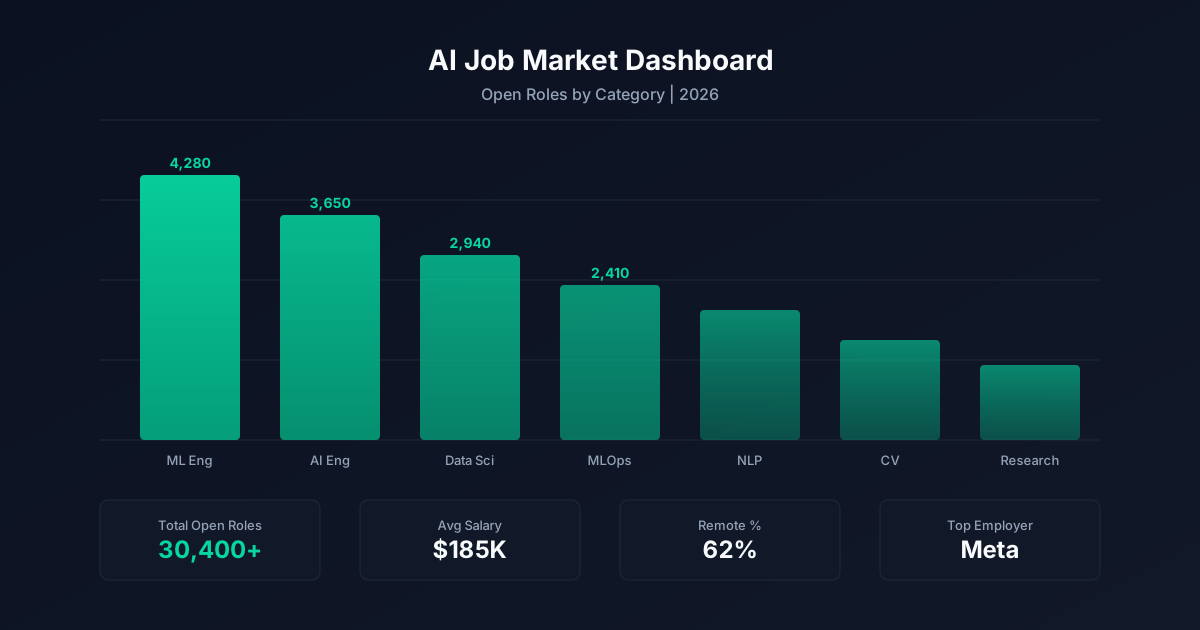
The AI job market has 3,708 open positions tracked in our dataset. By seniority: 102 entry-level, 1,705 mid-level, 1,469 senior, and 432 leadership roles (Director, VP, C-Level). Remote roles make up 14% of the market (508 positions). The remaining 3,180 roles require on-site or hybrid attendance.
The market median for AI roles is $217,500. Top-quartile compensation starts at $272,100. The 90th percentile reaches $325,000. Highest-paying categories: AI Safety ($300,000 median, 21 roles); Research Engineer ($280,000 median, 147 roles); AI Architect ($254,798 median, 67 roles).
Demand for AI/ML Engineers has been strong and consistent. Unlike some AI roles that spike with hype cycles, ML engineering is a foundational need. Every company deploying AI models needs people who can keep them running, and the gap between research prototypes and production systems keeps growing.
The AI Job Market Today
The AI job market spans 3,708 open positions across 16 role categories. The largest categories by volume: AI/ML Engineer (2,605), Data Scientist (310), AI Software Engineer (259). These three account for the majority of open positions, though smaller categories often have higher per-role compensation because of specialized skill requirements.
The seniority mix tells a story about where AI teams are in their maturity. Entry-level roles (102) are outnumbered by mid-level (1,705) and senior (1,469) positions, reflecting that most companies are past the 'build a team from scratch' phase and need experienced engineers who can ship production systems. Leadership roles (Director, VP, C-Level) total 432 positions, representing the bottleneck between technical execution and organizational strategy.
Remote work availability sits at 14% of all AI roles (508 positions), with 3,180 requiring on-site or hybrid attendance. The remote share has stabilized after the post-pandemic correction. Senior and specialized roles (Research Scientist, ML Architect) are more likely to be remote-eligible than entry-level positions, partly because experienced hires have more negotiating power and partly because these roles require less hands-on mentorship.
AI compensation is structured in clear tiers. The market median sits at $217,500. Top-quartile roles start at $272,100, and the 90th percentile reaches $325,000. These figures include base salary with disclosed compensation. Total compensation (including equity, bonuses, and sign-on) runs 20-40% higher at companies that offer those components.
Category matters for compensation. AI Safety roles lead at $300,000 median, while Prompt Engineer roles sit at $140,000. The spread between highest and lowest-paying categories reflects the premium on specialized technical skills versus broader analytical roles.
The most in-demand skills across all AI postings: Python (1,890 postings), Aws (1,103 postings), Azure (877 postings), Rag (855 postings), Gcp (631 postings), Prompt Engineering (560 postings), Pytorch (545 postings), Claude (498 postings). Python dominates, appearing in the vast majority of role descriptions regardless of category. Cloud platform experience (AWS, GCP, Azure) is the second most common requirement. The newer entrants to the top skills list (RAG, vector databases, LLM APIs) reflect the shift from traditional ML toward generative AI applications.
Frequently Asked Questions
Get Weekly AI Career Intelligence
Salary data, skills demand, and market signals from 16,000+ AI job postings. Every Monday.