
Interested in this AI/ML Engineer role at Dotmatics Ltd.?
Apply Now →About This Role
Our Why At Dotmatics
At Dotmatics, we believe science, data, and decision\-making must be deeply intertwined for innovation to thrive.
Our Portfolio includes Luma, LumaLab Connect, ELN Platform, Graphpad Prism, Geneious, SnapGene, Protein Metrics, OMIQ, FCS Express, LabArchives, NQuery, EasyPanel, MStar, SoftGenetics and Virscidian.
We have a vision for a new Lab of the Future that will change the future of scientific research.
We have created the world’s most comprehensive digital science platform – best\-of\-breed software applications already used by more than 2 million scientists, together in a single ecosystem united by a powerful, flexible enterprise data platform. This is not flat data buried away in digital graveyards. This is dynamic, multi\-dimensional decision\-making.
Scientific enterprises need a new level of effectiveness to achieve tomorrow’s breakthroughs. Illness will not wait. The biosphere will not wait. We are tireless in our vision, because the time for innovation is now.
Shaping the Future of Science At Dotmatics
Our global team of more than 800 colleagues are dedicated to supporting our customers in over 180 countries. Together, with our scientific community of users, we accelerate scientific innovation in order to make the world a healthier, cleaner, and safer place to live.
You’ll join a collaborative, global team pushing the boundaries of scientific innovation. Your ideas and efforts will have a tangible impact, accelerating scientific progress and discovery. We offer a dynamic, remote\-friendly environment that fosters high integrity and collaboration, empowering you to excel. Dotmatics is a company built by scientists, for scientists. Combined, we are now the world’s largest cloud\-based scientific research R\&D platform. We need your help to keep growing and pioneering the future.
We are Science Driven. We are Customer Centric. We are Better Together.
What do we need
We are seeking a technically credible, collaborative Head of AI Governance to provide strategic leadership and oversight of Dotmatics' AI governance program. This role ensures the responsible, compliant, and business\-aligned use of AI technologies across the organization, covering governance frameworks, risk management processes, and compliance controls that support our delivery of high\-quality scientific informatics software.
Reporting to the VP, Information Security, you will serve as the central cross\-functional connector across HR, Information Security, Product, Engineering, Legal, Privacy, Quality, and other functions; ensuring AI governance is embedded consistently throughout the organization rather than siloed within a single team. A central aspect of this role is interfacing with Siemens AI Governance colleagues to build and mature a joint AI governance consortium, sharing best practices, frameworks, and emerging standards across the broader Siemens portfolio.
You are a seasoned governance operator with deep technical credibility, adept at navigating complex stakeholder environments and translating AI risk concepts into business language that resonates at the executive level.
In this role you will get to:
- Lead the development and ongoing improvement of a comprehensive AI Governance Framework aligned with Dotmatics' risk appetite and regulatory obligations, including the EU AI Act, ISO 42001, and NIST AI RMF
- Maintain an AI use case registry, establish risk tiering and oversight levels for AI systems, and provide subject matter expertise to evaluate AI tools, models, and applications proposed by business and product teams
- Partner with leadership and functional teams to assess AI use cases across model behaviour, data usage, privacy, and operational risk; ensuring alignment with the company's ISO/IEC 27001 ISMS, ISO 9001 QMS, and GxP requirements
- Serve as program lead for the Dotmatics AI Governance Council, coordinating agendas, workflows, and decision\-ready materials for Council and executive review
- Act as the primary Dotmatics liaison to the Siemens AI Governance Consortium, representing the company in cross\-portfolio working groups and contributing to joint frameworks and maturity models
- Provide AI governance responses to customer RFIs, security questionnaires, and due diligence inquiries
- Embed governance checkpoints into the SDLC alongside Product and Engineering; align AI controls with the broader security posture and incident response procedures
- Lead the creation and maintenance of AI governance policies, SOPs, and supporting documentation; and develop and deliver AI governance training across the organization
- Produce management reporting, metrics, and dashboards to keep senior leadership informed of program status, risk exposure, and control effectiveness
- Drive continuous improvement by incorporating lessons learned, evolving standards, and regulatory developments
We are looking for people who have a Bachelor's degree in Computer Science, Information Systems, Risk Management, Engineering, Business, or a related discipline (or equivalent experience), combined with 15\-20 years in information security, technology risk management, data governance, or compliance in a regulated industry, including 5\-8 years of progressive experience specifically in AI/ML governance. Experience in the Life Sciences (GxP) sector and knowledge of the scientific informatics or cheminformatics space is a strong advantage.
The key skills we are looking for:
- Demonstrated experience designing or operating AI governance programs, model risk management frameworks, or technology risk management processes
- Deep understanding of the AI risk landscape, including generative AI, large language models, AI agents, and associated regulatory expectations
- Working knowledge of global AI and privacy regulatory frameworks, including the EU AI Act, GDPR, NIST AI RMF, and ISO/IEC 42001
- Proven ability to work across and influence cross\-functional stakeholder groups, including HR, Product, Engineering, Legal, Compliance, Finance, and Executive leadership, without direct line authority
- Experience managing or contributing to governance councils, steering committees, or similar oversight bodies
- In\-depth knowledge of AI/ML technologies, including large language models, AI\-enabled applications, APIs, and data pipelines, sufficient to assess technical feasibility and risk
- Implementation\-level understanding of information security principles, data privacy controls, and life science compliance frameworks (e.g., ISO 27001, NIST 800\-53, ISO 9001, GxP, GDPR, CCPA)
- Strong project management discipline with a track record of building programs and processes from the ground up
- Excellent written and verbal communication skills, including the ability to prepare executive\-ready materials and governance documentation
- Relevant professional certifications desirable: AIGP, CIPP, CISM, CRISC, or equivalent
Total Rewards
Dotmatics utilises a national market\-based approach to base pay benchmarking and pay band development. The candidate's final starting pay is based on job\-related skills, experience, job specific qualifications \& location. In addition to base salary, Dotmatics has implemented a total rewards strategy, which is the combination of compensation, benefits and recognition.
*Certain positions are also eligible for variable pay; your recruiter will discuss the full compensation package details.*
Other Total Rewards Offered
- Medical, Dental, Vision, Insurance
- Health Spending Accounts
- Wellness Benefits (Mental Health Apps and Fitness Perks)
- Company\-paid Life and Disability Insurance
- 401k Retirement Plan (with 4% company match; immediate vesting)
- Flexible Time off Plan (for US exempt employees)
This is the range that we, in good faith, believe is the range of possible compensation for this role at the time of this posting. We may ultimately pay more or less than the posted range. This range may be modified in the future.
Base Pay Range
$151,149 \- $204,496 USD
Research shows us the confidence gap and imposter syndrome can get in the way of meeting outstanding candidates, so please don’t hesitate to apply — we’d love to hear from you.
By submitting your application, you agree that Dotmatics may collect your personal data for recruiting, global organization planning, and related purposes. Dotmatics Privacy Notice explains what personal information we may process, where we may process your personal information, our purposes for processing your personal information, and the rights you can exercise over Dotmatics use of your personal information.
Dotmatics is an equal opportunity employer. We are a welcoming place for everyone, and we do our best to make sure all people feel supported and connected at work.
Salary Context
This $151K-$204K range is below the median for AI/ML Engineer roles in our dataset (median: $180K across 1841 roles with salary data).
View full AI/ML Engineer salary data →Role Details
About This Role
AI/ML Engineers build and deploy machine learning models in production. They work across the full ML lifecycle: data pipelines, model training, evaluation, and serving infrastructure. The role has evolved significantly over the past two years. Where ML Engineers once spent most of their time on model architecture, the job now tilts heavily toward inference optimization, cost management, and integrating LLM capabilities into existing systems. Companies want engineers who can ship production systems, and the experimenter-only role is fading fast.
Day-to-day, you're writing training pipelines, debugging data quality issues, setting up evaluation frameworks, and figuring out why your model performs differently in staging than it did on your dev set. The best ML engineers are obsessive about reproducibility and measurement. They instrument everything. They know that a model is only as good as the data feeding it and the infrastructure serving it.
Across the 3,708 AI roles we're tracking, AI/ML Engineer positions make up 70% of the market. At Dotmatics Ltd., this role fits into their broader AI and engineering organization.
Demand for AI/ML Engineers has been strong and consistent. Unlike some AI roles that spike with hype cycles, ML engineering is a foundational need. Every company deploying AI models needs people who can keep them running, and the gap between research prototypes and production systems keeps growing.
What the Work Looks Like
A typical week might include: debugging a data pipeline that's silently dropping 3% of training examples, running A/B tests on a new model version, writing documentation for a feature flag system that lets you roll back model deployments, and reviewing a junior engineer's PR for a new evaluation metric. Meetings tend to be cross-functional since ML touches product, engineering, and data teams.
Demand for AI/ML Engineers has been strong and consistent. Unlike some AI roles that spike with hype cycles, ML engineering is a foundational need. Every company deploying AI models needs people who can keep them running, and the gap between research prototypes and production systems keeps growing.
Skills in Demand for This Role
Python and PyTorch dominate the requirements. Most roles expect experience with cloud platforms (AWS, GCP, or Azure) and familiarity with ML frameworks like TensorFlow or JAX. RAG (Retrieval-Augmented Generation) has become a top-3 skill requirement as companies integrate LLMs into their products. Docker and Kubernetes show up in about a third of postings, reflecting the production focus of the role.
Beyond the core stack, employers increasingly want experience with experiment tracking tools (MLflow, Weights & Biases), feature stores, and vector databases. Fine-tuning experience is valuable but less common than you'd think from reading Twitter. Most production LLM work is RAG and prompt engineering, not fine-tuning. If you have both, you're in a strong position.
Companies that are serious about AI/ML hiring tend to post specific infrastructure details in the job description: the frameworks they use, their model serving stack, their data pipeline tools. Vague postings that just say 'ML experience required' without specifics are often companies that haven't figured out what they need yet.
Compensation Benchmarks
AI/ML Engineer roles pay a median of $218,750 based on 3,817 positions with disclosed compensation. Mid-level AI roles across all categories have a median of $200,000. This role's midpoint ($177K) sits 19% below the category median. Disclosed range: $151K to $204K.
Across all AI roles, the market median is $217,500. Top-quartile compensation starts at $272,100. The 90th percentile reaches $325,000. For comparison, the highest-paying categories include AI Safety ($300,000) and Research Engineer ($280,000). By seniority level: Entry: $120,000; Mid: $200,000; Senior: $230,000; Director: $272,150; VP: $250,000.
Dotmatics Ltd. AI Hiring
Dotmatics Ltd. has 1 open AI role right now. They're hiring across AI/ML Engineer. Based in US. Compensation range: $204K - $204K.
Location Context
AI roles in Austin pay a median of $214,343 across 87 tracked positions.
Career Path
Common paths into AI/ML Engineer roles include Data Scientist, Software Engineer, Research Engineer.
From here, career progression typically leads toward ML Architect, AI Engineering Manager, Principal ML Engineer.
The fastest path into ML engineering is through software engineering with a self-directed ML education. A CS degree helps, but production engineering skills matter more than academic credentials. Build something that works, deploy it, and measure it. That portfolio project is worth more than a Coursera certificate. For career growth, the fork comes around the senior level: go deep on technical complexity (staff/principal track) or move into managing ML teams.
What to Expect in Interviews
Expect system design questions around ML pipelines: how you'd build a training pipeline for a specific use case, handle data drift, or design A/B testing infrastructure for model deployments. Coding rounds typically involve Python, with emphasis on data manipulation (pandas, numpy) and algorithm implementation. Take-home assignments often ask you to build an end-to-end ML pipeline from raw data to deployed model.
When evaluating opportunities: Companies that are serious about AI/ML hiring tend to post specific infrastructure details in the job description: the frameworks they use, their model serving stack, their data pipeline tools. Vague postings that just say 'ML experience required' without specifics are often companies that haven't figured out what they need yet.
AI Hiring Overview
The AI job market has 3,708 open positions tracked in our dataset. By seniority: 102 entry-level, 1,705 mid-level, 1,469 senior, and 432 leadership roles (Director, VP, C-Level). Remote roles make up 14% of the market (508 positions). The remaining 3,180 roles require on-site or hybrid attendance.
The market median for AI roles is $217,500. Top-quartile compensation starts at $272,100. The 90th percentile reaches $325,000. Highest-paying categories: AI Safety ($300,000 median, 21 roles); Research Engineer ($280,000 median, 147 roles); AI Architect ($254,798 median, 67 roles).
Demand for AI/ML Engineers has been strong and consistent. Unlike some AI roles that spike with hype cycles, ML engineering is a foundational need. Every company deploying AI models needs people who can keep them running, and the gap between research prototypes and production systems keeps growing.
The AI Job Market Today
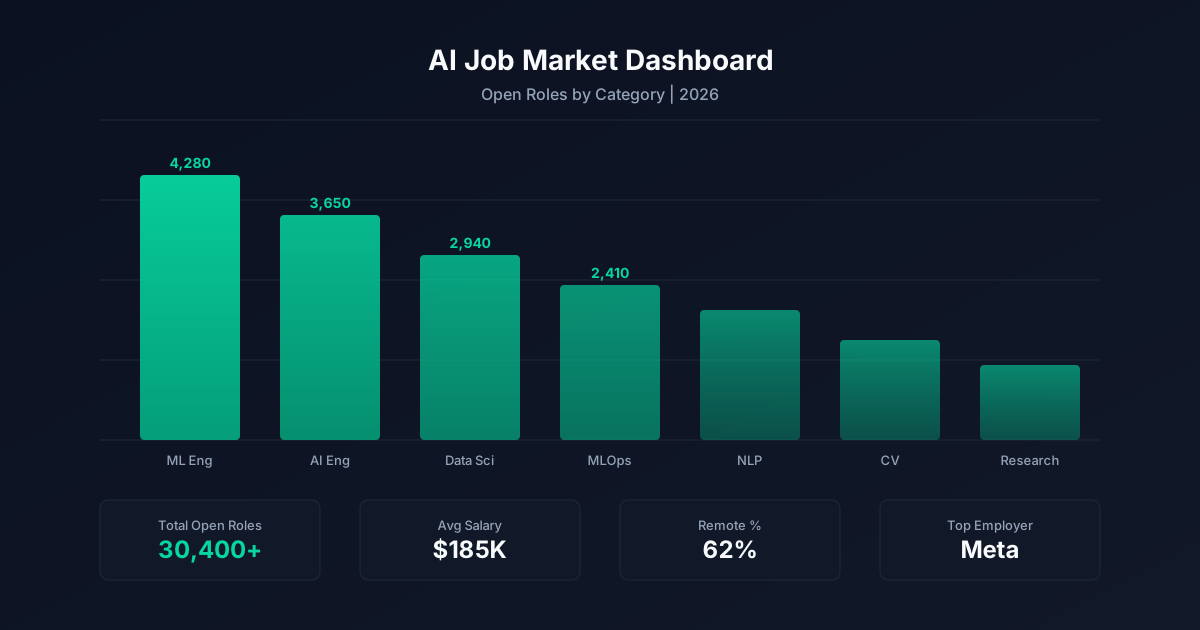
The AI job market spans 3,708 open positions across 16 role categories. The largest categories by volume: AI/ML Engineer (2,605), Data Scientist (310), AI Software Engineer (259). These three account for the majority of open positions, though smaller categories often have higher per-role compensation because of specialized skill requirements.
The seniority mix tells a story about where AI teams are in their maturity. Entry-level roles (102) are outnumbered by mid-level (1,705) and senior (1,469) positions, reflecting that most companies are past the 'build a team from scratch' phase and need experienced engineers who can ship production systems. Leadership roles (Director, VP, C-Level) total 432 positions, representing the bottleneck between technical execution and organizational strategy.
Remote work availability sits at 14% of all AI roles (508 positions), with 3,180 requiring on-site or hybrid attendance. The remote share has stabilized after the post-pandemic correction. Senior and specialized roles (Research Scientist, ML Architect) are more likely to be remote-eligible than entry-level positions, partly because experienced hires have more negotiating power and partly because these roles require less hands-on mentorship.
AI compensation is structured in clear tiers. The market median sits at $217,500. Top-quartile roles start at $272,100, and the 90th percentile reaches $325,000. These figures include base salary with disclosed compensation. Total compensation (including equity, bonuses, and sign-on) runs 20-40% higher at companies that offer those components.
Category matters for compensation. AI Safety roles lead at $300,000 median, while Prompt Engineer roles sit at $140,000. The spread between highest and lowest-paying categories reflects the premium on specialized technical skills versus broader analytical roles.
The most in-demand skills across all AI postings: Python (1,890 postings), Aws (1,103 postings), Azure (877 postings), Rag (855 postings), Gcp (631 postings), Prompt Engineering (560 postings), Pytorch (545 postings), Claude (498 postings). Python dominates, appearing in the vast majority of role descriptions regardless of category. Cloud platform experience (AWS, GCP, Azure) is the second most common requirement. The newer entrants to the top skills list (RAG, vector databases, LLM APIs) reflect the shift from traditional ML toward generative AI applications.
Frequently Asked Questions
Get Weekly AI Career Intelligence
Salary data, skills demand, and market signals from 16,000+ AI job postings. Every Monday.