
Interested in this AI/ML Engineer role at DrFirst?
Apply Now →Skills & Technologies
About This Role
About DrFirst:
For 25 years, DrFirst has empowered providers and patients to achieve better health through intelligent medication management. We improve healthcare workflows and help patients start and stay on therapy with end\-to\-end solutions that enhance prescription access, affordability, and adherence. Our solutions help 100 million patients a year and are used by more than 420,000 prescribers, 71,000 pharmacies, 270 EHRs and health information systems, and over 2,000 hospitals in the U.S. This is a great opportunity to be a part of a successful Healthcare IT company experiencing significant growth. Here you'll get to work with some of the smartest and most interesting people around; solving unique and complex challenges in healthcare on a scale matched by a few companies. If you get excited about stretching yourself in new ways, developing yourself to your fullest potential, care about working with smart colleagues; we want to talk to you!
Position Overview:
DrFirst is building an agentic ecosystem at scale. In the last 90 days we have shipped production AI systems across HR, Finance, Legal, and Marketing, automating hundreds of hours of manual work monthly and delivering measurable business impact.
This is a hands\-on technical leadership role. You architect and build production AI automation systems from discovery to deployment. You work directly with department leaders to map workflows and ship tools that augment their work.
The split is 80% individual\-contributor engineering and 20% servant leadership and mentorship. You build. You own technical architecture decisions. As the team scales from 2 to 5\-6 engineers over 18 months, you mentor through code review and pairing. You also teach non\-technical department leaders how to use AI tools, translate technical concepts for executives, and run discovery sessions that extract workflows from stakeholders. Building stays your primary focus.
Who Will Love This Job
--------------------------
- You are a senior IC who loves shipping code daily. You have been a Staff or Principal Engineer or led small teams, but you miss hands\-on building.
- You can architect multi\-agent systems and run discovery sessions with department VPs to map their workflows.
- You can debug OAuth2 flows through enterprise proxies and explain security requirements to non\-technical stakeholders.
- You are a servant leader. You remove blockers for others, teach through pairing rather than directives, and make stakeholders successful.
- You organize chaos: 15 stakeholders, 6 systems, 3 sprints in flight. You ask “How can I help?” before “Here is what you should do.”
What you will work on:
Build Production AI Automation (80%)
----------------------------------------
You own the technical implementation of department sprints. Example: an HR sprint delivered resume screening (40\-candidate PDF extraction with table\-of\-contents parsing and fuzzy name matching), OKR coaching (Leapsome API integration with performance rating analytics), performance ratings (calibration detection across 328 employees), and milestone email automation in 4 weeks.
- Architecture and Implementation: Design and build Python/FastAPI backends connecting to enterprise APIs (HRIS, ERP, CRM, finance systems, project management).
- Frontend Development: Build Next.js/React frontends with Okta SSO, role\-based access control, and audit trails.
- Multi\-Agent Systems: Design agent coordination systems, skill discovery hubs, agent registries, and workflow orchestration.
- Enterprise Integration: Navigate Zscaler proxies, VPNs, SSL certificates, Kubernetes pod networking, DynamoDB, and AWS Bedrock.
- Testing and Quality: Write Playwright end\-to\-end tests before production deploy and maintain a 1000\+ test suite with visual regression baselines.
- Deployment: Ship via GitLab CI/CD to AWS EKS (Kubernetes, ArgoCD, Helm, Secrets Manager) and diagnose pod restarts and liveness probe issues.
- Async and Performance: Debug event loop blocking, convert synchronous I/O to async, and optimize CPU\-bound operations.
- Security: Partner with the CISO on PII/PHI de\-identification, least privilege, and per\-user OAuth2\.
- Production Support: Debug authentication flows, token expiration, API rate limits, and health check failures.
You will ship 3\-5 production tools in parallel within each sprint, deploying multiple times per day based on stakeholder feedback.
Servant Leadership and Mentorship (20%)
-------------------------------------------
Guide 2\-3 engineers through code reviews and pairing. Teach department leaders how to use AI tools effectively. Translate technical decisions for non\-technical executives. No direct reports and no performance reviews. Pure servant leadership.
- Technical Mentorship: Code reviews, pairing sessions, and unblocking complex integrations.
- Non\-Technical Teaching: Run discovery sessions with department VPs, teach Finance/HR/Legal leaders how to prompt AI tools, and build interfaces non\-technical users can modify.
- Stakeholder Translation: Explain security trade\-offs to executives and translate “OAuth2 delegation” into “everyone sees only their own data.”
- Remove Blockers: Clear obstacles for team members, escalate infrastructure issues, and coordinate across departments.
- Knowledge Sharing: Document patterns so others can self\-serve and write playbooks department heads can follow without engineering help.
Daily Work
--------------
- Morning sync with the VP of AI Automation on build queue, blockers, and technical decisions.
- Direct coordination with 15\+ stakeholders across departments.
- Discovery sessions with department leaders to map workflows.
- Hands\-on coding: backend services, frontend components, and integration tests.
- Security reviews with the CISO.
- Ship multiple times per day and debug production issues.
- Code reviews for 2\-3 team members.
Qualifications:
Required
------------
- 8\+ years building production systems end\-to\-end (backend, frontend, integrations, infrastructure).
- Staff/Principal Engineer or Tech Lead experience, owning technical decisions on production systems.
- Shipped SaaS products with OAuth2, multi\-tenancy, audit trails, and enterprise compliance.
- Deep AI/ML experience: production systems using LLM APIs (OpenAI, Anthropic, AWS Bedrock) and agent frameworks.
- Production Python: FastAPI, Pydantic, httpx, pytest (1000\+ test suite experience).
- Production TypeScript/React: Next.js App Router, server components, Okta/NextAuth SSO, Playwright testing.
- AWS and Kubernetes: EKS operations, GitLab CI/CD, ArgoCD, Helm, Secrets Manager.
- Enterprise security patterns: Zscaler proxies, SSL certificates, Kubernetes networking, JWKS verification.
- Healthcare or regulated industry experience (HIPAA, SOC 2, or similar frameworks).
- Strong communication skills: run discovery sessions with non\-technical stakeholders, explain security trade\-offs to executives, and write architecture docs department leaders can follow.
- Servant leadership mindset: remove blockers for others, teach through questions not directives, and make stakeholders successful first.
- Thrives in organized chaos: 15 stakeholders, 6 systems, 3 sprints in flight.
- Bias toward shipping: “good enough to get feedback” beats “perfect in 3 months.”
- Highly collaborative: challenges ideas constructively and welcomes being challenged.
Preferred
-------------
- Led small teams (2\-5 people) through technical mentorship or tech lead roles.
- US\-based (US Central time zone preferred; Poland also considered).
- Built agentic systems: agent coordination, scheduled routines, and feedback loops.
- MCP (Model Context Protocol) experience: custom connectors for enterprise systems.
- Active contributor to AI/ML communities (papers, open source, conference talks).
- Teaching through code: strong code review skills, pairing experience, and documentation focus.
- Experience teaching non\-technical users through workshops, training sessions, and business\-user documentation.
AI\-Augmented Engineering (Non\-Negotiable)
-----------------------------------------------
DrFirst runs on AI\-assisted development. We use Claude (Anthropic) as our primary AI model via AWS Bedrock for enterprise control, and we are standardizing on AI coding assistants for all development work.
- Active, daily use of AI engineering tools (Claude Code, GitHub Copilot, Cursor, Windsurf, Cline, or similar). Hard requirement. You should be writing code with AI assistants, not just using them occasionally.
- Experience with Claude (Anthropic) is highly valued, whether through Claude.ai, Claude Code CLI, API integration, or AWS Bedrock. Our automation platform runs on Claude Sonnet 4\.5\.
- At least one automation you have built that eliminated hours of manual work, ideally using LLM APIs.
- Comfort teaching others to use AI tools effectively through pairing and code review.
Technical Stack
-------------------
- Backend: Python (FastAPI, Pydantic, httpx, pytest), OAuth2, AWS Secrets Manager, PostgreSQL, AWS Bedrock.
- Frontend: js 14 (React 18, TypeScript, Tailwind CSS), NextAuth.js/Okta SSO, Playwright.
- Infrastructure: AWS EKS (Kubernetes), GitLab CI/CD, ArgoCD, Helm, Zscaler proxies.
- AI and Agentic: Anthropic Claude (AWS Bedrock), AI coding assistants (GitHub Copilot/Cursor), MCP connectors.
Physical Requirements:
- Primarily desk\-based work, approximately 90\-95% of the time, at a computer workstation.
- Occasional travel, less than 5\-10% of the time.
\#LI\-GF1 \#LI\-Remote
Benefits:
- Competitive compensation, with a base salary of $175,000 \- $200,000 (Exact compensation may vary based on skills and experience)
- Eligible for Company Performance\-based Bonus Program, based on individual and company performance
- Medical, dental, and vision insurance
- 401K eligible after 3 months of employment, with 50% company match up to first 5% of salary contributed to the plan with a 3\-year vesting schedule
- HSA for eligible employees enrolled in the HDHP, with a generous company contribution up to $500 for individual coverage and $1000 for family coverage per year
- 100% company paid short and long\-term disability, AD\&D, and group life insurance
- Accrued annual paid time off (PTO) of 18 days for the first 3 years of service, increasing thereafter and 7 paid holiday days
- Employee Assistance Program
- Continuing Education funds up to $1500 annually for eligible programs after 1 year of service
- Voluntary benefits including FSA, Hospital indemnity, Accident and Critical Illness insurances
DrFirst is committed to being a Remote\-First company, creating a dynamic and flexible workplace where everyone can thrive, no matter where they log in from. Check out our approach to remote work https://drfirst.com/company/about\-us/careers/.
Our recruitment process at DrFirst is straightforward and secure. You will only be contacted by our recruitment team through an official @drfirst.com email address. We will never ask you for payment or sensitive personal information, such as your social security number or banking details, at any stage of the hiring process. Additionally, we will not request that you purchase equipment or accept e\-checks or checks for deposit. If you encounter any communications claiming to be from DrFirst that seem suspicious, please contact our recruitment team directly at recruiter@drfirst.com to verify the message's authenticity. Your security is important to us!
Learn more about our benefits and professional development opportunities https://drfirst.com/company/about\-us/careers/the\-perks/.
Salary Context
This $175K-$200K range is above the median for AI/ML Engineer roles in our dataset (median: $180K across 1841 roles with salary data).
View full AI/ML Engineer salary data →Role Details
About This Role
AI/ML Engineers build and deploy machine learning models in production. They work across the full ML lifecycle: data pipelines, model training, evaluation, and serving infrastructure. The role has evolved significantly over the past two years. Where ML Engineers once spent most of their time on model architecture, the job now tilts heavily toward inference optimization, cost management, and integrating LLM capabilities into existing systems. Companies want engineers who can ship production systems, and the experimenter-only role is fading fast.
Day-to-day, you're writing training pipelines, debugging data quality issues, setting up evaluation frameworks, and figuring out why your model performs differently in staging than it did on your dev set. The best ML engineers are obsessive about reproducibility and measurement. They instrument everything. They know that a model is only as good as the data feeding it and the infrastructure serving it.
Across the 3,708 AI roles we're tracking, AI/ML Engineer positions make up 70% of the market. At DrFirst, this role fits into their broader AI and engineering organization.
Demand for AI/ML Engineers has been strong and consistent. Unlike some AI roles that spike with hype cycles, ML engineering is a foundational need. Every company deploying AI models needs people who can keep them running, and the gap between research prototypes and production systems keeps growing.
What the Work Looks Like
A typical week might include: debugging a data pipeline that's silently dropping 3% of training examples, running A/B tests on a new model version, writing documentation for a feature flag system that lets you roll back model deployments, and reviewing a junior engineer's PR for a new evaluation metric. Meetings tend to be cross-functional since ML touches product, engineering, and data teams.
Demand for AI/ML Engineers has been strong and consistent. Unlike some AI roles that spike with hype cycles, ML engineering is a foundational need. Every company deploying AI models needs people who can keep them running, and the gap between research prototypes and production systems keeps growing.
Skills Required
Python and PyTorch dominate the requirements. Most roles expect experience with cloud platforms (AWS, GCP, or Azure) and familiarity with ML frameworks like TensorFlow or JAX. RAG (Retrieval-Augmented Generation) has become a top-3 skill requirement as companies integrate LLMs into their products. Docker and Kubernetes show up in about a third of postings, reflecting the production focus of the role.
Beyond the core stack, employers increasingly want experience with experiment tracking tools (MLflow, Weights & Biases), feature stores, and vector databases. Fine-tuning experience is valuable but less common than you'd think from reading Twitter. Most production LLM work is RAG and prompt engineering, not fine-tuning. If you have both, you're in a strong position.
Companies that are serious about AI/ML hiring tend to post specific infrastructure details in the job description: the frameworks they use, their model serving stack, their data pipeline tools. Vague postings that just say 'ML experience required' without specifics are often companies that haven't figured out what they need yet.
Compensation Benchmarks
AI/ML Engineer roles pay a median of $218,750 based on 3,817 positions with disclosed compensation. Senior-level AI roles across all categories have a median of $230,000. This role's midpoint ($187K) sits 14% below the category median. Disclosed range: $175K to $200K.
Across all AI roles, the market median is $217,500. Top-quartile compensation starts at $272,100. The 90th percentile reaches $325,000. For comparison, the highest-paying categories include AI Safety ($300,000) and Research Engineer ($280,000). By seniority level: Entry: $120,000; Mid: $200,000; Senior: $230,000; Director: $272,150; VP: $250,000.
DrFirst AI Hiring
DrFirst has 1 open AI role right now. They're hiring across AI/ML Engineer. Based in US. Compensation range: $200K - $200K.
Location Context
AI roles in Austin pay a median of $214,343 across 87 tracked positions.
Career Path
Common paths into AI/ML Engineer roles include Data Scientist, Software Engineer, Research Engineer.
From here, career progression typically leads toward ML Architect, AI Engineering Manager, Principal ML Engineer.
The fastest path into ML engineering is through software engineering with a self-directed ML education. A CS degree helps, but production engineering skills matter more than academic credentials. Build something that works, deploy it, and measure it. That portfolio project is worth more than a Coursera certificate. For career growth, the fork comes around the senior level: go deep on technical complexity (staff/principal track) or move into managing ML teams.
What to Expect in Interviews
Expect system design questions around ML pipelines: how you'd build a training pipeline for a specific use case, handle data drift, or design A/B testing infrastructure for model deployments. Coding rounds typically involve Python, with emphasis on data manipulation (pandas, numpy) and algorithm implementation. Take-home assignments often ask you to build an end-to-end ML pipeline from raw data to deployed model.
When evaluating opportunities: Companies that are serious about AI/ML hiring tend to post specific infrastructure details in the job description: the frameworks they use, their model serving stack, their data pipeline tools. Vague postings that just say 'ML experience required' without specifics are often companies that haven't figured out what they need yet.
AI Hiring Overview
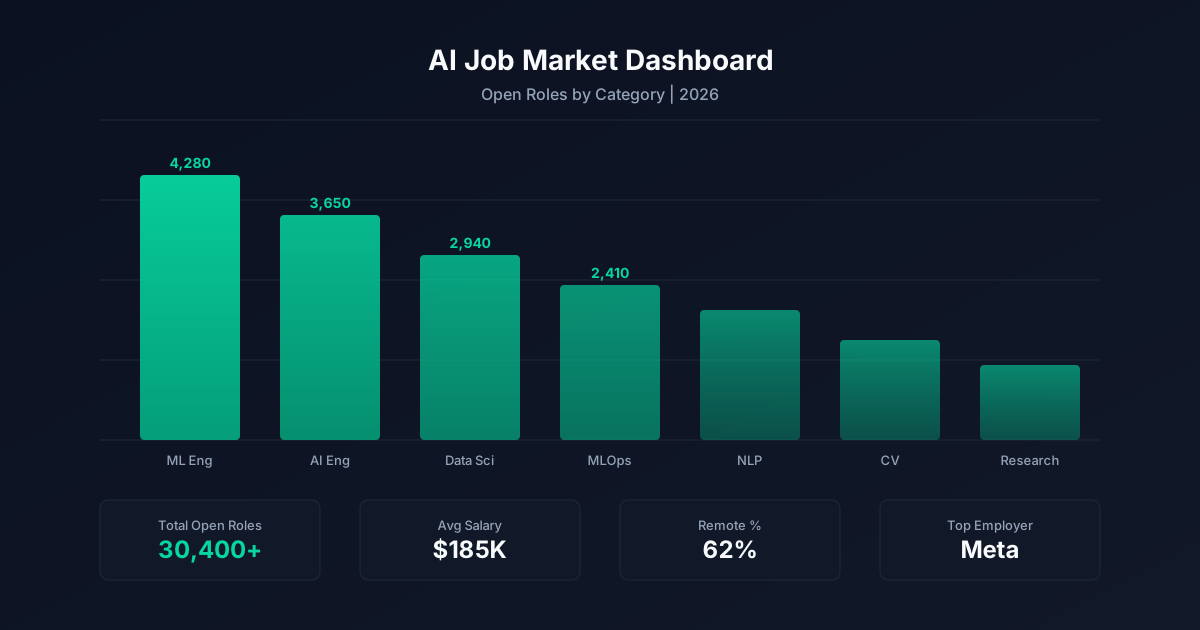
The AI job market has 3,708 open positions tracked in our dataset. By seniority: 102 entry-level, 1,705 mid-level, 1,469 senior, and 432 leadership roles (Director, VP, C-Level). Remote roles make up 14% of the market (508 positions). The remaining 3,180 roles require on-site or hybrid attendance.
The market median for AI roles is $217,500. Top-quartile compensation starts at $272,100. The 90th percentile reaches $325,000. Highest-paying categories: AI Safety ($300,000 median, 21 roles); Research Engineer ($280,000 median, 147 roles); AI Architect ($254,798 median, 67 roles).
Demand for AI/ML Engineers has been strong and consistent. Unlike some AI roles that spike with hype cycles, ML engineering is a foundational need. Every company deploying AI models needs people who can keep them running, and the gap between research prototypes and production systems keeps growing.
The AI Job Market Today
The AI job market spans 3,708 open positions across 16 role categories. The largest categories by volume: AI/ML Engineer (2,605), Data Scientist (310), AI Software Engineer (259). These three account for the majority of open positions, though smaller categories often have higher per-role compensation because of specialized skill requirements.
The seniority mix tells a story about where AI teams are in their maturity. Entry-level roles (102) are outnumbered by mid-level (1,705) and senior (1,469) positions, reflecting that most companies are past the 'build a team from scratch' phase and need experienced engineers who can ship production systems. Leadership roles (Director, VP, C-Level) total 432 positions, representing the bottleneck between technical execution and organizational strategy.
Remote work availability sits at 14% of all AI roles (508 positions), with 3,180 requiring on-site or hybrid attendance. The remote share has stabilized after the post-pandemic correction. Senior and specialized roles (Research Scientist, ML Architect) are more likely to be remote-eligible than entry-level positions, partly because experienced hires have more negotiating power and partly because these roles require less hands-on mentorship.
AI compensation is structured in clear tiers. The market median sits at $217,500. Top-quartile roles start at $272,100, and the 90th percentile reaches $325,000. These figures include base salary with disclosed compensation. Total compensation (including equity, bonuses, and sign-on) runs 20-40% higher at companies that offer those components.
Category matters for compensation. AI Safety roles lead at $300,000 median, while Prompt Engineer roles sit at $140,000. The spread between highest and lowest-paying categories reflects the premium on specialized technical skills versus broader analytical roles.
The most in-demand skills across all AI postings: Python (1,890 postings), Aws (1,103 postings), Azure (877 postings), Rag (855 postings), Gcp (631 postings), Prompt Engineering (560 postings), Pytorch (545 postings), Claude (498 postings). Python dominates, appearing in the vast majority of role descriptions regardless of category. Cloud platform experience (AWS, GCP, Azure) is the second most common requirement. The newer entrants to the top skills list (RAG, vector databases, LLM APIs) reflect the shift from traditional ML toward generative AI applications.
Frequently Asked Questions
Get Weekly AI Career Intelligence
Salary data, skills demand, and market signals from 16,000+ AI job postings. Every Monday.