
Interested in this AI Software Engineer role at EXPRESSION?
Apply Now →Skills & Technologies
About This Role
Expression is seeking an experienced Senior AI Software Engineer and Technical Lead to lead the development of a prototype platform that performs intelligent data processing, distributed inference, and resilient edge computing in communication\-constrained environments. The platform integrates software\-defined radio (SDR) technologies, edge AI, distributed systems, and modern software engineering practices to enable autonomous processing and decision support at the tactical edge.
The ideal candidate is an experienced hands\-on engineer who enjoys building complex systems from the ground up. You are equally comfortable designing system architecture, writing production\-quality code, integrating hardware and software components, and mentoring other engineers while remaining deeply involved in implementation.
Security Clearance: Eligible to obtain Secret or Top Secret Clearance (U.S citizenship required)
Responsibilities:
- Lead the technical architecture and implementation of an edge\-native intelligent processing platform supporting distributed sensing, edge inference, and resilient mission operations.
- Design scalable software architectures supporting heterogeneous edge computing devices, software\-defined radios, embedded compute platforms, and cloud\-enabled mission services.
- Develop high\-performance backend services using Python, FastAPI, asynchronous programming, and modern distributed software engineering techniques.
- Lead integration of Software Defined Radio (SDR) platforms (such as Ettus USRP, GNU Radio, or equivalent SDR ecosystems) into software pipelines for real\-time data processing and analytics.
- Design resilient distributed processing frameworks capable of operating under degraded, disconnected, intermittent, and bandwidth\-constrained communications.
- Develop intelligent data processing pipelines that reduce communication overhead through feature extraction, prioritization, and adaptive data management.
- Design peer\-to\-peer communication services supporting decentralized collaboration across heterogeneous edge devices.
- Implement secure synchronization, workload distribution, and fault\-tolerant processing across multiple edge computing nodes.
- Lead software integration across embedded Linux systems, containerized services, edge compute devices, and cloud infrastructure.
- Establish software architecture standards, CI/CD pipelines, testing frameworks, DevSecOps practices, and engineering best practices.
- Collaborate closely with AI engineers to integrate machine learning inference capabilities into production software.
- Produce technical documentation, software architecture artifacts, interface specifications, and engineering design documentation.
- Support technical demonstrations, customer engagements, and prototype evaluations.
- Mentor junior engineers while maintaining significant hands\-on software development responsibilities.
Required Qualifications:
- Bachelor degree in Computer Science, Software Engineering, Electrical Engineering, Data Science, or related fields. An advanced degree is preferred.
- 10\+ years of professional software engineering experience designing and building distributed software systems.
- Demonstrated experience serving as technical lead of complex software development efforts.
- Strong Python experience including, asyncio and asynchronous programming, FastAPI, Pydantic, type hinting, and modern development practices.
- Experience developing distributed systems, microservices, or event\-driven architectures.
- Proven experience implementing retrieval architectures.
- Experience deploying applications using Docker and cloud\-native services within AWS or Azure.
- Experience implementing CI/CD pipelines using GitLab CI, GitHub Actions, or similar automation platforms.
- Experience with Kubernetes, Infrastructure as Code (Terraform and Helm, or equivalent), and modern cloud\-native deployment practices.
- Experience integrating hardware and software systems.
- Experience designing resilient software systems capable of operating under degraded or intermittent network conditions.
- Strong written and verbal communication skills with the ability to produce technical documentation and communicate effectively with technical and executive stakeholders.
Preferred Qualifications:
- Experience with Software Defined Radio (GNU Radio, USRP, Ettus, SoapySDR, UHD, etc.)
- Experience developing edge computing applications.
- Experience with embedded Linux.
- Experience supporting DoD, Intelligence Community, or Federal programs.
- Experience with distributed data synchronization technologies.
- Experience with low\-latency data processing pipelines.
- Experience working with autonomous systems, ISR, electronic warfare, or sensor fusion applications.
- Experience integrating AI/ML inference into operational software systems.
- Experience supporting National Security or Federal Civilian customers.
Location: Hybrid or Remote with limited travel
Benefits:
Expression offers competitive salaries and benefits, such as:
- 401k matching
- PPO and HDHP medical/dental/vision insurance
- Education reimbursement up to $10,000/yr
- Complimentary life insurance
- Generous rollover PTO and 11 days of holiday leave
- Onsite gym facility and trainer
- Commuter Benefits Plan
- In\-office Cold Brew Coffee
About Expression:
Founded in 1997 and headquartered in Washington DC, Expression provides data fusion, data analytics, AI/ML, software engineering, information technology, and electromagnetic spectrum management solutions to the U.S. Department of Defense, Department of State, and national security community. Expression's culture focuses on creating immediate and sustainable value for our clients via agile delivery of tailored solutions built through constant engagement with our clients. Expression was ranked \#1 on the Washington Technology 2018's Fast 50 list of fastest\-growing small business Government contractors and a Top 20 Big Data Solutions Provider by CIO Review.
We make sure to provide everyone with the tools and opportunities to grow while working on some of the newest technologies in the industry. We get excited about celebrating our professionals' milestones, accomplishments, promotions, overcoming challenges, and many other aspects that make an engaging collaborative environment.
Equal Opportunity Employer/Veterans/Disabled
Salary Context
This $180K-$210K range is above the median for AI Software Engineer roles in our dataset (median: $183K across 194 roles with salary data).
Role Details
About This Role
AI Software Engineers build the applications and systems that AI models run inside. They own the API layers, data pipelines, frontend integrations, and infrastructure that turn a model into a product users interact with. Every AI company needs engineers who can build the software around the AI.
The challenge is building reliable systems around inherently unreliable components. Models are probabilistic. They'll give different answers to the same question. They hallucinate. They're slow. They're expensive. Your job is to build an application layer that handles all of this gracefully while delivering a product that users trust and enjoy.
Across the 3,708 AI roles we're tracking, AI Software Engineer positions make up 7% of the market. At EXPRESSION, this role fits into their broader AI and engineering organization.
AI Software Engineer roles are among the most numerous in the AI job market. Every company deploying AI needs software engineers who understand AI integration patterns. The demand is broad, spanning startups to enterprises, across every industry adopting AI capabilities.
What the Work Looks Like
A typical week includes: building API endpoints that serve model inference with caching and fallback logic, designing the data pipeline that feeds context to a RAG system, implementing streaming responses in the frontend, debugging a race condition in the async inference pipeline, and optimizing database queries for the vector search layer. It's full-stack engineering with AI at the center.
AI Software Engineer roles are among the most numerous in the AI job market. Every company deploying AI needs software engineers who understand AI integration patterns. The demand is broad, spanning startups to enterprises, across every industry adopting AI capabilities.
Skills Required
Full-stack engineering skills with AI integration experience. Python and TypeScript are the most common requirements. You'll need to understand API design, database architecture, and how to build reliable systems around probabilistic outputs. Experience with streaming, async processing, and caching patterns is increasingly important as real-time AI applications proliferate.
Knowledge of vector databases, embedding APIs, and LLM integration patterns (function calling, structured outputs, retry logic) differentiates AI software engineers from general software engineers. Understanding cost optimization (caching strategies, model routing, batched inference) is valuable since inference costs can dominate application economics.
Strong postings describe the product you'll be building, the AI integration patterns you'll work with, and the scale requirements. Look for companies that have existing AI features and need engineers to improve and expand them, not companies that are 'planning to add AI' someday.
Compensation Benchmarks
AI Software Engineer roles pay a median of $219,250 based on 424 positions with disclosed compensation. Senior-level AI roles across all categories have a median of $230,000. This role's midpoint ($195K) sits 11% below the category median. Disclosed range: $180K to $210K.
Across all AI roles, the market median is $217,500. Top-quartile compensation starts at $272,100. The 90th percentile reaches $325,000. For comparison, the highest-paying categories include AI Safety ($300,000) and Research Engineer ($280,000). By seniority level: Entry: $120,000; Mid: $200,000; Senior: $230,000; Director: $272,150; VP: $250,000.
EXPRESSION AI Hiring
EXPRESSION has 1 open AI role right now. They're hiring across AI Software Engineer. Based in Washington, DC, US. Compensation range: $210K - $210K.
Location Context
Across all AI roles, 14% (508 positions) offer remote work, while 3,180 require on-site attendance. Top AI hiring metros: New York (1,045 roles, $220,000 median); San Francisco (810 roles, $277,088 median); Los Angeles (397 roles, $215,000 median).
Career Path
Common paths into AI Software Engineer roles include Software Engineer, Full-Stack Developer, Backend Engineer.
From here, career progression typically leads toward Staff Engineer, AI Architect, Engineering Manager.
If you're a software engineer, you're already 80% there. Learn the AI integration patterns: RAG, streaming inference, function calling, structured outputs. Build a project that demonstrates you can wrap an AI model in a production-quality application with proper error handling, caching, and user experience. That's the portfolio piece that gets you hired.
What to Expect in Interviews
Technical screens look like standard software engineering interviews with an AI twist. Expect system design questions about building reliable applications around probabilistic models: handling streaming responses, implementing retry logic for API failures, and designing caching strategies for LLM outputs. Coding rounds test standard algorithms plus practical integration patterns like async processing and rate limiting.
When evaluating opportunities: Strong postings describe the product you'll be building, the AI integration patterns you'll work with, and the scale requirements. Look for companies that have existing AI features and need engineers to improve and expand them, not companies that are 'planning to add AI' someday.
AI Hiring Overview
The AI job market has 3,708 open positions tracked in our dataset. By seniority: 102 entry-level, 1,705 mid-level, 1,469 senior, and 432 leadership roles (Director, VP, C-Level). Remote roles make up 14% of the market (508 positions). The remaining 3,180 roles require on-site or hybrid attendance.
The market median for AI roles is $217,500. Top-quartile compensation starts at $272,100. The 90th percentile reaches $325,000. Highest-paying categories: AI Safety ($300,000 median, 21 roles); Research Engineer ($280,000 median, 147 roles); AI Architect ($254,798 median, 67 roles).
AI Software Engineer roles are among the most numerous in the AI job market. Every company deploying AI needs software engineers who understand AI integration patterns. The demand is broad, spanning startups to enterprises, across every industry adopting AI capabilities.
The AI Job Market Today
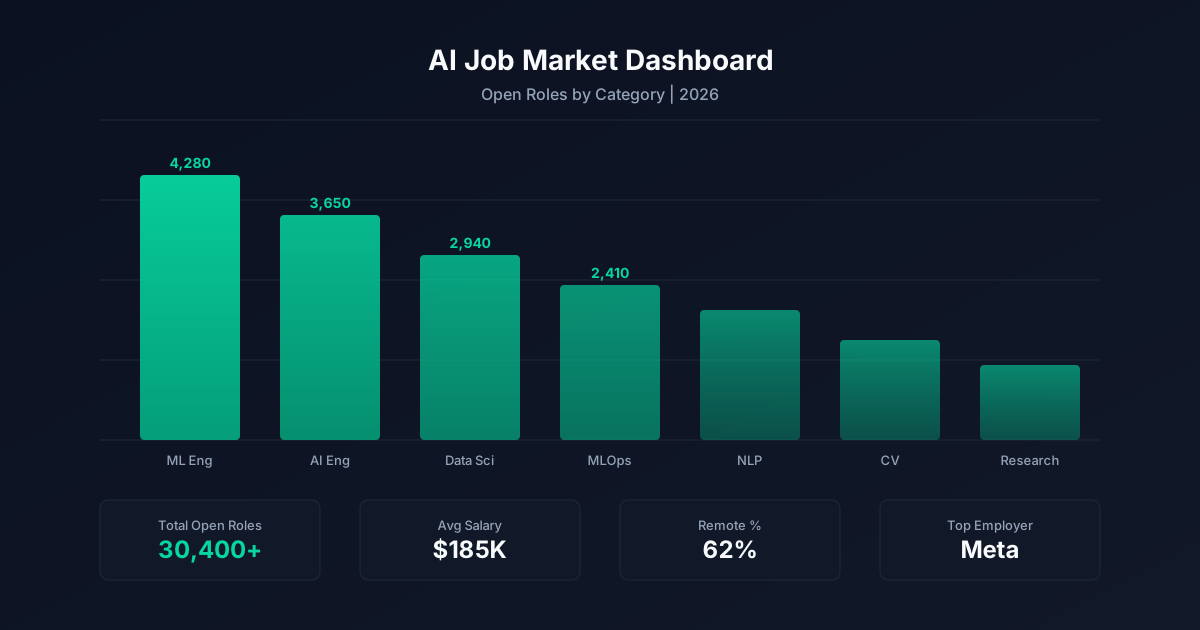
The AI job market spans 3,708 open positions across 16 role categories. The largest categories by volume: AI/ML Engineer (2,605), Data Scientist (310), AI Software Engineer (259). These three account for the majority of open positions, though smaller categories often have higher per-role compensation because of specialized skill requirements.
The seniority mix tells a story about where AI teams are in their maturity. Entry-level roles (102) are outnumbered by mid-level (1,705) and senior (1,469) positions, reflecting that most companies are past the 'build a team from scratch' phase and need experienced engineers who can ship production systems. Leadership roles (Director, VP, C-Level) total 432 positions, representing the bottleneck between technical execution and organizational strategy.
Remote work availability sits at 14% of all AI roles (508 positions), with 3,180 requiring on-site or hybrid attendance. The remote share has stabilized after the post-pandemic correction. Senior and specialized roles (Research Scientist, ML Architect) are more likely to be remote-eligible than entry-level positions, partly because experienced hires have more negotiating power and partly because these roles require less hands-on mentorship.
AI compensation is structured in clear tiers. The market median sits at $217,500. Top-quartile roles start at $272,100, and the 90th percentile reaches $325,000. These figures include base salary with disclosed compensation. Total compensation (including equity, bonuses, and sign-on) runs 20-40% higher at companies that offer those components.
Category matters for compensation. AI Safety roles lead at $300,000 median, while Prompt Engineer roles sit at $140,000. The spread between highest and lowest-paying categories reflects the premium on specialized technical skills versus broader analytical roles.
The most in-demand skills across all AI postings: Python (1,890 postings), Aws (1,103 postings), Azure (877 postings), Rag (855 postings), Gcp (631 postings), Prompt Engineering (560 postings), Pytorch (545 postings), Claude (498 postings). Python dominates, appearing in the vast majority of role descriptions regardless of category. Cloud platform experience (AWS, GCP, Azure) is the second most common requirement. The newer entrants to the top skills list (RAG, vector databases, LLM APIs) reflect the shift from traditional ML toward generative AI applications.
Frequently Asked Questions
Get Weekly AI Career Intelligence
Salary data, skills demand, and market signals from 16,000+ AI job postings. Every Monday.