
Interested in this AI Software Engineer role at FICO?
Apply Now →Skills & Technologies
About This Role
FICO (NYSE: FICO) is a leading global analytics software company, helping businesses in 100\+ countries make better decisions. Join our world\-class team today and fulfill your career potential!
The Opportunity
As a Principal Engineer on our Applied AI team, you will be at the forefront of building AI\-powered software that transforms how our platform operates. You will design, build, and maintain production\-grade applications and agentic systems — leveraging LLMs, agent SDKs, MCP\-based tooling, and modern AI frameworks — to power critical functions from fraud investigation and decision automation to process optimization and customer communications. In this role, you will uphold high standards of reliability, evaluation rigor, and responsible AI governance across all initiatives, shipping capabilities that make a lasting impact on FICO's platform. You will collaborate with a high\-caliber, multidisciplinary team and drive innovation through deep expertise in applied AI, software engineering, and systems design.
What You'll Contribute
- Design and build production AI systems — including agents, RAG pipelines, and LLM\-powered workflows — that integrate seamlessly into FICO's analytics and decision management platform.
- Translate product requirements into technical designs, balancing model capabilities, latency, cost, and reliability against real\-world business constraints.
- Develop robust evaluation frameworks and benchmarks to measure quality, safety, and regression across LLM\-based features, and use those signals to drive iterative improvement.
- Drive end\-to\-end delivery of AI features, including prompt and context engineering, tool/function design, writing reusable and well\-tested code, running offline and online evaluations, and communicating results to stakeholders.
- Build and operate the application layer around foundation models: orchestration, tool use, memory, retrieval, guardrails, observability, and human\-in\-the\-loop workflows.
- Fine\-tune, distill, and adapt open and closed foundation models when warranted, and align technical choices with FICO's product strategy and roadmap.
- Optimize inference performance, throughput, and cost across the serving stack — including caching, batching, routing, and model selection strategies.
- Apply modern AI engineering practices across heterogeneous infrastructure, from CPU\-bound orchestration services to GPU\-accelerated inference and training workloads.
What We're Seeking
- 12\+ years Software engineering experience, with a demonstrated track record of shipping complex, production\-grade systems and building applications powered by LLMs or other foundation models.
- Hands\-on experience designing and deploying LLM\-based features in production including prompt and context engineering, tool/function calling, agentic workflows, and evaluation\-driven iteration.
- Strong coding skills in Python and/or TypeScript, with experience using modern AI SDKs and frameworks (e.g., the Anthropic, OpenAI, or Google SDKs; LangChain, LlamaIndex, LangGraph; agent frameworks; MCP).
- Solid working knowledge of how foundation models behave in practice — including their capabilities and failure modes and experience with fine\-tuning, distillation, or model adaptation when product needs warrant it.
- In\-depth knowledge of architectural patterns of production LLM systems, including orchestration, tool use, memory, guardrails, observability, caching, and cost/latency optimization.
- Experience with embeddings and information retrieval; hands\-on experience with Retrieval\-Augmented Generation (RAG) architectures and vector stores (e.g., Pinecone, Weaviate, pgvector) is strongly preferred.
- Experience building offline and online evaluation pipelines for AI systems defining metrics, building eval sets, running A/B tests, and using signals to drive iterative improvement.
- Strong problem\-solving and communication skills, with the ability to mentor peers, influence technical direction, and collaborate effectively across engineering, product, and data science teams.
- Masters degree/Phd in Computer Science, a related technical field, or equivalent practical experience. Advanced degrees and open\-source contributions are a plus.
Our Offer to You
- An inclusive culture strongly reflecting our core values: Act Like an Owner, Delight Our Customers and Earn the Respect of Others.
- The opportunity to make an impact and develop professionally by leveraging your unique strengths and participating in valuable learning experiences.
- Highly competitive compensation, benefits and rewards programs that encourage you to bring your best every day and be recognized for doing so.
- An engaging, people\-first work environment offering work/life balance, employee resource groups, and social events to promote interaction and camaraderie.
- The targeted base pay range for this role is: $171,500 to $269,500 with this range reflecting differences in candidate knowledge, skills and experience.
\#LI\-RR1
\#LI\-remote
Why Make a Move to FICO?
At FICO, you can develop your career with a leading organization in one of the fastest\-growing fields in technology today – Big Data analytics. You’ll play a part in our commitment to help businesses use data to improve every choice they make, using advances in artificial intelligence, machine learning, optimization, and much more.
FICO makes a real difference in the way businesses operate worldwide:
- Credit Scoring — FICO® Scores are used by 90 of the top 100 US lenders.
- Fraud Detection and Security — 4 billion payment cards globally are protected by FICO fraud systems.
- Lending — 3/4 of US mortgages are approved using the FICO Score.
Global trends toward digital transformation have created tremendous demand for FICO’s solutions, placing us among the world’s top 100 software companies by revenue. We help many of the world’s largest banks, insurers, retailers, telecommunications providers and other firms reach a new level of success. Our success is dependent on really talented people – just like you – who thrive on the collaboration and innovation that’s nurtured by a diverse and inclusive environment. We’ll provide the support you need, while ensuring you have the freedom to develop your skills and grow your career. Join FICO and help change the way business thinks!
Learn more about how you can fulfil your potential at www.fico.com/Careers
FICO promotes a culture of inclusion and seeks to attract a diverse set of candidates for each job opportunity. We are an equal employment opportunity employer and we’re proud to offer employment and advancement opportunities to all candidates without regard to race, color, ancestry, religion, sex, national origin, pregnancy, sexual orientation, age, citizenship, marital status, disability, gender identity or Veteran status. Research has shown that women and candidates from underrepresented communities may not apply for an opportunity if they don’t meet all stated qualifications. While our qualifications are clearly related to role success, each candidate’s profile is unique and strengths in certain skill and/or experience areas can be equally effective. If you believe you have many, but not necessarily all, of the stated qualifications we encourage you to apply.
Information submitted with your application is subject to the FICO Privacy policy at https://www.fico.com/en/privacy\-policy
Salary Context
This $171K-$269K range is above the 75th percentile for AI Software Engineer roles in our dataset (median: $183K across 194 roles with salary data).
Role Details
About This Role
AI Software Engineers build the applications and systems that AI models run inside. They own the API layers, data pipelines, frontend integrations, and infrastructure that turn a model into a product users interact with. Every AI company needs engineers who can build the software around the AI.
The challenge is building reliable systems around inherently unreliable components. Models are probabilistic. They'll give different answers to the same question. They hallucinate. They're slow. They're expensive. Your job is to build an application layer that handles all of this gracefully while delivering a product that users trust and enjoy.
Across the 3,708 AI roles we're tracking, AI Software Engineer positions make up 7% of the market. At FICO, this role fits into their broader AI and engineering organization.
AI Software Engineer roles are among the most numerous in the AI job market. Every company deploying AI needs software engineers who understand AI integration patterns. The demand is broad, spanning startups to enterprises, across every industry adopting AI capabilities.
What the Work Looks Like
A typical week includes: building API endpoints that serve model inference with caching and fallback logic, designing the data pipeline that feeds context to a RAG system, implementing streaming responses in the frontend, debugging a race condition in the async inference pipeline, and optimizing database queries for the vector search layer. It's full-stack engineering with AI at the center.
AI Software Engineer roles are among the most numerous in the AI job market. Every company deploying AI needs software engineers who understand AI integration patterns. The demand is broad, spanning startups to enterprises, across every industry adopting AI capabilities.
Skills Required
Full-stack engineering skills with AI integration experience. Python and TypeScript are the most common requirements. You'll need to understand API design, database architecture, and how to build reliable systems around probabilistic outputs. Experience with streaming, async processing, and caching patterns is increasingly important as real-time AI applications proliferate.
Knowledge of vector databases, embedding APIs, and LLM integration patterns (function calling, structured outputs, retry logic) differentiates AI software engineers from general software engineers. Understanding cost optimization (caching strategies, model routing, batched inference) is valuable since inference costs can dominate application economics.
Strong postings describe the product you'll be building, the AI integration patterns you'll work with, and the scale requirements. Look for companies that have existing AI features and need engineers to improve and expand them, not companies that are 'planning to add AI' someday.
Compensation Benchmarks
AI Software Engineer roles pay a median of $219,250 based on 424 positions with disclosed compensation. Senior-level AI roles across all categories have a median of $230,000. Disclosed range: $171K to $269K.
Across all AI roles, the market median is $217,500. Top-quartile compensation starts at $272,100. The 90th percentile reaches $325,000. For comparison, the highest-paying categories include AI Safety ($300,000) and Research Engineer ($280,000). By seniority level: Entry: $120,000; Mid: $200,000; Senior: $230,000; Director: $272,150; VP: $250,000.
FICO AI Hiring
FICO has 2 open AI roles right now. They're hiring across MLOps Engineer, AI Software Engineer. Based in Remote, US. Compensation range: $220K - $269K.
Remote Work Context
Remote AI roles pay a median of $185,334 across 717 positions. About 14% of all AI roles offer remote work.
Career Path
Common paths into AI Software Engineer roles include Software Engineer, Full-Stack Developer, Backend Engineer.
From here, career progression typically leads toward Staff Engineer, AI Architect, Engineering Manager.
If you're a software engineer, you're already 80% there. Learn the AI integration patterns: RAG, streaming inference, function calling, structured outputs. Build a project that demonstrates you can wrap an AI model in a production-quality application with proper error handling, caching, and user experience. That's the portfolio piece that gets you hired.
What to Expect in Interviews
Technical screens look like standard software engineering interviews with an AI twist. Expect system design questions about building reliable applications around probabilistic models: handling streaming responses, implementing retry logic for API failures, and designing caching strategies for LLM outputs. Coding rounds test standard algorithms plus practical integration patterns like async processing and rate limiting.
When evaluating opportunities: Strong postings describe the product you'll be building, the AI integration patterns you'll work with, and the scale requirements. Look for companies that have existing AI features and need engineers to improve and expand them, not companies that are 'planning to add AI' someday.
AI Hiring Overview
The AI job market has 3,708 open positions tracked in our dataset. By seniority: 102 entry-level, 1,705 mid-level, 1,469 senior, and 432 leadership roles (Director, VP, C-Level). Remote roles make up 14% of the market (508 positions). The remaining 3,180 roles require on-site or hybrid attendance.
The market median for AI roles is $217,500. Top-quartile compensation starts at $272,100. The 90th percentile reaches $325,000. Highest-paying categories: AI Safety ($300,000 median, 21 roles); Research Engineer ($280,000 median, 147 roles); AI Architect ($254,798 median, 67 roles).
AI Software Engineer roles are among the most numerous in the AI job market. Every company deploying AI needs software engineers who understand AI integration patterns. The demand is broad, spanning startups to enterprises, across every industry adopting AI capabilities.
The AI Job Market Today
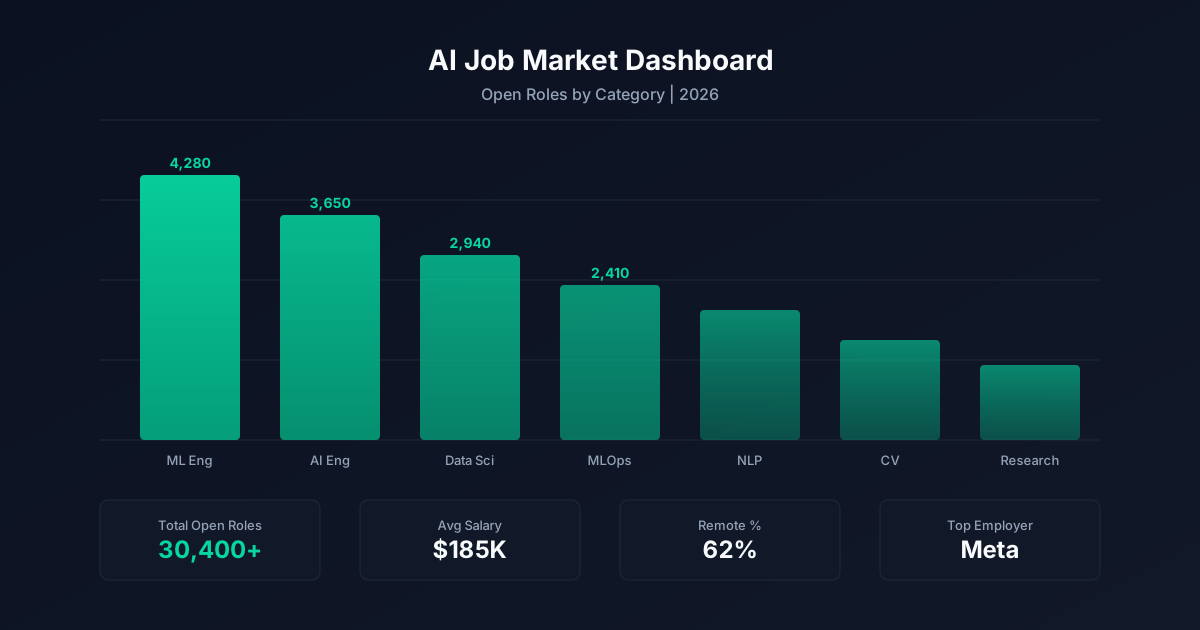
The AI job market spans 3,708 open positions across 16 role categories. The largest categories by volume: AI/ML Engineer (2,605), Data Scientist (310), AI Software Engineer (259). These three account for the majority of open positions, though smaller categories often have higher per-role compensation because of specialized skill requirements.
The seniority mix tells a story about where AI teams are in their maturity. Entry-level roles (102) are outnumbered by mid-level (1,705) and senior (1,469) positions, reflecting that most companies are past the 'build a team from scratch' phase and need experienced engineers who can ship production systems. Leadership roles (Director, VP, C-Level) total 432 positions, representing the bottleneck between technical execution and organizational strategy.
Remote work availability sits at 14% of all AI roles (508 positions), with 3,180 requiring on-site or hybrid attendance. The remote share has stabilized after the post-pandemic correction. Senior and specialized roles (Research Scientist, ML Architect) are more likely to be remote-eligible than entry-level positions, partly because experienced hires have more negotiating power and partly because these roles require less hands-on mentorship.
AI compensation is structured in clear tiers. The market median sits at $217,500. Top-quartile roles start at $272,100, and the 90th percentile reaches $325,000. These figures include base salary with disclosed compensation. Total compensation (including equity, bonuses, and sign-on) runs 20-40% higher at companies that offer those components.
Category matters for compensation. AI Safety roles lead at $300,000 median, while Prompt Engineer roles sit at $140,000. The spread between highest and lowest-paying categories reflects the premium on specialized technical skills versus broader analytical roles.
The most in-demand skills across all AI postings: Python (1,890 postings), Aws (1,103 postings), Azure (877 postings), Rag (855 postings), Gcp (631 postings), Prompt Engineering (560 postings), Pytorch (545 postings), Claude (498 postings). Python dominates, appearing in the vast majority of role descriptions regardless of category. Cloud platform experience (AWS, GCP, Azure) is the second most common requirement. The newer entrants to the top skills list (RAG, vector databases, LLM APIs) reflect the shift from traditional ML toward generative AI applications.
Frequently Asked Questions
Get Weekly AI Career Intelligence
Salary data, skills demand, and market signals from 16,000+ AI job postings. Every Monday.