
Interested in this Data Engineer role at Google?
Apply Now →Skills & Technologies
About This Role
Applicants in San Francisco: Qualified applications with arrest or conviction records will be considered for employment in accordance with the San Francisco Fair Chance Ordinance for Employers and the California Fair Chance Act.
Note: By applying to this position you will have an opportunity to share your preferred working location from the following: New York, NY, USA; Mountain View, CA, USA; San Francisco, CA, USA.### Minimum qualifications:
- Bachelor's degree in Computer Science, a related technical field, or equivalent practical experience.
- 1 year of experience designing data pipelines (ETL) and model data.
- Experience analyzing data and creating reports, and with database query (e.g., SQL) and visualization tools (e.g., Tableau, dashboards).
- Experience with one or more general purpose programming languages (e.g., Python, C/C\+\+, Java).
### Preferred qualifications:
- Experience working in a data science environment, supporting feature engineering and model automation needs.
- Experience working with big data tools, distributed computing and non\-relational databases.
- Structured thinking with ability to easily break down ambiguous problems and propose impactful data modeling designs.
- Passion for analyzing large and complex data sets and converting them into the information which drive business decisions.
About the job
-----------------
The GCS Data Science team is working on challenging yet interesting problems for the GCS (Google Customer Solutions) division of Global Business Organization (GBO). Our goal is to build efficient and scalable ML models that help small and midsize businesses around the world to grow their business leveraging the power of Google solutions.
The Data Science Engineering (DSet) subteam is responsible for supporting data engineering needs for the GCS Data Science teams including building new data pipelines, automation, observability and reporting tools.
As a Data Engineer, you will take on big data challenges in an agile way. In this role, you will use an analytical, data\-driven approach to drive a deep understanding of our fast changing business. You will build data pipelines and reporting tools that enable our data scientists, through feature engineering, automated data extracts and wrangling needs, and scaled insights for both the data science team and our users.
Google Customer Solutions (GCS) sales teams are trusted advisors and competitive sellers who maintain a relentless focus on customer success by bringing the best Google has to offer to small\- and medium\-sized businesses (SMBs), which are the backbone of our communities. As a member of our team, you’ll have the opportunity to work with company owners and make a real difference in their businesses by helping them grow. Together, we help shape the future of innovation for customers, partners, and sellers...and we have fun doing it.
Individual pay is determined by factors including job\-related skills, experience, and relevant education or training.
US: $106000 \- $151000 (USD) \+ 15% bonus target \+ equity \+ benefits
Learn more about benefits at Google.Responsibilities
--------------------
- Build data pipelines, reports, best practices and frameworks that enable analysts and other stakeholders across the organization.
- Use feature engineering to support data needs for ML/AI model development and subsequent scaling through ETL pipeline development.
- Recognize and adopt best practices in developing pipelines, analytical insights including data integrity, test design, analysis, validation and documentation.
- Design and develop scalable and actionable solutions (dashboards, automated collateral, web applications) that tell a story and provide insights to help our advertisers grow.
- Work closely with various stakeholders to understand feature/tooling gaps and innovate on behalf of our customers.
Google is proud to be an equal opportunity workplace and is an affirmative action employer. We are committed to equal employment opportunity regardless of race, color, ancestry, religion, sex, national origin, sexual orientation, age, citizenship, marital status, disability, gender identity or Veteran status. We also consider qualified applicants regardless of criminal histories, consistent with legal requirements. See also Google's EEO Policy and EEO is the Law. If you have a disability or special need that requires accommodation, please let us know by completing our Accommodations for Applicants form.
Salary Context
This $106K-$151K range is below the median for Data Engineer roles in our dataset (median: $150K across 15 roles with salary data).
Role Details
About This Role
Data Engineers build the pipelines that feed AI models. They design ETL workflows, manage data lakes, and ensure training and inference data is clean, timely, and accessible. Without good data engineering, AI projects fail. It's that simple.
The AI era has expanded the data engineer's scope far beyond batch ETL jobs. You're building real-time embedding pipelines for RAG systems, managing vector databases, ensuring training data quality at scale, and building the infrastructure that lets ML teams iterate on data as fast as they iterate on models. Data quality is the biggest predictor of model quality, and you're the person responsible for it.
Across the 3,708 AI roles we're tracking, Data Engineer positions make up 1% of the market. At Google, this role fits into their broader AI and engineering organization.
Data Engineer demand in AI contexts is strong and growing. Every company building AI needs clean, reliable data pipelines. The shift toward real-time AI applications (chatbots, recommendation engines, agent systems) means data engineering is more critical than ever. Companies are willing to pay premium salaries for data engineers with AI/ML pipeline experience.
What the Work Looks Like
A typical week includes: debugging a data pipeline that's producing stale embeddings for the RAG system, optimizing a Spark job that processes training data, building a data quality monitoring dashboard, meeting with the ML team to understand their next data requirements, and writing dbt models that transform raw event data into ML-ready features. The work is deeply technical and high-impact.
Data Engineer demand in AI contexts is strong and growing. Every company building AI needs clean, reliable data pipelines. The shift toward real-time AI applications (chatbots, recommendation engines, agent systems) means data engineering is more critical than ever. Companies are willing to pay premium salaries for data engineers with AI/ML pipeline experience.
Skills Required
SQL, Python, and distributed systems (Spark, Airflow, dbt) are core. Cloud data platforms (Snowflake, BigQuery, Redshift) are increasingly standard. Many AI-focused roles also want familiarity with vector databases and embedding pipelines. Understanding data modeling, pipeline orchestration, and data quality frameworks covers the essentials.
AI-specific data engineering skills include: building feature stores, managing training data versioning, implementing data lineage tracking, and building real-time embedding pipelines. Experience with streaming systems (Kafka, Flink) is valuable for real-time AI applications. Understanding ML data requirements (balanced datasets, data augmentation, evaluation set construction) makes you much more effective working with ML teams.
Strong postings specify the data stack, mention ML pipeline work, and describe the scale of data you'll be working with. Look for companies that understand the connection between data quality and model quality. Avoid roles that conflate data engineering with data analysis.
Compensation Benchmarks
Data Engineer roles pay a median of $178,800 based on 40 positions with disclosed compensation. Mid-level AI roles across all categories have a median of $200,000. This role's midpoint ($128K) sits 28% below the category median. Disclosed range: $106K to $151K.
Across all AI roles, the market median is $217,500. Top-quartile compensation starts at $272,100. The 90th percentile reaches $325,000. For comparison, the highest-paying categories include AI Safety ($300,000) and Research Engineer ($280,000). By seniority level: Entry: $120,000; Mid: $200,000; Senior: $230,000; Director: $272,150; VP: $250,000.
Google AI Hiring
Google has 126 open AI roles right now. They're hiring across Data Scientist, AI/ML Engineer, AI Product Manager, AI Software Engineer. Positions span Mountain View, CA, US, New York, NY, US, Boulder, CO, US. Compensation range: $151K - $428K.
Location Context
AI roles in New York pay a median of $220,000 across 1,045 tracked positions.
Career Path
Common paths into Data Engineer roles include Backend Engineer, Database Administrator, Analytics Engineer.
From here, career progression typically leads toward Senior Data Engineer, ML Engineer, Data Platform Lead.
Master SQL and Python first. Then learn a distributed processing framework (Spark or its modern alternatives) and a pipeline orchestrator (Airflow, Dagster, Prefect). Build a portfolio project that demonstrates end-to-end pipeline construction: ingest, transform, validate, serve. If you want to specialize in AI data engineering, add vector databases and embedding pipelines to your skill set.
What to Expect in Interviews
Expect SQL deep-dives (query optimization, partitioning strategies, data modeling), Python coding focused on data pipeline patterns, and system design questions about building scalable ETL workflows. Companies with ML teams will ask about feature stores, embedding pipelines, and training data management. Be ready to discuss data quality monitoring, pipeline orchestration, and how you'd handle schema evolution in a production data lake.
When evaluating opportunities: Strong postings specify the data stack, mention ML pipeline work, and describe the scale of data you'll be working with. Look for companies that understand the connection between data quality and model quality. Avoid roles that conflate data engineering with data analysis.
AI Hiring Overview
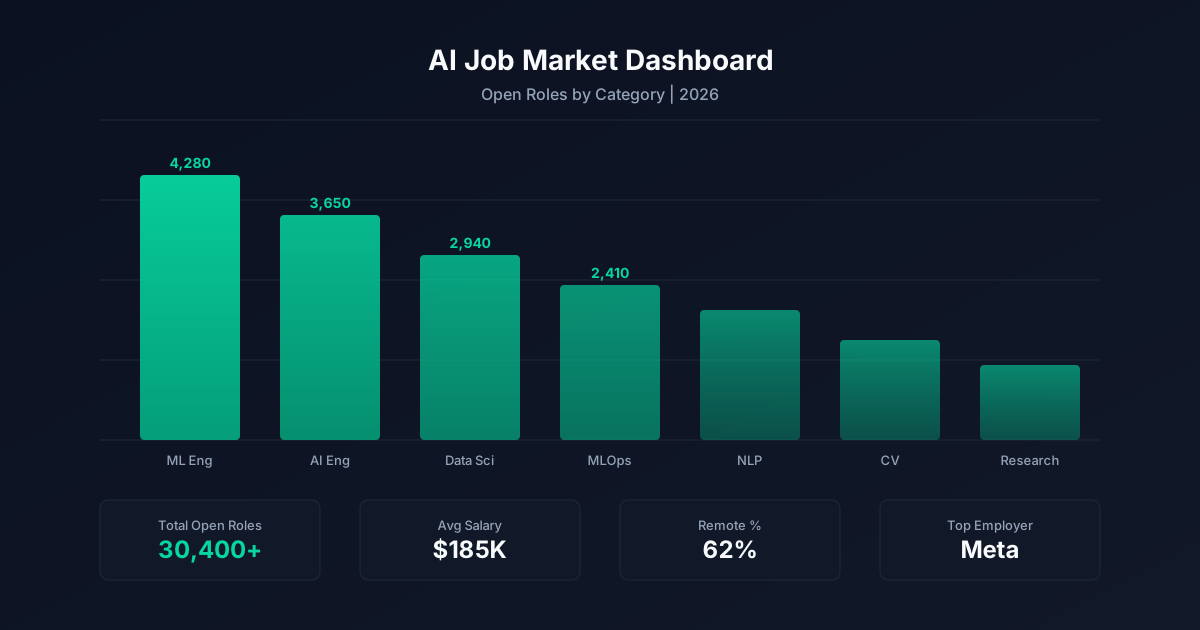
The AI job market has 3,708 open positions tracked in our dataset. By seniority: 102 entry-level, 1,705 mid-level, 1,469 senior, and 432 leadership roles (Director, VP, C-Level). Remote roles make up 14% of the market (508 positions). The remaining 3,180 roles require on-site or hybrid attendance.
The market median for AI roles is $217,500. Top-quartile compensation starts at $272,100. The 90th percentile reaches $325,000. Highest-paying categories: AI Safety ($300,000 median, 21 roles); Research Engineer ($280,000 median, 147 roles); AI Architect ($254,798 median, 67 roles).
Data Engineer demand in AI contexts is strong and growing. Every company building AI needs clean, reliable data pipelines. The shift toward real-time AI applications (chatbots, recommendation engines, agent systems) means data engineering is more critical than ever. Companies are willing to pay premium salaries for data engineers with AI/ML pipeline experience.
The AI Job Market Today
The AI job market spans 3,708 open positions across 16 role categories. The largest categories by volume: AI/ML Engineer (2,605), Data Scientist (310), AI Software Engineer (259). These three account for the majority of open positions, though smaller categories often have higher per-role compensation because of specialized skill requirements.
The seniority mix tells a story about where AI teams are in their maturity. Entry-level roles (102) are outnumbered by mid-level (1,705) and senior (1,469) positions, reflecting that most companies are past the 'build a team from scratch' phase and need experienced engineers who can ship production systems. Leadership roles (Director, VP, C-Level) total 432 positions, representing the bottleneck between technical execution and organizational strategy.
Remote work availability sits at 14% of all AI roles (508 positions), with 3,180 requiring on-site or hybrid attendance. The remote share has stabilized after the post-pandemic correction. Senior and specialized roles (Research Scientist, ML Architect) are more likely to be remote-eligible than entry-level positions, partly because experienced hires have more negotiating power and partly because these roles require less hands-on mentorship.
AI compensation is structured in clear tiers. The market median sits at $217,500. Top-quartile roles start at $272,100, and the 90th percentile reaches $325,000. These figures include base salary with disclosed compensation. Total compensation (including equity, bonuses, and sign-on) runs 20-40% higher at companies that offer those components.
Category matters for compensation. AI Safety roles lead at $300,000 median, while Prompt Engineer roles sit at $140,000. The spread between highest and lowest-paying categories reflects the premium on specialized technical skills versus broader analytical roles.
The most in-demand skills across all AI postings: Python (1,890 postings), Aws (1,103 postings), Azure (877 postings), Rag (855 postings), Gcp (631 postings), Prompt Engineering (560 postings), Pytorch (545 postings), Claude (498 postings). Python dominates, appearing in the vast majority of role descriptions regardless of category. Cloud platform experience (AWS, GCP, Azure) is the second most common requirement. The newer entrants to the top skills list (RAG, vector databases, LLM APIs) reflect the shift from traditional ML toward generative AI applications.
Frequently Asked Questions
Get Weekly AI Career Intelligence
Salary data, skills demand, and market signals from 16,000+ AI job postings. Every Monday.