
Interested in this AI Software Engineer role at Guidehouse?
Apply Now →Skills & Technologies
About This Role
Job Family:
Software Development \& Support Travel Required:
None Clearance Required:
Ability to Obtain Public Trust
Guidehouse Technology is seeking a motivated AI Software Engineer to join our growing team supporting federal clients. This role is ideal for an early\- to mid\-career technologist who is passionate about building secure, scalable, user\-centric AI\-enabled solutions that address complex government mission challenges.
What You Will Do
You will contribute to the design, development, testing, and deployment of full\-stack web applications on AWS, integrating workflow orchestration, relational data systems, analytics, and accessible user interfaces. Working with cross\-functional teams—including senior engineers, data scientists, product managers, and mission stakeholders—you will help deliver high\-impact solutions that combine modern engineering practices with Artificial Intelligence capabilities.
This role emphasizes strong engineering fundamentals, hands\-on development, collaboration, continuous learning, and responsible use of Generative AI–assisted coding tools to accelerate development, improve quality, and enhance delivery velocity.
- Contribute to the design, development, testing, and deployment of AI\-enabled full\-stack web applications deployed on AWS.
- Develop and maintain application components spanning frontend interfaces, backend services, APIs, workflow orchestration, and relational database layers.
- Build and enhance accessible, user\-friendly web interfaces using ReactJS and related frontend technologies, supporting Section 508 and usability standards.
- Develop backend services using Java or Python, including RESTful APIs, business logic, integrations, unit tests, and support for microservices\-based architectures.
- Support the design and maintenance of RDBMS\-based data models and SQL queries using technologies such as PostgreSQL, MySQL, or Amazon Aurora.
- Implement workflow and process automation capabilities to support business and mission operations.
- Develop data visualization and analytics features, including dashboards, charts, reports, and interactive UI components that support decision\-making.
- Support implementation of AI\-enabled features such as intelligent search, chatbots, document processing, summarization, semantic search, or agent\-assisted workflows.
- Use Generative AI–assisted development tools, such as GitHub Copilot, Cursor, or Claude Code, for code generation, debugging, testing, refactoring, and documentation while following code quality and security practices.
- Participate in a SAFe (Scaled Agile Framework) or Agile delivery environment, contributing to sprint planning, backlog refinement, demos, retrospectives, and cross\-team coordination.
- Support DevSecOps practices by using application security tools and processes, including SAST, DAST, SCA, dependency scanning, container scanning, and vulnerability remediation.
- Contribute to CI/CD pipeline activities, including automated testing, security scanning, deployment automation, and compliance checks.
- Participate in code reviews, technical design discussions, troubleshooting, documentation, and peer collaboration to improve software quality and maintainability.
- Collaborate with cross\-functional teams to prototype, iterate, and deliver scalable, secure, and maintainable solutions aligned to mission requirements.
What You Will Need
- Must be able to OBTAIN and MAINTAIN a Federal or DoD "PUBLIC TRUST"; candidates must obtain approved adjudication of their PUBLIC TRUST prior to onboarding with Guidehouse. Candidates with an ACTIVE PUBLIC TRUST or SUITABILITY are preferred.
- Bachelor’s degree in Computer Science, Engineering, Data Science, Information Systems, or a related technical field, OR Additional FOUR (4\) years experience in lieu of Degree.
- Minimum of TWO (2\) years of professional software engineering experience, or a combination of professional experience, internships, academic projects, bootcamp experience, or equivalent hands\-on development experience.
- Working proficiency in Java or Python for backend development, including object\-oriented programming, debugging, automated testing, and API development.
- Hands\-on experience with ReactJS, JavaScript, HTML, and CSS for modern frontend application development.
- Experience or strong familiarity with building and deploying applications in cloud environments, preferably AWS.
- Experience with RESTful APIs, version control using Git, collaborative development workflows, and basic microservices or distributed application concepts.
- Experience with relational databases and SQL, such as PostgreSQL, MySQL, or Amazon Aurora.
- Familiarity with accessibility principles and web interface development aligned with Section 508 and usability standards.
- Interest in and practical exposure to AI\-enabled software capabilities such as intelligent search, chatbots, document processing, analytics, summarization, or workflow automation.
- Hands\-on experience using or willingness to use Generative AI–assisted coding tools to support development, testing, refactoring, and documentation.
- Basic understanding of secure coding, automated testing, CI/CD, DevSecOps, and application security concepts.
- Ability to work effectively in an Agile or SAFe team environment and contribute to sprint\-based delivery activities.
- Strong analytical, problem\-solving, communication, and collaboration skills, with the ability to work independently on assigned tasks and seek guidance when needed.
What Would Be Nice to Have
- Experience developing AI/ML\-enabled applications, such as Retrieval\-Augmented Generation (RAG), chatbots, semantic search, summarization, document processing, or agentic workflows.
- Familiarity with AI frameworks or libraries such as LangChain, Haystack, Semantic Kernel, OpenAI\-compatible APIs, or similar tools.
- Experience with AWS services such as Lambda, ECS/Fargate, API Gateway, Step Functions, S3, Glue, CloudWatch, IAM, or Amazon Bedrock.
- Exposure to modern data architectures, including data lakes, lakehouse patterns, federated query engines, or analytics platforms.
- Experience with data visualization tools and libraries, such as D3\.js, Plotly, Tableau, Amazon QuickSight, or similar.
- Familiarity with Infrastructure as Code tools such as Terraform, AWS CDK, or CloudFormation.
- Awareness of federal security and compliance standards, including FISMA, FedRAMP, NIST 800\-53, or secure software development practices.
- Exposure to application security and DevSecOps tools, including SAST, DAST, software composition analysis, dependency scanning, or container scanning.
- SAFe, Agile, AWS, security, or AI\-related training or certifications.
- Demonstrated curiosity, adaptability, and commitment to continuous learning in AI\-enabled, cloud\-native software development.
The annual salary range for this position is $74,000\.00\-$124,000\.00\. Compensation decisions depend on a wide range of factors, including but not limited to skill sets, experience and training, security clearances, licensure and certifications, and other business and organizational needs. What We Offer:
Guidehouse offers a comprehensive, total rewards package that includes competitive compensation and a flexible benefits package that reflects our commitment to creating a diverse and supportive workplace.
Benefits include:
- Medical, Rx, Dental \& Vision Insurance
- Personal and Family Sick Time \& Company Paid Holidays
- Parental Leave
- 401(k) Retirement Plan
- Group Term Life and Travel Assistance
- Voluntary Life and AD\&D Insurance
- Health Savings Account, Health Care \& Dependent Care Flexible Spending Accounts
- Transit and Parking Commuter Benefits
- Short\-Term \& Long\-Term Disability
- Tuition Reimbursement, Personal Development, Certifications \& Learning Opportunities
- Employee Referral Program
- Corporate Sponsored Events \& Community Outreach
- Care.com annual membership
- Employee Assistance Program
- Supplemental Benefits via Corestream (Critical Care, Hospital Indemnity, Accident Insurance, Legal Assistance and ID theft protection, etc.)
- Position may be eligible for a discretionary variable incentive bonus
About Guidehouse
Guidehouse is an Equal Opportunity Employer–Protected Veterans, Individuals with Disabilities or any other basis protected by law, ordinance, or regulation.
Guidehouse will consider for employment qualified applicants with criminal histories in a manner consistent with the requirements of applicable law or ordinance including the Fair Chance Ordinance of Los Angeles and San Francisco.
If you have visited our website for information about employment opportunities, or to apply for a position, and you require an accommodation, please contact Guidehouse Recruiting at 1\-571\-633\-1711 or via email at RecruitingAccommodation@guidehouse.com. All information you provide will be kept confidential and will be used only to the extent required to provide needed reasonable accommodation.
All communication regarding recruitment for a Guidehouse position will be sent from Guidehouse email domains including @guidehouse.com or guidehouse@myworkday.com. Correspondence received by an applicant from any other domain should be considered unauthorized and will not be honored by Guidehouse. Note that Guidehouse will never charge a fee or require a money transfer at any stage of the recruitment process and does not collect fees from educational institutions for participation in a recruitment event. Never provide your banking information to a third party purporting to need that information to proceed in the hiring process.
If any person or organization demands money related to a job opportunity with Guidehouse, please report the matter to Guidehouse’s Ethics Hotline. If you want to check the validity of correspondence you have received, please contact recruiting@guidehouse.com. Guidehouse is not responsible for losses incurred (monetary or otherwise) from an applicant’s dealings with unauthorized third parties.
*Guidehouse does not accept unsolicited resumes through or from search firms or staffing agencies. All unsolicited resumes will be considered the property of Guidehouse and Guidehouse will not be obligated to pay a placement fee.*
Salary Context
This $74K-$124K range is in the lower quartile for AI Software Engineer roles in our dataset (median: $183K across 194 roles with salary data).
Role Details
About This Role
AI Software Engineers build the applications and systems that AI models run inside. They own the API layers, data pipelines, frontend integrations, and infrastructure that turn a model into a product users interact with. Every AI company needs engineers who can build the software around the AI.
The challenge is building reliable systems around inherently unreliable components. Models are probabilistic. They'll give different answers to the same question. They hallucinate. They're slow. They're expensive. Your job is to build an application layer that handles all of this gracefully while delivering a product that users trust and enjoy.
Across the 3,708 AI roles we're tracking, AI Software Engineer positions make up 7% of the market. At Guidehouse, this role fits into their broader AI and engineering organization.
AI Software Engineer roles are among the most numerous in the AI job market. Every company deploying AI needs software engineers who understand AI integration patterns. The demand is broad, spanning startups to enterprises, across every industry adopting AI capabilities.
What the Work Looks Like
A typical week includes: building API endpoints that serve model inference with caching and fallback logic, designing the data pipeline that feeds context to a RAG system, implementing streaming responses in the frontend, debugging a race condition in the async inference pipeline, and optimizing database queries for the vector search layer. It's full-stack engineering with AI at the center.
AI Software Engineer roles are among the most numerous in the AI job market. Every company deploying AI needs software engineers who understand AI integration patterns. The demand is broad, spanning startups to enterprises, across every industry adopting AI capabilities.
Skills Required
Full-stack engineering skills with AI integration experience. Python and TypeScript are the most common requirements. You'll need to understand API design, database architecture, and how to build reliable systems around probabilistic outputs. Experience with streaming, async processing, and caching patterns is increasingly important as real-time AI applications proliferate.
Knowledge of vector databases, embedding APIs, and LLM integration patterns (function calling, structured outputs, retry logic) differentiates AI software engineers from general software engineers. Understanding cost optimization (caching strategies, model routing, batched inference) is valuable since inference costs can dominate application economics.
Strong postings describe the product you'll be building, the AI integration patterns you'll work with, and the scale requirements. Look for companies that have existing AI features and need engineers to improve and expand them, not companies that are 'planning to add AI' someday.
Compensation Benchmarks
AI Software Engineer roles pay a median of $219,250 based on 424 positions with disclosed compensation. Mid-level AI roles across all categories have a median of $200,000. This role's midpoint ($99K) sits 55% below the category median. Disclosed range: $74K to $124K.
Across all AI roles, the market median is $217,500. Top-quartile compensation starts at $272,100. The 90th percentile reaches $325,000. For comparison, the highest-paying categories include AI Safety ($300,000) and Research Engineer ($280,000). By seniority level: Entry: $120,000; Mid: $200,000; Senior: $230,000; Director: $272,150; VP: $250,000.
Guidehouse AI Hiring
Guidehouse has 6 open AI roles right now. They're hiring across Data Engineer, AI/ML Engineer, AI Software Engineer, Data Scientist. Positions span New York, NY, US, Chicago, IL, US, Washington, DC, US. Compensation range: $124K - $216K.
Location Context
Across all AI roles, 14% (508 positions) offer remote work, while 3,180 require on-site attendance. Top AI hiring metros: New York (1,045 roles, $220,000 median); San Francisco (810 roles, $277,088 median); Los Angeles (397 roles, $215,000 median).
Career Path
Common paths into AI Software Engineer roles include Software Engineer, Full-Stack Developer, Backend Engineer.
From here, career progression typically leads toward Staff Engineer, AI Architect, Engineering Manager.
If you're a software engineer, you're already 80% there. Learn the AI integration patterns: RAG, streaming inference, function calling, structured outputs. Build a project that demonstrates you can wrap an AI model in a production-quality application with proper error handling, caching, and user experience. That's the portfolio piece that gets you hired.
What to Expect in Interviews
Technical screens look like standard software engineering interviews with an AI twist. Expect system design questions about building reliable applications around probabilistic models: handling streaming responses, implementing retry logic for API failures, and designing caching strategies for LLM outputs. Coding rounds test standard algorithms plus practical integration patterns like async processing and rate limiting.
When evaluating opportunities: Strong postings describe the product you'll be building, the AI integration patterns you'll work with, and the scale requirements. Look for companies that have existing AI features and need engineers to improve and expand them, not companies that are 'planning to add AI' someday.
AI Hiring Overview
The AI job market has 3,708 open positions tracked in our dataset. By seniority: 102 entry-level, 1,705 mid-level, 1,469 senior, and 432 leadership roles (Director, VP, C-Level). Remote roles make up 14% of the market (508 positions). The remaining 3,180 roles require on-site or hybrid attendance.
The market median for AI roles is $217,500. Top-quartile compensation starts at $272,100. The 90th percentile reaches $325,000. Highest-paying categories: AI Safety ($300,000 median, 21 roles); Research Engineer ($280,000 median, 147 roles); AI Architect ($254,798 median, 67 roles).
AI Software Engineer roles are among the most numerous in the AI job market. Every company deploying AI needs software engineers who understand AI integration patterns. The demand is broad, spanning startups to enterprises, across every industry adopting AI capabilities.
The AI Job Market Today
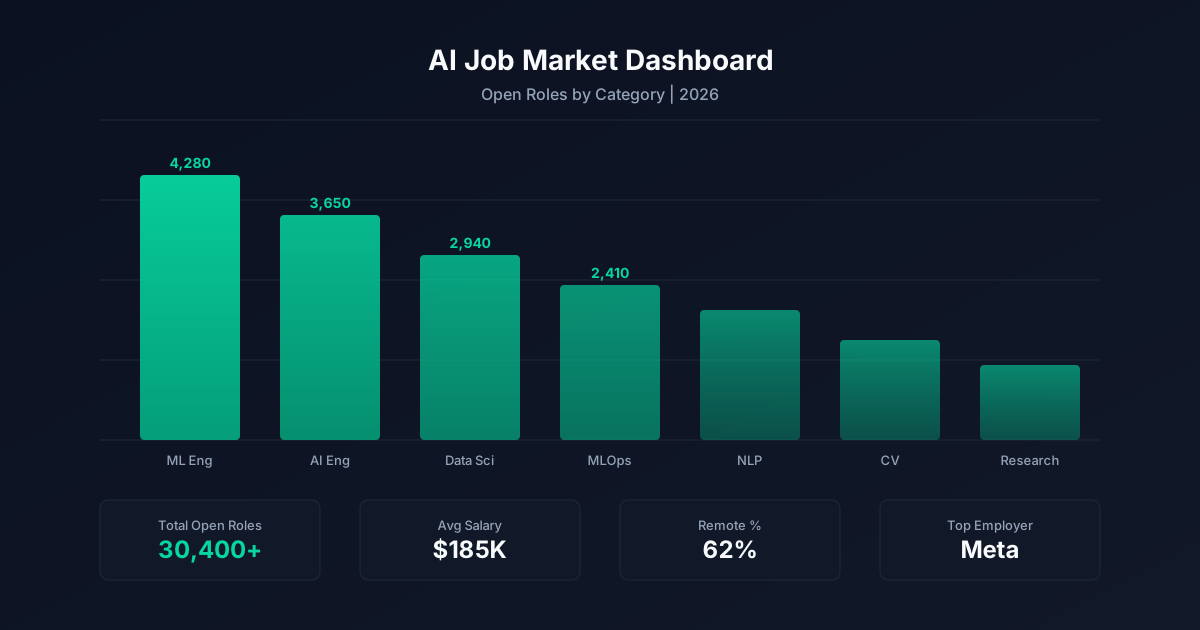
The AI job market spans 3,708 open positions across 16 role categories. The largest categories by volume: AI/ML Engineer (2,605), Data Scientist (310), AI Software Engineer (259). These three account for the majority of open positions, though smaller categories often have higher per-role compensation because of specialized skill requirements.
The seniority mix tells a story about where AI teams are in their maturity. Entry-level roles (102) are outnumbered by mid-level (1,705) and senior (1,469) positions, reflecting that most companies are past the 'build a team from scratch' phase and need experienced engineers who can ship production systems. Leadership roles (Director, VP, C-Level) total 432 positions, representing the bottleneck between technical execution and organizational strategy.
Remote work availability sits at 14% of all AI roles (508 positions), with 3,180 requiring on-site or hybrid attendance. The remote share has stabilized after the post-pandemic correction. Senior and specialized roles (Research Scientist, ML Architect) are more likely to be remote-eligible than entry-level positions, partly because experienced hires have more negotiating power and partly because these roles require less hands-on mentorship.
AI compensation is structured in clear tiers. The market median sits at $217,500. Top-quartile roles start at $272,100, and the 90th percentile reaches $325,000. These figures include base salary with disclosed compensation. Total compensation (including equity, bonuses, and sign-on) runs 20-40% higher at companies that offer those components.
Category matters for compensation. AI Safety roles lead at $300,000 median, while Prompt Engineer roles sit at $140,000. The spread between highest and lowest-paying categories reflects the premium on specialized technical skills versus broader analytical roles.
The most in-demand skills across all AI postings: Python (1,890 postings), Aws (1,103 postings), Azure (877 postings), Rag (855 postings), Gcp (631 postings), Prompt Engineering (560 postings), Pytorch (545 postings), Claude (498 postings). Python dominates, appearing in the vast majority of role descriptions regardless of category. Cloud platform experience (AWS, GCP, Azure) is the second most common requirement. The newer entrants to the top skills list (RAG, vector databases, LLM APIs) reflect the shift from traditional ML toward generative AI applications.
Frequently Asked Questions
Get Weekly AI Career Intelligence
Salary data, skills demand, and market signals from 16,000+ AI job postings. Every Monday.