
What Does a Data Scientist Do?
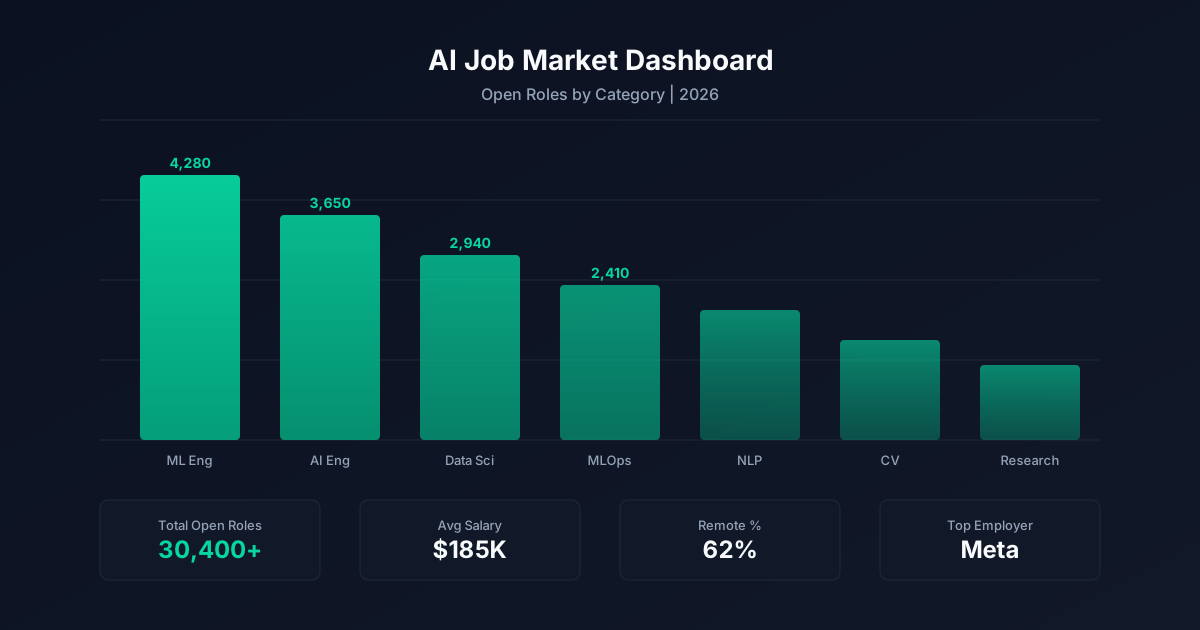
Data Scientists extract insights from complex datasets using statistical analysis and machine learning. In the AI era, they increasingly work with LLMs for data analysis automation and build predictive models.
A Typical Day
- Analyzing large datasets to identify patterns and business opportunities
- Building predictive models and recommendation systems
- Creating dashboards and data visualizations for stakeholders
- Designing and running A/B tests
- Collaborating with engineering on model deployment
Required Skills
The most in-demand skills for Data Scientist roles, ranked by how often they appear in job postings.
- 1 Python 316 jobs
- 2 Aws 115 jobs
- 3 Azure 74 jobs
- 4 Pytorch 68 jobs
- 5 Tensorflow 68 jobs
- 6 Tableau 55 jobs
- 7 Power Bi 52 jobs
- 8 Gcp 51 jobs
- 9 Rag 45 jobs
- 10 Prompt Engineering 35 jobs
Salary & Compensation
Based on 258 job postings with disclosed compensation ranges.
Salary by Experience Level
| Level | Jobs | Salary Range |
|---|---|---|
| Entry Level | 12 | $111K - $159K |
| Mid Level | 116 | $117K - $173K |
| Senior | 130 | $139K - $219K |
Highest Paying Cities
| Metro | Jobs | Avg Salary Range |
|---|---|---|
| San Francisco | 20 | $157K - $248K |
| Seattle | 12 | $154K - $239K |
| New York | 51 | $133K - $199K |
| Boston | 8 | $136K - $181K |
| Los Angeles | 25 | $117K - $180K |
How to Get Started
-
1
Build Your Foundation
Data Scientists typically hold degrees in statistics, mathematics, computer science, or a quantitative field. A master's or PhD is common but not mandatory with strong portfolio work.
-
2
Master the Core Skills
Focus on the skills employers are asking for right now: Python, Aws, Azure. These are the top 3 skills appearing in Data Scientist job postings.
-
3
Build Portfolio Projects
Ship real projects that demonstrate your skills. Open-source contributions, personal projects, or freelance work all count. Hiring managers want to see what you can build, not just what you know.
-
4
Apply Strategically
Target companies actively hiring for this role. Top employers include JPMorganChase, Walmart, Amazon.com, Booz Allen Hamilton. Tailor your resume to match the specific skills each company lists in their job descriptions.
Top Hiring Companies
Companies with the most Data Scientist job openings right now.
Career Progression
A typical career path for Data Scientist professionals.
Explore Data Scientist Careers
Related Roles
About This Role
Data Scientists extract insights and build predictive models from data. In the AI era, many roles now include LLM-powered analytics, automated reporting, and integration with generative AI tools. The role has evolved from 'the person who runs SQL queries' to 'the person who builds AI-powered data products.'
Modern data science roles fall into two camps: analytics-focused (insights, dashboards, experimentation) and ML-focused (building predictive models, recommendation systems, NLP features). The best data scientists can operate in both modes. The AI shift means that even analytics-focused roles now involve building automated insight pipelines using LLMs, going well beyond one-off reports.
Across the 4,317 AI roles we're tracking, Data Scientist positions make up 8% of the market.
Data Scientist roles remain in high demand, though the definition keeps shifting. Companies increasingly want candidates who can bridge traditional statistics with modern ML and LLM capabilities. The 'pure insights' data scientist role is consolidating into analytics engineering, while the 'build models' data scientist role is merging with ML engineering.
Skills Required
Python, SQL, and statistical modeling are the foundation. Increasingly, roles want experience with LLMs for data analysis, automated insight generation, and building AI-powered data products. Familiarity with cloud data platforms (Snowflake, BigQuery, Databricks) and ML frameworks (scikit-learn, PyTorch) covers most job requirements.
Experimentation design and causal inference are underrated skills that separate strong candidates. Companies care about whether their product changes cause improvements, and can distinguish causation from correlation. A/B testing methodology, Bayesian statistics, and the ability to communicate uncertainty to non-technical stakeholders are high-value skills.
Good postings specify the data stack, the types of problems you'll work on, and the team structure. Look for companies that differentiate between analytics and ML data science. Vague 'data scientist' postings that list every skill under the sun usually mean the company doesn't know what they need.
Compensation Benchmarks
Data Scientist roles pay a median of $192,890 based on 789 positions with disclosed compensation. This role's midpoint ($162K) sits 16% below the category median. Disclosed range: $128K to $195K.
Across all AI roles, the market median is $215,000. Top-quartile compensation starts at $266,300. The 90th percentile reaches $320,790. For comparison, the highest-paying categories include AI Safety ($287,500) and Research Engineer ($272,100). By seniority level: Entry: $110,000; Mid: $194,400; Senior: $227,400; Director: $274,554; VP: $241,000.
What the Work Looks Like
A typical week includes: analyzing experiment results for a product feature launch, building a predictive model for customer churn, creating an automated reporting pipeline using LLM-powered summarization, presenting insights to stakeholders, and cleaning data (always cleaning data). The ratio of analysis to engineering varies by company, but expect both.
Data Scientist roles remain in high demand, though the definition keeps shifting. Companies increasingly want candidates who can bridge traditional statistics with modern ML and LLM capabilities. The 'pure insights' data scientist role is consolidating into analytics engineering, while the 'build models' data scientist role is merging with ML engineering.
Career Path
Common paths into Data Scientist roles include Data Analyst, Statistician, Quantitative Researcher.
From here, career progression typically leads toward Senior Data Scientist, ML Engineer, AI Product Manager.
Start with statistics and SQL. Build a real analysis project on public data that demonstrates insight generation alongside model building. The market values data scientists who can communicate findings clearly to business stakeholders. If you want to move toward ML engineering, invest in software engineering fundamentals and production deployment skills.
AI Hiring Overview
The AI job market has 4,317 open positions tracked in our dataset. By seniority: 138 entry-level, 2,071 mid-level, 1,655 senior, and 453 leadership roles (Director, VP, C-Level). Remote roles make up 15% of the market (635 positions). The remaining 3,657 roles require on-site or hybrid attendance.
The market median for AI roles is $215,000. Top-quartile compensation starts at $266,300. The 90th percentile reaches $320,790. Highest-paying categories: AI Safety ($287,500 median, 34 roles); Research Engineer ($272,100 median, 227 roles); AI Engineering Manager ($244,000 median, 23 roles).
Data Scientist roles remain in high demand, though the definition keeps shifting. Companies increasingly want candidates who can bridge traditional statistics with modern ML and LLM capabilities. The 'pure insights' data scientist role is consolidating into analytics engineering, while the 'build models' data scientist role is merging with ML engineering.
What to Expect in Interviews
Interviews combine statistics, coding, and business acumen. SQL is almost always tested, often with complex joins and window functions. Expect a case study round where you're given a business problem and asked to design an analysis plan. Coding rounds focus on pandas, statistical modeling, and visualization. The strongest differentiator is how well you communicate insights to non-technical stakeholders during presentation rounds.
When evaluating opportunities: Good postings specify the data stack, the types of problems you'll work on, and the team structure. Look for companies that differentiate between analytics and ML data science. Vague 'data scientist' postings that list every skill under the sun usually mean the company doesn't know what they need.
Frequently Asked Questions
Ready to Start Your AI Career?
Get weekly salary data, job alerts, and career insights for Data Scientist roles.