
Interested in this AI Architect role at Information Technology Senior Management Forum?
Apply Now →Skills & Technologies
About This Role
Posted Date 4/10/2026
Description
We are:
The Advanced Technology Centers (ATCs) are the engine for reinvention in our clients’ transformation journey. Powered by more than 255,000 people across 24 countries, ATCs provide our clients with seamless access to industry insights and innovative technology solutions.
Stronger together!
The Advanced Technology Centers (ATCs) make a tremendous impact in solving our clients’ business problems by leveraging innovation, intelligence, industry insights, new IT, and new technology skills. With the global environment changing at a faster pace, our clients are facing unprecedented challenges, and they need us more than ever before. As a Network, ATCs are positioned to unlock greater opportunities and exponential value for our clients.
The value for our clients and our people:
For our clients, the Network provides the strength of our geographic diversity, greater resilience, and seamless access to the deepest industry knowledge, the latest in Gen AI solutions, and tech expertise from around the world. For our people, it brings an opportunity to shape truly boundaryless career paths in a highly collaborative team of experts where they can learn from each other and solve the world’s most complex client challenges.
You Are:
An AI/ML Architect with strong engineering skills and expertise in LLM and agentic architectures. You design, build, and operationalize AI agents, data pipelines, and ML solutions that run reliably in regulated enterprise environments.
The Work:
You embed with clients to stand up custom AI agent frameworks across cloud providers (Amazon Bedrock AgentCore, Azure AI Foundry, Google Vertex AI Agent Builder) and the Anthropic Claude Agent SDK. You partner with stakeholders to define use cases, prototype agentic workflows, and ship production\-ready agents that operate reliably.
Responsibilities:
- Design AI agents with retrieval, orchestration, tool invocation, evaluation harnesses, and lifecycle observability.
- Build LLM and agentic systems with function\-calling, prompt engineering, and agent orchestration in production.
- Implement RAG patterns with vector databases (FAISS, Pinecone, Chroma, Milvus) and tune embeddings for retrieval quality.
- Train and deploy ML models with PyTorch, TensorFlow, MLflow, SageMaker, Azure ML, or Kubeflow.
- Stand up custom agent frameworks across providers (Amazon Bedrock AgentCore, Azure AI Foundry, Google Vertex AI Agent Builder, Anthropic Claude Agent SDK); design the supporting architecture for production.
- Integrate AI agents with enterprise APIs, microservices, and workflow systems; ship via CI/CD on Azure, AWS, or GCP. Apply Responsible AI controls (fairness, bias detection, safety filters) in regulated industries.
This is a hybrid role in Dallas, TX and requires 3 days per week in the office. May consider qualified applicants in Columbus, OH; Tampa, FL; Atlanta, GA; Houston, TX.
Travel may be required for this role. The amount of travel will vary from 25% to 75% depending on business need and client requirements.
Here's What You Need:
- Minimum 4 years of experience in Python, Java, or equivalent. Comfortable with evaluation tooling, logging, monitoring, and observability.
- Minimum 3 years experience in designing and implementing scaled Agentic AI and Generative AI solutions that are in operations.
- Minimum 3 years experience in designing and implementing Agentic AI and Generative AI platforms and frameworks used by multiple AI solutions.
- Minimum 2 years experience in designing, engineering, and operationalizing large\-scale AI/ML solutions on at least one major public cloud, using cloud\-native AI services and frameworks, open\-source technologies, and 3rd party tools.
- Minimum 2 years of experience with key AI technologies from public cloud providers, open source, and 3rd party tooling.
- Minimum 2 years of hands\-on experience with AI platforms (OpenAI, Claude, Vertex AI, open\-source), agentic orchestration tools (LangGraph, CrewAI, AutoGen), and MLOps/LLMOps practices across the ML and LLM lifecycle.
- Bachelor's degree or equivalent (minimum 12 years) work experience. (If Associate Degree, must have minimum 6 years work experience)
Compensation at Accenture varies depending on a wide array of factors, which may include but are not limited to the specific office location, role, skill set, and level of experience. As required by local law, Accenture provides a reasonable range of compensation for roles that may be hired as set forth below.
We anticipate this job posting will be posted until 07/27/2026\.
Accenture offers a market competitive suite of benefits including medical, dental, vision, life, and long\-term disability coverage, a 401(k) plan, bonus opportunities, paid holidays, and paid time off. See more information on our benefits here:
U.S. Employee Benefits \| Accenture
Role Location Annual Salary Range
California $73,800 to $220,400
Cleveland $68,300 to $176,300
Colorado $73,800 to $190,400
District of Columbia $78,500 to $202,700
Illinois $68,300 to $190,400
Maine $62,800 to $162,200
Maryland $73,800 to $190,400
Massachusetts $73,800 to $202,700
Minnesota $73,800 to $190,400
New York $68,300 to $220,400
New Jersey $78,500 to $220,400
Virginia $68,300 to $202,700
Washington $80,200 to $202,700
Requesting an Accommodation
Accenture is committed to providing equal employment opportunities for persons with disabilities or religious observances, including reasonable accommodation when needed. If you are hired by Accenture and require accommodation to perform the essential functions of your role, you will be asked to participate in our reasonable accommodation process. Accommodations made to facilitate the recruiting process are not a guarantee of future or continued accommodations once hired.
If you would like to be considered for employment opportunities with Accenture and have accommodation needs such as for a disability or religious observance, please call us toll free at 1 (877\) 889\-9009 or send us an email or speak with your recruiter.
Equal Employment Opportunity Statement
We believe that no one should be discriminated against because of their differences. All employment decisions shall be made without regard to age, race, creed, color, religion, sex, national origin, ancestry, disability status, veteran status, sexual orientation, gender identity or expression, genetic information, marital status, citizenship status or any other basis as protected by federal, state, or local law. Our rich diversity makes us more innovative, more competitive, and more creative, which helps us better serve our clients and our communities.
For details, view a copy of the Accenture Equal Opportunity Statement
Accenture is an EEO and Affirmative Action Employer of Veterans/Individuals with Disabilities.
Accenture is committed to providing veteran employment opportunities to our service men and women.
Other Employment Statements
Applicants for employment in the US must have work authorization that does not now or in the future require sponsorship of a visa for employment authorization in the United States.
Candidates who are currently employed by a client of Accenture or an affiliated Accenture business may not be eligible for consideration.
Job candidates will not be obligated to disclose sealed or expunged records of conviction or arrest as part of the hiring process. Further, at Accenture a criminal conviction history is not an absolute bar to employment.
The Company will not discharge or in any other manner discriminate against employees or applicants because they have inquired about, discussed, or disclosed their own pay or the pay of another employee or applicant. Additionally, employees who have access to the compensation information of other employees or applicants as a part of their essential job functions cannot disclose the pay of other employees or applicants to individuals who do not otherwise have access to compensation information, unless the disclosure is (a) in response to a formal complaint or charge, (b) in furtherance of an investigation, proceeding, hearing, or action, including an investigation conducted by the employer, or (c) consistent with the Company's legal duty to furnish information.
California requires additional notifications for applicants and employees. If you are a California resident, live in or plan to work from Los Angeles County upon being hired for this position, please click here for additional important information.
Please read Accenture’s Recruiting and Hiring Statement for more information on how we process your data during the Recruiting and Hiring process.
We work with one shared purpose: to deliver on the promise of technology and human ingenuity. Every day, more than 775,000 of us help our stakeholders continuously reinvent. Together, we drive positive change and deliver value to our clients, partners, shareholders, communities, and each other.
We believe that delivering value requires innovation, and innovation thrives in an inclusive and diverse environment. We actively foster a workplace free from bias, where everyone feels a sense of belonging and is respected and empowered to do their best work.
At Accenture, we see well\-being holistically, supporting our people’s physical, mental, and financial health. We also provide opportunities to keep skills relevant through certifications, learning, and diverse work experiences. We’re proud to be consistently recognized as one of the World’s Best Workplaces™.
Join Accenture to work at the heart of change. Visit us at www.accenture.com.
Salary73,800\.00 \- 220,400\.00 Annual
Type
Full\-time
Salary Context
This $68K-$220K range is in the lower quartile for AI Architect roles in our dataset (median: $197K across 33 roles with salary data).
Role Details
About This Role
This role sits at the intersection of AI and engineering, building systems that bring machine learning capabilities into production environments. The scope varies by company, but the common thread is applying AI technology to solve real business problems at scale. Most AI roles today require a combination of software engineering fundamentals and domain-specific ML knowledge, with the exact mix depending on the team's maturity and the product they're building.
The AI job market is evolving fast. New role categories emerge as companies figure out what they need to ship AI-powered products. What matters most is the ability to learn quickly, build working systems, and iterate based on real-world performance data. The specific title matters less than the skills you bring and the problems you can solve. Companies are past the experimentation phase and want engineers who can deliver production-quality systems that work reliably at scale.
Across the 3,708 AI roles we're tracking, AI Architect positions make up 1% of the market. At Information Technology Senior Management Forum, this role fits into their broader AI and engineering organization.
AI hiring keeps growing across industries. Companies in tech, finance, healthcare, and retail are all building AI teams. The strongest demand is for people who can bridge the gap between AI research and production engineering. The shift toward generative AI has created new role types (LLM Engineer, Prompt Engineer, AI Agent Developer) that didn't exist three years ago, while traditional roles (Data Scientist, ML Engineer) have evolved to incorporate LLM capabilities.
What the Work Looks Like
Day-to-day work involves a mix of building, debugging, and collaborating. You'll write code, review pull requests, participate in design discussions, and work with cross-functional teams (product, design, data) to define what AI features should do and how they should behave. Expect to spend time on both technical implementation and communication. Most AI teams operate in two-week sprint cycles, with regular demos and retrospectives. The ratio of heads-down coding to meetings and reviews varies by seniority, with senior roles spending more time on architecture decisions and mentorship.
AI hiring keeps growing across industries. Companies in tech, finance, healthcare, and retail are all building AI teams. The strongest demand is for people who can bridge the gap between AI research and production engineering. The shift toward generative AI has created new role types (LLM Engineer, Prompt Engineer, AI Agent Developer) that didn't exist three years ago, while traditional roles (Data Scientist, ML Engineer) have evolved to incorporate LLM capabilities.
Skills Required
Python and cloud platform experience are common requirements. Specific skill needs vary by company and focus area, but familiarity with ML frameworks, data pipelines, and API design covers the basics for most roles. RAG (Retrieval-Augmented Generation), vector databases, and LLM API integration are increasingly standard requirements across role types.
Beyond the core stack, communication skills matter more than many technical candidates realize. The ability to explain AI capabilities and limitations to non-technical stakeholders is a differentiator at every level. Technical writing, documentation, and clear thinking about tradeoffs are underrated skills in AI roles. Experience with evaluation methodology (how to measure whether an AI system is working well) is becoming a core requirement, especially for roles that involve LLM integration.
Look for job postings that specify the problems you'll work on, the tech stack, and the team structure. Vague postings that list every AI buzzword are often a sign the company hasn't figured out what they need. Strong postings describe the product context, the team you'd join, and the specific challenges you'd tackle.
Compensation Benchmarks
AI Architect roles pay a median of $254,798 based on 67 positions with disclosed compensation. Entry-level AI roles across all categories have a median of $120,000. This role's midpoint ($144K) sits 43% below the category median. Disclosed range: $68K to $220K.
Across all AI roles, the market median is $217,500. Top-quartile compensation starts at $272,100. The 90th percentile reaches $325,000. For comparison, the highest-paying categories include AI Safety ($300,000) and Research Engineer ($280,000). By seniority level: Entry: $120,000; Mid: $200,000; Senior: $230,000; Director: $272,150; VP: $250,000.
Information Technology Senior Management Forum AI Hiring
Information Technology Senior Management Forum has 44 open AI roles right now. They're hiring across AI/ML Engineer, Data Scientist, AI Architect, AI Safety. Positions span McLean, VA, US, San Jose, CA, US, New York, NY, US. Compensation range: $126K - $392K.
Location Context
Across all AI roles, 14% (508 positions) offer remote work, while 3,180 require on-site attendance. Top AI hiring metros: New York (1,045 roles, $220,000 median); San Francisco (810 roles, $277,088 median); Los Angeles (397 roles, $215,000 median).
Career Path
Common paths into AI Architect roles include Software Engineer, Data Scientist, Data Analyst.
From here, career progression typically leads toward Senior Engineer, AI Architect, Engineering Manager, Principal Engineer.
Focus on building things that work. A deployed project that solves a real problem is worth more than any certification. Contribute to open-source, build portfolio projects, and invest in fundamentals (software engineering, statistics, systems design) rather than chasing the latest framework. The AI field moves fast, but the engineers who succeed long-term are the ones with strong fundamentals who can adapt to new tools and paradigms as they emerge.
What to Expect in Interviews
AI interviews typically combine coding challenges (Python-focused), system design questions tailored to the role, and discussions about your experience with relevant tools and frameworks. Strong candidates demonstrate both technical depth and the ability to make pragmatic engineering tradeoffs. Prepare portfolio projects that demonstrate end-to-end capability rather than isolated skills.
When evaluating opportunities: Look for job postings that specify the problems you'll work on, the tech stack, and the team structure. Vague postings that list every AI buzzword are often a sign the company hasn't figured out what they need. Strong postings describe the product context, the team you'd join, and the specific challenges you'd tackle.
AI Hiring Overview
The AI job market has 3,708 open positions tracked in our dataset. By seniority: 102 entry-level, 1,705 mid-level, 1,469 senior, and 432 leadership roles (Director, VP, C-Level). Remote roles make up 14% of the market (508 positions). The remaining 3,180 roles require on-site or hybrid attendance.
The market median for AI roles is $217,500. Top-quartile compensation starts at $272,100. The 90th percentile reaches $325,000. Highest-paying categories: AI Safety ($300,000 median, 21 roles); Research Engineer ($280,000 median, 147 roles); AI Architect ($254,798 median, 67 roles).
AI hiring keeps growing across industries. Companies in tech, finance, healthcare, and retail are all building AI teams. The strongest demand is for people who can bridge the gap between AI research and production engineering. The shift toward generative AI has created new role types (LLM Engineer, Prompt Engineer, AI Agent Developer) that didn't exist three years ago, while traditional roles (Data Scientist, ML Engineer) have evolved to incorporate LLM capabilities.
The AI Job Market Today
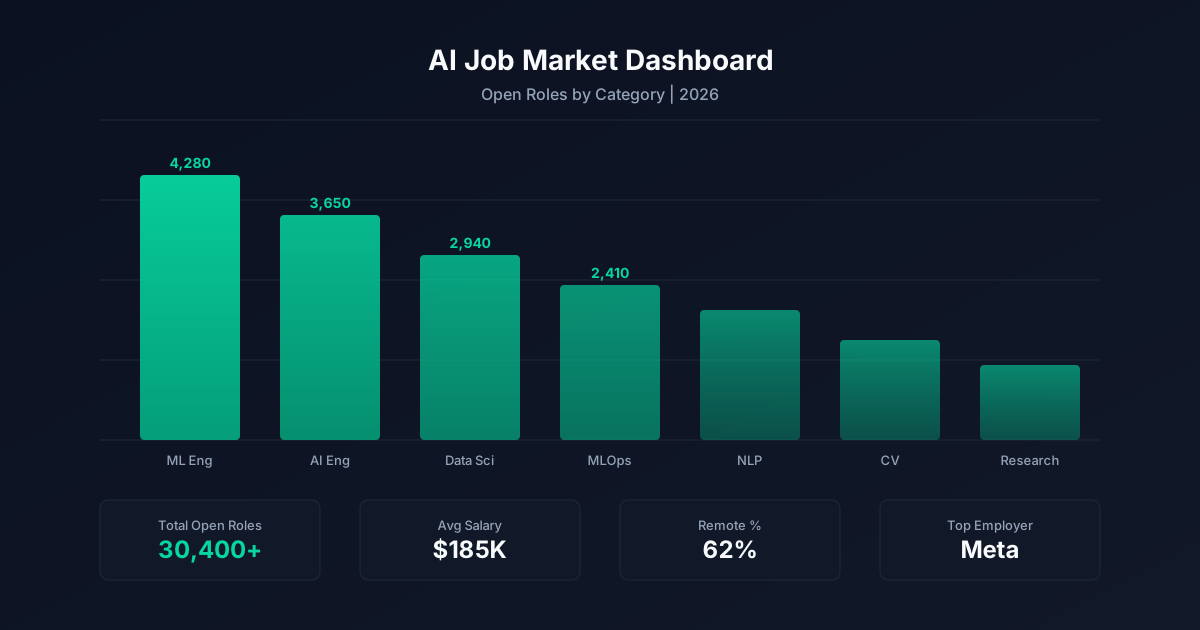
The AI job market spans 3,708 open positions across 16 role categories. The largest categories by volume: AI/ML Engineer (2,605), Data Scientist (310), AI Software Engineer (259). These three account for the majority of open positions, though smaller categories often have higher per-role compensation because of specialized skill requirements.
The seniority mix tells a story about where AI teams are in their maturity. Entry-level roles (102) are outnumbered by mid-level (1,705) and senior (1,469) positions, reflecting that most companies are past the 'build a team from scratch' phase and need experienced engineers who can ship production systems. Leadership roles (Director, VP, C-Level) total 432 positions, representing the bottleneck between technical execution and organizational strategy.
Remote work availability sits at 14% of all AI roles (508 positions), with 3,180 requiring on-site or hybrid attendance. The remote share has stabilized after the post-pandemic correction. Senior and specialized roles (Research Scientist, ML Architect) are more likely to be remote-eligible than entry-level positions, partly because experienced hires have more negotiating power and partly because these roles require less hands-on mentorship.
AI compensation is structured in clear tiers. The market median sits at $217,500. Top-quartile roles start at $272,100, and the 90th percentile reaches $325,000. These figures include base salary with disclosed compensation. Total compensation (including equity, bonuses, and sign-on) runs 20-40% higher at companies that offer those components.
Category matters for compensation. AI Safety roles lead at $300,000 median, while Prompt Engineer roles sit at $140,000. The spread between highest and lowest-paying categories reflects the premium on specialized technical skills versus broader analytical roles.
The most in-demand skills across all AI postings: Python (1,890 postings), Aws (1,103 postings), Azure (877 postings), Rag (855 postings), Gcp (631 postings), Prompt Engineering (560 postings), Pytorch (545 postings), Claude (498 postings). Python dominates, appearing in the vast majority of role descriptions regardless of category. Cloud platform experience (AWS, GCP, Azure) is the second most common requirement. The newer entrants to the top skills list (RAG, vector databases, LLM APIs) reflect the shift from traditional ML toward generative AI applications.
Frequently Asked Questions
Get Weekly AI Career Intelligence
Salary data, skills demand, and market signals from 16,000+ AI job postings. Every Monday.