
Interested in this AI/ML Engineer role at International Rescue Committee?
Apply Now →About This Role
The International Rescue Committee (IRC) responds to the world's worst humanitarian crises, helping to restore health, safety, education, economic wellbeing, and power to people devastated by conflict and disaster. Founded in 1933 at the call of Albert Einstein, the IRC is one of the world's largest international humanitarian non\-governmental organizations (INGO), at work in more than 40 countries and 29 U.S. cities helping people to survive, reclaim control of their future and strengthen their communities. A force for humanity, IRC employees deliver lasting impact by restoring safety, dignity and hope to millions. If you're a solutions\-driven, passionate change\-maker, come join us in positively impacting the lives of millions of people world\-wide for a better future.
Job Role Overview
The Director, AI Security is a newly created senior leadership role responsible for building, leading, and continuously maturing the IRC’s AI security function. As AI agents and AI\-powered tools proliferate across the business, this role sets the organizational direction for securing AI systems — from initial design through production deployment, ongoing governance, and team development.
This is a high\-visibility, cross\-functional leadership role that sits at the intersection of security engineering, risk management, and emerging technology. The Director, AI Security will advise the CISO, build and develop a dedicated AI security team, own the function’s budget, and partner with Security Operations, Identity \& Access Management, Governance Risk \& Compliance, and business unit technology teams to ensure AI adoption is secure by design.
Key Responsibilities
AI Security Strategy \& Governance
- Define, own, and continuously mature the IRC's AI security strategy and program roadmap
- Establish and maintain the organization\-wide AI agent registry — a governed inventory of all AI agents in production, including their purpose, permissions, data access, and accountable owners
- Develop and publish secure\-by\-default standards, frameworks, and reference architectures for internal AI agent development
- Create and enforce AI security policies covering agent development, deployment, monitoring, and decommissioning
- Report AI security risk posture, program progress, and emerging threats to the CISO and senior leadership on a regular cadence; serve as a key member of the security leadership team
Security Risk Assessment \& Review
- Coordinate and perform GIS security reviews within the organization's AI governance framework, ensuring AI platforms, agents, and use cases receive appropriate security assessment and approval prior to production deployment.
- Partner with AI Governance, Privacy, Legal, and Technology stakeholders to support the AI intake, assessment, and stage\-gating process, providing security expertise, control requirements, and risk\-based recommendations throughout the solution lifecycle.
- Perform security risk assessments and classify AI platforms, agents, and use cases according to the approved risk\-tiering model, applying review, control, and approval requirements proportionate to risk.
- Conduct a structured controls assessment for every use case, validating that mandatory security baseline requirements are met — including least\-privilege access, credential management, audit logging, data minimization, human\-in\-the\-loop checkpoints, and kill switch capability
- Issue formal, documented approval decisions for every reviewed use case — Approved, Approved with Conditions, or Not Approved — with a full written rationale recorded in the AI agent registry to maintain an auditable approval history
- Manage defined SLA timelines for all reviews (Tier 1: 5 business days, Tier 2: 10 business days, Tier 3: 15 business days) to ensure security review does not become a blocker to business unit velocity
- Conduct periodic reassessments of all active agents on a risk\-appropriate cycle — annually for Tier 1, semi\-annually for Tier 2, and quarterly for Tier 3 — and trigger immediate out\-of\-cycle reviews whenever a material change is made to an agent's capabilities, data access, or toolset
- Monitor the evolving AI threat landscape on an ongoing basis and proactively assess whether newly discovered attack techniques — including new prompt injection methods, jailbreaks, or model\-specific vulnerabilities — expose any currently approved use cases, initiating remediation where required
- Lead post\-incident reassessments for any active agent involved in a security incident, updating the agent's approval status and controls requirements based on findings
- Evaluate third\-party AI tools, models, and platforms for security risk prior to organizational adoption
- Maintain a risk register specific to AI systems, tracking identified vulnerabilities, mitigations, and residual risk
- Report aggregate review metrics to the CISO on a regular cadence — including number of use cases reviewed, approval rates by tier, common findings, and AI risk distribution across business units — providing organizational visibility into the AI risk posture
Technical Oversight \& Controls
- Define technical security requirements for AI agents including least\-privilege access, prompt injection defenses, output filtering, audit logging, and human\-in\-the\-loop controls
- Build, lead, and develop a team of AI security engineers responsible for implementing and validating controls across the AI agent development lifecycle
- Own and resource red team and adversarial testing programs targeting AI systems, ensuring adequate coverage through the AI Red Team Engineer and contracted specialists
- Drive adoption of secure coding practices and security tooling within AI development workflows
Identity \& Data Security Coordination
- Establish governance frameworks with the IAM team to ensure AI agent identities, service accounts, and credentials are provisioned and governed under least\-privilege principles across the organization
- Set data security standards with the ML/Data Security Analyst to ensure sensitive data — including PII, PHI, and proprietary information — is handled correctly throughout AI agent workflows, and hold teams accountable to those standards
- Define data classification requirements for information flowing through AI systems, including what data may and may not be included in model context
Incident Response
- Develop and maintain AI\-specific incident response runbooks covering scenarios such as prompt injection attacks, rogue agent behavior, credential compromise, and data leakage via AI systems
- Serve as executive sponsor and escalation point for significant AI\-related security incidents, ensuring the organization maintains a tested, capable incident response function
- Conduct post\-incident reviews and drive lessons learned back into the AI security program
Regulatory \& Compliance Alignment
- Serve as the organization's primary subject matter expert on AI\-specific regulatory requirements including the EU AI Act, NIST AI Risk Management Framework (AI RMF), GDPR as applied to AI systems, and emerging regional AI legislation
- Partner with the GRC team to map AI security controls to compliance obligations and maintain evidence for audits
- Monitor the evolving AI regulatory landscape and proactively advise leadership on upcoming obligations
People Leadership \& Team Development
- Recruit, hire, onboard, and develop a high\-performing AI security team, including AI security engineers, a red team engineer, and a data/ML security analyst
- Set clear team goals, conduct regular performance reviews, and create development plans that grow individual skills and advance careers
- Foster a team culture of continuous learning, given the rapidly evolving AI threat landscape, and ensure team members maintain current expertise in AI security techniques and tooling
Vendor Management
- Lead vendor evaluation and selection for AI security tooling, negotiating contracts and managing ongoing relationships with key security vendors and managed service providers
- Develop a multi\-year AI security roadmap aligned to IRC risk appetite, and evolving regulatory obligations
Working Relationships
Internal:
- CISO, ITLT, Security Operations \& Engineering lead and team, Identity \& Access Management (IAM) lead and team, Governance, Risk \& Compliance (GRC) lead, AI Review Panel lead and team, Office of General Council team, AI \& Program tech engineering and team, Data Architecture lead and engineering Team
External:
- AI and Security Vendors — ongoing for product evaluation, contracts, and threat intel
- Industry Peers \& Research Communities — active participation in ISACs, working groups, and conferences
Required Qualifications
Education
- Bachelor's degree in Computer Science, Information Security, Cybersecurity, or a related technical field
- Advanced degree (Master's or equivalent) preferred but not required where experience is demonstrably strong
Experience
- 10\+ years of experience in information security, with at least 4\-5 years in a people management or senior security leadership role
- Demonstrated hands\-on experience securing AI/ML systems, LLM\-based applications, or agentic AI workflows
- Proven experience conducting threat modeling, security architecture reviews, and risk assessments for complex, distributed systems
- Experience building and leading security teams, including hiring, developing, and retaining talent in a fast\-moving technical domain
- Track record of working cross\-functionally with engineering, product, legal, and compliance teams; experience owning and managing a security budget including tooling, vendor, and headcount decisions
- Prior experience with incident response and managing security incidents involving automated or AI\-driven systems is strongly preferred
- Demonstrated experience managing and developing a team of security professionals, including hiring, performance management, and career development
*This is a remote position open to internal candidates based in countries where IRC operates who have the right to work in their location. Successful candidates will be hired on a local employment contract and according to local salary scale**.*
Compensation: (US *Pay Range: $158,492\-$184,536/yr; UK Pay Range: £77,499\-£93,814/yr)* Posted pay ranges apply to US\-based candidates. Ranges are based on various factors including the labor market, job type, internal equity, and budget. Exact offers are calibrated by work location, individual candidate experience and skills relative to the defined job requirements.
PROFESSIONAL STANDARDS
All International Rescue Committee workers must adhere to the core values and principles outlined in IRC Way \- Standards for Professional Conduct. Our Standards are Integrity, Service, Equality and Accountability. In accordance with these values, the IRC operates and enforces policies on Safeguarding, Conflicts of Interest, Fiscal Integrity, and Reporting Wrongdoing and Protection from Retaliation. IRC is committed to take all necessary preventive measures and create an environment where people feel safe, and to take all necessary actions and corrective measures when harm occurs. IRC builds teams of professionals who promote critical reflection, power sharing, debate, and objectivity to deliver the best possible services to our clients.
Cookies: https://careers.rescue.org/us/en/cookiesettings
Compensation: Posted pay ranges apply to US\-based candidates. Ranges are based on various factors including the labor market, job type, internal equity, and budget. Exact offers are calibrated by work location, individual candidate experience and skills relative to the defined job requirements.
US Benefits: We offer a comprehensive and highly competitive set of benefits. In the US, these include: 10 sick days, 10 US holidays, 20\-25 paid time off days depending on role and tenure, medical insurance starting at $163 per month, dental starting at $6\.50 per month, and vision starting at $5 per month, FSA for healthcare and commuter costs, a 403b retirement savings plans with immediately vested matching, disability \& life insurance, and an Employee Assistance Program which is available to our staff and their families to support counseling and care in times of crisis and mental health struggles.
Equal Opportunity Employer: IRC is an Equal Opportunity Employer. IRC considers all applicants on the basis of merit without regard to race, sex, color, national origin, religion, sexual orientation, age, marital status, veteran status, disability or any other characteristic protected by applicable law.
\#li\-1
Salary Context
This $158K-$184K range is below the median for AI/ML Engineer roles in our dataset (median: $180K across 1841 roles with salary data).
View full AI/ML Engineer salary data →Role Details
About This Role
AI/ML Engineers build and deploy machine learning models in production. They work across the full ML lifecycle: data pipelines, model training, evaluation, and serving infrastructure. The role has evolved significantly over the past two years. Where ML Engineers once spent most of their time on model architecture, the job now tilts heavily toward inference optimization, cost management, and integrating LLM capabilities into existing systems. Companies want engineers who can ship production systems, and the experimenter-only role is fading fast.
Day-to-day, you're writing training pipelines, debugging data quality issues, setting up evaluation frameworks, and figuring out why your model performs differently in staging than it did on your dev set. The best ML engineers are obsessive about reproducibility and measurement. They instrument everything. They know that a model is only as good as the data feeding it and the infrastructure serving it.
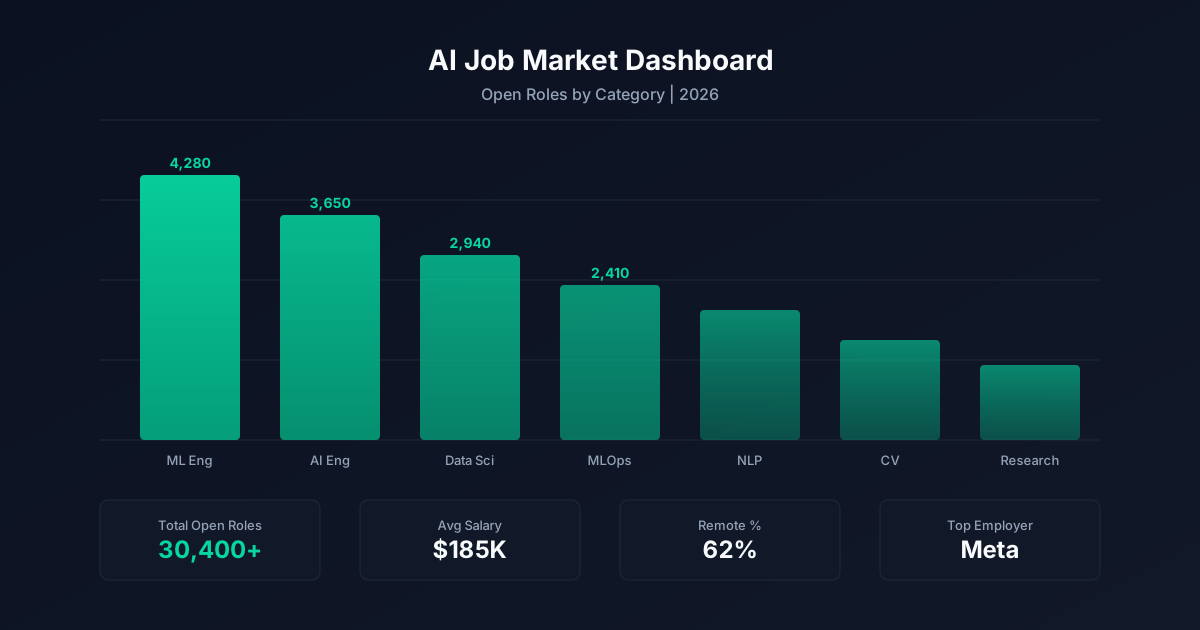
Across the 3,708 AI roles we're tracking, AI/ML Engineer positions make up 70% of the market. At International Rescue Committee, this role fits into their broader AI and engineering organization.
Demand for AI/ML Engineers has been strong and consistent. Unlike some AI roles that spike with hype cycles, ML engineering is a foundational need. Every company deploying AI models needs people who can keep them running, and the gap between research prototypes and production systems keeps growing.
What the Work Looks Like
A typical week might include: debugging a data pipeline that's silently dropping 3% of training examples, running A/B tests on a new model version, writing documentation for a feature flag system that lets you roll back model deployments, and reviewing a junior engineer's PR for a new evaluation metric. Meetings tend to be cross-functional since ML touches product, engineering, and data teams.
Demand for AI/ML Engineers has been strong and consistent. Unlike some AI roles that spike with hype cycles, ML engineering is a foundational need. Every company deploying AI models needs people who can keep them running, and the gap between research prototypes and production systems keeps growing.
Skills in Demand for This Role
Python and PyTorch dominate the requirements. Most roles expect experience with cloud platforms (AWS, GCP, or Azure) and familiarity with ML frameworks like TensorFlow or JAX. RAG (Retrieval-Augmented Generation) has become a top-3 skill requirement as companies integrate LLMs into their products. Docker and Kubernetes show up in about a third of postings, reflecting the production focus of the role.
Beyond the core stack, employers increasingly want experience with experiment tracking tools (MLflow, Weights & Biases), feature stores, and vector databases. Fine-tuning experience is valuable but less common than you'd think from reading Twitter. Most production LLM work is RAG and prompt engineering, not fine-tuning. If you have both, you're in a strong position.
Companies that are serious about AI/ML hiring tend to post specific infrastructure details in the job description: the frameworks they use, their model serving stack, their data pipeline tools. Vague postings that just say 'ML experience required' without specifics are often companies that haven't figured out what they need yet.
Compensation Benchmarks
AI/ML Engineer roles pay a median of $218,750 based on 3,817 positions with disclosed compensation. Director-level AI roles across all categories have a median of $272,150. This role's midpoint ($171K) sits 22% below the category median. Disclosed range: $158K to $184K.
Across all AI roles, the market median is $217,500. Top-quartile compensation starts at $272,100. The 90th percentile reaches $325,000. For comparison, the highest-paying categories include AI Safety ($300,000) and Research Engineer ($280,000). By seniority level: Entry: $120,000; Mid: $200,000; Senior: $230,000; Director: $272,150; VP: $250,000.
International Rescue Committee AI Hiring
International Rescue Committee has 2 open AI roles right now. They're hiring across AI/ML Engineer. Based in New York, NY, US. Compensation range: $102K - $184K.
Location Context
AI roles in New York pay a median of $220,000 across 1,045 tracked positions.
Career Path
Common paths into AI/ML Engineer roles include Data Scientist, Software Engineer, Research Engineer.
From here, career progression typically leads toward ML Architect, AI Engineering Manager, Principal ML Engineer.
The fastest path into ML engineering is through software engineering with a self-directed ML education. A CS degree helps, but production engineering skills matter more than academic credentials. Build something that works, deploy it, and measure it. That portfolio project is worth more than a Coursera certificate. For career growth, the fork comes around the senior level: go deep on technical complexity (staff/principal track) or move into managing ML teams.
What to Expect in Interviews
Expect system design questions around ML pipelines: how you'd build a training pipeline for a specific use case, handle data drift, or design A/B testing infrastructure for model deployments. Coding rounds typically involve Python, with emphasis on data manipulation (pandas, numpy) and algorithm implementation. Take-home assignments often ask you to build an end-to-end ML pipeline from raw data to deployed model.
When evaluating opportunities: Companies that are serious about AI/ML hiring tend to post specific infrastructure details in the job description: the frameworks they use, their model serving stack, their data pipeline tools. Vague postings that just say 'ML experience required' without specifics are often companies that haven't figured out what they need yet.
AI Hiring Overview
The AI job market has 3,708 open positions tracked in our dataset. By seniority: 102 entry-level, 1,705 mid-level, 1,469 senior, and 432 leadership roles (Director, VP, C-Level). Remote roles make up 14% of the market (508 positions). The remaining 3,180 roles require on-site or hybrid attendance.
The market median for AI roles is $217,500. Top-quartile compensation starts at $272,100. The 90th percentile reaches $325,000. Highest-paying categories: AI Safety ($300,000 median, 21 roles); Research Engineer ($280,000 median, 147 roles); AI Architect ($254,798 median, 67 roles).
Demand for AI/ML Engineers has been strong and consistent. Unlike some AI roles that spike with hype cycles, ML engineering is a foundational need. Every company deploying AI models needs people who can keep them running, and the gap between research prototypes and production systems keeps growing.
The AI Job Market Today
The AI job market spans 3,708 open positions across 16 role categories. The largest categories by volume: AI/ML Engineer (2,605), Data Scientist (310), AI Software Engineer (259). These three account for the majority of open positions, though smaller categories often have higher per-role compensation because of specialized skill requirements.
The seniority mix tells a story about where AI teams are in their maturity. Entry-level roles (102) are outnumbered by mid-level (1,705) and senior (1,469) positions, reflecting that most companies are past the 'build a team from scratch' phase and need experienced engineers who can ship production systems. Leadership roles (Director, VP, C-Level) total 432 positions, representing the bottleneck between technical execution and organizational strategy.
Remote work availability sits at 14% of all AI roles (508 positions), with 3,180 requiring on-site or hybrid attendance. The remote share has stabilized after the post-pandemic correction. Senior and specialized roles (Research Scientist, ML Architect) are more likely to be remote-eligible than entry-level positions, partly because experienced hires have more negotiating power and partly because these roles require less hands-on mentorship.
AI compensation is structured in clear tiers. The market median sits at $217,500. Top-quartile roles start at $272,100, and the 90th percentile reaches $325,000. These figures include base salary with disclosed compensation. Total compensation (including equity, bonuses, and sign-on) runs 20-40% higher at companies that offer those components.
Category matters for compensation. AI Safety roles lead at $300,000 median, while Prompt Engineer roles sit at $140,000. The spread between highest and lowest-paying categories reflects the premium on specialized technical skills versus broader analytical roles.
The most in-demand skills across all AI postings: Python (1,890 postings), Aws (1,103 postings), Azure (877 postings), Rag (855 postings), Gcp (631 postings), Prompt Engineering (560 postings), Pytorch (545 postings), Claude (498 postings). Python dominates, appearing in the vast majority of role descriptions regardless of category. Cloud platform experience (AWS, GCP, Azure) is the second most common requirement. The newer entrants to the top skills list (RAG, vector databases, LLM APIs) reflect the shift from traditional ML toward generative AI applications.
Frequently Asked Questions
Get Weekly AI Career Intelligence
Salary data, skills demand, and market signals from 16,000+ AI job postings. Every Monday.