
Interested in this AI/ML Engineer role at KBX?
Apply Now →Skills & Technologies
About This Role
Your Job
KBX Logistics is looking for a PrincipalAI Platform and Solutions Architect to lead the transformation of our Enterprise Data Platform (EDP)from a traditional reporting platform into an AI\-enabled data platform. This is a hands\-on, execution\-focused role for someone who can design solution architecture and build production capabilities \- starting with a governed MCP Server over our data platform and an AI\-enabled, self\-serve chat experience for the business.
You'll bring deep AWS solution architecture expertise , a builder's mindset, and growing fluency in applying GenAI over enterprise data, while partnering closely with our data governance, cloud platform, and security teams to deliver secure, scalable, and reusable AI/data architecture.
Our Team
The KBX DataOps team builds and supports enterprise data capabilities house d in AWS that help business teams access trusted data, improve decision\-making, and scale analytics. We partner across business, technology, governance, cloud, and security teams to deliver reliable data products and modern platform capabilities.
What You Will Do
- Design and build a governed AI\- to\- data inte gration patterns ( such as Sk ills, Ag ents, and MCP Server ) over the Enterprise Data Platform that lets approved AI agents and copilots securely query and act on enterprise data, replacing one\-off integrations built per use case
- Lead solution architecture and hands\-on delivery of AI\-enabled, self\-service data experiences that allow users to interact with enterprise data through natural language.
- Translate AI and GenAI opportunities into production\-ready architecture with clear implementation patterns and governance controls while prio ritizing hi gh\- value , low \-e ffort win s first.
- Build the foundational architecture capa bilities includ ing metadata layers, gover ned semantic models, orche stration work flows , and s ecure access patterns that suppo rt LLM and agent \- based use cas es.
- Partner with AI capabilities across the organization to reuse existing patterns
- Serve as the hands\-on technical lead for the team's AWS\-native platform architecture , owning design decisions and direc tly contributing to implementation
- Continuously modernize data pipelines to reduce redundancy, control cost, and improve reliability and observability.
- Codify reusable architecture patterns and mentor data engineers to sc ale succe ssful patterns acr oss in iti ative s/proje cts .
- Serve as the solution architecture contributor in architecture review processes
Who You Are (Basic Qualifications)
- Experience delivering reli able , sca la ble, and cost\-effective production data platforms in a data engineering, solution architecture, or platform engineering capacity.
- Experience designing solutions using AWS technologies such as Glue, S3, Redshift, Lambda, Step Functions, and IAM r o les and p ol icies.
- Experience applying GenAI/LLM patterns over enterprise data
- Experience applying the following fundamentals as a solution architect: RBAC, data lineage, DR/HA, modular design, cost optimization.
- Experience influencing architecture and architectural strategy across the organization at various levels
What Will Put You Ahead
- Experience imple menting the Model Context Protocol (MCP) or comparable patterns for governed AI\-to\-data integrations
- Experience with moder n dataLakehouse archi tecture patterns
- Experience partnering with IT Security teams on IAM and secure data access pattern initiatives
- Experience mentoring data engineers and esta blishi ng re us able architecture st and ards / patterns that scale across teams
At Koch companies, we are entrepreneurs. This means we openly challenge the status quo, find new ways to create value and get rewarded for our individual contributions. Any compensation range provided for a role is an estimate determined by available market data. The actual amount may be higher or lower than the range provided considering each candidate's knowledge, skills, abilities, and geographic location. If you have questions, please speak to your recruiter about the flexibility and detail of our compensation philosophy.
Hiring Philosophy
All Koch companies value diversity of thought, perspectives, aptitudes, experiences, and backgrounds. We are Military Ready and Second Chance employers. Learn more about our hiring philosophy here .
Who We Are
KBX Logistics, a Koch company and global leader in transportation, offers world\-class, technology\-driven capabilities across all modes of managed freight and transportation asset management. KBX is uniquely positioned to meet the challenges shippers face, leveraging decades of firsthand experience and data\-driven insights from a large, diverse, and global business network. By building mutually beneficial partnerships and innovative technology, KBX creates a competitive advantage for its customers and meets the growing need for cost effective and reliable supply chain solutions. For more information on KBX, visit www.kbx.com
At Koch, employees are empowered to do what they do best to make life better. Learn how our business philosophy helps employees unleash their potential while creating value for themselves and the company.
Our Benefits
Our goal is for each employee, and their families, to live fulfilling and healthy lives. We provide essential resources and support to build and maintain physical, financial, and emotional strength \- focusing on overall wellbeing so you can focus on what matters most. Our benefits plan includes \- medical, dental, vision, flexible spending and health savings accounts, life insurance, ADD, disability, retirement, paid vacation/time off, educational assistance, and may also include infertility assistance, paid parental leave and adoption assistance. Specific eligibility criteria is set by the applicable Summary Plan Description, policy or guideline and benefits may vary by geographic region. If you have questions on what benefits apply to you, please speak to your recruiter.
Additionally, everyone has individual work and personal needs. We seek to enable the best work environment that helps you and the business work together to produce superior results.
Equal Opportunities
Equal Opportunity Employer, including disability and protected veteran status. Except where prohibited by state law, some offers of employment are conditioned upon successfully passing a drug test. This employer uses E\-Verify. Please click here for additional information. (For Illinois E\-Verify information click here , aquí , or tu ).
Role Details
About This Role
AI/ML Engineers build and deploy machine learning models in production. They work across the full ML lifecycle: data pipelines, model training, evaluation, and serving infrastructure. The role has evolved significantly over the past two years. Where ML Engineers once spent most of their time on model architecture, the job now tilts heavily toward inference optimization, cost management, and integrating LLM capabilities into existing systems. Companies want engineers who can ship production systems, and the experimenter-only role is fading fast.
Day-to-day, you're writing training pipelines, debugging data quality issues, setting up evaluation frameworks, and figuring out why your model performs differently in staging than it did on your dev set. The best ML engineers are obsessive about reproducibility and measurement. They instrument everything. They know that a model is only as good as the data feeding it and the infrastructure serving it.
Across the 3,708 AI roles we're tracking, AI/ML Engineer positions make up 70% of the market. At KBX, this role fits into their broader AI and engineering organization.
Demand for AI/ML Engineers has been strong and consistent. Unlike some AI roles that spike with hype cycles, ML engineering is a foundational need. Every company deploying AI models needs people who can keep them running, and the gap between research prototypes and production systems keeps growing.
What the Work Looks Like
A typical week might include: debugging a data pipeline that's silently dropping 3% of training examples, running A/B tests on a new model version, writing documentation for a feature flag system that lets you roll back model deployments, and reviewing a junior engineer's PR for a new evaluation metric. Meetings tend to be cross-functional since ML touches product, engineering, and data teams.
Demand for AI/ML Engineers has been strong and consistent. Unlike some AI roles that spike with hype cycles, ML engineering is a foundational need. Every company deploying AI models needs people who can keep them running, and the gap between research prototypes and production systems keeps growing.
Skills Required
Python and PyTorch dominate the requirements. Most roles expect experience with cloud platforms (AWS, GCP, or Azure) and familiarity with ML frameworks like TensorFlow or JAX. RAG (Retrieval-Augmented Generation) has become a top-3 skill requirement as companies integrate LLMs into their products. Docker and Kubernetes show up in about a third of postings, reflecting the production focus of the role.
Beyond the core stack, employers increasingly want experience with experiment tracking tools (MLflow, Weights & Biases), feature stores, and vector databases. Fine-tuning experience is valuable but less common than you'd think from reading Twitter. Most production LLM work is RAG and prompt engineering, not fine-tuning. If you have both, you're in a strong position.
Companies that are serious about AI/ML hiring tend to post specific infrastructure details in the job description: the frameworks they use, their model serving stack, their data pipeline tools. Vague postings that just say 'ML experience required' without specifics are often companies that haven't figured out what they need yet.
Compensation Benchmarks
AI/ML Engineer roles pay a median of $218,750 based on 3,817 positions with disclosed compensation. Senior-level AI roles across all categories have a median of $230,000.
Across all AI roles, the market median is $217,500. Top-quartile compensation starts at $272,100. The 90th percentile reaches $325,000. For comparison, the highest-paying categories include AI Safety ($300,000) and Research Engineer ($280,000). By seniority level: Entry: $120,000; Mid: $200,000; Senior: $230,000; Director: $272,150; VP: $250,000.
KBX AI Hiring
KBX has 1 open AI role right now. They're hiring across AI/ML Engineer. Based in Green Bay, WI, US.
Location Context
Across all AI roles, 14% (508 positions) offer remote work, while 3,180 require on-site attendance. Top AI hiring metros: New York (1,045 roles, $220,000 median); San Francisco (810 roles, $277,088 median); Los Angeles (397 roles, $215,000 median).
Career Path
Common paths into AI/ML Engineer roles include Data Scientist, Software Engineer, Research Engineer.
From here, career progression typically leads toward ML Architect, AI Engineering Manager, Principal ML Engineer.
The fastest path into ML engineering is through software engineering with a self-directed ML education. A CS degree helps, but production engineering skills matter more than academic credentials. Build something that works, deploy it, and measure it. That portfolio project is worth more than a Coursera certificate. For career growth, the fork comes around the senior level: go deep on technical complexity (staff/principal track) or move into managing ML teams.
What to Expect in Interviews
Expect system design questions around ML pipelines: how you'd build a training pipeline for a specific use case, handle data drift, or design A/B testing infrastructure for model deployments. Coding rounds typically involve Python, with emphasis on data manipulation (pandas, numpy) and algorithm implementation. Take-home assignments often ask you to build an end-to-end ML pipeline from raw data to deployed model.
When evaluating opportunities: Companies that are serious about AI/ML hiring tend to post specific infrastructure details in the job description: the frameworks they use, their model serving stack, their data pipeline tools. Vague postings that just say 'ML experience required' without specifics are often companies that haven't figured out what they need yet.
AI Hiring Overview
The AI job market has 3,708 open positions tracked in our dataset. By seniority: 102 entry-level, 1,705 mid-level, 1,469 senior, and 432 leadership roles (Director, VP, C-Level). Remote roles make up 14% of the market (508 positions). The remaining 3,180 roles require on-site or hybrid attendance.
The market median for AI roles is $217,500. Top-quartile compensation starts at $272,100. The 90th percentile reaches $325,000. Highest-paying categories: AI Safety ($300,000 median, 21 roles); Research Engineer ($280,000 median, 147 roles); AI Architect ($254,798 median, 67 roles).
Demand for AI/ML Engineers has been strong and consistent. Unlike some AI roles that spike with hype cycles, ML engineering is a foundational need. Every company deploying AI models needs people who can keep them running, and the gap between research prototypes and production systems keeps growing.
The AI Job Market Today
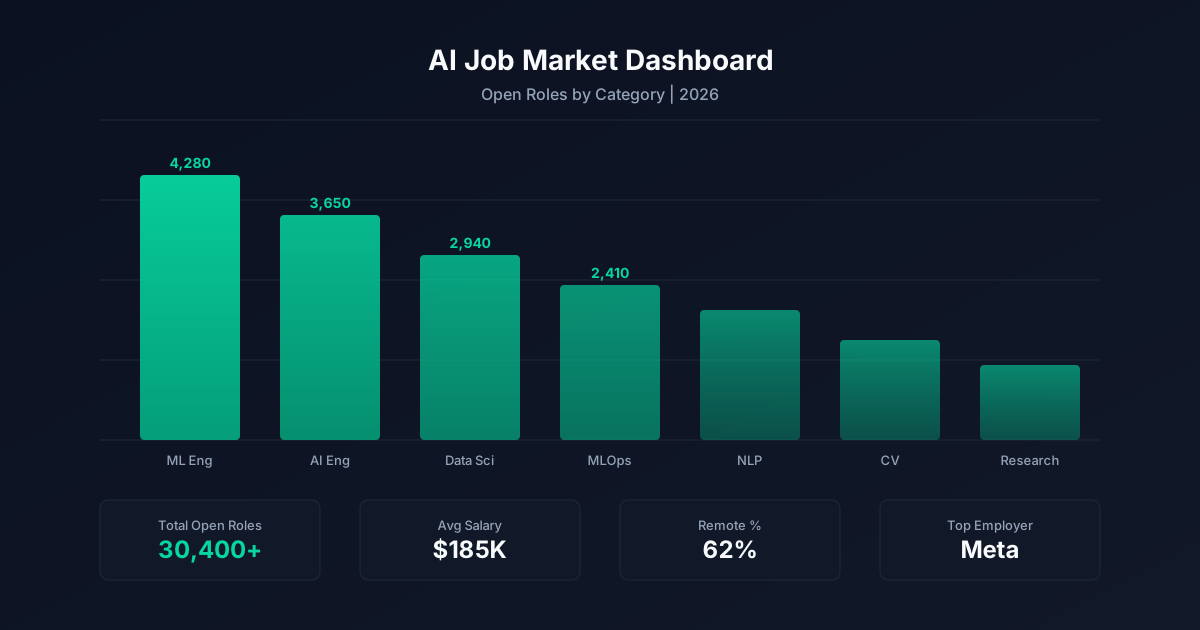
The AI job market spans 3,708 open positions across 16 role categories. The largest categories by volume: AI/ML Engineer (2,605), Data Scientist (310), AI Software Engineer (259). These three account for the majority of open positions, though smaller categories often have higher per-role compensation because of specialized skill requirements.
The seniority mix tells a story about where AI teams are in their maturity. Entry-level roles (102) are outnumbered by mid-level (1,705) and senior (1,469) positions, reflecting that most companies are past the 'build a team from scratch' phase and need experienced engineers who can ship production systems. Leadership roles (Director, VP, C-Level) total 432 positions, representing the bottleneck between technical execution and organizational strategy.
Remote work availability sits at 14% of all AI roles (508 positions), with 3,180 requiring on-site or hybrid attendance. The remote share has stabilized after the post-pandemic correction. Senior and specialized roles (Research Scientist, ML Architect) are more likely to be remote-eligible than entry-level positions, partly because experienced hires have more negotiating power and partly because these roles require less hands-on mentorship.
AI compensation is structured in clear tiers. The market median sits at $217,500. Top-quartile roles start at $272,100, and the 90th percentile reaches $325,000. These figures include base salary with disclosed compensation. Total compensation (including equity, bonuses, and sign-on) runs 20-40% higher at companies that offer those components.
Category matters for compensation. AI Safety roles lead at $300,000 median, while Prompt Engineer roles sit at $140,000. The spread between highest and lowest-paying categories reflects the premium on specialized technical skills versus broader analytical roles.
The most in-demand skills across all AI postings: Python (1,890 postings), Aws (1,103 postings), Azure (877 postings), Rag (855 postings), Gcp (631 postings), Prompt Engineering (560 postings), Pytorch (545 postings), Claude (498 postings). Python dominates, appearing in the vast majority of role descriptions regardless of category. Cloud platform experience (AWS, GCP, Azure) is the second most common requirement. The newer entrants to the top skills list (RAG, vector databases, LLM APIs) reflect the shift from traditional ML toward generative AI applications.
Frequently Asked Questions
Get Weekly AI Career Intelligence
Salary data, skills demand, and market signals from 16,000+ AI job postings. Every Monday.