
Interested in this AI Software Engineer role at KLA?
Apply Now →Skills & Technologies
About This Role
Company Overview
KLA is a global leader in diversified electronics for the semiconductor manufacturing ecosystem. Virtually every electronic device in the world is produced using our technologies. No laptop, smartphone, wearable device, voice\-controlled gadget, flexible screen, VR device or smart car would have made it into your hands without us. KLA invents systems and solutions for the manufacturing of wafers and reticles, integrated circuits, packaging, printed circuit boards and flat panel displays. The innovative ideas and devices that are advancing humanity all begin with inspiration, research and development. KLA focuses more than average on innovation and we invest 15% of sales back into R\&D. Our expert teams of physicists, engineers, data scientists and problem\-solvers work together with the world’s leading technology providers to accelerate the delivery of tomorrow’s electronic devices. Life here is exciting and our teams thrive on tackling really hard problems. There is never a dull moment with us.
Job Description/Preferred Qualifications
The AI Software Engineer will design and build AI\-driven applications powered by large language models (LLMs), with a focus on integrating AI capabilities into user\-facing products. This role emphasizes application development, orchestration, and user experience rather than model training. The engineer will develop scalable backend services, prototype intuitive user interfaces, and enable seamless interaction between users and LLM\-based systems.
This position requires a strong blend of software engineering, systems thinking, and practical AI implementation to deliver production\-ready solutions that leverage LLM APIs and frameworks.Design and develop end\-to\-end AI applications that leverage LLMs for business use cases
- Build and maintain backend services that orchestrate LLM interactions, prompts, and workflows
- Prototype and develop intuitive user interfaces that enable effective human\-AI interaction
- Integrate LLM APIs (e.g., OpenAI, Azure OpenAI, Anthropic) into scalable applications
- Develop prompt engineering strategies and manage prompt lifecycle for performance and reliability
- Implement retrieval\-augmented generation (RAG) architectures using internal and external data sources
- Design data pipelines and connectors to enterprise systems (e.g., databases, APIs, knowledge bases)
- Monitor, evaluate, and improve AI application performance using metrics such as latency, cost, and response quality
- Collaborate with product managers, data scientists, and business stakeholders to translate requirements into AI\-enabled solutions
- Ensure responsible AI practices, including privacy, security, and bias mitigation
- Rapidly prototype AI tools and iterate based on user feedback
Preferred Qualifications
----------------------------
- Experience building AI products using LLM frameworks (e.g., LangChain, Semantic Kernel, LlamaIndex)
- Knowledge of retrieval\-augmented generation (RAG) and vector databases (e.g., Pinecone, FAISS, Azure Cognitive Search)
- Vector database (Milvus) for semantic search, along with a knowledge graph (Neo4j)
- Experience orchestrating multi\-step AI workflows or agent\-based systems
- Familiarity with enterprise data platforms and integrations (e.g., Snowflake, SAP, APIs, knowledge graphs)
- Experience designing conversational interfaces or chat\-based applications
- Understanding of evaluation techniques for LLM outputs (quality, grounding, hallucination mitigation)
- Exposure to prompt optimization, fine\-tuning concepts (not necessarily hands\-on training)
- Experience deploying scalable microservices architectures
- Strong UI/UX sensibility for AI\-driven applications
- Experience working in cross\-functional teams delivering production\-grade AI solutions
- Bachelor’s degree in Computer Science, Software Engineering, or related field
- 3\+ years of professional software development experience
- Strong programming skills in Python, JavaScript, or similar languages
- Experience building and consuming RESTful APIs
- Hands\-on experience integrating LLM APIs or similar AI services into applications
- Familiarity with prompt engineering and LLM interaction patterns
- Experience developing web\-based user interfaces (e.g., React, Angular, or similar frameworks)
- Understanding of cloud platforms (e.g., Azure, Snowflake)
- Knowledge of software design principles, version control, and CI/CD practices
Minimum Qualifications
- Master's Level Degree and related work experience of 6 years; OR Bachelor's Level Degree and related work experience of 8 years; OR equivalent work experience
Base Pay Range: $111,100\.00 \- $188,900\.00 Annually
Primary Location: USA\-MI\-Ann Arbor\-KLA
KLA’s total rewards package for employees may also include participation in performance incentive programs and eligibility for additional benefits including but not limited to: medical, dental, vision, life, and other voluntary benefits, 401(K) including company matching, employee stock purchase program (ESPP), student debt assistance, tuition reimbursement program, development and career growth opportunities and programs, financial planning benefits, wellness benefits including an employee assistance program (EAP), paid time off and paid company holidays, and family care and bonding leave.
Interns are eligible for some of the benefits listed. Our pay ranges are determined by role, level, and location. The range displayed reflects the pay for this position in the primary location identified in this posting. Actual pay depends on several factors, including state minimum pay wage rates, location, job\-related skills, experience, and relevant education level or training. We are committed to complying with all applicable federal and state minimum wage requirements where applicable. If applicable, your recruiter can share more about the specific pay range for your preferred location during the hiring process.
KLA is proud to be an Equal Opportunity Employer. We will ensure that qualified individuals with disabilities are provided reasonable accommodation to participate in the job application or interview process, to perform essential job functions, and to receive other benefits and privileges of employment. Please contact us at talent.acquisition@kla.com or at \+1\-408\-352\-2808 to request accommodation.
Be aware of potentially fraudulent job postings or suspicious recruiting activity by persons that are currently posing as KLA employees. KLA never asks for any financial compensation to be considered for an interview, to become an employee, or for equipment. Further, KLA does not work with any recruiters or third parties who charge such fees either directly or on behalf of KLA . Please ensure that you have searched KLA’s Careers website for legitimate job postings. KLA follows a recruiting process that involves multiple interviews in person or on video conferencing with our hiring managers. If you are concerned that a communication, an interview, an offer of employment, or that an employee is not legitimate, please send an email to talent.acquisition@kla.com to confirm the person you are communicating with is an employee. We take your privacy very seriously and confidentially handle your information.
Salary Context
This $111K-$188K range is in the lower quartile for AI Software Engineer roles in our dataset (median: $183K across 194 roles with salary data).
Role Details
About This Role
AI Software Engineers build the applications and systems that AI models run inside. They own the API layers, data pipelines, frontend integrations, and infrastructure that turn a model into a product users interact with. Every AI company needs engineers who can build the software around the AI.
The challenge is building reliable systems around inherently unreliable components. Models are probabilistic. They'll give different answers to the same question. They hallucinate. They're slow. They're expensive. Your job is to build an application layer that handles all of this gracefully while delivering a product that users trust and enjoy.
Across the 3,708 AI roles we're tracking, AI Software Engineer positions make up 7% of the market. At KLA, this role fits into their broader AI and engineering organization.
AI Software Engineer roles are among the most numerous in the AI job market. Every company deploying AI needs software engineers who understand AI integration patterns. The demand is broad, spanning startups to enterprises, across every industry adopting AI capabilities.
What the Work Looks Like
A typical week includes: building API endpoints that serve model inference with caching and fallback logic, designing the data pipeline that feeds context to a RAG system, implementing streaming responses in the frontend, debugging a race condition in the async inference pipeline, and optimizing database queries for the vector search layer. It's full-stack engineering with AI at the center.
AI Software Engineer roles are among the most numerous in the AI job market. Every company deploying AI needs software engineers who understand AI integration patterns. The demand is broad, spanning startups to enterprises, across every industry adopting AI capabilities.
Skills Required
Full-stack engineering skills with AI integration experience. Python and TypeScript are the most common requirements. You'll need to understand API design, database architecture, and how to build reliable systems around probabilistic outputs. Experience with streaming, async processing, and caching patterns is increasingly important as real-time AI applications proliferate.
Knowledge of vector databases, embedding APIs, and LLM integration patterns (function calling, structured outputs, retry logic) differentiates AI software engineers from general software engineers. Understanding cost optimization (caching strategies, model routing, batched inference) is valuable since inference costs can dominate application economics.
Strong postings describe the product you'll be building, the AI integration patterns you'll work with, and the scale requirements. Look for companies that have existing AI features and need engineers to improve and expand them, not companies that are 'planning to add AI' someday.
Compensation Benchmarks
AI Software Engineer roles pay a median of $219,250 based on 424 positions with disclosed compensation. Mid-level AI roles across all categories have a median of $200,000. This role's midpoint ($150K) sits 32% below the category median. Disclosed range: $111K to $188K.
Across all AI roles, the market median is $217,500. Top-quartile compensation starts at $272,100. The 90th percentile reaches $325,000. For comparison, the highest-paying categories include AI Safety ($300,000) and Research Engineer ($280,000). By seniority level: Entry: $120,000; Mid: $200,000; Senior: $230,000; Director: $272,150; VP: $250,000.
KLA AI Hiring
KLA has 5 open AI roles right now. They're hiring across AI/ML Engineer, AI Software Engineer, Research Scientist. Positions span Milpitas, CA, US, Ann Arbor, MI, US. Compensation range: $188K - $235K.
Location Context
Across all AI roles, 14% (508 positions) offer remote work, while 3,180 require on-site attendance. Top AI hiring metros: New York (1,045 roles, $220,000 median); San Francisco (810 roles, $277,088 median); Los Angeles (397 roles, $215,000 median).
Career Path
Common paths into AI Software Engineer roles include Software Engineer, Full-Stack Developer, Backend Engineer.
From here, career progression typically leads toward Staff Engineer, AI Architect, Engineering Manager.
If you're a software engineer, you're already 80% there. Learn the AI integration patterns: RAG, streaming inference, function calling, structured outputs. Build a project that demonstrates you can wrap an AI model in a production-quality application with proper error handling, caching, and user experience. That's the portfolio piece that gets you hired.
What to Expect in Interviews
Technical screens look like standard software engineering interviews with an AI twist. Expect system design questions about building reliable applications around probabilistic models: handling streaming responses, implementing retry logic for API failures, and designing caching strategies for LLM outputs. Coding rounds test standard algorithms plus practical integration patterns like async processing and rate limiting.
When evaluating opportunities: Strong postings describe the product you'll be building, the AI integration patterns you'll work with, and the scale requirements. Look for companies that have existing AI features and need engineers to improve and expand them, not companies that are 'planning to add AI' someday.
AI Hiring Overview
The AI job market has 3,708 open positions tracked in our dataset. By seniority: 102 entry-level, 1,705 mid-level, 1,469 senior, and 432 leadership roles (Director, VP, C-Level). Remote roles make up 14% of the market (508 positions). The remaining 3,180 roles require on-site or hybrid attendance.
The market median for AI roles is $217,500. Top-quartile compensation starts at $272,100. The 90th percentile reaches $325,000. Highest-paying categories: AI Safety ($300,000 median, 21 roles); Research Engineer ($280,000 median, 147 roles); AI Architect ($254,798 median, 67 roles).
AI Software Engineer roles are among the most numerous in the AI job market. Every company deploying AI needs software engineers who understand AI integration patterns. The demand is broad, spanning startups to enterprises, across every industry adopting AI capabilities.
The AI Job Market Today
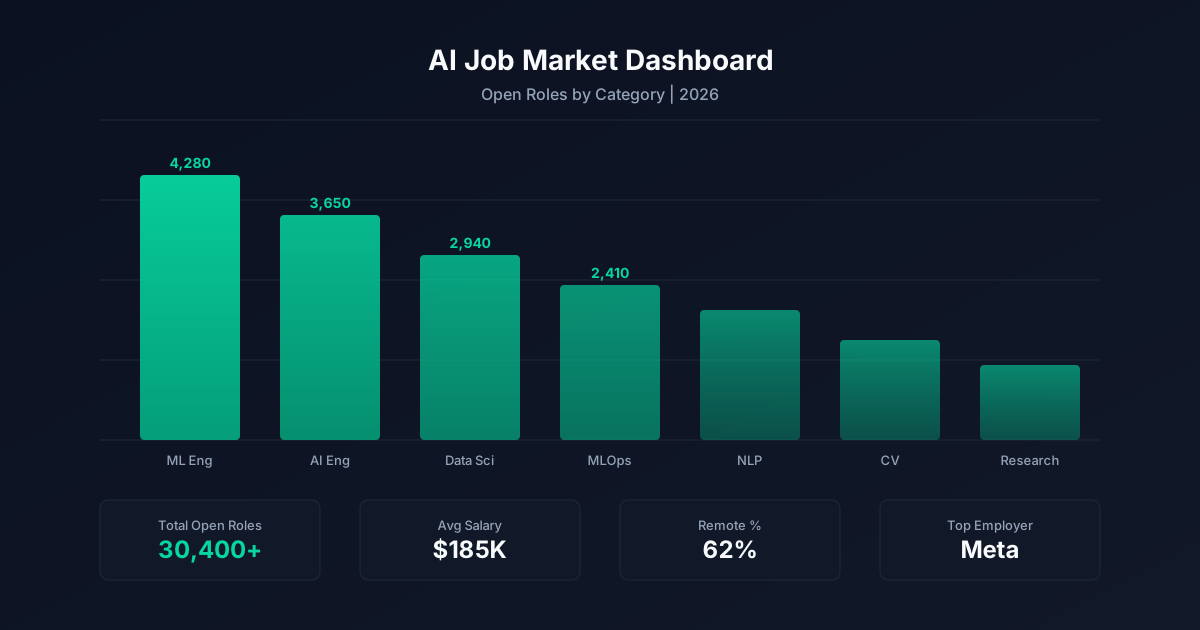
The AI job market spans 3,708 open positions across 16 role categories. The largest categories by volume: AI/ML Engineer (2,605), Data Scientist (310), AI Software Engineer (259). These three account for the majority of open positions, though smaller categories often have higher per-role compensation because of specialized skill requirements.
The seniority mix tells a story about where AI teams are in their maturity. Entry-level roles (102) are outnumbered by mid-level (1,705) and senior (1,469) positions, reflecting that most companies are past the 'build a team from scratch' phase and need experienced engineers who can ship production systems. Leadership roles (Director, VP, C-Level) total 432 positions, representing the bottleneck between technical execution and organizational strategy.
Remote work availability sits at 14% of all AI roles (508 positions), with 3,180 requiring on-site or hybrid attendance. The remote share has stabilized after the post-pandemic correction. Senior and specialized roles (Research Scientist, ML Architect) are more likely to be remote-eligible than entry-level positions, partly because experienced hires have more negotiating power and partly because these roles require less hands-on mentorship.
AI compensation is structured in clear tiers. The market median sits at $217,500. Top-quartile roles start at $272,100, and the 90th percentile reaches $325,000. These figures include base salary with disclosed compensation. Total compensation (including equity, bonuses, and sign-on) runs 20-40% higher at companies that offer those components.
Category matters for compensation. AI Safety roles lead at $300,000 median, while Prompt Engineer roles sit at $140,000. The spread between highest and lowest-paying categories reflects the premium on specialized technical skills versus broader analytical roles.
The most in-demand skills across all AI postings: Python (1,890 postings), Aws (1,103 postings), Azure (877 postings), Rag (855 postings), Gcp (631 postings), Prompt Engineering (560 postings), Pytorch (545 postings), Claude (498 postings). Python dominates, appearing in the vast majority of role descriptions regardless of category. Cloud platform experience (AWS, GCP, Azure) is the second most common requirement. The newer entrants to the top skills list (RAG, vector databases, LLM APIs) reflect the shift from traditional ML toward generative AI applications.
Frequently Asked Questions
Get Weekly AI Career Intelligence
Salary data, skills demand, and market signals from 16,000+ AI job postings. Every Monday.