
Interested in this AI Software Engineer role at LPL Financial?
Apply Now →Skills & Technologies
About This Role
*Lead with Purpose, Unlock Your Team’s Passion*
At LPL, people leaders hold the key to the employee experience — shaping culture, driving performance, and guiding individuals to new heights. Because when that happens, we all win – clients, LPL, and most importantly our, employees.
If you're ready to lead with intention and discover what’s possible, LPL Financial invites you to apply today.
LPL Financial is seeking a hands\-on AI engineering leader to own the Tenant Engine, a critical AI\-powered static\-analysis and remediation framework supporting a high\-visibility, portfolio\-scale multi\-tenant migration. This role is ideal for a builder who can combine technical depth in LLM/GenAI systems, disciplined engineering execution, and people leadership to improve code remediation quality, scan throughput, and operating cost at scale.
Job Overview
The VPII, Software Engineering Manager \& AI Lead \- M\&A \& Partner Integration owns the day\-to\-day operations, roadmap, and delivery performance of LPL’s Tenant Engine. Reporting to the SVP, Technology, this leader directs regeneration cycles across scanning, noise filtering, LLM validation, and remediated\-code generation; approves noise\-filter rules and validator/sampler prompt updates; oversees scan operations across a large repository portfolio; and coordinates engine\-to\-migration handoffs with DB \& App and E2E Quality Engineering leads. The role is accountable for the quality, throughput, actionability, and cost of the engine’s output.
Responsibilities
- Own the Tenant Engine roadmap and operating rhythm:prioritize remediation automation, portfolio\-scale scanning, and the SME\-gated regeneration loop to keep migration work moving on cadence.
- Direct regeneration cycles:lead each scan noise\-filter LLM\-validation remediated\-code generation cycle, incorporating SME feedback into successive rounds and sustaining measurable progress through the Discovery loop.
- Govern noise\-filter rules and prompts:review and approve NF rule changes and validator/sampler prompt iterations, balancing false\-positive reduction with recall, must\-fix coverage, and migration risk.
- Lead and develop the team:supervise the Applied AI Engineer, AI Platform Engineer, and scan\-operations analysts; set goals, remove blockers, and run the weekly engine standup.
- Oversee scan operations at scale:hold accountability for scan coverage, SLA performance, output integrity, and per\-finding cost across approximately 900\+ repositories in partnership with platform engineering.
- Coordinate cross\-track handoff:partner with DB \& App and E2E QE leads to move remediated findings into migration execution and represent the engine in Architecture Review Board decisions related to G\-category RLS/batch work.
- Report quality and economics:translate false\-positive rate, finding actionability, throughput, and unit\-cost trends into clear updates for senior leadership and governance forums.
- Build operational independence:establish runbooks, processes, and team capability so the engine can operate, improve, and scale without executive intervention.
What are we looking for?
We’re looking for strong collaborators who deliver exceptional client experiences and thrive in fast\-paced, team\-oriented environments. Our ideal candidates pursue greatness, act with integrity, and are driven to help our clients succeed. We value those who embrace creativity, continuous improvement, and contribute to a culture where we win together and create and share joy in our work.
Requirements
- AI/ML and engineering leadership:10 or more years of progressive software, AI, ML, platform, or data\-intensive engineering experience, including 5 or more years in AI/ML or platform technical leadership and 3 or more years directly leading engineering teams.
- Production LLM/GenAI ownership:Experience owning production LLM/GenAI systems, including prompt and evaluation pipelines, LLM validation at scale, and output quality/cost gating on AWS Bedrock or an equivalent foundation\-model platform.
- Roadmap and delivery at scale:Experience owning a technical roadmap and deliver across teams in a large\-scale or regulated program, including systems operating at portfolio scale and delivery against hard deadlines.
- Static analysis and automated remediation:Experience leading large\-scale code analysis, automated remediation, developer tooling, or similar engineering productivity programs with the depth to review code, prompts, and architecture decisions.
- Education:Bachelor’s degree in Computer Science, Engineering, or a related field, or equivalent practical experience; Master’s degree preferred.
Core Competencies
- Hands\-on technical leadership:Earns credibility through sound technical judgment while developing the team to operate with increasing independence.
- Systems thinking and prioritization:Optimizes the full scanning, validation, remediation, and handoff pipeline while focusing scarce SME and engineering capacity on must\-fix work.
- Decisive executive communication:Makes evidence\-based decisions on NF rules and prompt changes, then communicates quality, cost, throughput, and risk clearly to senior stakeholders.
Preferences
- Experience operationalizing AI in a regulated financial\-services or other compliance\-driven environment.
- Familiarity with AWS\-native ML/data infrastructure such as Bedrock, EKS, Neptune, S3, Step Functions, and infrastructure\-as\-code practices.
- Background in multi\-tenancy, platform consolidation, or large\-scale application\-modernization programs.
Pay Range:
$211,356\.00 \- $352,260\.00###
Actual base salary varies based on factors, including but not limited to, relevant skill, prior experience, education, base salary of internal peers, demonstrated performance, and geographic location. Additionally, LPL Total Rewards package is highly competitive, designed to support your success at work, at home, and at play – such as 401K matching, health benefits, employee stock options, paid time off, volunteer time off, and more. Your recruiter will be happy to discuss all that LPL has to offer! Company Overview:
LPL Financial Holdings Inc. (Nasdaq: LPLA) is among the fastest growing wealth management firms in the U.S. As a leader in the financial advisor\-mediated marketplace(6\) , LPL supports over 32,000 financial advisors and the wealth management practices of approximately 1,100 financial institutions, servicing and custodying approximately $2\.3 trillion in brokerage and advisory assets on behalf of approximately 8 million Americans. The firm provides a wide range of advisor affiliation models, investment solutions, fintech tools and practice management services, ensuring that advisors and institutions have the flexibility to choose the business model, services, and technology resources they need to run thriving businesses. For further information about LPL, please visit www.lpl.com.
At LPL, independence means that advisors and institution leaders have the freedom they deserve to choose the business model, services, and technology resources that allow them to run a thriving business. They have the flexibility to do business their way. And they have the freedom to manage their client relationships, because they know their clients best. Simply put, we take care of our advisors and institutions, so they can take care of their clients.
For further information about LPL, please visit www.lpl.com.
Join the LPL team and help us make a difference by turning life’s aspirations into financial realities. Please log in or create an account to apply to this position. Principals only. EOE.
Information on Interviews:
LPL will only communicate with a job applicant directly from an @lplfinancial.com email address and will never conduct an interview online or in a chatroom forum. During an interview, LPL will not request any form of payment from the applicant, or information regarding an applicant’s bank or credit card. Should you have any questions regarding the application process, please contact LPL’s Human Resources Solutions Center at (855\) 575\-6947\.
EAC 5\.19\.26
Salary Context
This $211K-$352K range is above the 75th percentile for AI Software Engineer roles in our dataset (median: $183K across 194 roles with salary data).
Role Details
About This Role
AI Software Engineers build the applications and systems that AI models run inside. They own the API layers, data pipelines, frontend integrations, and infrastructure that turn a model into a product users interact with. Every AI company needs engineers who can build the software around the AI.
The challenge is building reliable systems around inherently unreliable components. Models are probabilistic. They'll give different answers to the same question. They hallucinate. They're slow. They're expensive. Your job is to build an application layer that handles all of this gracefully while delivering a product that users trust and enjoy.
Across the 3,708 AI roles we're tracking, AI Software Engineer positions make up 7% of the market. At LPL Financial, this role fits into their broader AI and engineering organization.
AI Software Engineer roles are among the most numerous in the AI job market. Every company deploying AI needs software engineers who understand AI integration patterns. The demand is broad, spanning startups to enterprises, across every industry adopting AI capabilities.
What the Work Looks Like
A typical week includes: building API endpoints that serve model inference with caching and fallback logic, designing the data pipeline that feeds context to a RAG system, implementing streaming responses in the frontend, debugging a race condition in the async inference pipeline, and optimizing database queries for the vector search layer. It's full-stack engineering with AI at the center.
AI Software Engineer roles are among the most numerous in the AI job market. Every company deploying AI needs software engineers who understand AI integration patterns. The demand is broad, spanning startups to enterprises, across every industry adopting AI capabilities.
Skills Required
Full-stack engineering skills with AI integration experience. Python and TypeScript are the most common requirements. You'll need to understand API design, database architecture, and how to build reliable systems around probabilistic outputs. Experience with streaming, async processing, and caching patterns is increasingly important as real-time AI applications proliferate.
Knowledge of vector databases, embedding APIs, and LLM integration patterns (function calling, structured outputs, retry logic) differentiates AI software engineers from general software engineers. Understanding cost optimization (caching strategies, model routing, batched inference) is valuable since inference costs can dominate application economics.
Strong postings describe the product you'll be building, the AI integration patterns you'll work with, and the scale requirements. Look for companies that have existing AI features and need engineers to improve and expand them, not companies that are 'planning to add AI' someday.
Compensation Benchmarks
AI Software Engineer roles pay a median of $219,250 based on 424 positions with disclosed compensation. Senior-level AI roles across all categories have a median of $230,000. This role's midpoint ($281K) sits 29% above the category median. Disclosed range: $211K to $352K.
Across all AI roles, the market median is $217,500. Top-quartile compensation starts at $272,100. The 90th percentile reaches $325,000. For comparison, the highest-paying categories include AI Safety ($300,000) and Research Engineer ($280,000). By seniority level: Entry: $120,000; Mid: $200,000; Senior: $230,000; Director: $272,150; VP: $250,000.
LPL Financial AI Hiring
LPL Financial has 7 open AI roles right now. They're hiring across AI Software Engineer, AI/ML Engineer. Positions span Austin, TX, US, San Diego, CA, US, Fort Mill, SC, US. Compensation range: $191K - $352K.
Location Context
Across all AI roles, 14% (508 positions) offer remote work, while 3,180 require on-site attendance. Top AI hiring metros: New York (1,045 roles, $220,000 median); San Francisco (810 roles, $277,088 median); Los Angeles (397 roles, $215,000 median).
Career Path
Common paths into AI Software Engineer roles include Software Engineer, Full-Stack Developer, Backend Engineer.
From here, career progression typically leads toward Staff Engineer, AI Architect, Engineering Manager.
If you're a software engineer, you're already 80% there. Learn the AI integration patterns: RAG, streaming inference, function calling, structured outputs. Build a project that demonstrates you can wrap an AI model in a production-quality application with proper error handling, caching, and user experience. That's the portfolio piece that gets you hired.
What to Expect in Interviews
Technical screens look like standard software engineering interviews with an AI twist. Expect system design questions about building reliable applications around probabilistic models: handling streaming responses, implementing retry logic for API failures, and designing caching strategies for LLM outputs. Coding rounds test standard algorithms plus practical integration patterns like async processing and rate limiting.
When evaluating opportunities: Strong postings describe the product you'll be building, the AI integration patterns you'll work with, and the scale requirements. Look for companies that have existing AI features and need engineers to improve and expand them, not companies that are 'planning to add AI' someday.
AI Hiring Overview
The AI job market has 3,708 open positions tracked in our dataset. By seniority: 102 entry-level, 1,705 mid-level, 1,469 senior, and 432 leadership roles (Director, VP, C-Level). Remote roles make up 14% of the market (508 positions). The remaining 3,180 roles require on-site or hybrid attendance.
The market median for AI roles is $217,500. Top-quartile compensation starts at $272,100. The 90th percentile reaches $325,000. Highest-paying categories: AI Safety ($300,000 median, 21 roles); Research Engineer ($280,000 median, 147 roles); AI Architect ($254,798 median, 67 roles).
AI Software Engineer roles are among the most numerous in the AI job market. Every company deploying AI needs software engineers who understand AI integration patterns. The demand is broad, spanning startups to enterprises, across every industry adopting AI capabilities.
The AI Job Market Today
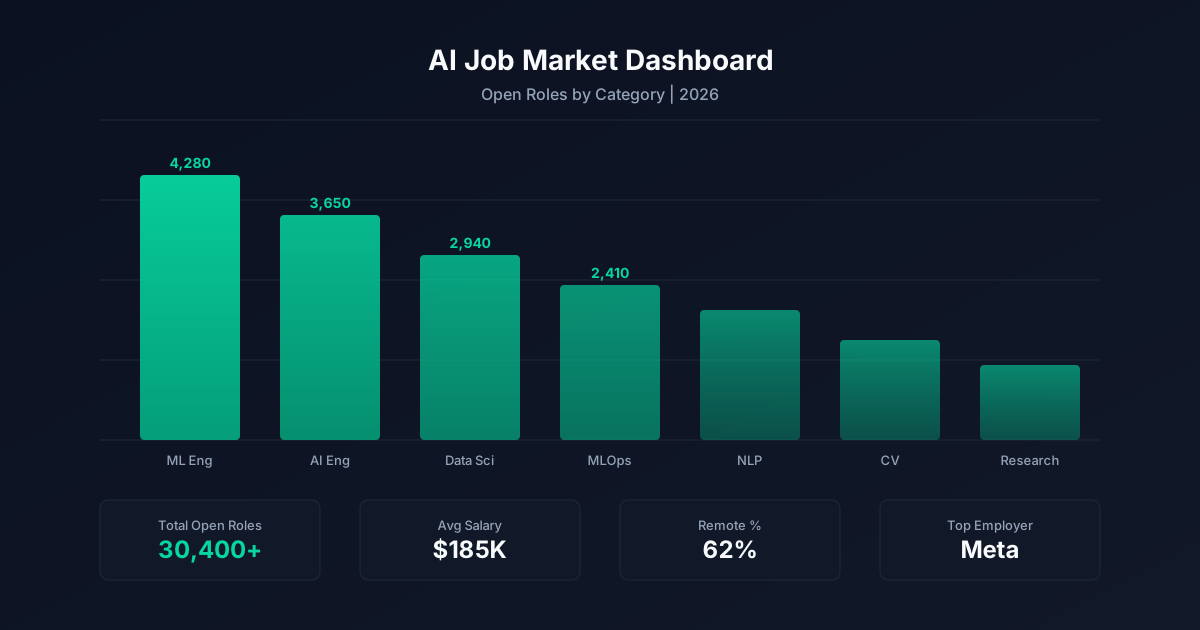
The AI job market spans 3,708 open positions across 16 role categories. The largest categories by volume: AI/ML Engineer (2,605), Data Scientist (310), AI Software Engineer (259). These three account for the majority of open positions, though smaller categories often have higher per-role compensation because of specialized skill requirements.
The seniority mix tells a story about where AI teams are in their maturity. Entry-level roles (102) are outnumbered by mid-level (1,705) and senior (1,469) positions, reflecting that most companies are past the 'build a team from scratch' phase and need experienced engineers who can ship production systems. Leadership roles (Director, VP, C-Level) total 432 positions, representing the bottleneck between technical execution and organizational strategy.
Remote work availability sits at 14% of all AI roles (508 positions), with 3,180 requiring on-site or hybrid attendance. The remote share has stabilized after the post-pandemic correction. Senior and specialized roles (Research Scientist, ML Architect) are more likely to be remote-eligible than entry-level positions, partly because experienced hires have more negotiating power and partly because these roles require less hands-on mentorship.
AI compensation is structured in clear tiers. The market median sits at $217,500. Top-quartile roles start at $272,100, and the 90th percentile reaches $325,000. These figures include base salary with disclosed compensation. Total compensation (including equity, bonuses, and sign-on) runs 20-40% higher at companies that offer those components.
Category matters for compensation. AI Safety roles lead at $300,000 median, while Prompt Engineer roles sit at $140,000. The spread between highest and lowest-paying categories reflects the premium on specialized technical skills versus broader analytical roles.
The most in-demand skills across all AI postings: Python (1,890 postings), Aws (1,103 postings), Azure (877 postings), Rag (855 postings), Gcp (631 postings), Prompt Engineering (560 postings), Pytorch (545 postings), Claude (498 postings). Python dominates, appearing in the vast majority of role descriptions regardless of category. Cloud platform experience (AWS, GCP, Azure) is the second most common requirement. The newer entrants to the top skills list (RAG, vector databases, LLM APIs) reflect the shift from traditional ML toward generative AI applications.
Frequently Asked Questions
Get Weekly AI Career Intelligence
Salary data, skills demand, and market signals from 16,000+ AI job postings. Every Monday.