
Interested in this AI/ML Engineer role at lululemon?
Apply Now →Skills & Technologies
About This Role
who we are
lululemon is an innovative performance apparel company for yoga, running, training, and other athletic pursuits. Setting the bar in technical fabrics and functional design, we create transformational products and experiences that support people in moving, growing, connecting, and being well. We owe our success to our innovative product, emphasis on stores, commitment to our people, and the incredible connections we make in every community we're in. As a company, we focus on creating positive change to build a healthier, thriving future. In particular, that includes creating an equitable, inclusive and growth-focused environment for our people.
About this team
Global Product Technology (GPT) delivers the platforms and capabilities that power lululemon’s product lifecycle - from 2D/3D design and development to merchandising, sourcing, assortment planning, master data management, and go to market. We partner closely with design, technical development, merchandising, sourcing, and planning functions to accelerate speed to market and elevate quality through PLM modernization, digital product creation, data and integration platforms, assortment planning, size planning, master data management, analytics, decision-making solutions, and AI assisted workflows.
The role
We’re seeking a Senior Director Technology to define and execute a multi year technology strategy that transforms how lululemon merchandises, plans, and deliver products to our guests. This leader will modernize the merchandise planning and allocations suite of solutions and related integration stacks, scale our capabilities to enable assortment planning, space planning, size planning, and embed AI-driven automation to compress planning cycles and unlock better business decision-making through both historical and forward looking insights. You will lead a global, multi disciplinary engineering organization across North America and India, stewarding platforms, products, and vendor ecosystems that serve our merchants and planners end to end.
The ideal candidate will have a history of demonstrated results leading large, cross-functional, and global teams to accomplish transformational initiatives across functional/matrixed organizations. They must thrive in fast-paced environments, be able to manage through ambiguity and complexity, commission charters and empower teams to create and simplify processes, and simultaneously support a growing global organization. This role requires excellent communication, organizational skills, and the ability to drive ideas from concept to execution. Maturity, curiosity, creative problem solving, and team leadership are all essential for success in this role.
Key responsibilities:
- Collaborate with internal stakeholders, drive change initiatives, and foster a culture of continuous improvement to keep pace with the organization’s growth strategy.
- Manage resources, oversee financial interests, and implement essential policies, practices, and processes.
- Evident leadership skills, a proven track record of building strong teams, setting high performance standards, challenging people to excel and eliciting their sustained high performance.
- Excellent verbal and written communication skills is essential.
- Drive world-class engineering solutions that are reliable, observable, secure, compliant, and highly available.
- Blend deep technical expertise with visionary leadership, to guide a globally dispersed engineering team that drives platform and solution modernization with advanced AI capabilities such as LLMs, vector retrieval, computer vision, and intelligent agents.
- You will drive the design and implementation of scalable, secure, and responsible AI/ML enabled systems that bridge merchandising, and planning - ensuring technology accelerates decisions-making.
- Translate lululemon’s merchandising and planning vision into a multi-year solution realization strategy.
- Leverage AI and ML solutions to drive measurable impact across planning capabilities that include attributes generation, demand forecasting, allocation optimization, store clustering, etc.
- Translate complex AI/ML architectures into clear narratives for executive stakeholders.
- Champion transparency, inclusion, and ethics as core enablers of innovation.
- Develop future-ready leaders capable of balancing technical depth and business acumen to drive meaningful growth.
Qualifications:
- Bachelor’s degree in computer science, or related field.
- 5+ years of engineering leadership and delivery experience.
- 5+ years in retail, merchandise planning and allocations, or related field is a bonus.
- Demonstrated experience in managing large budgets.
- Demonstrated experience translating business strategy into technology and engineering roadmaps.
- Demonstrated experience in data-heavy planning systems such as Anaplan, Oracle RPAS, etc.
- Expert proficiency in programming languages (eg: Python, Java), and relevant libraries/frameworks (TensorFlow, PyTorch, scikit-learn, etc.).
- Deep understanding of machine learning, NLP, computer vision, and generative AI techniques.
- Able to produce documentation such as narratives and root cause analysis providing actionable insights.
- Hands on experience with cloud platforms (AWS, GCP, Azure), and MLOps tools.
- Strong knowledge of data engineering concepts and big data.
- Continuous learning mindset that stays on the leading edge of applied ML, LLM’s and NLP advancements.
- Exceptional communication and storytelling skills for executive audiences.
- PhD/Master’s in computer science, applied mathematics, statistics is a bonus.
must haves
- Acknowledge the presence of choice in every moment and take personal responsibility for your life.
- Possess an entrepreneurial spirit and continuously innovate to achieve great results.
- Communicate with honesty and kindness and create the space for others to do the same.
- Lead with courage, knowing the possibility of greatness is bigger than the fear of failure.
- Foster connection by putting people first and building trusting relationships.
- Integrate fun and joy as a way of being and working, aka doesn’t take yourself too seriously.
additional notes
Authorization to work in the United States is required for this role.
compensation and benefits package
lululemon’s compensation offerings are grounded in a pay-for-performance philosophy that recognizes exceptional individual and team performance. The typical hiring range for this position is from $223,100 - $292,800 annually; the base pay offered is based on market location and may vary depending on job-related knowledge, skills, experience, and internal equity. As part of our total rewards offering, permanent employees in this position may be eligible for our competitive annual bonus program and equity offerings, subject to program eligibility requirements.
At lululemon, investing in our people is a top priority. We believe that when life works, work works. We strive to be the place where inclusive leaders come to develop and enable all to be well. Recognizing our teams for their performance and dedication, other components of our total rewards offerings include support of career development, wellbeing, and personal growth:
- Extended health and dental benefits, and mental health plans
- Paid time off
- Savings and retirement plan matching
- Generous employee discount
- Fitness & yoga classes
- Parenthood top-up
- Extensive catalog of development course offerings
- People networks, mentorship programs, and leadership series (to name a few)
Note: The incentive programs, benefits, and perks have certain eligibility requirements. The Company reserves the right to alter these incentive programs, benefits, and perks in whole or in part at any time without advance notice.
workplace arrangement
Hybrid
In-person collaboration and connection is important to our culture. Work is performed onsite, minimum 4 days per week.
#LI-Onsite #LI-AC1
Salary Context
This $223K-$292K range is above the 75th percentile for AI/ML Engineer roles in our dataset (median: $170K across 217 roles with salary data).
View full AI/ML Engineer salary data →Role Details
About This Role
AI/ML Engineers build and deploy machine learning models in production. They work across the full ML lifecycle: data pipelines, model training, evaluation, and serving infrastructure. The role has evolved significantly over the past two years. Where ML Engineers once spent most of their time on model architecture, the job now tilts heavily toward inference optimization, cost management, and integrating LLM capabilities into existing systems. Companies want engineers who can ship production systems, and the experimenter-only role is fading fast.
Day-to-day, you're writing training pipelines, debugging data quality issues, setting up evaluation frameworks, and figuring out why your model performs differently in staging than it did on your dev set. The best ML engineers are obsessive about reproducibility and measurement. They instrument everything. They know that a model is only as good as the data feeding it and the infrastructure serving it.
Across the 3,897 AI roles we're tracking, AI/ML Engineer positions make up 70% of the market. At lululemon, this role fits into their broader AI and engineering organization.
Demand for AI/ML Engineers has been strong and consistent. Unlike some AI roles that spike with hype cycles, ML engineering is a foundational need. Every company deploying AI models needs people who can keep them running, and the gap between research prototypes and production systems keeps growing.
What the Work Looks Like
A typical week might include: debugging a data pipeline that's silently dropping 3% of training examples, running A/B tests on a new model version, writing documentation for a feature flag system that lets you roll back model deployments, and reviewing a junior engineer's PR for a new evaluation metric. Meetings tend to be cross-functional since ML touches product, engineering, and data teams.
Demand for AI/ML Engineers has been strong and consistent. Unlike some AI roles that spike with hype cycles, ML engineering is a foundational need. Every company deploying AI models needs people who can keep them running, and the gap between research prototypes and production systems keeps growing.
Skills Required
Python and PyTorch dominate the requirements. Most roles expect experience with cloud platforms (AWS, GCP, or Azure) and familiarity with ML frameworks like TensorFlow or JAX. RAG (Retrieval-Augmented Generation) has become a top-3 skill requirement as companies integrate LLMs into their products. Docker and Kubernetes show up in about a third of postings, reflecting the production focus of the role.
Beyond the core stack, employers increasingly want experience with experiment tracking tools (MLflow, Weights & Biases), feature stores, and vector databases. Fine-tuning experience is valuable but less common than you'd think from reading Twitter. Most production LLM work is RAG and prompt engineering, not fine-tuning. If you have both, you're in a strong position.
Companies that are serious about AI/ML hiring tend to post specific infrastructure details in the job description: the frameworks they use, their model serving stack, their data pipeline tools. Vague postings that just say 'ML experience required' without specifics are often companies that haven't figured out what they need yet.
Compensation Benchmarks
AI/ML Engineer roles pay a median of $154,000 based on 8,743 positions with disclosed compensation. Director-level AI roles across all categories have a median of $230,600. This role's midpoint ($257K) sits 68% above the category median. Disclosed range: $223K to $292K.
Across all AI roles, the market median is $190,000. Top-quartile compensation starts at $244,000. The 90th percentile reaches $300,688. For comparison, the highest-paying categories include AI Engineering Manager ($293,500) and AI Safety ($274,200). By seniority level: Entry: $85,000; Mid: $147,000; Senior: $225,000; Director: $230,600; VP: $248,357.
lululemon AI Hiring
lululemon has 1 open AI role right now. They're hiring across AI/ML Engineer. Based in Seattle, WA, US. Compensation range: $292K - $292K.
Location Context
AI roles in Seattle pay a median of $223,600 across 744 tracked positions. That's 18% above the national median.
Career Path
Common paths into AI/ML Engineer roles include Data Scientist, Software Engineer, Research Engineer.
From here, career progression typically leads toward ML Architect, AI Engineering Manager, Principal ML Engineer.
The fastest path into ML engineering is through software engineering with a self-directed ML education. A CS degree helps, but production engineering skills matter more than academic credentials. Build something that works, deploy it, and measure it. That portfolio project is worth more than a Coursera certificate. For career growth, the fork comes around the senior level: go deep on technical complexity (staff/principal track) or move into managing ML teams.
What to Expect in Interviews
Expect system design questions around ML pipelines: how you'd build a training pipeline for a specific use case, handle data drift, or design A/B testing infrastructure for model deployments. Coding rounds typically involve Python, with emphasis on data manipulation (pandas, numpy) and algorithm implementation. Take-home assignments often ask you to build an end-to-end ML pipeline from raw data to deployed model.
When evaluating opportunities: Companies that are serious about AI/ML hiring tend to post specific infrastructure details in the job description: the frameworks they use, their model serving stack, their data pipeline tools. Vague postings that just say 'ML experience required' without specifics are often companies that haven't figured out what they need yet.
AI Hiring Overview
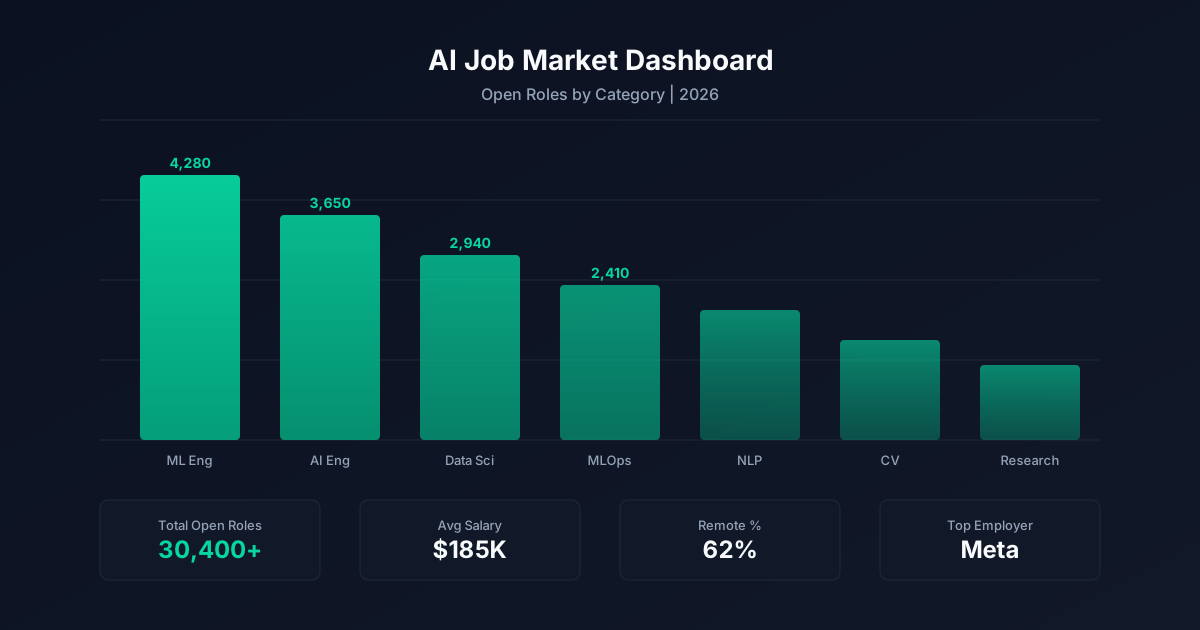
The AI job market has 3,897 open positions tracked in our dataset. By seniority: 111 entry-level, 1,958 mid-level, 1,413 senior, and 415 leadership roles (Director, VP, C-Level). Remote roles make up 16% of the market (615 positions). The remaining 3,251 roles require on-site or hybrid attendance.
The market median for AI roles is $190,000. Top-quartile compensation starts at $244,000. The 90th percentile reaches $300,688. Highest-paying categories: AI Engineering Manager ($293,500 median, 21 roles); AI Safety ($274,200 median, 24 roles); Research Engineer ($260,000 median, 264 roles).
Demand for AI/ML Engineers has been strong and consistent. Unlike some AI roles that spike with hype cycles, ML engineering is a foundational need. Every company deploying AI models needs people who can keep them running, and the gap between research prototypes and production systems keeps growing.
The AI Job Market Today
The AI job market spans 3,897 open positions across 16 role categories. The largest categories by volume: AI/ML Engineer (2,733), Data Scientist (273), AI Software Engineer (271). These three account for the majority of open positions, though smaller categories often have higher per-role compensation because of specialized skill requirements.
The seniority mix tells a story about where AI teams are in their maturity. Entry-level roles (111) are outnumbered by mid-level (1,958) and senior (1,413) positions, reflecting that most companies are past the 'build a team from scratch' phase and need experienced engineers who can ship production systems. Leadership roles (Director, VP, C-Level) total 415 positions, representing the bottleneck between technical execution and organizational strategy.
Remote work availability sits at 16% of all AI roles (615 positions), with 3,251 requiring on-site or hybrid attendance. The remote share has stabilized after the post-pandemic correction. Senior and specialized roles (Research Scientist, ML Architect) are more likely to be remote-eligible than entry-level positions, partly because experienced hires have more negotiating power and partly because these roles require less hands-on mentorship.
AI compensation is structured in clear tiers. The market median sits at $190,000. Top-quartile roles start at $244,000, and the 90th percentile reaches $300,688. These figures include base salary with disclosed compensation. Total compensation (including equity, bonuses, and sign-on) runs 20-40% higher at companies that offer those components.
Category matters for compensation. AI Engineering Manager roles lead at $293,500 median, while Prompt Engineer roles sit at $145,600. The spread between highest and lowest-paying categories reflects the premium on specialized technical skills versus broader analytical roles.
The most in-demand skills across all AI postings: Python (2,064 postings), Aws (1,085 postings), Azure (867 postings), Rag (865 postings), Gcp (697 postings), Pytorch (650 postings), Prompt Engineering (597 postings), Kubernetes (499 postings). Python dominates, appearing in the vast majority of role descriptions regardless of category. Cloud platform experience (AWS, GCP, Azure) is the second most common requirement. The newer entrants to the top skills list (RAG, vector databases, LLM APIs) reflect the shift from traditional ML toward generative AI applications.
Frequently Asked Questions
Get Weekly AI Career Intelligence
Salary data, skills demand, and market signals from 16,000+ AI job postings. Every Monday.