
Interested in this AI/ML Engineer role at Lumexa Imaging?
Apply Now →Skills & Technologies
About This Role
Lumexa Imaging is one of the country's largest providers of outpatient medical imaging. With over 5,000 team members and more than 185 outpatient imaging centers across 13 states, our team conducts more than 4 million outpatient studies annually. We are the partner of choice for health systems and radiologists, delivering best\-in\-class clinical excellence, operations, and state\-of\-the\-art technology across our platform.
AI Solution Engineer, Clinical Imaging
Lumexa Imaging is seeking an experienced AI Adoption Engineer, Clinical Imaging to lead the technical evaluation, validation, and successful clinical adoption of AI solutions across our imaging environment. Reporting to the SVP of AI Integrations and partnering closely with clinical leadership, the Clinical Applications team, and broader IT functions, this role owns the end\-to\-end process of bringing third\-party clinical AI software from vendor selection through validated, deployment\-ready recommendation.
This role sits at the intersection of clinical imaging workflow expertise, hands\-on AI/ML implementation, and enterprise integration. The ideal candidate is equally comfortable installing and configuring vendor AI software across a range of deployment environments, designing validation methodologies that compare AI\-generated results against radiologist findings using LLM/NLP techniques, and translating those findings into clear, defensible recommendations for live clinical deployment.
Success requires deep familiarity with radiology and imaging workflows from day one, including PACS, RIS, DICOM, HL7, and how radiologists read and report studies, combined with the ability to collaborate credibly with both clinical leadership and technical IT stakeholders.
Key Responsibilities
Clinical AI Deployment, Validation \& Methodology
- Install, configure, and maintain a diverse portfolio of third\-party clinical AI software (including detection, classification, quantification, triage, decision support, and reporting solutions) across deployment environments in collaboration with Clinical Applications team, such as Lumexa's AI sandbox, vendor\-provided edge servers, on\-premise infrastructure, and cloud\-based architectures – this role is expected to contribute to the decision\-making of such best\-fit architectures
- Establish and operate DICOM routing, HL7 messaging, and de\-identification workflows for both medical images and reports to support safe, compliant evaluation at scale
- Design and execute structured validation studies tailored to each AI solution's clinical purpose, applying methodologies and metrics appropriate to the output type (e.g., sensitivity, specificity, discrepancy rates, clinical/workflow impact measures)
- Build LLM/NLP\-based comparison and analysis frameworks that systematically evaluate AI outputs against radiologist ground truth or other clinically relevant benchmarks
- Build and continuously evolve Lumexa's clinical AI validation playbook as a flexible, reusable framework, including automated tooling that reduces time\-to\-evaluation through streamlined de\-identification, cohort selection, and vendor data transfer
- Author clear, evidence\-based go/no\-go recommendations for the AI Governance Council, including risk assessment and deployment scope
Clinical Leadership Partnership \& Workflow Integration
- Collaborate closely with the Chief Medical Officer, National Physician Leadership Board, and local clinical/operational leaders to validate clinical solutions, define ground truth, set acceptance thresholds, and ensure AI capabilities align with radiologist workflows and clinical priorities
- Translate validated AI capabilities into deployment\-ready integration designs that fit within radiologist reading workflows, and turn clinical feedback into actionable technical configurations to drive maximum fit
- Map current\-state vs. future\-state workflows showing how AI outputs surface to radiologists, technologists, and operations teams
- Identify workflow risks, change management considerations, and adoption barriers ahead of production deployment, and build trust with clinical leadership through clear communication and rigorous methodology
- Build trust and credibility with clinical leadership through clear communication, rigorous methodology, and responsiveness to clinical input
Cross\-Functional Technical Collaboration
- Partner with the Clinical Applications team to ensure validated solutions are designed for production\-portable deployment and to support the handoff from evaluation to live implementation in clinical technology stack (RIS, PACS, Reporting, etc.)
- Engage Infrastructure to assess deployment architecture, edge server requirements, network considerations, compute and storage needs, and networking with existing environments
- Engage Information Security to evaluate vendor security posture, data handling practices, encryption, access controls, and HIPAA compliance
- Assess each vendor's overall technical maturity, including how the solution is built, supportability, scalability, and readiness for enterprise engagement, and surface risks early in the evaluation process
Vendor Technical Evaluation
- Partner with the AI Integrations leadership team and Procurement during vendor selection by assessing technical fit, integration complexity, performance claims, and FDA/regulatory status
- Conduct hands\-on technical due diligence including reviewing model performance documentation, regulatory clearances, edge server architecture, and integration requirements
- Support contract negotiations with technical input on SLAs, model retraining cadence, and performance guarantees
Continuous Improvement \& Knowledge Leadership
- Stay current on the rapidly evolving clinical imaging AI landscape, including new vendors, modalities, FDA clearances, and CPT reimbursement codes
- Identify opportunities to expand Lumexa's clinical AI portfolio based on emerging capabilities
- Contribute to thought leadership in AI governance and validation methodology
Required Qualifications
- 5\+ years of experience in clinical imaging informatics, radiology AI deployment, or imaging AI vendor field engineeringCon
- Hands\-on experience installing and configuring clinical AI software across one or more deployment environments (sandbox, edge server, on\-prem, or cloud), including end\-to\-end responsibility for data routing, anonymization, and system configuration
- Demonstrated working knowledge of clinical imaging workflows, including how radiologists read studies, interpret findings and finalize reports
- Strong fluency with imaging informatics standards: DICOM, HL7, FHIR, and PACS/RIS architecture
- Hands\-on technical skills with Python (or equivalent) for scripting validation pipelines, data extraction, and comparison analysis
- Experience with LLM/NLP techniques for text comparison, semantic similarity, or structured information extraction from clinical reports
- Demonstrated experience designing and executing AI performance validation studies, including defining metrics, ground truth, and study methodology
- Demonstrated experience building or improving automated de\-identification and data preparation pipelines for clinical AI vendor evaluations, including PACS cohort selection, DICOM header and burned\-in pixel anonymization, paired report de\-identification, and secure vendor packaging. Hands\-on experience with DICOM routing and anonymization platforms (e.g., Laurel Bridge Compass, RSNA CTP) alongside complementary tooling (e.g., Presidio, AWS Comprehend Medical, OCR\-based pixel masking) strongly desired
- Proven ability to collaborate with both clinical leadership and technical IT stakeholders
- Ability to operate independently in ambiguous, fast\-moving environments with minimal oversight
- Strong project scoping, prioritization, and execution skills across multiple concurrent vendor evaluations and projects
Preferred Qualifications
- Basic clinical knowledge of radiology modalities and respective clinical workflows (e.g., CT, MRI, mammography, X\-ray, ultrasound)
- Experience at a clinical imaging AI vendor in a solutions, field, or implementation engineering capacity
- CIIP (Certified Imaging Informatics Professional) certification or equivalent
- Background as a radiology technologist, imaging informaticist, or radiology research engineer
- Experience with cloud platforms (AWS, Azure, GCP) for AI workload deployment
- Familiarity with FDA 510(k) clearance process and CPT reimbursement codes for imaging AI
- Strong understanding of HIPAA and healthcare compliance requirements related to clinical AI
- Advanced degree in biomedical engineering, medical imaging, computer science, or related field
Success Profile
- Clinically fluent: Speaks the language of radiology and imaging workflows with credibility
- Hands\-on and pragmatic: Builds, installs, and validates directly rather than just designing on paper
- Methodologically rigorous: Brings structure and reproducibility to validation, not ad\-hoc testing
- Cross\-functionally credible: Earns the trust of IT, clinical and operational stakeholders
- Self\-starter: Identifies what needs to be done and drives it forward with minimal direction
- Adaptable: Thrives in a fast\-evolving AI landscape with new vendors, modalities, and capabilities arriving constantly
- Continuous learner: Actively stays current on imaging AI capabilities, regulatory developments, and validation methodologies
Example Scope of Work – Modality and Vendor Example for Illustration Purpose Only
- Installing a new chest CT AI vendor's edge server in the appropriate environment, configuring DICOM routing and de\-identification, and running it against a curated set of exams to score AI\-vs\-radiologist concordance using LLM\-based report comparison
- Designing the validation study, ground truth methodology, and acceptance criteria for a new mammography AI module in partnership with lead breast radiologists and the CMO
- Partnering with Infrastructure and Information Security to evaluate a vendor's edge server architecture, security posture, and overall technical maturity prior to procurement
- Building the standard validation playbook applied to every new imaging AI module before live deployment
- Monitoring post\-deployment performance of live AI solutions and validating real\-world results against pre\-deployment assumptions and expectations, identifying drift, performance gaps, or unintended workflow impact, and recommending tuning, expansion, or retirement appropriate
Lumexa Imaging provides a competitive compensation program to attract, retain, and motivate a high\-performance workforce.
Lumexa Imaging is an equal opportunity employer.
Role Details
About This Role
AI/ML Engineers build and deploy machine learning models in production. They work across the full ML lifecycle: data pipelines, model training, evaluation, and serving infrastructure. The role has evolved significantly over the past two years. Where ML Engineers once spent most of their time on model architecture, the job now tilts heavily toward inference optimization, cost management, and integrating LLM capabilities into existing systems. Companies want engineers who can ship production systems, and the experimenter-only role is fading fast.
Day-to-day, you're writing training pipelines, debugging data quality issues, setting up evaluation frameworks, and figuring out why your model performs differently in staging than it did on your dev set. The best ML engineers are obsessive about reproducibility and measurement. They instrument everything. They know that a model is only as good as the data feeding it and the infrastructure serving it.
Across the 3,708 AI roles we're tracking, AI/ML Engineer positions make up 70% of the market. At Lumexa Imaging, this role fits into their broader AI and engineering organization.
Demand for AI/ML Engineers has been strong and consistent. Unlike some AI roles that spike with hype cycles, ML engineering is a foundational need. Every company deploying AI models needs people who can keep them running, and the gap between research prototypes and production systems keeps growing.
What the Work Looks Like
A typical week might include: debugging a data pipeline that's silently dropping 3% of training examples, running A/B tests on a new model version, writing documentation for a feature flag system that lets you roll back model deployments, and reviewing a junior engineer's PR for a new evaluation metric. Meetings tend to be cross-functional since ML touches product, engineering, and data teams.
Demand for AI/ML Engineers has been strong and consistent. Unlike some AI roles that spike with hype cycles, ML engineering is a foundational need. Every company deploying AI models needs people who can keep them running, and the gap between research prototypes and production systems keeps growing.
Skills Required
Python and PyTorch dominate the requirements. Most roles expect experience with cloud platforms (AWS, GCP, or Azure) and familiarity with ML frameworks like TensorFlow or JAX. RAG (Retrieval-Augmented Generation) has become a top-3 skill requirement as companies integrate LLMs into their products. Docker and Kubernetes show up in about a third of postings, reflecting the production focus of the role.
Beyond the core stack, employers increasingly want experience with experiment tracking tools (MLflow, Weights & Biases), feature stores, and vector databases. Fine-tuning experience is valuable but less common than you'd think from reading Twitter. Most production LLM work is RAG and prompt engineering, not fine-tuning. If you have both, you're in a strong position.
Companies that are serious about AI/ML hiring tend to post specific infrastructure details in the job description: the frameworks they use, their model serving stack, their data pipeline tools. Vague postings that just say 'ML experience required' without specifics are often companies that haven't figured out what they need yet.
Compensation Benchmarks
AI/ML Engineer roles pay a median of $218,750 based on 3,817 positions with disclosed compensation. Mid-level AI roles across all categories have a median of $200,000.
Across all AI roles, the market median is $217,500. Top-quartile compensation starts at $272,100. The 90th percentile reaches $325,000. For comparison, the highest-paying categories include AI Safety ($300,000) and Research Engineer ($280,000). By seniority level: Entry: $120,000; Mid: $200,000; Senior: $230,000; Director: $272,150; VP: $250,000.
Lumexa Imaging AI Hiring
Lumexa Imaging has 1 open AI role right now. They're hiring across AI/ML Engineer. Based in Plano, TX, US.
Location Context
Across all AI roles, 14% (508 positions) offer remote work, while 3,180 require on-site attendance. Top AI hiring metros: New York (1,045 roles, $220,000 median); San Francisco (810 roles, $277,088 median); Los Angeles (397 roles, $215,000 median).
Career Path
Common paths into AI/ML Engineer roles include Data Scientist, Software Engineer, Research Engineer.
From here, career progression typically leads toward ML Architect, AI Engineering Manager, Principal ML Engineer.
The fastest path into ML engineering is through software engineering with a self-directed ML education. A CS degree helps, but production engineering skills matter more than academic credentials. Build something that works, deploy it, and measure it. That portfolio project is worth more than a Coursera certificate. For career growth, the fork comes around the senior level: go deep on technical complexity (staff/principal track) or move into managing ML teams.
What to Expect in Interviews
Expect system design questions around ML pipelines: how you'd build a training pipeline for a specific use case, handle data drift, or design A/B testing infrastructure for model deployments. Coding rounds typically involve Python, with emphasis on data manipulation (pandas, numpy) and algorithm implementation. Take-home assignments often ask you to build an end-to-end ML pipeline from raw data to deployed model.
When evaluating opportunities: Companies that are serious about AI/ML hiring tend to post specific infrastructure details in the job description: the frameworks they use, their model serving stack, their data pipeline tools. Vague postings that just say 'ML experience required' without specifics are often companies that haven't figured out what they need yet.
AI Hiring Overview
The AI job market has 3,708 open positions tracked in our dataset. By seniority: 102 entry-level, 1,705 mid-level, 1,469 senior, and 432 leadership roles (Director, VP, C-Level). Remote roles make up 14% of the market (508 positions). The remaining 3,180 roles require on-site or hybrid attendance.
The market median for AI roles is $217,500. Top-quartile compensation starts at $272,100. The 90th percentile reaches $325,000. Highest-paying categories: AI Safety ($300,000 median, 21 roles); Research Engineer ($280,000 median, 147 roles); AI Architect ($254,798 median, 67 roles).
Demand for AI/ML Engineers has been strong and consistent. Unlike some AI roles that spike with hype cycles, ML engineering is a foundational need. Every company deploying AI models needs people who can keep them running, and the gap between research prototypes and production systems keeps growing.
The AI Job Market Today
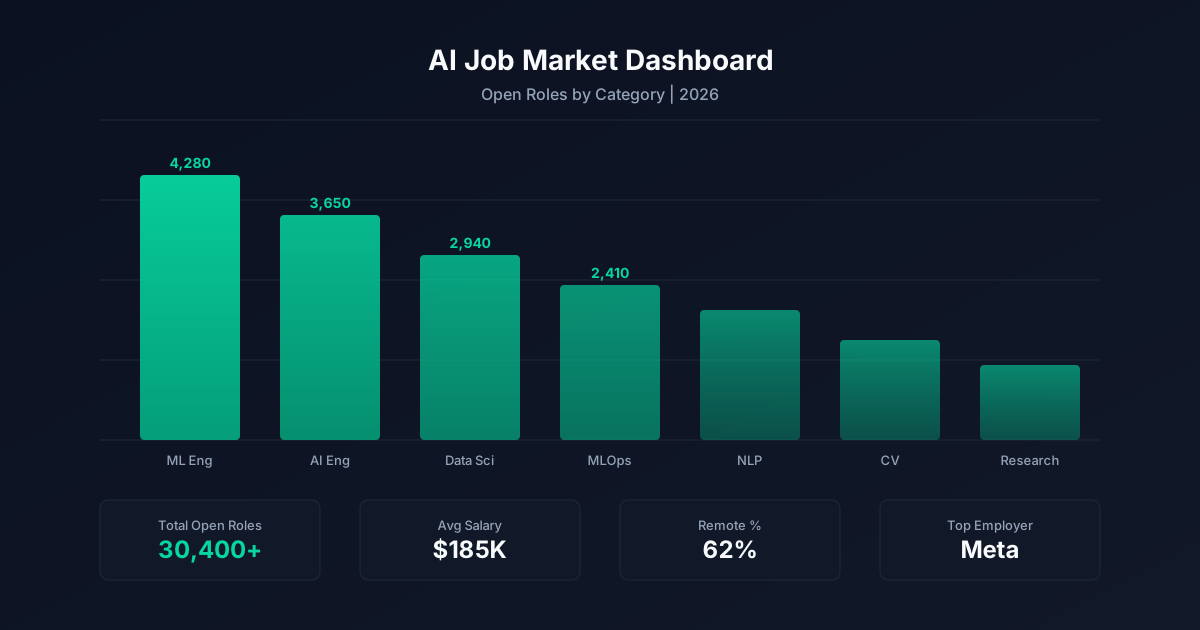
The AI job market spans 3,708 open positions across 16 role categories. The largest categories by volume: AI/ML Engineer (2,605), Data Scientist (310), AI Software Engineer (259). These three account for the majority of open positions, though smaller categories often have higher per-role compensation because of specialized skill requirements.
The seniority mix tells a story about where AI teams are in their maturity. Entry-level roles (102) are outnumbered by mid-level (1,705) and senior (1,469) positions, reflecting that most companies are past the 'build a team from scratch' phase and need experienced engineers who can ship production systems. Leadership roles (Director, VP, C-Level) total 432 positions, representing the bottleneck between technical execution and organizational strategy.
Remote work availability sits at 14% of all AI roles (508 positions), with 3,180 requiring on-site or hybrid attendance. The remote share has stabilized after the post-pandemic correction. Senior and specialized roles (Research Scientist, ML Architect) are more likely to be remote-eligible than entry-level positions, partly because experienced hires have more negotiating power and partly because these roles require less hands-on mentorship.
AI compensation is structured in clear tiers. The market median sits at $217,500. Top-quartile roles start at $272,100, and the 90th percentile reaches $325,000. These figures include base salary with disclosed compensation. Total compensation (including equity, bonuses, and sign-on) runs 20-40% higher at companies that offer those components.
Category matters for compensation. AI Safety roles lead at $300,000 median, while Prompt Engineer roles sit at $140,000. The spread between highest and lowest-paying categories reflects the premium on specialized technical skills versus broader analytical roles.
The most in-demand skills across all AI postings: Python (1,890 postings), Aws (1,103 postings), Azure (877 postings), Rag (855 postings), Gcp (631 postings), Prompt Engineering (560 postings), Pytorch (545 postings), Claude (498 postings). Python dominates, appearing in the vast majority of role descriptions regardless of category. Cloud platform experience (AWS, GCP, Azure) is the second most common requirement. The newer entrants to the top skills list (RAG, vector databases, LLM APIs) reflect the shift from traditional ML toward generative AI applications.
Frequently Asked Questions
Get Weekly AI Career Intelligence
Salary data, skills demand, and market signals from 16,000+ AI job postings. Every Monday.