
Interested in this AI/ML Engineer role at Mammoth Brands?
Apply Now →Skills & Technologies
About This Role
About Mammoth Brands
Mammoth Brands (formerly Harry's Inc.) is the modern CPG company behind brands Harry's, Flamingo, Lume, Mando, and Coterie. We're building a new model—and home—brands, founders, and talent looking to solve unmet needs, improve peoples' lives, and ultimately challenge the status quo. Our mission is to "Create Things People Like More." Simply put: everything we do should be better than what already exists. If it's not, we don't do it. This guides everything we do, from developing the best product experiences, to making Mammoth Brands a great place to work, to exploring innovative ways to give back to our community.
We got our start in 2013 when our co\-founders created Harry's. They built the brand differently—online first, prioritizing direct relationships with customers—and in the process learned they'd created something bigger: a playbook and platform that could help other brands grow and scale to their full potential, and a vision to reimagine consumer packaged goods. Today, Mammoth Brands is a growing portfolio of brands and the largest CPG company built in the last 20 years. Even as we grow, we take extra care to maintain the small, scrappy, entrepreneurial culture that helped to get us where we are today: to create a company that people like more, that better serves its customers, employees, and community. As a company, we're also committed to making a positive impact and have donated over $20 million through our network of nonprofit partners to date.
About the team
The Central AI Team is leading Mammoth Brands' transformation into an AI\-native company. We believe AI will drive the largest shift to how businesses operate in our lifetimes, and we are investing accordingly — across people, tools, infrastructure, and the workflows that run our business. Our 2026 mandate is to scale AI adoption thoughtfully across every function, drive measurable business impact in our highest\-priority areas, and democratize access to high\-quality data so every team can move faster.
The team partners across Marketing, Growth, CX, Supply Chain, Finance, Product, Analytics, Legal, Retail, and Technology to embed AI into real work, accelerate adoption of approved tools, and build custom solutions where off\-the\-shelf software is not enough. We sit at the intersection of strategy, engineering, and execution — and we are building the playbook for how Mammoth Brands operates in the AI era.
About the role
This is not a theoretical role. It is an operational technical leadership position responsible for translating Mammoth Brands' AI ambition into deployed systems, durable infrastructure, and measurable business outcomes.
As Director of Technology, AI Transformation, you will own the technical strategy and execution arm of the Central AI Team. You will report directly to the CTO \& Chief AI Officer and partner closely with the Head of GenAI Strategy to set direction across the company's AI portfolio. You will hire and lead a team of Forward Deployed AI Engineers, make the build\-versus\-buy calls that determine where we invest, and own the infrastructure — agents, evals, integrations, MCP servers, data plumbing — that makes our AI work scalable, secure, and reliable.
You will operate as the senior technical voice in the room when functional teams scope ambitious AI initiatives, when vendors pitch us, and when we have to decide whether a workflow gets a custom build, a configured tool, or a different approach entirely. You will also be a hands\-on builder when it matters. The role demands strong technical judgment, fast execution, and the ability to lead through influence across a cross\-functional org.
This is a career\-defining opportunity to shape how a major CPG company runs in the AI era — with real budget, real executive backing, and a team to build it with you.
What you will accomplish
- Own the technical AI strategy for Mammoth Brands — agent architecture, tooling stack, data access patterns, and the infrastructure that lets us scale from dozens of pilots to hundreds of deployed workflows
- Lead the Forward Deployed AI Engineering team, setting hiring bar, technical standards, and the operating model for embedding engineers with business teams
- Drive build\-versus\-buy decisions across the AI portfolio — partnering with the Head of GenAI Strategy and functional VPs to evaluate vendors, configure existing tools deeply, and build custom only where it creates differentiated advantage
- Partner closely with the Data Platform team to ensure Mammoth Brands' data foundation is AI\-ready — informing warehouse architecture, data modeling, governance, and access patterns so that agents, copilots, and analytics tools can reliably reason over our data
- Set the standard for AI infrastructure at Mammoth Brands — evals, prompt systems, agent frameworks, observability, and reusable patterns that turn one\-off solutions into platform capabilities
- Partner with Security, Legal, and IT to build the governance frameworks that let us move fast responsibly — data privacy, vendor security review, model selection, and responsible AI practices
- Serve as the technical lead in executive forums — translating AI capabilities into business outcomes for the C\-suite, Lane Leads, and Board, and shaping technical roadmaps that align with company priorities
- Scout the emerging AI landscape — model releases, agent frameworks, MCP ecosystem, vertical AI tooling — and translate what matters into clear recommendations and pilots
- Build durable cross\-functional partnerships with AI Champions across the company, ensuring the central team's technical work compounds against the workflows our teams actually run
- Own the technical AI tooling budget and make it deliver against business outcomes
This should describe you
- You have 12\+ years of experience in software engineering, applied AI, platform engineering, or technical leadership roles, including meaningful time leading engineering teams
- You have deep, current technical fluency in modern AI — LLMs, agentic systems, retrieval, evals, prompt engineering, MCP, and the tradeoffs between hosted models, open weights, and fine\-tuning
- You have shipped real AI systems into production at scale — not just prototypes — and you know what breaks, what's expensive, and what's fragile
- You have led technical organizations through ambiguous, fast\-moving environments and built the operating muscles that let small teams deliver disproportionate impact
- You have strong product and business judgment. You can sit across from a CMO, a Head of Growth, or a Head of Supply Chain and translate their problem into a technical plan — and the reverse
- You have a clear point of view on build versus buy, and you have made those calls with real money on the line
- You communicate with executive presence. You can present to a CEO, defend a roadmap to a CFO, and rally an engineering team in the same week
- You have success collaborating across diverse teams \& stakeholders and driving cross\-functional consensus
- You are pragmatic to the core. You care more about workflow impact and adoption than novelty, and you are allergic to AI theater
- You move fast and lead from the front. You are still hands\-on enough to spike a prototype, debug an agent, or write the eval when it matters
- You build great teams. You have a track record of hiring excellent engineers and creating environments where they do their best work
- You are excited by the opportunity to help define how Mammoth Brands operates in the AI era — and to build a function and a playbook that could become a model for the industry
The opportunity
This role reports directly to the CTO \& Chief AI Officer, sits on the Central AI team, and works in close partnership with the Head of GenAI Strategy. You will have visibility to the CEO, the Lane Leads, and the broader executive team. You will own real budget, build a real team, and ship work that touches every function in the company.
If you want to define how a major CPG company runs in the AI era — and you want to do it with autonomy, executive backing, and a team that's already moving — we'd love to talk.
Benefits and perks
- Medical, dental, and vision coverage
- 401k match
- Equity in Mammoth Brands
- Flexible time off and working hours
- L\&D stipend
- 4 weeks sabbatical after 5 years, 6 weeks after 10 years, and 8 weeks after 15 years
- 20 fully paid weeks off for parents who give birth, or 16 fully paid weeks off for all other paths to parenthood
- Fun IRL and virtual events including happy hours, team building events, and parties on our rooftop
- Free products from our family of brands
*The Mammoth Brands' working model is in\-office Tuesday, Wednesday, and Thursday. Our beautiful* *70,000 square foot SoHo office* *is decked out with bagels on Wednesdays and lunch on Thursdays, and fully stocked kitchens with snacks, coffee, and drinks everyday. Can't forget the free products and the opportunity to have some meetings without Zoom!*
We can't quantify all of the intangible things we think you'll love about working at Mammoth Brands, like the exciting challenges we tackle, the smart and humble team you'll get to work with, and our supportive and inclusive culture. That said, our salary ranges are based on paying competitively for our size and industry, and are one part of our total rewards package, which also includes a comprehensive set of benefits and our equity program. The base salary hiring range for this position is $285,000\-$300,000, but the final compensation offer will ultimately be based on the candidate's location, skill level and experience.
Mammoth Brands is committed to bringing together individuals from different backgrounds and perspectives. We strive to create an inclusive environment where everyone can thrive, feel a sense of belonging, and do great work together.
Mammoth Brands is an Equal Opportunity Employer, providing equal employment and advancement opportunities to all individuals. We recruit, hire and promote into all job levels the most qualified applicants without regard to race, color, creed, national origin, religion, sex (including pregnancy, childbirth and related medical conditions), parental status, age, disability, genetic information, citizenship status, veteran status, gender identity or expression, transgender status, sexual orientation, marital, family or partnership status, political affiliation or activities, military service, domestic violence victim status, arrest/conviction record, sexual or reproductive health decisions, caregiver status, credit history immigration status, unemployment status, traits historically associated with race, including but not limited to hair texture and protective hairstyles or any other status protected under applicable federal, state and local laws. Mammoth Brands' commitment to providing equal employment opportunities extends to all aspects of employment, including job assignment, compensation, discipline and access to benefits and training.
We respect the laws enforced by the EEOC and are dedicated to going above and beyond in fostering diversity across our company.
*If visa sponsorship is required for work authorization, please note that Mammoth Brands in collaboration with immigration counsel will manage and submit all necessary legal filings on behalf of the candidate.*
Salary Context
This $285K-$300K range is above the 75th percentile for AI/ML Engineer roles in our dataset (median: $180K across 1841 roles with salary data).
View full AI/ML Engineer salary data →Role Details
About This Role
AI/ML Engineers build and deploy machine learning models in production. They work across the full ML lifecycle: data pipelines, model training, evaluation, and serving infrastructure. The role has evolved significantly over the past two years. Where ML Engineers once spent most of their time on model architecture, the job now tilts heavily toward inference optimization, cost management, and integrating LLM capabilities into existing systems. Companies want engineers who can ship production systems, and the experimenter-only role is fading fast.
Day-to-day, you're writing training pipelines, debugging data quality issues, setting up evaluation frameworks, and figuring out why your model performs differently in staging than it did on your dev set. The best ML engineers are obsessive about reproducibility and measurement. They instrument everything. They know that a model is only as good as the data feeding it and the infrastructure serving it.
Across the 3,708 AI roles we're tracking, AI/ML Engineer positions make up 70% of the market. At Mammoth Brands, this role fits into their broader AI and engineering organization.
Demand for AI/ML Engineers has been strong and consistent. Unlike some AI roles that spike with hype cycles, ML engineering is a foundational need. Every company deploying AI models needs people who can keep them running, and the gap between research prototypes and production systems keeps growing.
What the Work Looks Like
A typical week might include: debugging a data pipeline that's silently dropping 3% of training examples, running A/B tests on a new model version, writing documentation for a feature flag system that lets you roll back model deployments, and reviewing a junior engineer's PR for a new evaluation metric. Meetings tend to be cross-functional since ML touches product, engineering, and data teams.
Demand for AI/ML Engineers has been strong and consistent. Unlike some AI roles that spike with hype cycles, ML engineering is a foundational need. Every company deploying AI models needs people who can keep them running, and the gap between research prototypes and production systems keeps growing.
Skills Required
Python and PyTorch dominate the requirements. Most roles expect experience with cloud platforms (AWS, GCP, or Azure) and familiarity with ML frameworks like TensorFlow or JAX. RAG (Retrieval-Augmented Generation) has become a top-3 skill requirement as companies integrate LLMs into their products. Docker and Kubernetes show up in about a third of postings, reflecting the production focus of the role.
Beyond the core stack, employers increasingly want experience with experiment tracking tools (MLflow, Weights & Biases), feature stores, and vector databases. Fine-tuning experience is valuable but less common than you'd think from reading Twitter. Most production LLM work is RAG and prompt engineering, not fine-tuning. If you have both, you're in a strong position.
Companies that are serious about AI/ML hiring tend to post specific infrastructure details in the job description: the frameworks they use, their model serving stack, their data pipeline tools. Vague postings that just say 'ML experience required' without specifics are often companies that haven't figured out what they need yet.
Compensation Benchmarks
AI/ML Engineer roles pay a median of $218,750 based on 3,817 positions with disclosed compensation. Director-level AI roles across all categories have a median of $272,150. This role's midpoint ($292K) sits 34% above the category median. Disclosed range: $285K to $300K.
Across all AI roles, the market median is $217,500. Top-quartile compensation starts at $272,100. The 90th percentile reaches $325,000. For comparison, the highest-paying categories include AI Safety ($300,000) and Research Engineer ($280,000). By seniority level: Entry: $120,000; Mid: $200,000; Senior: $230,000; Director: $272,150; VP: $250,000.
Mammoth Brands AI Hiring
Mammoth Brands has 1 open AI role right now. They're hiring across AI/ML Engineer. Based in New York, NY, US. Compensation range: $300K - $300K.
Location Context
AI roles in New York pay a median of $220,000 across 1,045 tracked positions.
Career Path
Common paths into AI/ML Engineer roles include Data Scientist, Software Engineer, Research Engineer.
From here, career progression typically leads toward ML Architect, AI Engineering Manager, Principal ML Engineer.
The fastest path into ML engineering is through software engineering with a self-directed ML education. A CS degree helps, but production engineering skills matter more than academic credentials. Build something that works, deploy it, and measure it. That portfolio project is worth more than a Coursera certificate. For career growth, the fork comes around the senior level: go deep on technical complexity (staff/principal track) or move into managing ML teams.
What to Expect in Interviews
Expect system design questions around ML pipelines: how you'd build a training pipeline for a specific use case, handle data drift, or design A/B testing infrastructure for model deployments. Coding rounds typically involve Python, with emphasis on data manipulation (pandas, numpy) and algorithm implementation. Take-home assignments often ask you to build an end-to-end ML pipeline from raw data to deployed model.
When evaluating opportunities: Companies that are serious about AI/ML hiring tend to post specific infrastructure details in the job description: the frameworks they use, their model serving stack, their data pipeline tools. Vague postings that just say 'ML experience required' without specifics are often companies that haven't figured out what they need yet.
AI Hiring Overview
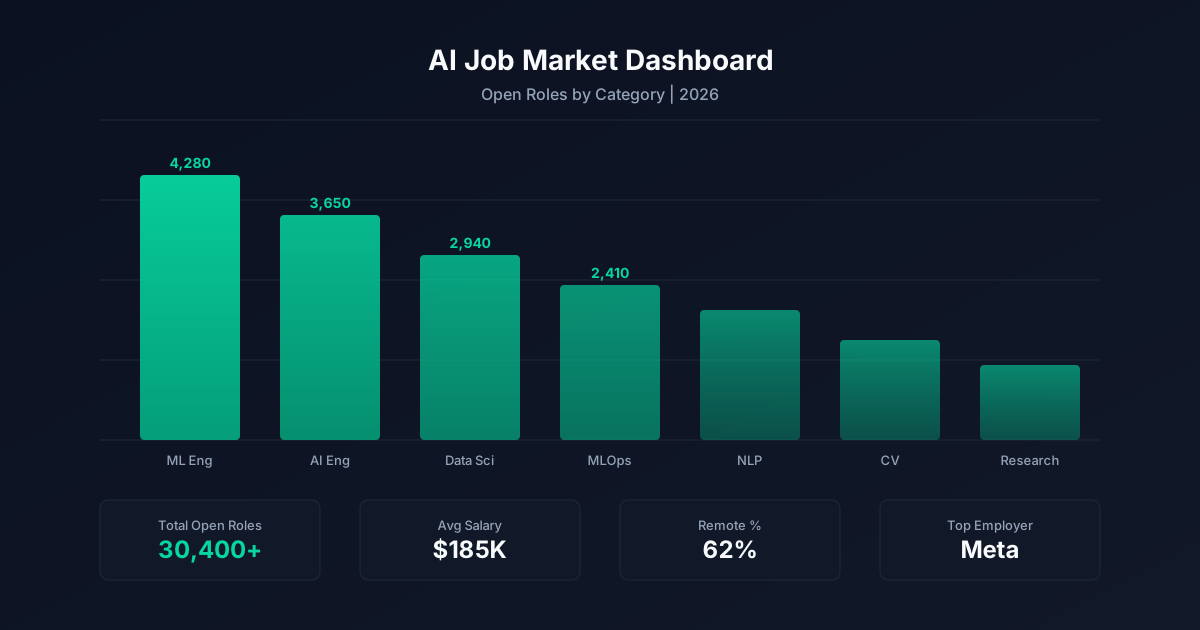
The AI job market has 3,708 open positions tracked in our dataset. By seniority: 102 entry-level, 1,705 mid-level, 1,469 senior, and 432 leadership roles (Director, VP, C-Level). Remote roles make up 14% of the market (508 positions). The remaining 3,180 roles require on-site or hybrid attendance.
The market median for AI roles is $217,500. Top-quartile compensation starts at $272,100. The 90th percentile reaches $325,000. Highest-paying categories: AI Safety ($300,000 median, 21 roles); Research Engineer ($280,000 median, 147 roles); AI Architect ($254,798 median, 67 roles).
Demand for AI/ML Engineers has been strong and consistent. Unlike some AI roles that spike with hype cycles, ML engineering is a foundational need. Every company deploying AI models needs people who can keep them running, and the gap between research prototypes and production systems keeps growing.
The AI Job Market Today
The AI job market spans 3,708 open positions across 16 role categories. The largest categories by volume: AI/ML Engineer (2,605), Data Scientist (310), AI Software Engineer (259). These three account for the majority of open positions, though smaller categories often have higher per-role compensation because of specialized skill requirements.
The seniority mix tells a story about where AI teams are in their maturity. Entry-level roles (102) are outnumbered by mid-level (1,705) and senior (1,469) positions, reflecting that most companies are past the 'build a team from scratch' phase and need experienced engineers who can ship production systems. Leadership roles (Director, VP, C-Level) total 432 positions, representing the bottleneck between technical execution and organizational strategy.
Remote work availability sits at 14% of all AI roles (508 positions), with 3,180 requiring on-site or hybrid attendance. The remote share has stabilized after the post-pandemic correction. Senior and specialized roles (Research Scientist, ML Architect) are more likely to be remote-eligible than entry-level positions, partly because experienced hires have more negotiating power and partly because these roles require less hands-on mentorship.
AI compensation is structured in clear tiers. The market median sits at $217,500. Top-quartile roles start at $272,100, and the 90th percentile reaches $325,000. These figures include base salary with disclosed compensation. Total compensation (including equity, bonuses, and sign-on) runs 20-40% higher at companies that offer those components.
Category matters for compensation. AI Safety roles lead at $300,000 median, while Prompt Engineer roles sit at $140,000. The spread between highest and lowest-paying categories reflects the premium on specialized technical skills versus broader analytical roles.
The most in-demand skills across all AI postings: Python (1,890 postings), Aws (1,103 postings), Azure (877 postings), Rag (855 postings), Gcp (631 postings), Prompt Engineering (560 postings), Pytorch (545 postings), Claude (498 postings). Python dominates, appearing in the vast majority of role descriptions regardless of category. Cloud platform experience (AWS, GCP, Azure) is the second most common requirement. The newer entrants to the top skills list (RAG, vector databases, LLM APIs) reflect the shift from traditional ML toward generative AI applications.
Frequently Asked Questions
Get Weekly AI Career Intelligence
Salary data, skills demand, and market signals from 16,000+ AI job postings. Every Monday.