
Interested in this LLM Engineer role at Meta?
Apply Now →Skills & Technologies
About This Role
From making valuable connections between people and businesses to building premium services that deliver high\-value experiences, the Monetization organization at Meta empowers people and businesses to succeed in the global economy. As Meta focuses on building the next evolution of social experiences, the Monetization team plays a crucial role in shaping the communication pathways and financial tools that all sized businesses need to thrive in the new digital economic environment. As a Machine Learning Research Scientist on the Monetization team at Meta, you can help build ML/AI technologies that can effectively connect users with businesses You’ll help develop solutions that power next\-generation, large\-scale platforms and AI innovations to power the Ads\-ranking for Meta\-scale across all the Meta surfaces.
### AI Research Scientist, VLLM (Vision Large Language Models) \- Generative AI Responsibilities:
- Develop highly scalable classifiers and tools leveraging Machine Learning, data regression, and rules\-based models
- Suggest, collect, and synthesize requirements to create an effective feature roadmap
- Adapt standard Machine Learning methods to best exploit modern parallel environments (e.g., distributed clusters, multicore SMP, and GPU)
- Lead and contribute to cutting\-edge research that results in industry\-leading tech demos and/or publications
- Collaborate closely with cross\-functional partners and contribute to Meta's research product development
### Minimum Qualifications:
- Experience in Deep Learning algorithms and techniques, e.g., convolutional neural networks (CNN), transformers, quantization, data\-efficient learning, or similar
- Must obtain work authorization in the country of employment at the time of hire and maintain ongoing work authorization during employment
### Preferred Qualifications:
- Demonstrated research and software engineering experience via an internship, work experience, coding competitions, or widely used contributions in open source repositories (e.g. GitHub)
- Experience in data efficient learning, domain adaptation, semi\-supervised learning, etc
- Experience working and communicating cross\-functionally in a team environment
- Proven track record of achieving significant results as demonstrated by grants, fellowships, patents, as well as first\-authored publications at leading workshops or conferences such as NeurIPS, ICML, ICLR, AAAI, or similar
- Exposure to architectural patterns of large\-scale software applications
- Experience in manipulating and analyzing complex, high\-volume, high\-dimensionality data from various sources
- Experience solving complex problems and comparing alternative solutions, trade\-offs, and varied points of view to determine a path forward
### About Meta:
Meta builds technologies that help people connect, find communities, and grow businesses. When Facebook launched in 2004, it changed the way people connect. Apps like Messenger, Instagram and WhatsApp further empowered billions around the world. Now, Meta is moving beyond 2D screens toward immersive experiences like augmented and virtual reality to help build the next evolution in social technology. People who choose to build their careers by building with us at Meta help shape a future that will take us beyond what digital connection makes possible today—beyond the constraints of screens, the limits of distance, and even the rules of physics.
Meta is proud to be an Equal Employment Opportunity and Affirmative Action employer. We do not discriminate based upon race, religion, color, national origin, sex (including pregnancy, childbirth, or related medical conditions), sexual orientation, gender, gender identity, gender expression, transgender status, sexual stereotypes, age, status as a protected veteran, status as an individual with a disability, or other applicable legally protected characteristics. We also consider qualified applicants with criminal histories, consistent with applicable federal, state and local law. Meta participates in the E\-Verify program in certain locations, as required by law. Please note that Meta may leverage artificial intelligence and machine learning technologies in connection with applications for employment.
Meta is committed to providing reasonable accommodations for candidates with disabilities in our recruiting process. If you need any assistance or accommodations due to a disability, please let us know at accommodations\-ext@meta.com.
$154,000/year to $217,000/year \+ bonus \+ equity \+ benefits
Individual compensation is determined by skills, qualifications, experience, and location. Compensation details listed in this posting reflect the base hourly rate, monthly rate, or annual salary only, and do not include bonus, equity or sales incentives, if applicable. In addition to base compensation, Meta offers benefits. Learn more about benefits at Meta.
Role Details
About This Role
LLM Engineers specialize in building applications powered by large language models. They design RAG systems, fine-tune models, build agent frameworks, and optimize inference pipelines for cost and latency. This is the role that didn't exist three years ago and now has thousands of open positions.
The scope is broad. You might be building a customer support chatbot that needs to pull from a knowledge base of 50,000 documents, or designing an agent that can navigate a company's internal tools to complete multi-step tasks. The common thread is taking a foundation model and making it do something useful, reliably, at scale, without bankrupting the company on API costs.
Across the 3,708 AI roles we're tracking, LLM Engineer positions make up 0% of the market. At Meta, this role fits into their broader AI and engineering organization.
LLM Engineer is one of the fastest-growing AI job titles. Every company building AI-powered products needs people who understand the full stack: from embedding models to vector stores to inference optimization. The supply of experienced LLM engineers is thin because the field is so new, which keeps compensation high and demand strong.
What the Work Looks Like
A typical week includes: building and testing RAG pipelines (chunking strategies, embedding models, retrieval evaluation), debugging why the agent took a wrong action path, optimizing inference costs (caching, batching, model selection), and working with the product team on new LLM-powered features. You'll context-switch between deep technical work and cross-functional collaboration.
LLM Engineer is one of the fastest-growing AI job titles. Every company building AI-powered products needs people who understand the full stack: from embedding models to vector stores to inference optimization. The supply of experienced LLM engineers is thin because the field is so new, which keeps compensation high and demand strong.
Skills Required
RAG and vector databases are the most common requirements. Expect to work with LangChain or LlamaIndex, embedding models, and at least one vector store (Pinecone, Weaviate, Chroma). Python is non-negotiable. Understanding the cost/latency/quality tradeoffs between different model providers and architectures is what separates senior from junior engineers.
Fine-tuning experience is valuable for specific use cases but most production LLM work is RAG-based. Agent frameworks (LangGraph, CrewAI, custom orchestration) are increasingly important as companies move beyond simple chat interfaces. Evaluation and observability tools (LangSmith, Arize, custom dashboards) are essential for production deployments.
Look for roles that specify the production stack, mention specific use cases, and talk about cost optimization. Companies that understand LLM engineering will mention evaluation methodology, latency requirements, and scale targets. Vague 'build AI features' postings often mean they haven't figured out their architecture yet.
Compensation Benchmarks
LLM Engineer roles pay a median of $203,940 based on 9 positions with disclosed compensation. Mid-level AI roles across all categories have a median of $200,000. This role's midpoint ($185K) sits 9% below the category median. Disclosed range: $154K to $217K.
Across all AI roles, the market median is $217,500. Top-quartile compensation starts at $272,100. The 90th percentile reaches $325,000. For comparison, the highest-paying categories include AI Safety ($300,000) and Research Engineer ($280,000). By seniority level: Entry: $120,000; Mid: $200,000; Senior: $230,000; Director: $272,150; VP: $250,000.
Meta AI Hiring
Meta has 26 open AI roles right now. They're hiring across Research Engineer, AI/ML Engineer, AI Product Manager, LLM Engineer. Positions span Menlo Park, CA, US, Burlingame, CA, US, New York, NY, US. Compensation range: $181K - $356K.
Location Context
AI roles in New York pay a median of $220,000 across 1,045 tracked positions.
Career Path
Common paths into LLM Engineer roles include Software Engineer, ML Engineer, Data Engineer.
From here, career progression typically leads toward AI Architect, Principal Engineer, AI Engineering Manager.
The fastest path is through software engineering. If you can build production systems and you understand LLM capabilities and limitations, you're already qualified for most roles. Build a portfolio project that demonstrates RAG implementation, evaluation, and cost optimization. Open-source contributions to LLM frameworks are strong signals to hiring managers.
What to Expect in Interviews
Technical screens cover RAG architecture design, embedding model selection, chunking strategies, and retrieval evaluation. Expect questions about cost optimization: how you'd reduce inference costs by 50% without degrading quality. System design rounds often present scenarios like 'design a customer support chatbot that can access 100K documents' and evaluate your understanding of the full stack from embedding to serving.
When evaluating opportunities: Look for roles that specify the production stack, mention specific use cases, and talk about cost optimization. Companies that understand LLM engineering will mention evaluation methodology, latency requirements, and scale targets. Vague 'build AI features' postings often mean they haven't figured out their architecture yet.
AI Hiring Overview
The AI job market has 3,708 open positions tracked in our dataset. By seniority: 102 entry-level, 1,705 mid-level, 1,469 senior, and 432 leadership roles (Director, VP, C-Level). Remote roles make up 14% of the market (508 positions). The remaining 3,180 roles require on-site or hybrid attendance.
The market median for AI roles is $217,500. Top-quartile compensation starts at $272,100. The 90th percentile reaches $325,000. Highest-paying categories: AI Safety ($300,000 median, 21 roles); Research Engineer ($280,000 median, 147 roles); AI Architect ($254,798 median, 67 roles).
LLM Engineer is one of the fastest-growing AI job titles. Every company building AI-powered products needs people who understand the full stack: from embedding models to vector stores to inference optimization. The supply of experienced LLM engineers is thin because the field is so new, which keeps compensation high and demand strong.
The AI Job Market Today
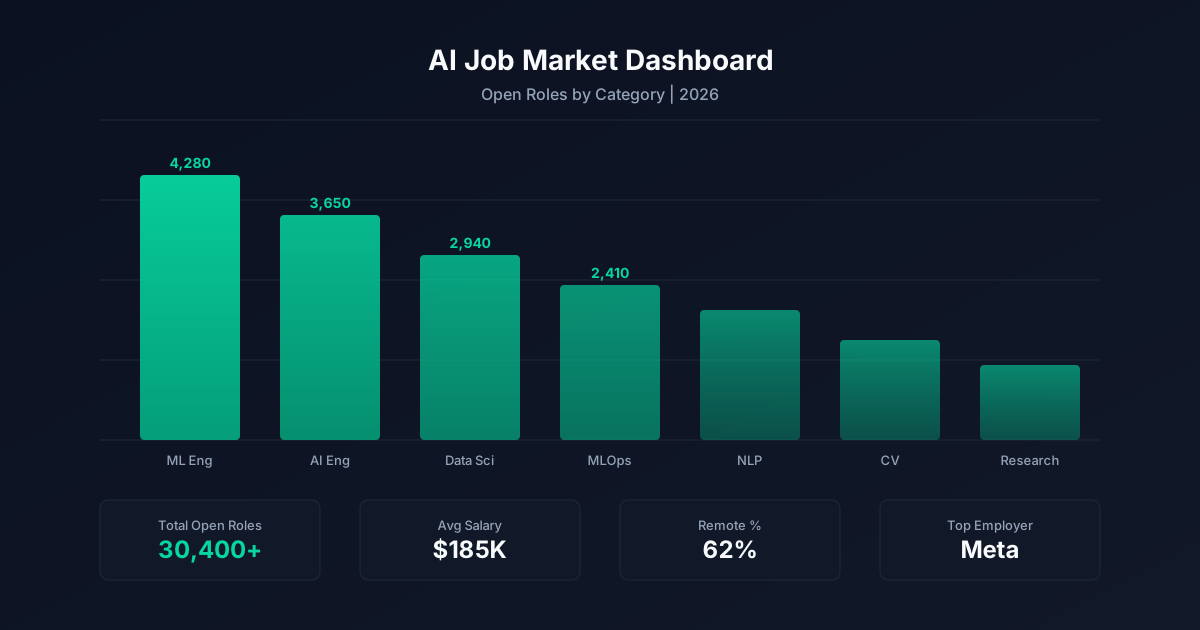
The AI job market spans 3,708 open positions across 16 role categories. The largest categories by volume: AI/ML Engineer (2,605), Data Scientist (310), AI Software Engineer (259). These three account for the majority of open positions, though smaller categories often have higher per-role compensation because of specialized skill requirements.
The seniority mix tells a story about where AI teams are in their maturity. Entry-level roles (102) are outnumbered by mid-level (1,705) and senior (1,469) positions, reflecting that most companies are past the 'build a team from scratch' phase and need experienced engineers who can ship production systems. Leadership roles (Director, VP, C-Level) total 432 positions, representing the bottleneck between technical execution and organizational strategy.
Remote work availability sits at 14% of all AI roles (508 positions), with 3,180 requiring on-site or hybrid attendance. The remote share has stabilized after the post-pandemic correction. Senior and specialized roles (Research Scientist, ML Architect) are more likely to be remote-eligible than entry-level positions, partly because experienced hires have more negotiating power and partly because these roles require less hands-on mentorship.
AI compensation is structured in clear tiers. The market median sits at $217,500. Top-quartile roles start at $272,100, and the 90th percentile reaches $325,000. These figures include base salary with disclosed compensation. Total compensation (including equity, bonuses, and sign-on) runs 20-40% higher at companies that offer those components.
Category matters for compensation. AI Safety roles lead at $300,000 median, while Prompt Engineer roles sit at $140,000. The spread between highest and lowest-paying categories reflects the premium on specialized technical skills versus broader analytical roles.
The most in-demand skills across all AI postings: Python (1,890 postings), Aws (1,103 postings), Azure (877 postings), Rag (855 postings), Gcp (631 postings), Prompt Engineering (560 postings), Pytorch (545 postings), Claude (498 postings). Python dominates, appearing in the vast majority of role descriptions regardless of category. Cloud platform experience (AWS, GCP, Azure) is the second most common requirement. The newer entrants to the top skills list (RAG, vector databases, LLM APIs) reflect the shift from traditional ML toward generative AI applications.
Frequently Asked Questions
Get Weekly AI Career Intelligence
Salary data, skills demand, and market signals from 16,000+ AI job postings. Every Monday.