
Interested in this AI/ML Engineer role at Mosaic North America?
Apply Now →About This Role
What we are looking for:
----------------------------
We are seeking a multidisciplinary AI Designer who is excited by emerging technology and the future of creative work. This role is for someone who thinks in pictures, motion, interactions, experiences, words, and sound. You should be as comfortable designing a beautifully crafted poster, social asset, or visual system as you are exploring how a new AI capability might show up in the world. You use design craft, motion sensibility, and emerging AI tools to concept, prototype, and create high\-quality visual work for one of the world’s most influential brands.
This is a hands\-on creative role for someone who leads through making. The right candidate is part designer, part motion graphics maker, and part AI craftsperson, with the ability to turn loose ideas into tangible creative outputs quickly. You should be able to design, art direct, prompt, animate, edit, prototype, refine, and present work with strong taste and a sharp eye for craft.
You will use AI platforms, motion tools, and design software to develop visual concepts, proof\-of\-concepts, campaign explorations, storyboards, social ideas, video frames, product demos, motion tests, and presentation\-ready creative. You should be curious about new tools, fast in your process, and thoughtful about how AI can improve both the work and the way the work gets made.
The strongest candidate will bring sharp design taste, strong motion instincts, and a clear point of view on how AI can elevate the work. You should be able to turn a rough idea into visual concepts that feel crafted, premium, and easy to understand, and know how to raise the level of existing work through stronger design, layout, motion, and visual storytelling.
You will collaborate with internal creative, brand, strategy, product marketing, production, and agency teams, bringing ideas to life through making. You should be able to take direction, build on feedback, generate options, pressure\-test ideas, and help the team see what is possible through visuals, prototypes, motion explorations, edits, and AI\-enabled creative.
We are looking to hire this role as a full\-time contractor for 3 months, with the possibility of transitioning to full\-time employment upon successful completion of the contract.
- Develop original visual concepts, design systems, campaign assets, prototypes, social ideas, motion explorations, presentation materials, and digital experiences using both traditional design tools and AI\-powered creative workflows.
- Use strong design craft, motion sensibility, and a sharp creative eye to create visual concepts across digital, social, video, campaign, and presentation work.
- Leverage AI tools and design platforms, including Adobe Creative Suite (After Effects, Adobe Premiere Pro, Photoshop), Figma, Gemiini / Nanobana, Google Flow, Antigravity, and other emerging creative tools, to concept, design, animate, edit, prototype, and refine creative ideas.
- Create AI\-generated visuals, style frames, motion tests, mood boards, proof\-of\-concepts that help pressure\-test ideas and creative concepts to support faster decision\-making.
- Develop multiple creative directions quickly, then refine selected routes with attention to craft, clarity, movement, and brand fit.
- Support a high bar for visual quality, motion craft, creative experimentation, and brand consistency across campaigns and channels.
- Adapt ideas for the strengths of each campaign platform, especially digital, social, video, and motion\-led formats.
- Collaborate with internal teams and external partners to develop, revise, and execute creative work.
- Stay hands\-on with emerging AI tools and creative platforms, bringing new techniques, workflows, and examples back to the team.
- Use AI to improve the creative process, including ideation, visual development, storyboarding, motion exploration, editing, prototyping, versioning, and presentation development.
- 8\+ years of experience in design, art direction, motion graphics, visual development, or multi\-disciplinary creative roles within an agency, in\-house creative team, or production environment. Agency background is a plus.
- A strong portfolio showing design craft, modern taste, visual storytelling, concept development, and hands\-on making across digital, social, video, campaigns, motion, or emerging formats.
- Proficiency in industry\-standard design software (e.g., Adobe Creative Suite, Figma). Comfort working in After Effects, editing tools (ie Adobe Premiere Pro CapCut), AI tools (Google Flow, Nanobanana and emerging AI production tools).
- Demonstrated fluency with AI creative tools for image, video, motion, ideation, prototyping, and visual exploration.
- Strong prompt\-writing skills and an understanding of how to guide AI tools toward specific creative outcomes.
- Ability to use AI\-generated work as part of a disciplined creative process, not as a shortcut for taste, judgment, or craft.
- Strong design eye, including composition, typography, color, layout, motion sensibility, pacing, editing rhythm, and visual storytelling.
- Ability to move quickly from idea to mockup, prototype, storyboard, motion test, edit, or presentation\-ready visual
- Strong collaborator who can take direction, respond to feedback, and improve the work without needing heavy oversight.
- Ability to manage multiple assignments, timelines, and rounds of feedback with focus and attention to detail.
- Curious, experimental, and self\-directed, with a bias toward making things rather than only talking about them.
- Understanding of brand safety, product accuracy, responsible AI, and the risks of using generative tools in consumer\-facing creative work.
Typically, a mosaic is where all the pieces fit together nicely. That’s not us. This Mosaic is where every piece stands out. That’s because each person at our agency brings their own, unique set of skills to every brief, build, interaction, reaction, design and idea.
As part of the Acosta Group, Mosaic is one of the original marketing agencies who specialize in interactions, experience isn’t just what we have, it's what we create. With 3,000\+ team members and hubs in Toronto and Dallas, we’ve spent over 35 years bringing brands to life through experiential marketing, integrated commerce campaigns, and field sales strategies that drive real behavior change.
From awareness, to earned, brand equity, consideration, and sales — we approach every project with people in mind, regardless of the channel or discipline. The result is an idea that can spark emotion and create action — whether it’s a sale or a smile. We celebrate bold thinking and embrace curiosity as we shape what’s next.
Acosta Group is an equal opportunity employer and will ensure that applicants with disabilities are provided with reasonable accommodations. If reasonable accommodation is needed, please contact AskHR@acosta.com. Be sure to include "Applicant Accommodation" in the subject of your email to expedite the request.
Acosta Group believes in good faith that the minimum and maximum annual salary or hourly compensation range for this opportunity is accurate and reasonable at the time of posting.
The Acosta Group utilizes E\-Verify for validating the ability to work in the United States for all job candidates. If you want more information on what this entails and your rights as a job applicant, please use the link provided to access information on our use of E\-Verify and your right to work. Employer Resources (e\-verify.gov)
By applying, you agree to our Privacy Policy and Terms and Conditions of Use.
\#DiscoverYourPath
Salary Context
This $135K-$200K range is below the median for AI/ML Engineer roles in our dataset (median: $180K across 1841 roles with salary data).
View full AI/ML Engineer salary data →Role Details
About This Role
AI/ML Engineers build and deploy machine learning models in production. They work across the full ML lifecycle: data pipelines, model training, evaluation, and serving infrastructure. The role has evolved significantly over the past two years. Where ML Engineers once spent most of their time on model architecture, the job now tilts heavily toward inference optimization, cost management, and integrating LLM capabilities into existing systems. Companies want engineers who can ship production systems, and the experimenter-only role is fading fast.
Day-to-day, you're writing training pipelines, debugging data quality issues, setting up evaluation frameworks, and figuring out why your model performs differently in staging than it did on your dev set. The best ML engineers are obsessive about reproducibility and measurement. They instrument everything. They know that a model is only as good as the data feeding it and the infrastructure serving it.
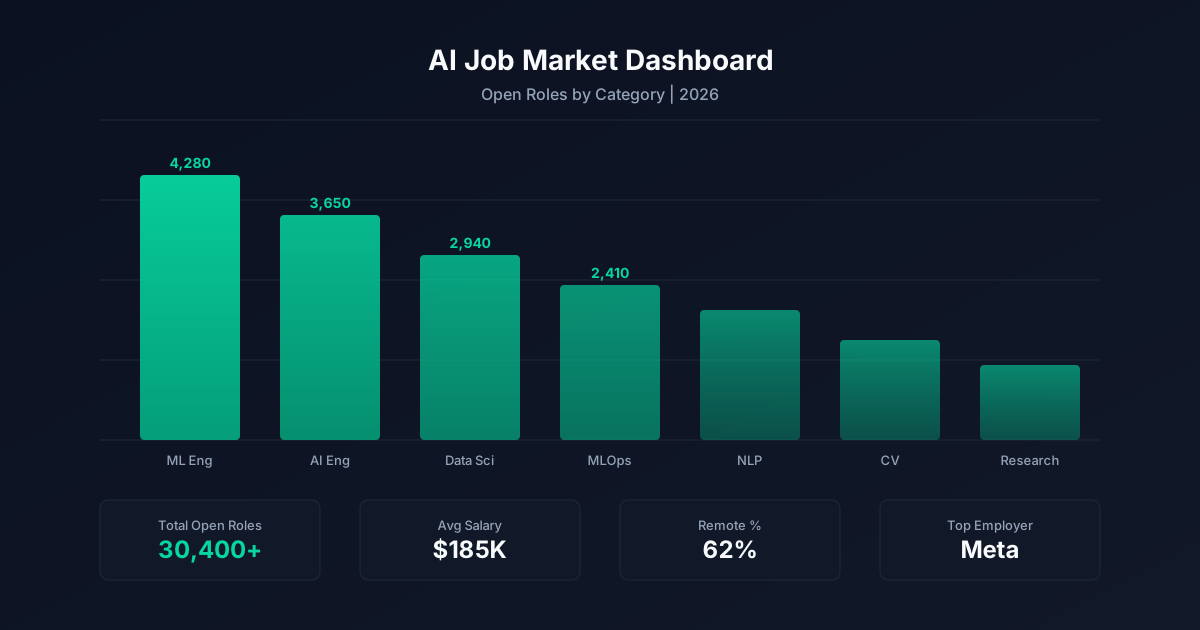
Across the 3,708 AI roles we're tracking, AI/ML Engineer positions make up 70% of the market. At Mosaic North America, this role fits into their broader AI and engineering organization.
Demand for AI/ML Engineers has been strong and consistent. Unlike some AI roles that spike with hype cycles, ML engineering is a foundational need. Every company deploying AI models needs people who can keep them running, and the gap between research prototypes and production systems keeps growing.
What the Work Looks Like
A typical week might include: debugging a data pipeline that's silently dropping 3% of training examples, running A/B tests on a new model version, writing documentation for a feature flag system that lets you roll back model deployments, and reviewing a junior engineer's PR for a new evaluation metric. Meetings tend to be cross-functional since ML touches product, engineering, and data teams.
Demand for AI/ML Engineers has been strong and consistent. Unlike some AI roles that spike with hype cycles, ML engineering is a foundational need. Every company deploying AI models needs people who can keep them running, and the gap between research prototypes and production systems keeps growing.
Skills in Demand for This Role
Python and PyTorch dominate the requirements. Most roles expect experience with cloud platforms (AWS, GCP, or Azure) and familiarity with ML frameworks like TensorFlow or JAX. RAG (Retrieval-Augmented Generation) has become a top-3 skill requirement as companies integrate LLMs into their products. Docker and Kubernetes show up in about a third of postings, reflecting the production focus of the role.
Beyond the core stack, employers increasingly want experience with experiment tracking tools (MLflow, Weights & Biases), feature stores, and vector databases. Fine-tuning experience is valuable but less common than you'd think from reading Twitter. Most production LLM work is RAG and prompt engineering, not fine-tuning. If you have both, you're in a strong position.
Companies that are serious about AI/ML hiring tend to post specific infrastructure details in the job description: the frameworks they use, their model serving stack, their data pipeline tools. Vague postings that just say 'ML experience required' without specifics are often companies that haven't figured out what they need yet.
Compensation Benchmarks
AI/ML Engineer roles pay a median of $218,750 based on 3,817 positions with disclosed compensation. Mid-level AI roles across all categories have a median of $200,000. This role's midpoint ($167K) sits 23% below the category median. Disclosed range: $135K to $200K.
Across all AI roles, the market median is $217,500. Top-quartile compensation starts at $272,100. The 90th percentile reaches $325,000. For comparison, the highest-paying categories include AI Safety ($300,000) and Research Engineer ($280,000). By seniority level: Entry: $120,000; Mid: $200,000; Senior: $230,000; Director: $272,150; VP: $250,000.
Mosaic North America AI Hiring
Mosaic North America has 1 open AI role right now. They're hiring across AI/ML Engineer. Based in US. Compensation range: $200K - $200K.
Location Context
AI roles in Austin pay a median of $214,343 across 87 tracked positions.
Career Path
Common paths into AI/ML Engineer roles include Data Scientist, Software Engineer, Research Engineer.
From here, career progression typically leads toward ML Architect, AI Engineering Manager, Principal ML Engineer.
The fastest path into ML engineering is through software engineering with a self-directed ML education. A CS degree helps, but production engineering skills matter more than academic credentials. Build something that works, deploy it, and measure it. That portfolio project is worth more than a Coursera certificate. For career growth, the fork comes around the senior level: go deep on technical complexity (staff/principal track) or move into managing ML teams.
What to Expect in Interviews
Expect system design questions around ML pipelines: how you'd build a training pipeline for a specific use case, handle data drift, or design A/B testing infrastructure for model deployments. Coding rounds typically involve Python, with emphasis on data manipulation (pandas, numpy) and algorithm implementation. Take-home assignments often ask you to build an end-to-end ML pipeline from raw data to deployed model.
When evaluating opportunities: Companies that are serious about AI/ML hiring tend to post specific infrastructure details in the job description: the frameworks they use, their model serving stack, their data pipeline tools. Vague postings that just say 'ML experience required' without specifics are often companies that haven't figured out what they need yet.
AI Hiring Overview
The AI job market has 3,708 open positions tracked in our dataset. By seniority: 102 entry-level, 1,705 mid-level, 1,469 senior, and 432 leadership roles (Director, VP, C-Level). Remote roles make up 14% of the market (508 positions). The remaining 3,180 roles require on-site or hybrid attendance.
The market median for AI roles is $217,500. Top-quartile compensation starts at $272,100. The 90th percentile reaches $325,000. Highest-paying categories: AI Safety ($300,000 median, 21 roles); Research Engineer ($280,000 median, 147 roles); AI Architect ($254,798 median, 67 roles).
Demand for AI/ML Engineers has been strong and consistent. Unlike some AI roles that spike with hype cycles, ML engineering is a foundational need. Every company deploying AI models needs people who can keep them running, and the gap between research prototypes and production systems keeps growing.
The AI Job Market Today
The AI job market spans 3,708 open positions across 16 role categories. The largest categories by volume: AI/ML Engineer (2,605), Data Scientist (310), AI Software Engineer (259). These three account for the majority of open positions, though smaller categories often have higher per-role compensation because of specialized skill requirements.
The seniority mix tells a story about where AI teams are in their maturity. Entry-level roles (102) are outnumbered by mid-level (1,705) and senior (1,469) positions, reflecting that most companies are past the 'build a team from scratch' phase and need experienced engineers who can ship production systems. Leadership roles (Director, VP, C-Level) total 432 positions, representing the bottleneck between technical execution and organizational strategy.
Remote work availability sits at 14% of all AI roles (508 positions), with 3,180 requiring on-site or hybrid attendance. The remote share has stabilized after the post-pandemic correction. Senior and specialized roles (Research Scientist, ML Architect) are more likely to be remote-eligible than entry-level positions, partly because experienced hires have more negotiating power and partly because these roles require less hands-on mentorship.
AI compensation is structured in clear tiers. The market median sits at $217,500. Top-quartile roles start at $272,100, and the 90th percentile reaches $325,000. These figures include base salary with disclosed compensation. Total compensation (including equity, bonuses, and sign-on) runs 20-40% higher at companies that offer those components.
Category matters for compensation. AI Safety roles lead at $300,000 median, while Prompt Engineer roles sit at $140,000. The spread between highest and lowest-paying categories reflects the premium on specialized technical skills versus broader analytical roles.
The most in-demand skills across all AI postings: Python (1,890 postings), Aws (1,103 postings), Azure (877 postings), Rag (855 postings), Gcp (631 postings), Prompt Engineering (560 postings), Pytorch (545 postings), Claude (498 postings). Python dominates, appearing in the vast majority of role descriptions regardless of category. Cloud platform experience (AWS, GCP, Azure) is the second most common requirement. The newer entrants to the top skills list (RAG, vector databases, LLM APIs) reflect the shift from traditional ML toward generative AI applications.
Frequently Asked Questions
Get Weekly AI Career Intelligence
Salary data, skills demand, and market signals from 16,000+ AI job postings. Every Monday.