
Interested in this AI/ML Engineer role at NBCUniversal?
Apply Now →Skills & Technologies
About This Role
Company Description
DreamWorks Animation is looking for more adventurous dreamers who shoot for the moon. We tell stories about the journeys our unconventional heroes take to make dreams come true. As a growth\-minded studio, we pride ourselves on being one of the world’s leading producers of high\-quality, award\-winning, animated films and series, reaching consumers around the globe. We push to feel more, laugh more, and build immersive new worlds.
DreamWorks creates a diverse array of original content in a variety of formats, delivering compelling stories with unique characters. We place tremendous value on the experiences our talent offers from their own non\-traditional paths to success. We believe in frequent communication and that transparency and trust yield the best work. We are a community of artists, technologists, innovators, and creators, who are passionate about animation and also happen to love eating lunch together.
DreamWorks is seeking a highly collaborative AI Architect who will be a hands\-on technical leader assistive across multiple teams aimed to provide results to both technical and creative departments. This role involves identifying, designing, and delivering AI\-powered agentic architecture that eliminates the repetitive, manual, low\-creativity tasks that pull artists and production management away from their craft, while maintaining high operational availability to ensure production systems run reliably. An ideal candidate should be an adventurous, growth\-minded problem solver who thrives in collaborative environments, values transparency and trust, and possesses a deep passion for leveraging technology to empower artists and storytellers.
If you are part of the fandom and believe teamwork makes the dream work, join us in \#livingthedream and \#doingyourdreamwork!
Job Description “What would you say you do here?”
- Collaborate and advise on next\-generation AI\-assisted agentic workflows strategy alongside product owners, developers and creatives.
- Design and own the architecture for AI\-powered frameworks and automation across the entire Studio pipeline and platforms.
- Define the end\-to\-end architecture for ingestion, processing, and routing of operational telemetry (metrics, logs, traces).
- Integrate solutions with popular industry DCC tools.
- Prototype solutions for high\-friction tasks: asset tagging, scene prep, render queue management, shot setup, and versioning.
- Define technical standards and integration patterns for AI tooling across departments and shows.
- Evaluate and select AI frameworks, foundation models, and automation technologies for creative production and operational stability.
- Build and maintain a library of reusable AI components and automation patterns.
- Partner with platform, systems and security teams to monitor model drift, system latency, and system security.
- Write, test, and deploy production\-ready tools that run reliably inside active show pipelines.
- Develop reference implementations that set the canonical pattern for future pipeline AI work.
- Partner with engineers and TDs to fold automation into existing artist\-facing toolsets.
- Maintain and iterate on deployed tools based on artist feedback and production data.
- Drive adoption across both technical and creative departments so tools are understood, trusted, and used.
- Create lightweight training and documentation for artists and engineers.
- Establish metrics for automation impact and report results to studio leadership on a regular cadence.
- Champion a culture of continuous improvement and surface new automation opportunities as workflows evolve.
Qualifications What do I need to have in order to do this job?”
- Bachelor’s degree in Computer Science, Engineering, or a related technical field.
- 10\+ years building production systems, with 2\+ years building AI/ML systems for real workflows.
- Hands\-on experience deploying enterprise software in AI, data, or integration environments.
- Expertise with containerization, orchestration, Python, TypeScript, React, and AI frameworks such as LangGraph, Spring AI and MCP.
- Deep understanding of LLM model integration and tuning.
- Experience with designing automation that reduces manual work in complex, multi\-stakeholder environments.
- Proven ability to influence senior engineers without authority and to be the person others learn from.
- History of building and supporting durable artifacts: frameworks, templates, training, open source that extend to other projects.
- Excellent communication skills and the ability to translate fluently between artists, production management, and engineers.
- Genuine passion for animation, storytelling, or creative production.
- Fully Remote: This position has been designated as fully remote, meaning that the position is expected to contribute from a non\-NBCUniversal worksite, most commonly an employee’s residence.
"What can I offer?”
- 2\+ years in a Principal, Staff, or Lead role responsible for AI or pipeline automation, ideally in a creative studio.
- Strong understanding of the animation production pipeline, departmental workflows, and industry\-standard digital content creation (DCC) software.
- Familiarity with animation frameworks and standards such as USD, Autodesk Flow Production Tracking and Jira.
- Experience measuring and reporting the productivity impact of engineering tooling investments.
- Stays current with AI trends and emerging technologies.
Fully Remote: This position has been designated as fully remote, meaning that the position is expected to contribute from a non\-DreamWorks worksite, most commonly an employee’s residence.
We are accepting applications for this position on an ongoing basis.
This position is eligible for company sponsored benefits, including medical, dental and vision insurance, 401(k), paid leave, tuition reimbursement, and a variety of other discounts and perks. Learn more about the benefits offered by NBCUniversal by visiting the Benefits page of the Careers website.
Salary range: $190,000 \- $230,000
Additional Information
As part of our selection process, external candidates may be required to attend an in\-person interview with an NBCUniversal employee at one of our locations prior to a hiring decision. NBCUniversal's policy is to provide equal employment opportunities to all applicants and employees without regard to race, color, religion, creed, gender, gender identity or expression, age, national origin or ancestry, citizenship, disability, sexual orientation, marital status, pregnancy, veteran status, membership in the uniformed services, genetic information, or any other basis protected by applicable law.
If you are a qualified individual with a disability or a disabled veteran, you have the right to request a reasonable accommodation if you are unable or limited in your ability to use or access nbcunicareers.com as a result of your disability. You can request reasonable accommodations by emailing AccessibilitySupport@nbcuni.com.
For LA County and City Residents Only: NBCUniversal will consider for employment qualified applicants with criminal histories, or arrest or conviction records, in a manner consistent with relevant legal requirements, including the City of Los Angeles' Fair Chance Initiative For Hiring Ordinance, the Los Angeles County Fair Chance Ordinance for Employers, and the California Fair Chance Act, where applicable.
Salary Context
This $190K-$230K range is above the median for AI/ML Engineer roles in our dataset (median: $180K across 1841 roles with salary data).
View full AI/ML Engineer salary data →Role Details
About This Role
AI/ML Engineers build and deploy machine learning models in production. They work across the full ML lifecycle: data pipelines, model training, evaluation, and serving infrastructure. The role has evolved significantly over the past two years. Where ML Engineers once spent most of their time on model architecture, the job now tilts heavily toward inference optimization, cost management, and integrating LLM capabilities into existing systems. Companies want engineers who can ship production systems, and the experimenter-only role is fading fast.
Day-to-day, you're writing training pipelines, debugging data quality issues, setting up evaluation frameworks, and figuring out why your model performs differently in staging than it did on your dev set. The best ML engineers are obsessive about reproducibility and measurement. They instrument everything. They know that a model is only as good as the data feeding it and the infrastructure serving it.
Across the 3,708 AI roles we're tracking, AI/ML Engineer positions make up 70% of the market. At NBCUniversal, this role fits into their broader AI and engineering organization.
Demand for AI/ML Engineers has been strong and consistent. Unlike some AI roles that spike with hype cycles, ML engineering is a foundational need. Every company deploying AI models needs people who can keep them running, and the gap between research prototypes and production systems keeps growing.
What the Work Looks Like
A typical week might include: debugging a data pipeline that's silently dropping 3% of training examples, running A/B tests on a new model version, writing documentation for a feature flag system that lets you roll back model deployments, and reviewing a junior engineer's PR for a new evaluation metric. Meetings tend to be cross-functional since ML touches product, engineering, and data teams.
Demand for AI/ML Engineers has been strong and consistent. Unlike some AI roles that spike with hype cycles, ML engineering is a foundational need. Every company deploying AI models needs people who can keep them running, and the gap between research prototypes and production systems keeps growing.
Skills Required
Python and PyTorch dominate the requirements. Most roles expect experience with cloud platforms (AWS, GCP, or Azure) and familiarity with ML frameworks like TensorFlow or JAX. RAG (Retrieval-Augmented Generation) has become a top-3 skill requirement as companies integrate LLMs into their products. Docker and Kubernetes show up in about a third of postings, reflecting the production focus of the role.
Beyond the core stack, employers increasingly want experience with experiment tracking tools (MLflow, Weights & Biases), feature stores, and vector databases. Fine-tuning experience is valuable but less common than you'd think from reading Twitter. Most production LLM work is RAG and prompt engineering, not fine-tuning. If you have both, you're in a strong position.
Companies that are serious about AI/ML hiring tend to post specific infrastructure details in the job description: the frameworks they use, their model serving stack, their data pipeline tools. Vague postings that just say 'ML experience required' without specifics are often companies that haven't figured out what they need yet.
Compensation Benchmarks
AI/ML Engineer roles pay a median of $218,750 based on 3,817 positions with disclosed compensation. Senior-level AI roles across all categories have a median of $230,000. Disclosed range: $190K to $230K.
Across all AI roles, the market median is $217,500. Top-quartile compensation starts at $272,100. The 90th percentile reaches $325,000. For comparison, the highest-paying categories include AI Safety ($300,000) and Research Engineer ($280,000). By seniority level: Entry: $120,000; Mid: $200,000; Senior: $230,000; Director: $272,150; VP: $250,000.
NBCUniversal AI Hiring
NBCUniversal has 2 open AI roles right now. They're hiring across AI/ML Engineer, AI Engineering Manager. Positions span Glendale, CA, US, New York, NY, US. Compensation range: $230K - $270K.
Location Context
Across all AI roles, 14% (508 positions) offer remote work, while 3,180 require on-site attendance. Top AI hiring metros: New York (1,045 roles, $220,000 median); San Francisco (810 roles, $277,088 median); Los Angeles (397 roles, $215,000 median).
Career Path
Common paths into AI/ML Engineer roles include Data Scientist, Software Engineer, Research Engineer.
From here, career progression typically leads toward ML Architect, AI Engineering Manager, Principal ML Engineer.
The fastest path into ML engineering is through software engineering with a self-directed ML education. A CS degree helps, but production engineering skills matter more than academic credentials. Build something that works, deploy it, and measure it. That portfolio project is worth more than a Coursera certificate. For career growth, the fork comes around the senior level: go deep on technical complexity (staff/principal track) or move into managing ML teams.
What to Expect in Interviews
Expect system design questions around ML pipelines: how you'd build a training pipeline for a specific use case, handle data drift, or design A/B testing infrastructure for model deployments. Coding rounds typically involve Python, with emphasis on data manipulation (pandas, numpy) and algorithm implementation. Take-home assignments often ask you to build an end-to-end ML pipeline from raw data to deployed model.
When evaluating opportunities: Companies that are serious about AI/ML hiring tend to post specific infrastructure details in the job description: the frameworks they use, their model serving stack, their data pipeline tools. Vague postings that just say 'ML experience required' without specifics are often companies that haven't figured out what they need yet.
AI Hiring Overview
The AI job market has 3,708 open positions tracked in our dataset. By seniority: 102 entry-level, 1,705 mid-level, 1,469 senior, and 432 leadership roles (Director, VP, C-Level). Remote roles make up 14% of the market (508 positions). The remaining 3,180 roles require on-site or hybrid attendance.
The market median for AI roles is $217,500. Top-quartile compensation starts at $272,100. The 90th percentile reaches $325,000. Highest-paying categories: AI Safety ($300,000 median, 21 roles); Research Engineer ($280,000 median, 147 roles); AI Architect ($254,798 median, 67 roles).
Demand for AI/ML Engineers has been strong and consistent. Unlike some AI roles that spike with hype cycles, ML engineering is a foundational need. Every company deploying AI models needs people who can keep them running, and the gap between research prototypes and production systems keeps growing.
The AI Job Market Today
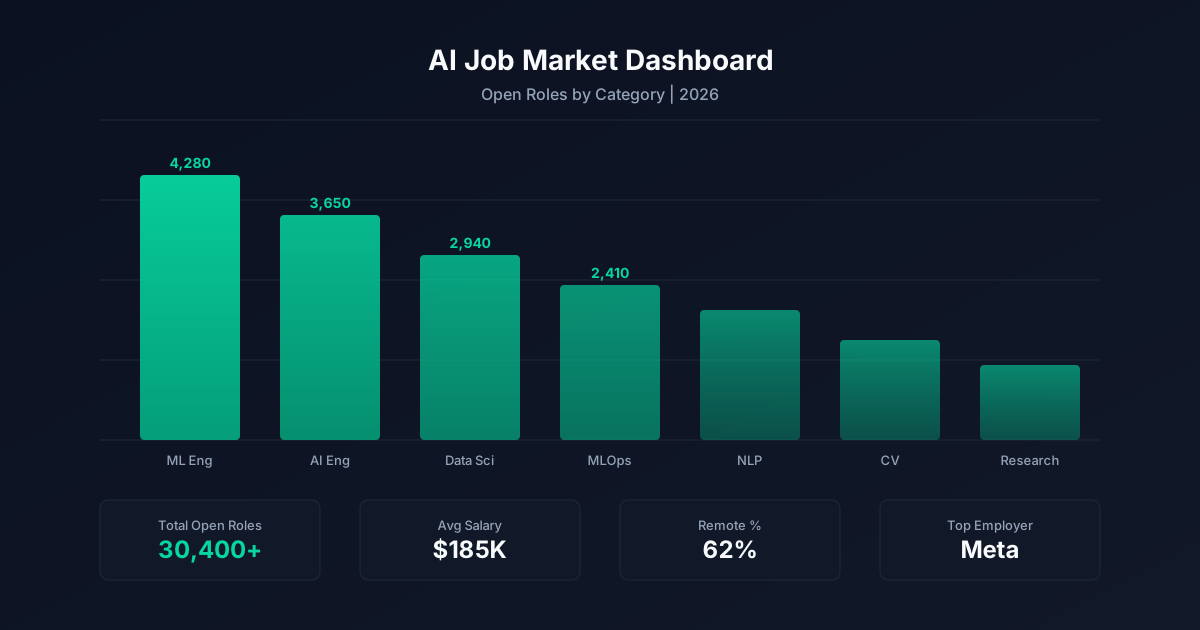
The AI job market spans 3,708 open positions across 16 role categories. The largest categories by volume: AI/ML Engineer (2,605), Data Scientist (310), AI Software Engineer (259). These three account for the majority of open positions, though smaller categories often have higher per-role compensation because of specialized skill requirements.
The seniority mix tells a story about where AI teams are in their maturity. Entry-level roles (102) are outnumbered by mid-level (1,705) and senior (1,469) positions, reflecting that most companies are past the 'build a team from scratch' phase and need experienced engineers who can ship production systems. Leadership roles (Director, VP, C-Level) total 432 positions, representing the bottleneck between technical execution and organizational strategy.
Remote work availability sits at 14% of all AI roles (508 positions), with 3,180 requiring on-site or hybrid attendance. The remote share has stabilized after the post-pandemic correction. Senior and specialized roles (Research Scientist, ML Architect) are more likely to be remote-eligible than entry-level positions, partly because experienced hires have more negotiating power and partly because these roles require less hands-on mentorship.
AI compensation is structured in clear tiers. The market median sits at $217,500. Top-quartile roles start at $272,100, and the 90th percentile reaches $325,000. These figures include base salary with disclosed compensation. Total compensation (including equity, bonuses, and sign-on) runs 20-40% higher at companies that offer those components.
Category matters for compensation. AI Safety roles lead at $300,000 median, while Prompt Engineer roles sit at $140,000. The spread between highest and lowest-paying categories reflects the premium on specialized technical skills versus broader analytical roles.
The most in-demand skills across all AI postings: Python (1,890 postings), Aws (1,103 postings), Azure (877 postings), Rag (855 postings), Gcp (631 postings), Prompt Engineering (560 postings), Pytorch (545 postings), Claude (498 postings). Python dominates, appearing in the vast majority of role descriptions regardless of category. Cloud platform experience (AWS, GCP, Azure) is the second most common requirement. The newer entrants to the top skills list (RAG, vector databases, LLM APIs) reflect the shift from traditional ML toward generative AI applications.
Frequently Asked Questions
Get Weekly AI Career Intelligence
Salary data, skills demand, and market signals from 16,000+ AI job postings. Every Monday.