
Interested in this AI/ML Engineer role at Propark Mobility?
Apply Now →Skills & Technologies
About This Role
- :
Upward Mobility with Propark Mobility! AI Automation SpecialistPropark Mobility Corporate Headquarters $70,000 \- $80,000 Annual Salary RangeFull\-time Opportunity; Full Company Benefits Work Modality: HybridSchedule: Full\-time, Monday \- FridayLocation: Hartford, CT Snapshot* The company: Propark Mobility is a national parking and mobility company, founded in Hartford in 1984 and now operating over 1,000 locations in more than 250 cities.
- Role: One of the first hires in a new department. You’ll build and ship, choose the stack, and set the standards the next hires build on.
- What you do: learn a manual business process from the person who runs it, document it, then replace it with AI tools and custom agents.
- The bigger arc: help unify Propark’s data and build AI into its own software, alongside the AVP of AI.
- The mix it takes: enough technical skill to build custom agents, enough business sense to understand how a manual process actually works, and enough polish to train non\-technical staff on what you ship.
Best fit: someone who came up through a business or analytical background and then taught themselves to ship real AI systems.
About the work
The AI Department turns Propark’s manual, expert\-run back\-office work into software and agents. This is the kind of work that today lives in one person’s head and a stack of spreadsheets.
For example:
- Reconciling two systems that are supposed to agree, and flagging every mismatch.
- Pulling data from several sources into a report that someone rebuilds by hand every month.
- Checking incoming documents against records before anything gets approved or paid.
- Turning a recurring spreadsheet routine into a tool that runs on its own.
- Pulling structured data out of PDFs, emails, and forms so no one has to retype it.
Work that eats a full day every month should take minutes. Closing that gap, across one process after another, is where you start. The bigger arc, which you grow into alongside the AVP of AI, is unifying Propark’s data and building AI straight into the company’s own software.
What you’ll do
- Sit with the expert who owns a manual process and learn their workflow the way you’d reverse\-engineer an undocumented codebase. Ask the obvious questions, watch them work, and find the edge cases they handle without thinking.
- Document the process: inputs, steps, decision rules, and exceptions. If you can’t write it down, you can’t automate it.
- Build the automation with AI coding tools as your daily drivers: Claude Code, Cursor, and Codex.
- Design and ship custom agents for specific jobs: retrieval over internal documents, agents that chain tools and make decisions, and tools that replace hours of manual review. You own them from first idea to production.
- Ship to real users inside the company, watch the work break, and fix it until the process runs without you.
- Run AI training sessions for non\-technical colleagues so the people who use what you built can run it without you.
- Help set the department’s direction: the stack, the standards, the roadmap, and what we take on next.
Bigger projects
Process automation is the on\-ramp. As you find your footing, you’ll take on larger work with the AVP of AI:
- Break down data silos and help stand up a central data warehouse, so every automation and agent works from one source of truth instead of scattered exports and one\-off reports.
- Build AI into Propark’s existing proprietary applications, not just standalone tools alongside them.
- Prototype and push new ideas with the AVP of AI, testing what becomes possible as the department and the tools mature.
How we work
- Business first. We don’t automate a process until we understand it.
- AI coding tools are the default here.
- Success is measured in processes shipped and hours handed back to the business.
- Small team, fast decisions, direct access to the people running it.
What we’re looking for
- 1 to 4 years building real software, including hands\-on AI/ML work.
- Shipped at least one of these yourself: a retrieval (RAG) system, an LLM\-powered tool, or a working agent.
- Real business sense: you can sit with someone who runs a manual process, follow what they describe, and see how to turn it into something a machine can run.
- Full\-stack fundamentals: Comfortable using AI to code in a modern web stack, enough to take a tool from idea to deployed on your own.
- Working knowledge of a modern AI stack: an orchestration approach, a vector store, and a major model provider. We care that you’ve built the real thing, not which library you used.
- AI coding tools already in your daily workflow (Claude Code, Cursor, Codex, Github Copilot, or similar).
- Strong communication. You can stand in front of a non\-technical room and explain AI clearly and patiently, without jargon. That matters here as much as the code.
- A bias for finding the work instead of waiting for it.
- US\-based, able to work a hybrid schedule in Hartford, CT, with regular days on\-site.
Nice to have
- A business or analytical background, or hands\-on experience with manual back\-office processes such as reconciliations, recurring reporting, or compliance.
- A portfolio of self\-directed builds, side projects, or deployed apps.
- Data engineering experience: SQL, building data pipelines, or standing up a data warehouse (for example, Snowflake, BigQuery, or Redshift).
- Cloud deployment with Azure, GCP, or AWS (containers, managed databases, serverless).
- Classic ML and data science (Pandas, scikit\-learn, XGBoost, explainability tools like SHAP or LIME) for automations that go past simple model calls.
- Experience presenting to or training stakeholders.
- Enterprise or regulated\-environment experience, where careful data handling and internal tooling at scale matter.
What We Offer* Fantastic opportunities for career growth \- we always look to promote from within first!
- Competitive salary that is commensurate with experience, plus incentive bonus potential.
- Very generous time off allowances \- holidays, vacation and wellness.
- Priority driven culture that is supportive, engaging, empowering and celebratory.
- A company that values diversity, inclusion, and belonging.
- The ability to work in a fun and progressive environment in which everyone is provided with strong direction and then empowered to complete their objectives.
- Learning opportunities through our internal training program \- Propark Univeristy
- Phenomenal Benefits Package, including medical, dental, vision, and 8 supplemental insurances, including pet insurance!
- Free and confidential employee assistance program (EAP) that provides support and resources to employees and their families 24/7
How to apply
Send us:
- A short note on why this role is a fit for you, plus one manual process you’ve automated or one you’d like to get your hands on.
- Your resume or LinkedIn.
- Links to things you’ve built: repos, deployed apps, agents, or demos.
Next steps in the process would be an intro conversation, a hands\-on working session, and a final conversation with the team!
Apply now!We can't wait to meet you! *Propark is an Equal Opportunity Employer (EOE). Qualified applicants are considered for employment without regard to age, race, color, religion, sex, national origin, sexual orientation, disability, or veteran status. If you need assistance or an accommodation during the application process because of a disability, it is available upon request. The company is pleased to provide such assistance, and no applicant will be penalized as a result of such a request.* *Please go to the Propark corporate careers portal to view our CPRA Applicant Notice and Privacy Policy for the state of CA. This policy will also be emailed to you upon receipt of your application.* *Please go to the Propark corporate* *careers portal* *to view our Notice of E\-Verify Participation \- Propark Mobility participates in E\-Verify. Following acceptance of your offer, we may verify your employment eligibility through the federal E\-Verify program.* *Notice of E\-Verify Participation*
Salary Context
This $70K-$80K range is in the lower quartile for AI/ML Engineer roles in our dataset (median: $180K across 1841 roles with salary data).
View full AI/ML Engineer salary data →Role Details
About This Role
AI/ML Engineers build and deploy machine learning models in production. They work across the full ML lifecycle: data pipelines, model training, evaluation, and serving infrastructure. The role has evolved significantly over the past two years. Where ML Engineers once spent most of their time on model architecture, the job now tilts heavily toward inference optimization, cost management, and integrating LLM capabilities into existing systems. Companies want engineers who can ship production systems, and the experimenter-only role is fading fast.
Day-to-day, you're writing training pipelines, debugging data quality issues, setting up evaluation frameworks, and figuring out why your model performs differently in staging than it did on your dev set. The best ML engineers are obsessive about reproducibility and measurement. They instrument everything. They know that a model is only as good as the data feeding it and the infrastructure serving it.
Across the 3,708 AI roles we're tracking, AI/ML Engineer positions make up 70% of the market. At Propark Mobility, this role fits into their broader AI and engineering organization.
Demand for AI/ML Engineers has been strong and consistent. Unlike some AI roles that spike with hype cycles, ML engineering is a foundational need. Every company deploying AI models needs people who can keep them running, and the gap between research prototypes and production systems keeps growing.
What the Work Looks Like
A typical week might include: debugging a data pipeline that's silently dropping 3% of training examples, running A/B tests on a new model version, writing documentation for a feature flag system that lets you roll back model deployments, and reviewing a junior engineer's PR for a new evaluation metric. Meetings tend to be cross-functional since ML touches product, engineering, and data teams.
Demand for AI/ML Engineers has been strong and consistent. Unlike some AI roles that spike with hype cycles, ML engineering is a foundational need. Every company deploying AI models needs people who can keep them running, and the gap between research prototypes and production systems keeps growing.
Skills Required
Python and PyTorch dominate the requirements. Most roles expect experience with cloud platforms (AWS, GCP, or Azure) and familiarity with ML frameworks like TensorFlow or JAX. RAG (Retrieval-Augmented Generation) has become a top-3 skill requirement as companies integrate LLMs into their products. Docker and Kubernetes show up in about a third of postings, reflecting the production focus of the role.
Beyond the core stack, employers increasingly want experience with experiment tracking tools (MLflow, Weights & Biases), feature stores, and vector databases. Fine-tuning experience is valuable but less common than you'd think from reading Twitter. Most production LLM work is RAG and prompt engineering, not fine-tuning. If you have both, you're in a strong position.
Companies that are serious about AI/ML hiring tend to post specific infrastructure details in the job description: the frameworks they use, their model serving stack, their data pipeline tools. Vague postings that just say 'ML experience required' without specifics are often companies that haven't figured out what they need yet.
Compensation Benchmarks
AI/ML Engineer roles pay a median of $218,750 based on 3,817 positions with disclosed compensation. Mid-level AI roles across all categories have a median of $200,000. This role's midpoint ($75K) sits 66% below the category median. Disclosed range: $70K to $80K.
Across all AI roles, the market median is $217,500. Top-quartile compensation starts at $272,100. The 90th percentile reaches $325,000. For comparison, the highest-paying categories include AI Safety ($300,000) and Research Engineer ($280,000). By seniority level: Entry: $120,000; Mid: $200,000; Senior: $230,000; Director: $272,150; VP: $250,000.
Propark Mobility AI Hiring
Propark Mobility has 1 open AI role right now. They're hiring across AI/ML Engineer. Based in Hartford, CT, US. Compensation range: $80K - $80K.
Location Context
Across all AI roles, 14% (508 positions) offer remote work, while 3,180 require on-site attendance. Top AI hiring metros: New York (1,045 roles, $220,000 median); San Francisco (810 roles, $277,088 median); Los Angeles (397 roles, $215,000 median).
Career Path
Common paths into AI/ML Engineer roles include Data Scientist, Software Engineer, Research Engineer.
From here, career progression typically leads toward ML Architect, AI Engineering Manager, Principal ML Engineer.
The fastest path into ML engineering is through software engineering with a self-directed ML education. A CS degree helps, but production engineering skills matter more than academic credentials. Build something that works, deploy it, and measure it. That portfolio project is worth more than a Coursera certificate. For career growth, the fork comes around the senior level: go deep on technical complexity (staff/principal track) or move into managing ML teams.
What to Expect in Interviews
Expect system design questions around ML pipelines: how you'd build a training pipeline for a specific use case, handle data drift, or design A/B testing infrastructure for model deployments. Coding rounds typically involve Python, with emphasis on data manipulation (pandas, numpy) and algorithm implementation. Take-home assignments often ask you to build an end-to-end ML pipeline from raw data to deployed model.
When evaluating opportunities: Companies that are serious about AI/ML hiring tend to post specific infrastructure details in the job description: the frameworks they use, their model serving stack, their data pipeline tools. Vague postings that just say 'ML experience required' without specifics are often companies that haven't figured out what they need yet.
AI Hiring Overview
The AI job market has 3,708 open positions tracked in our dataset. By seniority: 102 entry-level, 1,705 mid-level, 1,469 senior, and 432 leadership roles (Director, VP, C-Level). Remote roles make up 14% of the market (508 positions). The remaining 3,180 roles require on-site or hybrid attendance.
The market median for AI roles is $217,500. Top-quartile compensation starts at $272,100. The 90th percentile reaches $325,000. Highest-paying categories: AI Safety ($300,000 median, 21 roles); Research Engineer ($280,000 median, 147 roles); AI Architect ($254,798 median, 67 roles).
Demand for AI/ML Engineers has been strong and consistent. Unlike some AI roles that spike with hype cycles, ML engineering is a foundational need. Every company deploying AI models needs people who can keep them running, and the gap between research prototypes and production systems keeps growing.
The AI Job Market Today
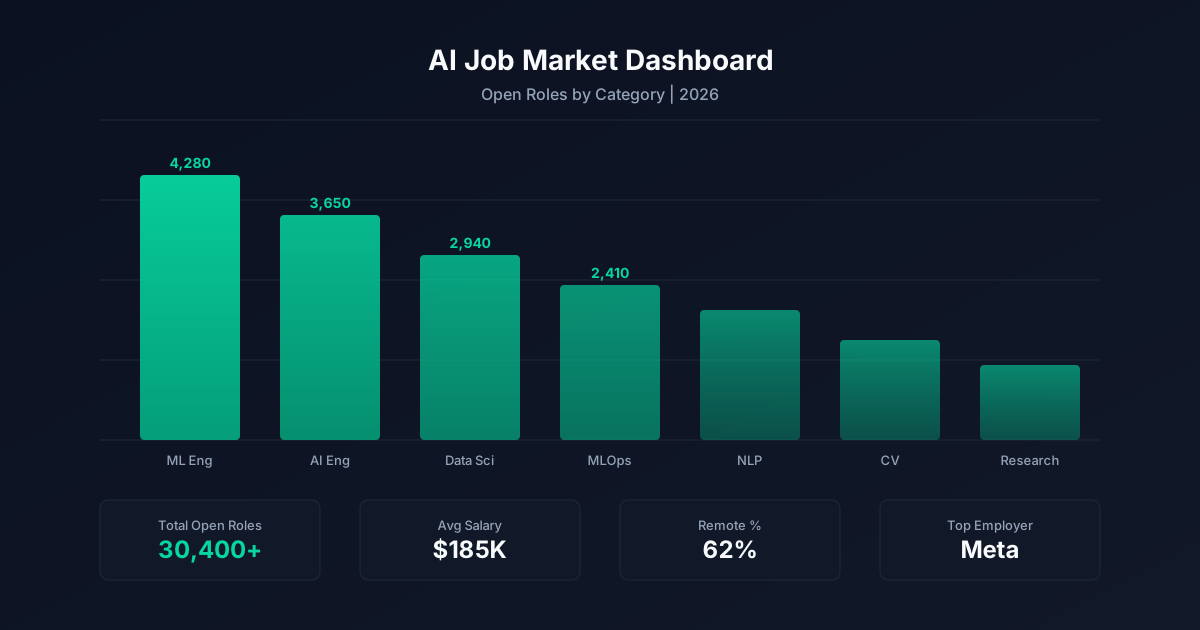
The AI job market spans 3,708 open positions across 16 role categories. The largest categories by volume: AI/ML Engineer (2,605), Data Scientist (310), AI Software Engineer (259). These three account for the majority of open positions, though smaller categories often have higher per-role compensation because of specialized skill requirements.
The seniority mix tells a story about where AI teams are in their maturity. Entry-level roles (102) are outnumbered by mid-level (1,705) and senior (1,469) positions, reflecting that most companies are past the 'build a team from scratch' phase and need experienced engineers who can ship production systems. Leadership roles (Director, VP, C-Level) total 432 positions, representing the bottleneck between technical execution and organizational strategy.
Remote work availability sits at 14% of all AI roles (508 positions), with 3,180 requiring on-site or hybrid attendance. The remote share has stabilized after the post-pandemic correction. Senior and specialized roles (Research Scientist, ML Architect) are more likely to be remote-eligible than entry-level positions, partly because experienced hires have more negotiating power and partly because these roles require less hands-on mentorship.
AI compensation is structured in clear tiers. The market median sits at $217,500. Top-quartile roles start at $272,100, and the 90th percentile reaches $325,000. These figures include base salary with disclosed compensation. Total compensation (including equity, bonuses, and sign-on) runs 20-40% higher at companies that offer those components.
Category matters for compensation. AI Safety roles lead at $300,000 median, while Prompt Engineer roles sit at $140,000. The spread between highest and lowest-paying categories reflects the premium on specialized technical skills versus broader analytical roles.
The most in-demand skills across all AI postings: Python (1,890 postings), Aws (1,103 postings), Azure (877 postings), Rag (855 postings), Gcp (631 postings), Prompt Engineering (560 postings), Pytorch (545 postings), Claude (498 postings). Python dominates, appearing in the vast majority of role descriptions regardless of category. Cloud platform experience (AWS, GCP, Azure) is the second most common requirement. The newer entrants to the top skills list (RAG, vector databases, LLM APIs) reflect the shift from traditional ML toward generative AI applications.
Frequently Asked Questions
Get Weekly AI Career Intelligence
Salary data, skills demand, and market signals from 16,000+ AI job postings. Every Monday.