
Interested in this AI Software Engineer role at Salk Institute for Biological Studies?
Apply Now →Skills & Technologies
About This Role
The Center for AI and Research Computing (AIRC) is seeking a Research Software Engineer I to help advance AI\-enabled scientific discovery at the Salk Institute for Biological Studies. The Center develops, deploys, and supports the shared research software, AI platforms, and high\-performance computing infrastructure used by laboratories and programs across the Institute.
Working closely with the Director of the Center, researchers, and the Information Technology department, the Research Software Engineer I designs, develops, deploys, and maintains software applications, web platforms, and research computing infrastructure that support computational and data\-intensive research. The position partners directly with scientists to understand evolving research needs and translate them into scalable software solutions that accelerate discovery across neuroscience, cancer biology, plant biology, human health, and other disciplines.
Primary responsibilities include developing and maintaining internal research applications and services; implementing and supporting AI tools and workflows for scientific research; managing and enhancing high\-performance computing, GPU, and data\-sharing infrastructure; integrating research software with institutional systems; and improving the accessibility, usability, and performance of shared computational resources. The position also evaluates and implements emerging technologies that enhance the Institute’s research computing capabilities and collaborates with cross\-functional teams to ensure reliable, secure, and sustainable research software and infrastructure.
The successful candidate will combine strong software development skills with an interest in scientific collaboration, working in a dynamic environment where research priorities evolve rapidly and innovative technical solutions are essential. This role offers the opportunity to directly contribute to enabling cutting\-edge research through modern software engineering, AI technologies, and advanced computing infrastructure.
Including a link to a GitHub profile or equivalent portfolio demonstrating previous programming work is strongly recommended for full consideration. We recognize that software developed for previous employers may be proprietary and unavailable for public review; however, candidates who can demonstrate personal projects, open\-source contributions, or other examples of software development beyond coursework will be viewed favorably.
Who We Are
The Salk Institute is an internationally renowned research institution that values all (https://www.salk.edu/about/our\-community/) members of our scientific community. We seek bold and interactive leaders passionate about exploring new frontiers in science. Our collaborative community embraces perspectives across discipline, professional acumen, and unique life experiences, fostering innovation, and a sense of belonging. Together, we strive to improve the wellbeing of humanity through groundbreaking research.
Founded by Jonas Salk, developer of the first safe and effective polio vaccine, the Institute is an independent, nonprofit research organization and architectural landmark: small by choice, intimate by nature, and fearless in the face of any challenge. Salk's vibrant community has many talented individuals from varied backgrounds, each playing a crucial role in driving our mission forward. From visionary leaders (https://www.salk.edu/about/management\-team/) to dedicated administrators (https://www.salk.edu/administration/) and brilliant faculty members (https://www.salk.edu/science/directory/faculty/), the Institute is united by a shared passion for scientific exploration and innovation.
What Your Key Responsibilities Will Be
- Design, build, and deploy internal software applications, web interfaces, and platforms that enable scientific research and the adoption of artificial intelligence across the Institute.
- Stand up and maintain self\-hosted systems and services, including data\-sharing platforms, web frontends, and collaboration tools, on centralized on\-premise and cloud infrastructure.
- Support the administration, configuration, and integration of high\-performance computing (HPC) resources, including GPU cluster and job scheduler (e.g., SLURM) transitions and workflows.
- Assist with the provisioning, configuration, and rollout of enterprise artificial intelligence tools and services (e.g., large language model platforms and APIs), and support their adoption by researchers and staff.
- Rapidly prototype, build, and iterate on small internal applications and utilities in response to evolving scientific and operational needs.
- Write well\-documented, tested code and follow professional software engineering practices, including version control (Git), code review, and continuous integration/continuous deployment (CI/CD).
- Integrate systems and services through APIs, authentication and single sign\-on, and automation to create seamless workflows for end users.
- Collaborate with the Information Technology department and other units on infrastructure, deployment, and security.
- Work directly with scientists to understand their needs and translate them into technical solutions that advance scientific AI enablement.
- Prepare and maintain documentation and training materials to enable researchers and staff to use the tools and systems developed.
- Participate in project planning and status discussions, and coordinate with other Salk labs, Core facilities, and programs.
- May assist with the onboarding or supervision of student trainees and interns.
- Perform additional duties as assigned.
Supervisory Responsibilities:
- This position has no supervisory responsibilities.
What we Require
- BS degree in computer science, engineering, quantitative science, or a related discipline is preferred for this position.
- This is an early\-career role; no prior professional experience is required. Demonstrated software engineering ability — through internships, research projects, open\-source contributions, or personal projects — is essential.
- Full\-stack software engineering ability, including proficiency in Python and at least one other language, and experience building complete applications spanning back\-end logic, front\-end interfaces, and data storage.
- Fluency with modern, AI\-assisted software development, including the effective use of AI coding tools and large language models (e.g., Claude Code) to design, build, debug, and ship software rapidly.
- Demonstrated ability to learn unfamiliar systems and technologies quickly and to stand up working services and infrastructure through code, scripting, and automation.
- Comfort working in Linux/Unix environments with version control (Git), testing, and code review.
Preferred:
- Master's degree or post\-baccalaureate certification in a computational or scientific field.
- Prior internship, research, or work experience in a scientific, laboratory, or academic environment.
- Exposure to, or eagerness to quickly learn, high\-performance computing environments and job schedulers such as SLURM; prior HPC operations or systems\-administration experience is welcome but not required.
- Experience deploying and maintaining self\-hosted applications and services, including containerization (e.g., Docker, Kubernetes) and cloud platforms (e.g., AWS, GCP).
- Full\-stack web development experience with modern frameworks (e.g., React, Svelte, Vue, FastAPI, Django) and database design.
- Experience building on or integrating large language model and AI tools and APIs (e.g., the Claude API, agentic coding tools), including provisioning and enabling AI tools for non\-technical users.
- Academic coursework, research experience, or demonstrated interest in biology, neuroscience, or another life\-science domain.
- A track record of shipping small tools or projects quickly and independently, and of picking up new languages, frameworks, and systems with minimal ramp\-up.
- Strong communication skills and the ability to work directly with scientists to translate their needs into technical solutions.
- A public code portfolio (e.g., GitHub) that demonstrates initiative beyond coursework, such as personal projects or contributions to open\-source software.
What We Can Offer
The expected pay range for this position is $33\.00 to $38\.00 an hour. Salk Institute provides pay ranges representing its good faith estimate of what the institute reasonably expects to pay for a position. The pay offered to a selected candidate will be determined based on factors such as (but not limited to) the scope and responsibilities of the position, the qualifications of the selected candidate, departmental budget availability, internal equity, geographic location, and external market pay for comparable jobs.
Benefits
Salk Institute offers competitive benefits (https://www.salk.edu/about/careers/benefits/), including medical, dental, vision, retirement, paid time off, tuition reimbursement, patient advocacy services, and transit/parking program.
Salk Values
The Salk Community, both scientists and administrators, worked together to define values that we believe support Salk’s pursuit of excellence. To be truly the best scientific institution requires not only incredible discoveries, but a common understanding of how we should work together to enable those discoveries.
The acronym “I CARE” (https://www.salk.edu/about/careers/values/) provides a simple way to remember each of the values and reminds each of us of the importance of what we do each day.
Equal Employment Opportunity Statement
The Salk Institute for Biological Studies is an Equal Opportunity Employer and is committed to providing equal access to opportunities for students, employees, applicants for employment and other visitors. Salk has also adopted and maintains a policy to encourage professional and respectful workplace behavior and prevent discriminatory and harassing conduct in our workplace.
Accordingly, the Institute prohibits harassment and discrimination in employment on the basis of, and considers all qualified applicants for employment without regard to, actual or perceived race (race is inclusive of traits associated with race, including, but not limited to, hair texture and protective hairstyles. Protective hairstyles include, but not limited to, such hairstyles as braids, and twists), color, religion, religious creed (including religious dress and grooming practices), national origin, ancestry, citizenship, physical or mental disability, medical condition (including cancer and genetic characteristics), genetic information, marital status, age, sex (including pregnancy, childbirth, breastfeeding, or related medical conditions), reproductive health decision making, gender, gender identity, gender expression, sexual orientation, veteran and/or military status (disabled veteran, veteran of the Vietnam era, other covered veteran status), political affiliation, and any other status protected by state or federal law.
Discrimination is prohibited with any intersectionality of the above\-mentioned characteristics, including:
- Any combination of characteristics.
- A perception that the person has any of the characteristics or any combination of those characteristics.
- A perception that the person is associated with a person who has, or is perceived to have, any of those characteristics or any combination of those characteristics.
Equal Opportunity Employer
This employer is required to notify all applicants of their rights pursuant to federal employment laws. For further information, please review the Know Your Rights (https://www.eeoc.gov/poster) notice from the Department of Labor.
Salary Context
This $68K-$79K range is in the lower quartile for AI Software Engineer roles in our dataset (median: $183K across 194 roles with salary data).
Role Details
About This Role
AI Software Engineers build the applications and systems that AI models run inside. They own the API layers, data pipelines, frontend integrations, and infrastructure that turn a model into a product users interact with. Every AI company needs engineers who can build the software around the AI.
The challenge is building reliable systems around inherently unreliable components. Models are probabilistic. They'll give different answers to the same question. They hallucinate. They're slow. They're expensive. Your job is to build an application layer that handles all of this gracefully while delivering a product that users trust and enjoy.
Across the 3,708 AI roles we're tracking, AI Software Engineer positions make up 7% of the market. At Salk Institute for Biological Studies, this role fits into their broader AI and engineering organization.
AI Software Engineer roles are among the most numerous in the AI job market. Every company deploying AI needs software engineers who understand AI integration patterns. The demand is broad, spanning startups to enterprises, across every industry adopting AI capabilities.
What the Work Looks Like
A typical week includes: building API endpoints that serve model inference with caching and fallback logic, designing the data pipeline that feeds context to a RAG system, implementing streaming responses in the frontend, debugging a race condition in the async inference pipeline, and optimizing database queries for the vector search layer. It's full-stack engineering with AI at the center.
AI Software Engineer roles are among the most numerous in the AI job market. Every company deploying AI needs software engineers who understand AI integration patterns. The demand is broad, spanning startups to enterprises, across every industry adopting AI capabilities.
Skills Required
Full-stack engineering skills with AI integration experience. Python and TypeScript are the most common requirements. You'll need to understand API design, database architecture, and how to build reliable systems around probabilistic outputs. Experience with streaming, async processing, and caching patterns is increasingly important as real-time AI applications proliferate.
Knowledge of vector databases, embedding APIs, and LLM integration patterns (function calling, structured outputs, retry logic) differentiates AI software engineers from general software engineers. Understanding cost optimization (caching strategies, model routing, batched inference) is valuable since inference costs can dominate application economics.
Strong postings describe the product you'll be building, the AI integration patterns you'll work with, and the scale requirements. Look for companies that have existing AI features and need engineers to improve and expand them, not companies that are 'planning to add AI' someday.
Compensation Benchmarks
AI Software Engineer roles pay a median of $219,250 based on 424 positions with disclosed compensation. Mid-level AI roles across all categories have a median of $200,000. This role's midpoint ($73K) sits 66% below the category median. Disclosed range: $68K to $79K.
Across all AI roles, the market median is $217,500. Top-quartile compensation starts at $272,100. The 90th percentile reaches $325,000. For comparison, the highest-paying categories include AI Safety ($300,000) and Research Engineer ($280,000). By seniority level: Entry: $120,000; Mid: $200,000; Senior: $230,000; Director: $272,150; VP: $250,000.
Salk Institute for Biological Studies AI Hiring
Salk Institute for Biological Studies has 1 open AI role right now. They're hiring across AI Software Engineer. Based in La Jolla, CA, US. Compensation range: $79K - $79K.
Location Context
Across all AI roles, 14% (508 positions) offer remote work, while 3,180 require on-site attendance. Top AI hiring metros: New York (1,045 roles, $220,000 median); San Francisco (810 roles, $277,088 median); Los Angeles (397 roles, $215,000 median).
Career Path
Common paths into AI Software Engineer roles include Software Engineer, Full-Stack Developer, Backend Engineer.
From here, career progression typically leads toward Staff Engineer, AI Architect, Engineering Manager.
If you're a software engineer, you're already 80% there. Learn the AI integration patterns: RAG, streaming inference, function calling, structured outputs. Build a project that demonstrates you can wrap an AI model in a production-quality application with proper error handling, caching, and user experience. That's the portfolio piece that gets you hired.
What to Expect in Interviews
Technical screens look like standard software engineering interviews with an AI twist. Expect system design questions about building reliable applications around probabilistic models: handling streaming responses, implementing retry logic for API failures, and designing caching strategies for LLM outputs. Coding rounds test standard algorithms plus practical integration patterns like async processing and rate limiting.
When evaluating opportunities: Strong postings describe the product you'll be building, the AI integration patterns you'll work with, and the scale requirements. Look for companies that have existing AI features and need engineers to improve and expand them, not companies that are 'planning to add AI' someday.
AI Hiring Overview
The AI job market has 3,708 open positions tracked in our dataset. By seniority: 102 entry-level, 1,705 mid-level, 1,469 senior, and 432 leadership roles (Director, VP, C-Level). Remote roles make up 14% of the market (508 positions). The remaining 3,180 roles require on-site or hybrid attendance.
The market median for AI roles is $217,500. Top-quartile compensation starts at $272,100. The 90th percentile reaches $325,000. Highest-paying categories: AI Safety ($300,000 median, 21 roles); Research Engineer ($280,000 median, 147 roles); AI Architect ($254,798 median, 67 roles).
AI Software Engineer roles are among the most numerous in the AI job market. Every company deploying AI needs software engineers who understand AI integration patterns. The demand is broad, spanning startups to enterprises, across every industry adopting AI capabilities.
The AI Job Market Today
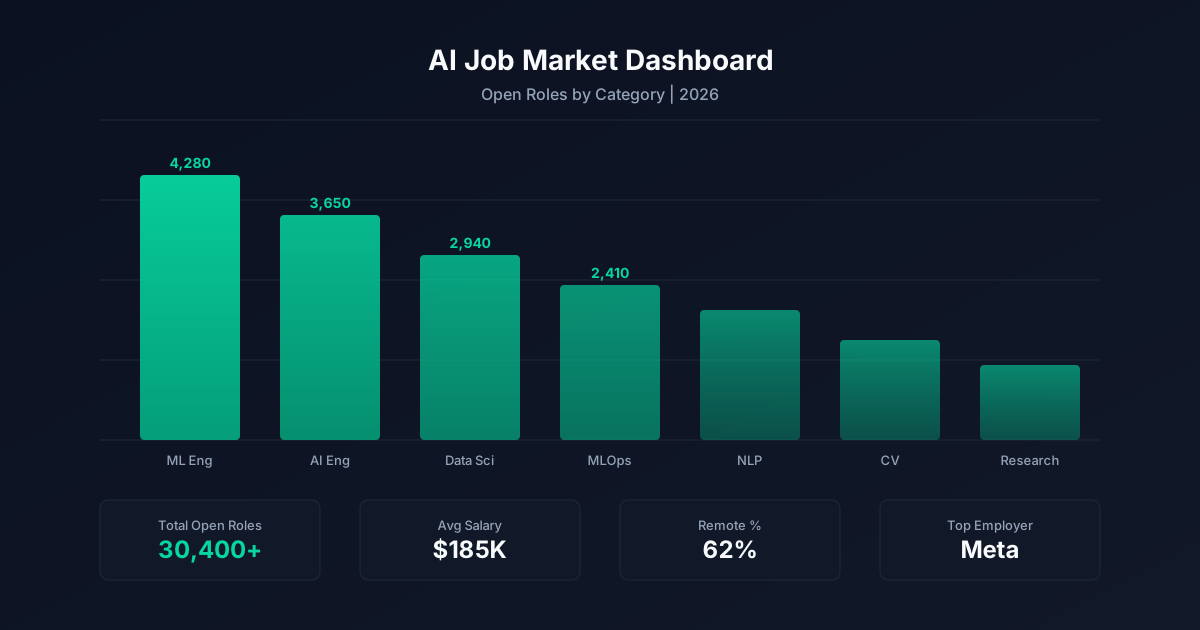
The AI job market spans 3,708 open positions across 16 role categories. The largest categories by volume: AI/ML Engineer (2,605), Data Scientist (310), AI Software Engineer (259). These three account for the majority of open positions, though smaller categories often have higher per-role compensation because of specialized skill requirements.
The seniority mix tells a story about where AI teams are in their maturity. Entry-level roles (102) are outnumbered by mid-level (1,705) and senior (1,469) positions, reflecting that most companies are past the 'build a team from scratch' phase and need experienced engineers who can ship production systems. Leadership roles (Director, VP, C-Level) total 432 positions, representing the bottleneck between technical execution and organizational strategy.
Remote work availability sits at 14% of all AI roles (508 positions), with 3,180 requiring on-site or hybrid attendance. The remote share has stabilized after the post-pandemic correction. Senior and specialized roles (Research Scientist, ML Architect) are more likely to be remote-eligible than entry-level positions, partly because experienced hires have more negotiating power and partly because these roles require less hands-on mentorship.
AI compensation is structured in clear tiers. The market median sits at $217,500. Top-quartile roles start at $272,100, and the 90th percentile reaches $325,000. These figures include base salary with disclosed compensation. Total compensation (including equity, bonuses, and sign-on) runs 20-40% higher at companies that offer those components.
Category matters for compensation. AI Safety roles lead at $300,000 median, while Prompt Engineer roles sit at $140,000. The spread between highest and lowest-paying categories reflects the premium on specialized technical skills versus broader analytical roles.
The most in-demand skills across all AI postings: Python (1,890 postings), Aws (1,103 postings), Azure (877 postings), Rag (855 postings), Gcp (631 postings), Prompt Engineering (560 postings), Pytorch (545 postings), Claude (498 postings). Python dominates, appearing in the vast majority of role descriptions regardless of category. Cloud platform experience (AWS, GCP, Azure) is the second most common requirement. The newer entrants to the top skills list (RAG, vector databases, LLM APIs) reflect the shift from traditional ML toward generative AI applications.
Frequently Asked Questions
Get Weekly AI Career Intelligence
Salary data, skills demand, and market signals from 16,000+ AI job postings. Every Monday.