
Interested in this AI/ML Engineer role at Sesame Workshop?
Apply Now →Skills & Technologies
About This Role
About Sesame Workshop
Sesame Workshop is the global nonprofit behind Sesame Street and so much more. For over 50 years, we have worked at the intersection of education, media, and research, creating joyful experiences that enrich minds and expand hearts, all in service of empowering each generation to build a better world. Our beloved characters, iconic shows, outreach in communities, and more bring playful early learning to families in more than 190 countries and advance our mission to help children everywhere grow smarter, stronger, and kinder. Learn more at www.sesame.org and follow Sesame Workshop on Instagram, TikTok, Facebook, and X.
Job Summary
The Senior Manager, Data Science \& Analytics is a member of Research \& Insights and reports to the Senior Director, Data Science. This is the first dedicated hire within the Data Science function and acts as the product owner for Sesame Workshop's shared data models and analytics layer. While the knowledge of what each source contains lives with its data owners across the business, this role knows that landscape end\-to\-end, documents it, and turns it into maintainable, well\-modeled data products in dbt that the organization's data analysts and business\-intelligence (BI) partners build on. This role owns the models and their trustworthiness, while those analysts own how the data is presented to stakeholders.
Sesame Workshop is building its internal data capabilities to better serve teams across the organization: from Marketing and Strategy to Revenue and Impact Programs. The Senior Manager, Data Science \& Analytics exists to own data models, transformation logic, and metric standards that turn raw, scattered data into a dependable analytics layer.
This is a product\-ownership role for the analytics layer. The right candidate is quick to learn and adapt to the ever\-changing data landscape, documents how each measure is calculated and to what quality standard, and encodes it as versioned, maintainable data products in dbt. This provides the backbone that lets analysts turn well\-modeled data into dashboards, reports, and presentations.
This is a hands\-on, senior individual\-contributor role with room to grow into broader technical leadership and data governance. The Senior Manager operates independently, is well organized, sets standards rather than waiting for direction, and finishes things: taking prototypes or proofs of concept and turning them into data products that run reliably. As Sesame Workshop's data practice matures, the role is positioned to own data governance operations for the organization.
Responsibilities \& Delivery
- Own the data models and documentation that encode the organization's key metrics, capturing, from each source system's data owners, which source answers which question, how each measure (e.g., "reach," "engagement," "revenue") is calculated, and the quality bar it must meet.
- Build and maintain the data models and transformation logic (e.g., dbt) that implement those definitions, turning proof\-of\-concept analyses and prototype tools into documented, tested, version\-controlled data products that downstream users can depend on without ongoing intervention.
- Manage data quality and documentation as a product, maintaining a catalog of the active data models and metrics (their sources, refresh schedules, and known limitations), keeping metric definitions and methodology transparent and easy to inspect (such as dbt docs) so the numbers are understood and trusted across teams, and proactively flagging data source changes or data\-quality issues before they reach downstream users.
- Build and maintain shared datasets that combine and standardize data from across the organization's source systems, so analysts can work from consistent, reliable data and build their own reports rather than manually pulling and reconciling exports.
- Integrate and model data from multiple systems, including but not limited to local databases, cloud object storage, Google Analytics, and Salesforce, into unified, reusable datasets that feed leadership\-level and board reporting.
- Improve the performance and reliability of the analytics layer by automating manual workflows, optimizing queries and downstream extracts and data preparation (e.g., for BI tools), and recommending improvements to data\-collection practices.
- This role may perform other related duties as needed to support team and organizational priorities.
Collaboration and teamwork:
- Partner with the Senior Director, Data Science, to set the roadmap for shared data products, prioritize what gets modeled, and align the analytics layer with the function's strategic initiatives.
- Coordinate with the Technology team on data infrastructure, access, and governance, and leverage shared platforms such as Snowflake.
- Partner with data analysts and BI colleagues across departments (e.g., Consumer Insights, Marketing) as the internal customers of the analytics layer, so that data products serve the questions teams need to answer.
Stakeholder and relationship management:
- Build trusted working relationships with these teams by delivering reliable, well\-documented data products they can build on with confidence.
- Cultivate an understanding of how each team uses data so that models, metrics, and documentation match the questions they need to answer.
- Foster a reputation as the person who turns shared metrics into consistent, well\-documented models the whole organization can rely on, rather than the person who fields ad\-hoc requests for them.
Communication and influence:
- Advocate for consistent metric definitions and data\-quality standards across departments, and document them so they are discoverable and reusable.
- Consult with analysts and business owners on how to translate questions into well\-defined, trackable metrics, establishing the definition and quality bar.
Cross\-functional and strategic engagement:
- Align the shared metric layer with official organizational priorities and the Strategy team's KPI framework, so the numbers reported across departments are consistent and reinforce the metrics leadership has endorsed.
- Break down data silos by partnering across departments to bring together data that lives in separate systems, so the organization can answer cross\-cutting questions, like total audience reach across platforms, that no single team can answer alone.
This role may perform other related duties as needed to support team and organizational priorities.
Required Qualifications:
- 5\+ years of professional experience in data modeling, data transformation, or building and owning shared data assets that other analysts and teams rely on.
- Strong SQL proficiency, including writing and optimizing complex queries across large, multi\-source datasets
- Python proficiency for data transformation, automation, and internal tooling, with comfort using modern developer workflows, including version control (git).
- Hands\-on experience with a data transformation framework (dbt preferred).
- Demonstrated ownership of data quality and metric definitions: defining canonical metrics, setting quality standards, and maintaining documentation or a data dictionary as a product.
- A product\-owner mindset for data: knowing the full data landscape, documenting it, and turning it into maintainable, well\-modeled data products, while prioritizing what to build and setting modeling and quality standards proactively rather than building one\-off queries on request.
- Ability to enable and upskill analysts through clear documentation, pairing, and code review.
- Bachelor's degree in a quantitative field (statistics, economics, data science, computer science, mathematics, social science with quantitative methods, or similar).
Preferred Qualifications:
- Experience working in a nonprofit, media, or mission\-driven organization where data maturity is still developing and processes must be built from scratch.
- Familiarity with a cloud data warehouse (e.g., Snowflake), Google Analytics, or Salesforce data.
- Familiarity with a BI tool (Tableau, Looker, or Power BI), particularly optimizing extracts and data preparation for performance.
- Experience establishing data governance, a semantic layer, or a metrics catalog.
- Comfort working in the terminal/command line and with AI coding assistants/agentic tooling used to accelerate development.
- Comfort operating in an ambiguous environment with evolving priorities and limited formal process, the kind of person who creates structure rather than waiting for it.
- Exposure to audience analytics or media measurement (viewership metrics, digital engagement, attribution modeling).
- Interest in the intersection of data, education, and social impact.
Sesame Workshop Hybrid Work Policy:
This position is based at our headquarters office in New York (Manhattan) at 1900 Broadway, New York, NY, and follows a hybrid work model. In\-office requirements vary by role and employee group, and currently range from two to five designated in\-office days per week.
Pay Transparency Policy Statement:
As a federal contractor, Sesame Workshop follows Pay Transparency and non\-discrimination provisions as guided by the U.S. Department of Labor.
Equal Opportunity Employment (EOE) Statement
Sesame Workshop is an Equal Opportunity Employer. All qualified applicants will receive consideration for employment without regard to race, ethnicity, religion, sex, sexual orientation, gender identity, gender expression, age, national origin, predisposing genetic characteristics, pregnancy\-related condition, familial status, domestic violence victim status, or protected veteran status and will not be discriminated against on the basis of disability.
PSEA Statement
Sesame Workshop is an equal\-opportunity employer. All employment decisions are based on the business needs, job requirements \& suitability of the candidate. Sesame Workshop strictly follows the Child Safeguarding Policy, and the Anti\-Trafficking in Persons Policy. These have been developed to ensure the maximum protection of program participants from exploitation and to clarify the responsibilities of Sesame Workshop staff, consultants, visitors to the program and partner organization, and the standards of behavior expected from them.
Salary Context
This $115K-$132K range is in the lower quartile for AI/ML Engineer roles in our dataset (median: $175K across 2162 roles with salary data).
View full AI/ML Engineer salary data →Role Details
About This Role
AI/ML Engineers build and deploy machine learning models in production. They work across the full ML lifecycle: data pipelines, model training, evaluation, and serving infrastructure. The role has evolved significantly over the past two years. Where ML Engineers once spent most of their time on model architecture, the job now tilts heavily toward inference optimization, cost management, and integrating LLM capabilities into existing systems. Companies want engineers who can ship production systems, and the experimenter-only role is fading fast.
Day-to-day, you're writing training pipelines, debugging data quality issues, setting up evaluation frameworks, and figuring out why your model performs differently in staging than it did on your dev set. The best ML engineers are obsessive about reproducibility and measurement. They instrument everything. They know that a model is only as good as the data feeding it and the infrastructure serving it.
Across the 4,317 AI roles we're tracking, AI/ML Engineer positions make up 70% of the market. At Sesame Workshop, this role fits into their broader AI and engineering organization.
Demand for AI/ML Engineers has been strong and consistent. Unlike some AI roles that spike with hype cycles, ML engineering is a foundational need. Every company deploying AI models needs people who can keep them running, and the gap between research prototypes and production systems keeps growing.
What the Work Looks Like
A typical week might include: debugging a data pipeline that's silently dropping 3% of training examples, running A/B tests on a new model version, writing documentation for a feature flag system that lets you roll back model deployments, and reviewing a junior engineer's PR for a new evaluation metric. Meetings tend to be cross-functional since ML touches product, engineering, and data teams.
Demand for AI/ML Engineers has been strong and consistent. Unlike some AI roles that spike with hype cycles, ML engineering is a foundational need. Every company deploying AI models needs people who can keep them running, and the gap between research prototypes and production systems keeps growing.
Skills Required
Python and PyTorch dominate the requirements. Most roles expect experience with cloud platforms (AWS, GCP, or Azure) and familiarity with ML frameworks like TensorFlow or JAX. RAG (Retrieval-Augmented Generation) has become a top-3 skill requirement as companies integrate LLMs into their products. Docker and Kubernetes show up in about a third of postings, reflecting the production focus of the role.
Beyond the core stack, employers increasingly want experience with experiment tracking tools (MLflow, Weights & Biases), feature stores, and vector databases. Fine-tuning experience is valuable but less common than you'd think from reading Twitter. Most production LLM work is RAG and prompt engineering, not fine-tuning. If you have both, you're in a strong position.
Companies that are serious about AI/ML hiring tend to post specific infrastructure details in the job description: the frameworks they use, their model serving stack, their data pipeline tools. Vague postings that just say 'ML experience required' without specifics are often companies that haven't figured out what they need yet.
Compensation Benchmarks
AI/ML Engineer roles pay a median of $214,900 based on 6,420 positions with disclosed compensation. Senior-level AI roles across all categories have a median of $227,400. This role's midpoint ($123K) sits 43% below the category median. Disclosed range: $115K to $132K.
Across all AI roles, the market median is $215,000. Top-quartile compensation starts at $266,300. The 90th percentile reaches $320,790. For comparison, the highest-paying categories include AI Safety ($287,500) and Research Engineer ($272,100). By seniority level: Entry: $110,000; Mid: $194,400; Senior: $227,400; Director: $274,554; VP: $241,000.
Sesame Workshop AI Hiring
Sesame Workshop has 1 open AI role right now. They're hiring across AI/ML Engineer. Based in New York, NY, US. Compensation range: $132K - $132K.
Location Context
AI roles in New York pay a median of $220,000 across 1,650 tracked positions.
Career Path
Common paths into AI/ML Engineer roles include Data Scientist, Software Engineer, Research Engineer.
From here, career progression typically leads toward ML Architect, AI Engineering Manager, Principal ML Engineer.
The fastest path into ML engineering is through software engineering with a self-directed ML education. A CS degree helps, but production engineering skills matter more than academic credentials. Build something that works, deploy it, and measure it. That portfolio project is worth more than a Coursera certificate. For career growth, the fork comes around the senior level: go deep on technical complexity (staff/principal track) or move into managing ML teams.
What to Expect in Interviews
Expect system design questions around ML pipelines: how you'd build a training pipeline for a specific use case, handle data drift, or design A/B testing infrastructure for model deployments. Coding rounds typically involve Python, with emphasis on data manipulation (pandas, numpy) and algorithm implementation. Take-home assignments often ask you to build an end-to-end ML pipeline from raw data to deployed model.
When evaluating opportunities: Companies that are serious about AI/ML hiring tend to post specific infrastructure details in the job description: the frameworks they use, their model serving stack, their data pipeline tools. Vague postings that just say 'ML experience required' without specifics are often companies that haven't figured out what they need yet.
AI Hiring Overview
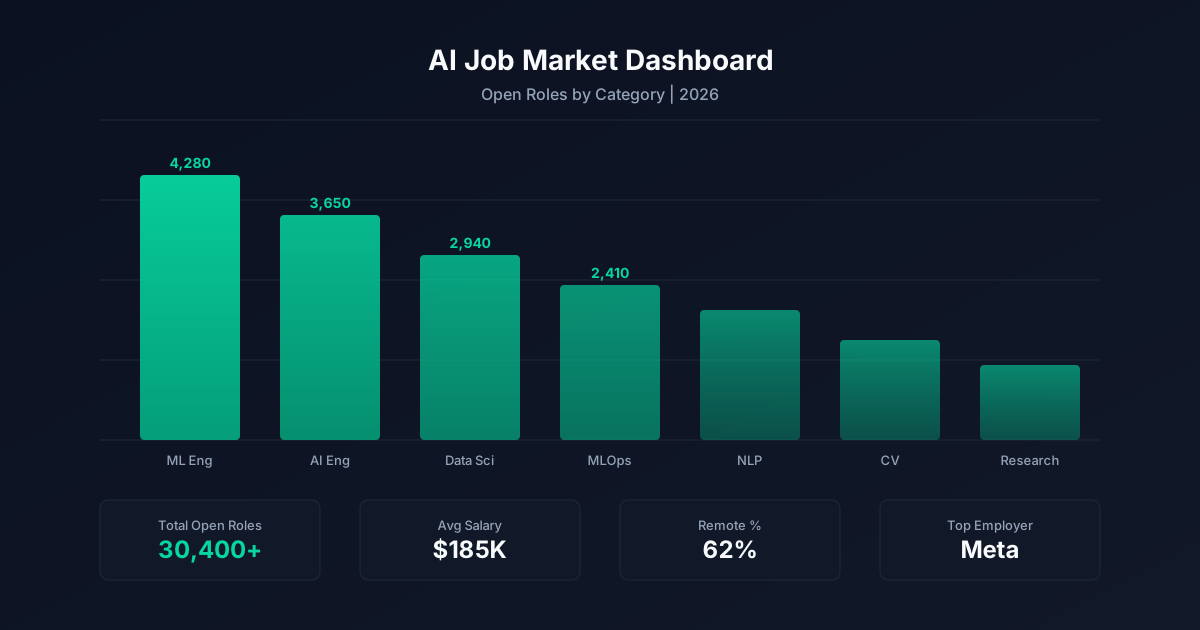
The AI job market has 4,317 open positions tracked in our dataset. By seniority: 138 entry-level, 2,071 mid-level, 1,655 senior, and 453 leadership roles (Director, VP, C-Level). Remote roles make up 15% of the market (635 positions). The remaining 3,657 roles require on-site or hybrid attendance.
The market median for AI roles is $215,000. Top-quartile compensation starts at $266,300. The 90th percentile reaches $320,790. Highest-paying categories: AI Safety ($287,500 median, 34 roles); Research Engineer ($272,100 median, 227 roles); AI Engineering Manager ($244,000 median, 23 roles).
Demand for AI/ML Engineers has been strong and consistent. Unlike some AI roles that spike with hype cycles, ML engineering is a foundational need. Every company deploying AI models needs people who can keep them running, and the gap between research prototypes and production systems keeps growing.
The AI Job Market Today
The AI job market spans 4,317 open positions across 15 role categories. The largest categories by volume: AI/ML Engineer (3,004), Data Scientist (345), AI Software Engineer (309). These three account for the majority of open positions, though smaller categories often have higher per-role compensation because of specialized skill requirements.
The seniority mix tells a story about where AI teams are in their maturity. Entry-level roles (138) are outnumbered by mid-level (2,071) and senior (1,655) positions, reflecting that most companies are past the 'build a team from scratch' phase and need experienced engineers who can ship production systems. Leadership roles (Director, VP, C-Level) total 453 positions, representing the bottleneck between technical execution and organizational strategy.
Remote work availability sits at 15% of all AI roles (635 positions), with 3,657 requiring on-site or hybrid attendance. The remote share has stabilized after the post-pandemic correction. Senior and specialized roles (Research Scientist, ML Architect) are more likely to be remote-eligible than entry-level positions, partly because experienced hires have more negotiating power and partly because these roles require less hands-on mentorship.
AI compensation is structured in clear tiers. The market median sits at $215,000. Top-quartile roles start at $266,300, and the 90th percentile reaches $320,790. These figures include base salary with disclosed compensation. Total compensation (including equity, bonuses, and sign-on) runs 20-40% higher at companies that offer those components.
Category matters for compensation. AI Safety roles lead at $287,500 median, while Prompt Engineer roles sit at $145,000. The spread between highest and lowest-paying categories reflects the premium on specialized technical skills versus broader analytical roles.
The most in-demand skills across all AI postings: Python (2,249 postings), Aws (1,224 postings), Azure (938 postings), Rag (915 postings), Gcp (660 postings), Pytorch (640 postings), Prompt Engineering (624 postings), Kubernetes (559 postings). Python dominates, appearing in the vast majority of role descriptions regardless of category. Cloud platform experience (AWS, GCP, Azure) is the second most common requirement. The newer entrants to the top skills list (RAG, vector databases, LLM APIs) reflect the shift from traditional ML toward generative AI applications.
Frequently Asked Questions
Get Weekly AI Career Intelligence
Salary data, skills demand, and market signals from 16,000+ AI job postings. Every Monday.