
Interested in this AI/ML Engineer role at SimpliSafe?
Apply Now →About This Role
About SimpliSafe
We're a high\-tech home security company that's passionate about protecting the life you've built and our mission of keeping Every Home Secure. And we've created a culture here that cares just as deeply about the career you're building. Ours is a no ego culture of collaboration and innovation where those seeking their next challenge can find big opportunities and make a huge impact on the lives of all those who we protect. We don't just want you to work here. We want you to grow and thrive here.
We're embracing a hybrid work model that enables our teams to split their time between office and home. Hybrid for us means we expect our teams to come together in our state\-of\-the\-art office on two core days, typically Tuesday, Wednesday, or Thursday – working together in person and choosing where they work for the remainder of the week. We all benefit from flexibility and get to use the best of both worlds to get our work done.
Why are we hiring?
Well, we're growing and thriving. So, we need smart, talented, and humble people who share our values to join us as we disrupt the home security space and relentlessly pursue our mission of keeping Every Home Secure.
About the Role
We are seeking a highly motivated and experienced Embedded Machine Learning Engineer to join our growing Edge AI team. As a key contributor, you will lead the on\-device inference and performance optimization of ML models powering outdoor monitoring in the home security space. This role is less about inventing new CV architectures and more about making models fast, power\-efficient, stable, and shippable on real embedded hardware (outdoor cameras and doorbells). You will operate across the stack (from model runtime integration down to kernel/operator optimization, memory movement, scheduling, and accelerator utilization) to deliver reliable real\-time behavior under tight compute, memory, bandwidth, and thermal constraints across device tiers.
Responsibilities:
- Own the embedded deployment and performance of on\-device ML inference for outdoor monitoring workloads (real\-time video/event pipelines).
- Optimize end\-to\-end inference performance across CPU/DSP/NPU/GPU (as applicable): latency, throughput (FPS), memory footprint, power, thermals, startup time, and stability.
- Perform kernel/operator\-level optimization:
- + vectorization (e.g., SIMD/NEON), tiling, cache\-friendly memory layouts
+ reducing bandwidth and memory copies, optimizing post\-processing
+ fusing ops, minimizing synchronization/overhead, thread scheduling
- Integrate and maintain ML models within embedded pipelines:
- + model import/export validation, operator compatibility, graph transforms
+ runtime integration in C/C\+\+ (including pre/post\-processing)
+ robust error handling, watchdogs, and safe fallback behavior
- Drive quantization and deployment readiness from an embedded perspective:
- + validate INT8/FP16 paths, calibration flows, numerical accuracy checks
+ debug quantization edge cases and operator mismatches on target runtimes
- Build tooling for profiling, benchmarking, and regression tracking on devices:
- + per\-layer timing, memory tracking, thermal/perf tests, CI gating
+ automated performance regression gating across device tiers and firmware versions
- Partner closely with ML engineers to translate model changes into deployment impact; provide constraints and design guidance that improve deployability and performance.
- Provide Staff\-level leadership: set performance standards, lead technical reviews, mentor engineers, and influence platform roadmap for on\-device ML.
Qualifications:
- 8\+ years of experience in embedded systems and/or performance engineering, with experience shipping production software on constrained devices.
- Strong C/C\+\+ expertise with deep knowledge of low\-level performance topics: CPU architecture, memory hierarchy, concurrency, and real\-time considerations.
- Demonstrated experience optimizing ML inference on embedded targets, including operator/kernel tuning and end\-to\-end pipeline optimization.
- Familiarity with modern vision model families (transformer\-based detectors such as DEIM/DFINE/RT\-DETR series and CNN\-based detectors such as YOLO family or similar) sufficient to optimize their execution characteristics (tensor shapes, attention/conv patterns, post\-processing).
- Experience with on\-device inference runtimes and deployment workflows (e.g., TFLite, ONNX Runtime, TensorRT or vendor runtimes), including operator support constraints and graph\-level transformations.
- Strong debugging and profiling skills (perf, flame graphs, hardware counters, tracing) and ability to drive performance investigations to closure.
- Ability to lead cross\-functionally across ML, firmware, and hardware teams; comfortable defining benchmarks/KPIs and making tradeoffs.
Bonus Points:
- Experience with embedded accelerators and vendor toolchains (DSP/NPU compilers, delegates, GPU compute, custom runtimes).
- SIMD expertise (ARM NEON/SVE), hand\-tuned kernels, or experience with libraries like XNNPACK/QNNPACK/oneDNN/CMSIS\-NN (or equivalents).
- Experience with quantized inference (INT8\) at scale: calibration strategies, numerical debugging, overflow/underflow handling, and accuracy\-performance tradeoffs.
- Experience with camera/doorbell pipelines: ISP/video decode/encode, DMA/zero\-copy buffers, multi\-threaded real\-time streaming.
- Exposure to OS/firmware constraints (embedded Linux, RTOS), power management, thermal throttling behavior, and performance under sustained load.
- Security/privacy experience for edge devices (secure boot/TEE boundaries, model protection, safe telemetry).
- Experience building performance regression systems and device\-lab automation for continuous benchmarking.
What Values You'll Share
- Customer Obsessed \- Building deep empathy for our customers, putting them at the core of our work, and developing strong, long\-term relationships with them.
- Aim High \- Always challenging ourselves and others to raise the bar.
- No Ego \- Maintaining a "no job too small" attitude, and an open, inclusive and humble style.
- One Team \- Taking a highly collaborative approach to achieving success.
- Lift As We Climb \- Investing in developing others and helping others around us succeed.
- Lean \& Nimble \- Working with agility and efficiency to experiment in an often ambiguous environment.
What We Offer
- A mission\- and values\-driven culture and a safe, inclusive environment where you can build, grow and thrive
- A comprehensive total rewards package that supports your wellness and provides security for SimpliSafers and their families *(For more information on our total rewards please* *click here**)*
- Free SimpliSafe system and professional monitoring for your home.
- Employee Resource Groups (ERGs) that bring people together, give opportunities to network, mentor and develop, and advocate for change.
The target annual base pay range for this role is $185,500 to $244,600
This target annual base pay range represents our good\-faith estimate of what we expect to pay for this role. We use a market\-based compensation approach to set our target annual base pay ranges and make adjustments annually. We carefully tailor individual compensation packages, including base pay, taking into consideration employees' job\-related skills, experience, qualifications, work location, and other relevant business factors.
Beyond base pay, we offer a Total Rewards package that may include participation in our annual bonus program, equity, and other forms of compensation, in addition to a full range of medical, retirement, and lifestyle benefits. More details can be found here.
We're committed to fair and equitable pay practices, as well as pay transparency. We regularly review our programs to ensure they remain competitive and aligned with our values.
*We wholeheartedly embrace and actively seek applications from all individuals, no matter how they identify. We are committed to cultivating a diverse and inclusive workplace, and we believe our work is enriched when we incorporate a multitude of perspectives, backgrounds, and experiences. We want everyone who works here to thrive and contribute to not only our mission of keeping every home secure, but also to making our workplace safe and supportive for others. If a reasonable accommodation may be needed to fully participate in the job application or interview process, to perform the essential functions of a position, or to receive other benefits and privileges of employment, please contact* *careers@simplisafe.com**.*
Salary Context
This $185K-$244K range is above the median for AI/ML Engineer roles in our dataset (median: $180K across 1841 roles with salary data).
View full AI/ML Engineer salary data →Role Details
About This Role
AI/ML Engineers build and deploy machine learning models in production. They work across the full ML lifecycle: data pipelines, model training, evaluation, and serving infrastructure. The role has evolved significantly over the past two years. Where ML Engineers once spent most of their time on model architecture, the job now tilts heavily toward inference optimization, cost management, and integrating LLM capabilities into existing systems. Companies want engineers who can ship production systems, and the experimenter-only role is fading fast.
Day-to-day, you're writing training pipelines, debugging data quality issues, setting up evaluation frameworks, and figuring out why your model performs differently in staging than it did on your dev set. The best ML engineers are obsessive about reproducibility and measurement. They instrument everything. They know that a model is only as good as the data feeding it and the infrastructure serving it.
Across the 3,708 AI roles we're tracking, AI/ML Engineer positions make up 70% of the market. At SimpliSafe, this role fits into their broader AI and engineering organization.
Demand for AI/ML Engineers has been strong and consistent. Unlike some AI roles that spike with hype cycles, ML engineering is a foundational need. Every company deploying AI models needs people who can keep them running, and the gap between research prototypes and production systems keeps growing.
What the Work Looks Like
A typical week might include: debugging a data pipeline that's silently dropping 3% of training examples, running A/B tests on a new model version, writing documentation for a feature flag system that lets you roll back model deployments, and reviewing a junior engineer's PR for a new evaluation metric. Meetings tend to be cross-functional since ML touches product, engineering, and data teams.
Demand for AI/ML Engineers has been strong and consistent. Unlike some AI roles that spike with hype cycles, ML engineering is a foundational need. Every company deploying AI models needs people who can keep them running, and the gap between research prototypes and production systems keeps growing.
Skills in Demand for This Role
Python and PyTorch dominate the requirements. Most roles expect experience with cloud platforms (AWS, GCP, or Azure) and familiarity with ML frameworks like TensorFlow or JAX. RAG (Retrieval-Augmented Generation) has become a top-3 skill requirement as companies integrate LLMs into their products. Docker and Kubernetes show up in about a third of postings, reflecting the production focus of the role.
Beyond the core stack, employers increasingly want experience with experiment tracking tools (MLflow, Weights & Biases), feature stores, and vector databases. Fine-tuning experience is valuable but less common than you'd think from reading Twitter. Most production LLM work is RAG and prompt engineering, not fine-tuning. If you have both, you're in a strong position.
Companies that are serious about AI/ML hiring tend to post specific infrastructure details in the job description: the frameworks they use, their model serving stack, their data pipeline tools. Vague postings that just say 'ML experience required' without specifics are often companies that haven't figured out what they need yet.
Compensation Benchmarks
AI/ML Engineer roles pay a median of $218,750 based on 3,817 positions with disclosed compensation. Senior-level AI roles across all categories have a median of $230,000. Disclosed range: $185K to $244K.
Across all AI roles, the market median is $217,500. Top-quartile compensation starts at $272,100. The 90th percentile reaches $325,000. For comparison, the highest-paying categories include AI Safety ($300,000) and Research Engineer ($280,000). By seniority level: Entry: $120,000; Mid: $200,000; Senior: $230,000; Director: $272,150; VP: $250,000.
SimpliSafe AI Hiring
SimpliSafe has 1 open AI role right now. They're hiring across AI/ML Engineer. Based in Boston, MA, US. Compensation range: $244K - $244K.
Location Context
AI roles in Boston pay a median of $210,000 across 97 tracked positions. That's 3% below the national median.
Career Path
Common paths into AI/ML Engineer roles include Data Scientist, Software Engineer, Research Engineer.
From here, career progression typically leads toward ML Architect, AI Engineering Manager, Principal ML Engineer.
The fastest path into ML engineering is through software engineering with a self-directed ML education. A CS degree helps, but production engineering skills matter more than academic credentials. Build something that works, deploy it, and measure it. That portfolio project is worth more than a Coursera certificate. For career growth, the fork comes around the senior level: go deep on technical complexity (staff/principal track) or move into managing ML teams.
What to Expect in Interviews
Expect system design questions around ML pipelines: how you'd build a training pipeline for a specific use case, handle data drift, or design A/B testing infrastructure for model deployments. Coding rounds typically involve Python, with emphasis on data manipulation (pandas, numpy) and algorithm implementation. Take-home assignments often ask you to build an end-to-end ML pipeline from raw data to deployed model.
When evaluating opportunities: Companies that are serious about AI/ML hiring tend to post specific infrastructure details in the job description: the frameworks they use, their model serving stack, their data pipeline tools. Vague postings that just say 'ML experience required' without specifics are often companies that haven't figured out what they need yet.
AI Hiring Overview
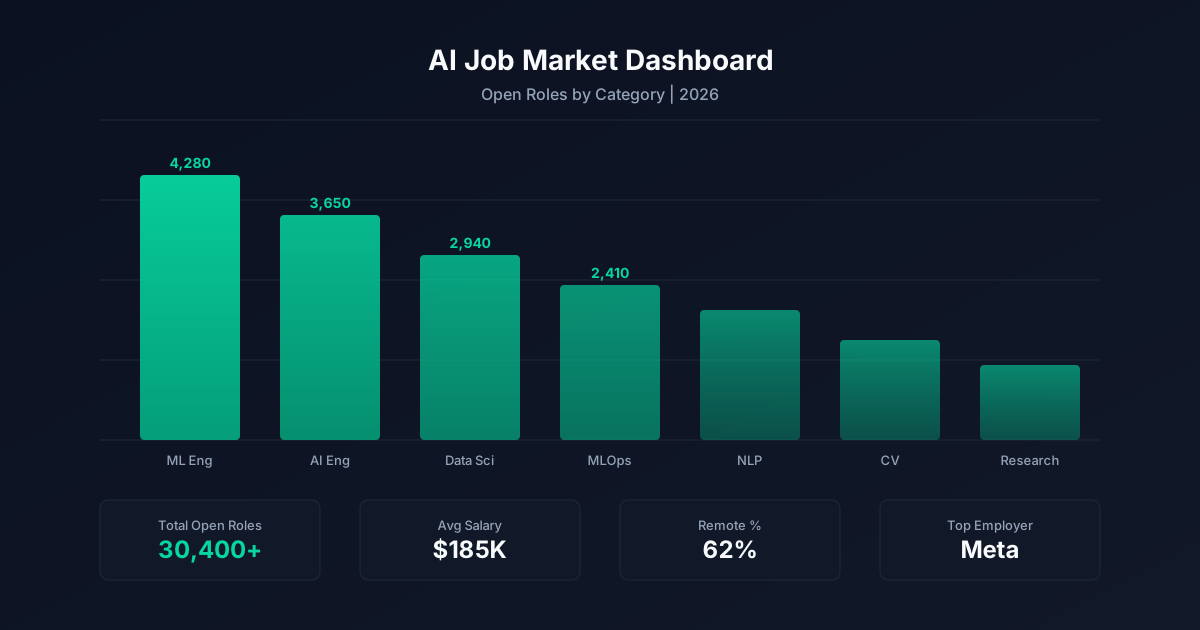
The AI job market has 3,708 open positions tracked in our dataset. By seniority: 102 entry-level, 1,705 mid-level, 1,469 senior, and 432 leadership roles (Director, VP, C-Level). Remote roles make up 14% of the market (508 positions). The remaining 3,180 roles require on-site or hybrid attendance.
The market median for AI roles is $217,500. Top-quartile compensation starts at $272,100. The 90th percentile reaches $325,000. Highest-paying categories: AI Safety ($300,000 median, 21 roles); Research Engineer ($280,000 median, 147 roles); AI Architect ($254,798 median, 67 roles).
Demand for AI/ML Engineers has been strong and consistent. Unlike some AI roles that spike with hype cycles, ML engineering is a foundational need. Every company deploying AI models needs people who can keep them running, and the gap between research prototypes and production systems keeps growing.
The AI Job Market Today
The AI job market spans 3,708 open positions across 16 role categories. The largest categories by volume: AI/ML Engineer (2,605), Data Scientist (310), AI Software Engineer (259). These three account for the majority of open positions, though smaller categories often have higher per-role compensation because of specialized skill requirements.
The seniority mix tells a story about where AI teams are in their maturity. Entry-level roles (102) are outnumbered by mid-level (1,705) and senior (1,469) positions, reflecting that most companies are past the 'build a team from scratch' phase and need experienced engineers who can ship production systems. Leadership roles (Director, VP, C-Level) total 432 positions, representing the bottleneck between technical execution and organizational strategy.
Remote work availability sits at 14% of all AI roles (508 positions), with 3,180 requiring on-site or hybrid attendance. The remote share has stabilized after the post-pandemic correction. Senior and specialized roles (Research Scientist, ML Architect) are more likely to be remote-eligible than entry-level positions, partly because experienced hires have more negotiating power and partly because these roles require less hands-on mentorship.
AI compensation is structured in clear tiers. The market median sits at $217,500. Top-quartile roles start at $272,100, and the 90th percentile reaches $325,000. These figures include base salary with disclosed compensation. Total compensation (including equity, bonuses, and sign-on) runs 20-40% higher at companies that offer those components.
Category matters for compensation. AI Safety roles lead at $300,000 median, while Prompt Engineer roles sit at $140,000. The spread between highest and lowest-paying categories reflects the premium on specialized technical skills versus broader analytical roles.
The most in-demand skills across all AI postings: Python (1,890 postings), Aws (1,103 postings), Azure (877 postings), Rag (855 postings), Gcp (631 postings), Prompt Engineering (560 postings), Pytorch (545 postings), Claude (498 postings). Python dominates, appearing in the vast majority of role descriptions regardless of category. Cloud platform experience (AWS, GCP, Azure) is the second most common requirement. The newer entrants to the top skills list (RAG, vector databases, LLM APIs) reflect the shift from traditional ML toward generative AI applications.
Frequently Asked Questions
Get Weekly AI Career Intelligence
Salary data, skills demand, and market signals from 16,000+ AI job postings. Every Monday.