
Interested in this AI/ML Engineer role at Sonar?
Apply Now →Skills & Technologies
About This Role
### Who is Sonar?
Sonar is driving the future of agent\-centric software development. As the leader in AI code verification and governance, we solve a critical problem: ensuring that software generated by AI\-assisted developers or autonomous agents is reliable, secure, and maintainable.
Integrating seamlessly with Claude Code, Codex, Cursor, GitHub Copilot, Gemini, and Devin, we help over 75% of the Fortune 100 build trusted, reliable, compliant software. Customers who use Sonar are 44% less likely to report an outage due to AI\-generated code.
We believe code verification is the critical missing link in the Agent\-Centric Development Cycle (AC/DC). Industry giants like Nvidia, ServiceNow, Booking.com, Goldman Sachs, AstraZeneca, and Ford Motor Company count on us to provide independent, explainable, consistent review and governance of their AI\-generated code via products like:
- SonarQube: The world’s leading AI code review and verification platform.
- SonarQube Foundation Agent: Currently topping the leaderboards for agentic software repair.
- SonarSweep \& Sonar Context Augmentation: Providing the enterprise\-grade context and constraints agents need to be truly effective.
Our team operates across global hubs in Austin, Bochum, Dubai, Geneva, London, Singapore, Tokyo, and Washington D.C. We move with a mindset we call CODE:
- Committed to our customers and community.
- Obsessed with quality.
- Deliberate in our decisions.
- Effective as one team.
With over $400M in revenue and profitable, fast\-paced growth, we are building the backbone of the AI software revolution. If you’re hungry to have an impact, want to build at a fast pace, and ready to work at the forefront of AI, we want to hear from you.
### Position description
The Business Technology team is composed of passionate technologists who are fully engaged in delivering the best products that help teams deliver their best work. We are focused on reducing friction and getting the most value from solutions to enhance outcomes. We want to expand our Business Technology landscape to manage more systems in a predictable way that accounts for scalability, resilience, and performance.
This role sits at the intersection of AI\-native operations, enterprise platform engineering, and IT service management. You will own how Sonar designs, builds, and operationalizes AI\-augmented systems across its internal technology ecosystem — engineering AI agents and connectors, automating workflows end\-to\-end, and integrating our enterprise tool stack, with Jira Service Management and the Atlassian suite as one core platform among several.
While Jira Service Management and the broader Atlassian suite form a core part of your platform footprint, your scope extends well beyond it: you will build and maintain integrations across our enterprise tool stack, engineer automation pipelines that eliminate manual work at scale, and operationalize AI\-native capabilities (Enterprise Apps connectors, Claude MCP integrations, Rovo agents) that put Sonar ahead of the curve in AI\-driven internal operations.
Your success will directly enable every internal team at Sonar to work faster, smarter, and with less friction — and will give leadership real\-time visibility, consistent governance, and a platform that scales effortlessly with the company's global growth.
### What you will do
You are confident in owning and evolving a multi\-platform internal technology ecosystem for a fast\-growing, multi\-site, multinational organization. You bring deep expertise in building AI\-native systems and automations, and you are equally at home administering and evolving ITSM platforms — especially Atlassian — that anchor Sonar's internal operations.
You bring proven, multi\-year experience in:
- AI Systems \& Agent Engineering (primary focus): Designing, building, and operationalizing AI\-native capabilities across Sonar's internal stack — Claude MCP (Model Context Protocol) integrations, custom Claude skills, Rovo agents, and Enterprise Apps connectors. You prototype on the frontier, then harden what works into reliable, governed production systems that internal teams depend on daily.
- ITSM Platform Ownership (JSM): Administering, configuring, and continuously evolving Jira Service Management — including service catalog design, SLA management, queue configuration, request type rationalization, and automated routing. You treat JSM as a product, not a ticket system.
- Atlassian Suite Administration: Managing the full Atlassian Cloud ecosystem (Jira Software, Confluence, JSM, Guard, Loom, Trello, Bitbucket) with deep expertise in governance, user access management, project templates, and platform health monitoring.
- Automation Engineering: Designing and implementing sophisticated workflow automations — using Atlassian Automation, REST APIs, and third\-party middleware — that eliminate manual processes and scale operations without adding headcount.
- Enterprise Integration Architecture: Building and maintaining integrations between Atlassian and adjacent enterprise systems (Slack, HR platforms, identity providers, monitoring tools) using webhooks, APIs, and marketplace apps.
- CMDB \& Asset Management: Owning JSM Assets configuration, data integrity, and lifecycle management across IT hardware, software licenses, and configuration items (CIs) — ensuring a reliable, audit\-ready source of truth.
- ITSM Process Governance: Defining and enforcing ITIL\-aligned processes including incident management, change management, problem management, and access management — translating business needs into governed, automated workflows.
- Security, Compliance \& Audit Support: Ensuring platform configurations adhere to SonarSource's data protection, access control, and audit requirements. Supporting external audit engagements (KPMG, PwC) with documentation and evidence packages.
- Stakeholder Enablement: Partnering with all internal teams (HR, Finance, Legal, IT, Security, GTM) to identify automation opportunities, gather requirements, and deliver continuous improvements — acting as a true internal platform consultant.
- Platform Roadmap Contribution: Proactively identifying opportunities to modernize internal processes, adopt new platform capabilities, and drive the platform roadmap forward in partnership with the BizTech BackOffice lead
### Experience and qualifications
Experience \& Technical Acumen
- AI Engineering (Required): Hands\-on experience with AI\-native platforms and building on them — Claude/Anthropic, MCP, agent frameworks (Rovo or equivalent), connectors, and prompt\-based workflows. You've built and shipped something real, not just experimented.
- Atlassian Platform Expertise (Required): 5\+ years hands\-on administration of Jira Service Management (JSM), Jira Software, and Confluence Cloud in enterprise, multi\-team environments. Deep knowledge of JSM request types, workflows, SLAs, queues, automations, and service catalog design.
- Automation \& Integration Engineering: Proven experience building workflow automations using Atlassian Automation and/or third\-party tools. Comfortable with REST APIs, webhooks, and JSON for system integrations. Scripting experience (Python, Groovy, JavaScript) is a strong plus.
- Enterprise Tool Breadth: Experience with adjacent enterprise systems — identity providers (Okta, JumpCloud), collaboration tools (Slack, Zoom), or business systems (NetSuite, BambooHR, Salesforce) — is a strong differentiator. We don't need deep expertise in all of them, but curiosity and adaptability across the stack matters.
- CMDB / Asset Management: Experience configuring and maintaining a CMDB or IT asset management system (JSM Assets, ServiceNow CMDB, or equivalent).
- ITSM \& ITIL Knowledge: Strong understanding of ITSM processes and ITIL v3/v4 frameworks — including incident, change, problem, and request management — with the ability to configure platform workflows that enforce these processes at scale.
- Security \& Compliance Awareness: Understanding of IT General Controls (ITGC), access governance, and audit\-readiness requirements. Experience supporting external audit engagements is a plus.
- Atlassian Certifications (Plus): ACP\-620 (Jira Service Management), ACP\-120 (Jira Administrator), or ACP\-420 (Confluence Administrator) are highly valued.
Leadership \& Soft Skills
- Exceptional analytical, strategic thinking, and problem\-solving abilities — you see patterns others miss and turn complexity into clean solutions.
- Highly autonomous and pragmatic: you make concrete progress in the face of ambiguity and imperfect information, without waiting for perfect requirements.
- Strong decision\-making skills, with the ability to prioritize across competing demands and manage multiple concurrent initiatives.
- Self\-confident enough to challenge the status quo — and to give and receive direct feedback in the service of continuous improvement.
- Excellent communication skills for both technical and non\-technical audiences. Fluent in English, written and verbal.
- Collaborative by nature: you share information and ideas freely, and you understand that the best solutions emerge from collective thinking.
- Leadership mindset: you take ownership of initiatives end\-to\-end and drive them to completion with accountability and autonomy.
- Values "done" over "perfect" — while continuously looking for ways to improve processes and deliver measurable impact.
### In\-office culture
We're intentional about this. We believe the best teams are built in the room together. Three anchor days — Mondays, Tuesdays, and Thursdays — create the collaboration rhythm that makes a hub office worth having.
Candidates need to be genuinely based in the location the role is posted — if that's not where you are today, we're happy to support relocation for the right person.
### We value diversity, equity, and inclusion
At Sonar, we believe that our diversity is our strength. We are a global company that values and respects different backgrounds, perspectives, and cultures. We are committed to fostering a diverse and inclusive work environment where everyone feels valued and empowered to contribute their best. We are proud to be an equal opportunity employer and welcome all qualified applicants, regardless of race, color, religion, gender, gender identity or expression, sexual orientation, national origin, genetics, disability, age, or veteran status.
If you need any accommodation, please reach out to us at \[email protected].
All offers of employment at Sonar are contingent upon the results of a comprehensive background check and reference verification conducted before the start date.
Applications that are submitted through agencies or third party recruiters will not be considered.
We may use artificial intelligence (AI) tools to support parts of the hiring process, such as reviewing applications, analyzing resumes, or assessing responses and identifying potential inconsistencies or verification signals in application materials based on available information. These tools assist our recruitment team but do not replace human judgment. Final hiring decisions are ultimately made by humans. If you would like more information about how your data is processed, please contact us.
Role Details
About This Role
AI/ML Engineers build and deploy machine learning models in production. They work across the full ML lifecycle: data pipelines, model training, evaluation, and serving infrastructure. The role has evolved significantly over the past two years. Where ML Engineers once spent most of their time on model architecture, the job now tilts heavily toward inference optimization, cost management, and integrating LLM capabilities into existing systems. Companies want engineers who can ship production systems, and the experimenter-only role is fading fast.
Day-to-day, you're writing training pipelines, debugging data quality issues, setting up evaluation frameworks, and figuring out why your model performs differently in staging than it did on your dev set. The best ML engineers are obsessive about reproducibility and measurement. They instrument everything. They know that a model is only as good as the data feeding it and the infrastructure serving it.
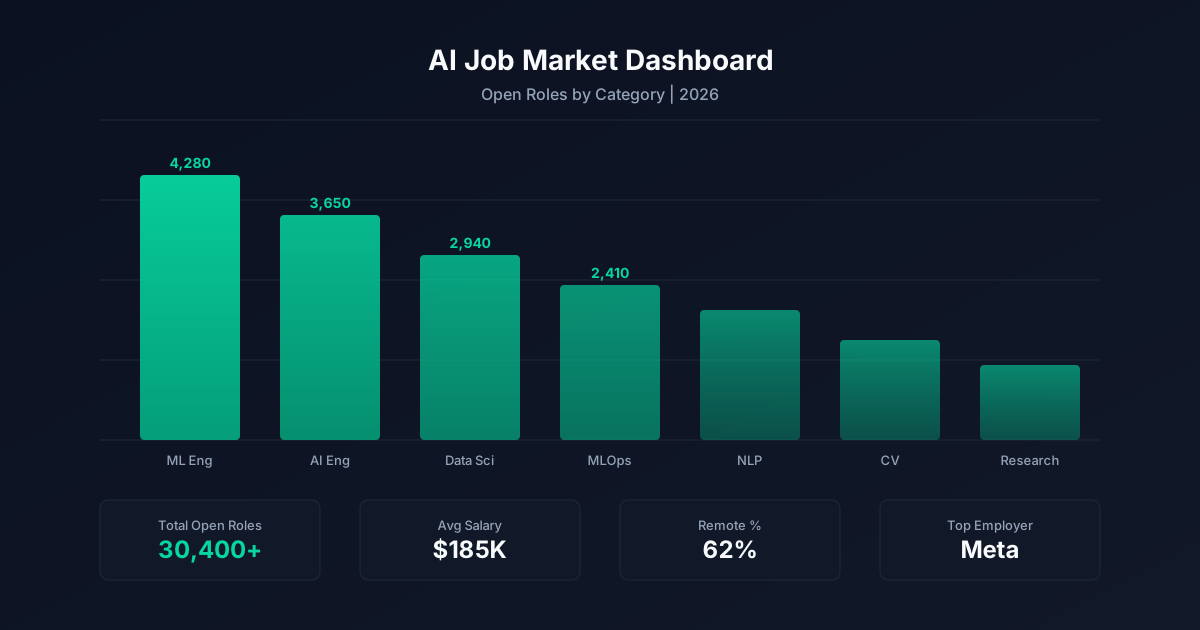
Across the 3,708 AI roles we're tracking, AI/ML Engineer positions make up 70% of the market. At Sonar, this role fits into their broader AI and engineering organization.
Demand for AI/ML Engineers has been strong and consistent. Unlike some AI roles that spike with hype cycles, ML engineering is a foundational need. Every company deploying AI models needs people who can keep them running, and the gap between research prototypes and production systems keeps growing.
What the Work Looks Like
A typical week might include: debugging a data pipeline that's silently dropping 3% of training examples, running A/B tests on a new model version, writing documentation for a feature flag system that lets you roll back model deployments, and reviewing a junior engineer's PR for a new evaluation metric. Meetings tend to be cross-functional since ML touches product, engineering, and data teams.
Demand for AI/ML Engineers has been strong and consistent. Unlike some AI roles that spike with hype cycles, ML engineering is a foundational need. Every company deploying AI models needs people who can keep them running, and the gap between research prototypes and production systems keeps growing.
Skills Required
Python and PyTorch dominate the requirements. Most roles expect experience with cloud platforms (AWS, GCP, or Azure) and familiarity with ML frameworks like TensorFlow or JAX. RAG (Retrieval-Augmented Generation) has become a top-3 skill requirement as companies integrate LLMs into their products. Docker and Kubernetes show up in about a third of postings, reflecting the production focus of the role.
Beyond the core stack, employers increasingly want experience with experiment tracking tools (MLflow, Weights & Biases), feature stores, and vector databases. Fine-tuning experience is valuable but less common than you'd think from reading Twitter. Most production LLM work is RAG and prompt engineering, not fine-tuning. If you have both, you're in a strong position.
Companies that are serious about AI/ML hiring tend to post specific infrastructure details in the job description: the frameworks they use, their model serving stack, their data pipeline tools. Vague postings that just say 'ML experience required' without specifics are often companies that haven't figured out what they need yet.
Compensation Benchmarks
AI/ML Engineer roles pay a median of $218,750 based on 3,817 positions with disclosed compensation. Mid-level AI roles across all categories have a median of $200,000.
Across all AI roles, the market median is $217,500. Top-quartile compensation starts at $272,100. The 90th percentile reaches $325,000. For comparison, the highest-paying categories include AI Safety ($300,000) and Research Engineer ($280,000). By seniority level: Entry: $120,000; Mid: $200,000; Senior: $230,000; Director: $272,150; VP: $250,000.
Sonar AI Hiring
Sonar has 2 open AI roles right now. They're hiring across AI/ML Engineer. Positions span Austin, TX, US, San Mateo, CA, US.
Location Context
AI roles in Austin pay a median of $214,343 across 87 tracked positions.
Career Path
Common paths into AI/ML Engineer roles include Data Scientist, Software Engineer, Research Engineer.
From here, career progression typically leads toward ML Architect, AI Engineering Manager, Principal ML Engineer.
The fastest path into ML engineering is through software engineering with a self-directed ML education. A CS degree helps, but production engineering skills matter more than academic credentials. Build something that works, deploy it, and measure it. That portfolio project is worth more than a Coursera certificate. For career growth, the fork comes around the senior level: go deep on technical complexity (staff/principal track) or move into managing ML teams.
What to Expect in Interviews
Expect system design questions around ML pipelines: how you'd build a training pipeline for a specific use case, handle data drift, or design A/B testing infrastructure for model deployments. Coding rounds typically involve Python, with emphasis on data manipulation (pandas, numpy) and algorithm implementation. Take-home assignments often ask you to build an end-to-end ML pipeline from raw data to deployed model.
When evaluating opportunities: Companies that are serious about AI/ML hiring tend to post specific infrastructure details in the job description: the frameworks they use, their model serving stack, their data pipeline tools. Vague postings that just say 'ML experience required' without specifics are often companies that haven't figured out what they need yet.
AI Hiring Overview
The AI job market has 3,708 open positions tracked in our dataset. By seniority: 102 entry-level, 1,705 mid-level, 1,469 senior, and 432 leadership roles (Director, VP, C-Level). Remote roles make up 14% of the market (508 positions). The remaining 3,180 roles require on-site or hybrid attendance.
The market median for AI roles is $217,500. Top-quartile compensation starts at $272,100. The 90th percentile reaches $325,000. Highest-paying categories: AI Safety ($300,000 median, 21 roles); Research Engineer ($280,000 median, 147 roles); AI Architect ($254,798 median, 67 roles).
Demand for AI/ML Engineers has been strong and consistent. Unlike some AI roles that spike with hype cycles, ML engineering is a foundational need. Every company deploying AI models needs people who can keep them running, and the gap between research prototypes and production systems keeps growing.
The AI Job Market Today
The AI job market spans 3,708 open positions across 16 role categories. The largest categories by volume: AI/ML Engineer (2,605), Data Scientist (310), AI Software Engineer (259). These three account for the majority of open positions, though smaller categories often have higher per-role compensation because of specialized skill requirements.
The seniority mix tells a story about where AI teams are in their maturity. Entry-level roles (102) are outnumbered by mid-level (1,705) and senior (1,469) positions, reflecting that most companies are past the 'build a team from scratch' phase and need experienced engineers who can ship production systems. Leadership roles (Director, VP, C-Level) total 432 positions, representing the bottleneck between technical execution and organizational strategy.
Remote work availability sits at 14% of all AI roles (508 positions), with 3,180 requiring on-site or hybrid attendance. The remote share has stabilized after the post-pandemic correction. Senior and specialized roles (Research Scientist, ML Architect) are more likely to be remote-eligible than entry-level positions, partly because experienced hires have more negotiating power and partly because these roles require less hands-on mentorship.
AI compensation is structured in clear tiers. The market median sits at $217,500. Top-quartile roles start at $272,100, and the 90th percentile reaches $325,000. These figures include base salary with disclosed compensation. Total compensation (including equity, bonuses, and sign-on) runs 20-40% higher at companies that offer those components.
Category matters for compensation. AI Safety roles lead at $300,000 median, while Prompt Engineer roles sit at $140,000. The spread between highest and lowest-paying categories reflects the premium on specialized technical skills versus broader analytical roles.
The most in-demand skills across all AI postings: Python (1,890 postings), Aws (1,103 postings), Azure (877 postings), Rag (855 postings), Gcp (631 postings), Prompt Engineering (560 postings), Pytorch (545 postings), Claude (498 postings). Python dominates, appearing in the vast majority of role descriptions regardless of category. Cloud platform experience (AWS, GCP, Azure) is the second most common requirement. The newer entrants to the top skills list (RAG, vector databases, LLM APIs) reflect the shift from traditional ML toward generative AI applications.
Frequently Asked Questions
Get Weekly AI Career Intelligence
Salary data, skills demand, and market signals from 16,000+ AI job postings. Every Monday.