
Interested in this AI/ML Engineer role at Tebra?
Apply Now →Skills & Technologies
About This Role
Tebra only initiates contact with candidates via email from an official Tebra email address (@tebra.com, @patientpop.com, or @kareo.com) or through our applicant tracking system, Greenhouse. We will only ask you to provide sensitive personal information through our official application portal — not via social media or text message. We do not conduct interviews via instant messaging.
About the Role
==================
We are hiring a hands\-on player coach to lead AI across how Tebra runs as a company. You will be building alongside a small team of one to two engineers while simultaneously leading process re\-engineering engagements with functional leaders. You will ship code, design agents and re\-engineer workflows, while also leading the team around you.
With a small team, this role will focus on our internal operations — not the AI in our product. It covers how every function works, how fast we move, and how much leverage each person has. As we scale toward $300M\+ in ARR, the goal is to decouple growth from headcount and build an operation that runs leaner as it gets bigger.
Most of the value comes from re\-engineering the work itself, so you will pair deep engineering and applied AI skill with strong business judgment and a relentless focus on outcomes.
Your Area of Focus
----------------------
AI Strategy \& Use Case Discovery
- Work with the CEO, CFO, and CPO to identify where AI can drive the greatest efficiency and operating leverage across the organization, and prioritize accordingly.
- Audit and re\-engineer business processes before automating them, so we improve how the work is done and not just how fast it runs.
- Build and maintain an AI Opportunity roadmap that prioritizes use cases by ROI, feasibility and strategic impact in partnership with the functional leaders.
Build the Hardest Workflows
- Perform deep\-dive assessments to identify the highest\-impact efficiency opportunities across all operating functions — then build them, don't just document them.
- Design and build high\-value internal agents and automations that address the hardest problems inside our operating functions. Stay hands\-on in the build yourself; this is not a role where you commission others and review outputs.
- Own the shared patterns for retrieval, agent design, and secure system\-of\-record connectivity — including MCP servers, agent\-to\-agent orchestration, and API integrations — with permission\-aware access across Gong, Salesforce, NetSuite, Snowflake, Slack, and Workato.
- Design multi\-agent systems where specialized agents hand off to each other across workflow steps, not just single agent automation.
- Build and maintain the organizational context layer, the connective tissue that makes Tebra queryable; meeting capture, knowledge connectors, MCP servers into our core systems and permission aware retrieval so agents and people have a single source of truth.
- Develop and maintain a library of reusable skills, frameworks, and how to guide, allowing one person's breakthrough workflow scale to the entire organization and the programs compound over time.
- Own the full lifecycle from rapid prototyping to production\-grade deployment, including monitoring, evaluation frameworks, error handling, and iteration based on real usage data.
Governance
- Define the approved tools, data\-handling rules, build standards, and a shared reference architecture for AI across Tebra's operating functions, in partnership with Legal and Security.
- Own how agents are deployed and monitored once live, ensuring full HIPAA compliance and strict adherence to our data privacy and security policies for PHI, without slowing teams down.
- Stand up an AI risk register, acceptable use policy, and audit trail standards for all production agents, and maintain them as the tooling landscape evolves.
Enable the Functions
- Partner with each function to find high\-value use cases and help them build and ship the more routine, accessible agents themselves.
- Coach AI owners inside each function, and run enablement and fluency programs so adoption scales beyond the central team.
- Build genuine on\-ramps for less\-technical teams: role\-specific training, prompt libraries, office hours, and ready\-to\-use templates that make AI approachable across every level of the org.
- Continuously identify emerging AI tooling, methodologies, and agent frameworks — evaluate new models and techniques to keep Tebra ahead of the curve.
Your Professional Qualifications
------------------------------------
Technical Foundation
- 8\+ years in software engineering, applied AI, or technical product roles, with a meaningful stretch spent hands\-on and building in production — not directing from a distance.
- An engineering background you still use. You can read and write code and ship production systems, not only manage people who do.
- Deep applied AI experience designing and deploying multi\-agents systems, RAG pipelines, agent\-to\-agent orchestrations, MCP servers, and API integrations into systems of record, and LLM\-based workflows in production.
- Hands\-on experience shipping AI in a HIPAA\-regulated or comparable environment — working within BAAs, maintaining audit trails, and keeping PHI out of non\-covered tools.
Business \& Operational Judgment
- A track record on operationally focused technology projects — workflow automation, systems integration, internal tooling — that demonstrably changed how a business runs.
- Strong business acumen. You can sit with a function leader, understand their workflow end\-to\-end, and translate it into the right automation — including knowing when the right answer is to redesign the process first.
- A process re\-engineering instinct, with the judgment to fix the work before automating it.
Change Leadership \& Adoption
- A proven track record of driving adoption and behavior change within non\-technical teams — not just shipping the tools, but building champions, running training, and sustaining usage until it becomes a habit.
- Experience leading a small team and coaching others to build while staying hands\-on yourself.
- Excellent communication. You can brief the CEO and pair with an engineer on the same day, and those conversations feel equally natural.
Location
- Although this position is remote, our strong preference is for candidates to be located on the West Coast or Pacific Time Zone.
*(For Recruiter use only)* \#LI\-BG1 \#LI\-Remote
About Tebra
===============
Tebra is the only all\-in\-one EHR\+ platform built exclusively for independent healthcare practices. Designed to replace the clunky, fragmented tools built for corporate systems, Tebra connects EHR software, billing, automation, telehealth solution, and marketing — so providers can spend less time on admin and more time with patients. More than 42,000 private practices trust Tebra to streamline operations, increase revenue, and reduce burnout — helping clinicians leave work on time and rediscover their purpose. Learn more at www.tebra.com.
Our Values
==============
Start with the Customer
---------------------------
We get to know our customers \- and their patients \- and look at the world through their lens.
Keep It Simple
------------------
Healthcare is too complex. We aim to simplify it for everyone.
Stay Entrepreneurial
------------------------
We reject the status quo and solve problems with creativity, perseverance, and a bias to action.
Better Together
-------------------
We are diverse, humble, and collaborative. We put the team first and win together.
Celebrate Success
---------------------
Life is short and joy is underrated. We take time to have fun and celebrate success.
Perks \& Benefits
=====================
United States: In addition to our healthcare benefits, we also offer amazing perks! Need work from home basics? We offer a discount through Dell! We also offer a number of resources to help you keep your mind and body healthy. Check out Gympass for a great workout, or TelusEmployee Assistance Program to find mental health resources, along with other resources for everyday occurrences.
Costa Rica: To assist with all of life's needs, Tebra also offers a wellness and childcare subsidy and a University/Education discount! We also offer a number of resources to help you keep your mind and body healthy. Check out Gympass for access to health and fitness apps, or Telus Employee Assistance Program to find mental health resources, along with other resources for everyday occurrences.
Compliance \& Privacy Disclosures
=====================================
*NOTE: Tebra is an equal opportunity employer. All applicants will be considered for employment without attention to age, race, color, religion, sex, sexual orientation, gender identity, national origin, veteran or disability status.*
*California residents who apply or are recruited for a job with us: please carefully review our California\-specific Privacy Notice under the California Consumer Protection Act here:* *https://www.tebra.com/privacy\-policy/california\-supplemental\-notice/*
*If you would like to report a fraudulent Tebra job posting, please contact us at* *talentacquisition@tebra.com* *and consider reporting your experience to the FBI's Internet Crime Complaint Center or the Better Business Bureau to help keep others safe online, too.*
*As part of our commitment to a fair and efficient hiring process, Tebra utilizes BrightHire, an interview intelligence platform, for our phone and video screenings.* *This technology records and transcribes interviews to help us ensure consistency, reduce bias, and make more informed hiring decisions.* *By applying for this position, you acknowledge that your interview may be recorded.*
Salary Context
This $224K-$325K range is above the 75th percentile for AI/ML Engineer roles in our dataset (median: $180K across 1841 roles with salary data).
View full AI/ML Engineer salary data →Role Details
About This Role
AI/ML Engineers build and deploy machine learning models in production. They work across the full ML lifecycle: data pipelines, model training, evaluation, and serving infrastructure. The role has evolved significantly over the past two years. Where ML Engineers once spent most of their time on model architecture, the job now tilts heavily toward inference optimization, cost management, and integrating LLM capabilities into existing systems. Companies want engineers who can ship production systems, and the experimenter-only role is fading fast.
Day-to-day, you're writing training pipelines, debugging data quality issues, setting up evaluation frameworks, and figuring out why your model performs differently in staging than it did on your dev set. The best ML engineers are obsessive about reproducibility and measurement. They instrument everything. They know that a model is only as good as the data feeding it and the infrastructure serving it.
Across the 3,708 AI roles we're tracking, AI/ML Engineer positions make up 70% of the market. At Tebra, this role fits into their broader AI and engineering organization.
Demand for AI/ML Engineers has been strong and consistent. Unlike some AI roles that spike with hype cycles, ML engineering is a foundational need. Every company deploying AI models needs people who can keep them running, and the gap between research prototypes and production systems keeps growing.
What the Work Looks Like
A typical week might include: debugging a data pipeline that's silently dropping 3% of training examples, running A/B tests on a new model version, writing documentation for a feature flag system that lets you roll back model deployments, and reviewing a junior engineer's PR for a new evaluation metric. Meetings tend to be cross-functional since ML touches product, engineering, and data teams.
Demand for AI/ML Engineers has been strong and consistent. Unlike some AI roles that spike with hype cycles, ML engineering is a foundational need. Every company deploying AI models needs people who can keep them running, and the gap between research prototypes and production systems keeps growing.
Skills Required
Python and PyTorch dominate the requirements. Most roles expect experience with cloud platforms (AWS, GCP, or Azure) and familiarity with ML frameworks like TensorFlow or JAX. RAG (Retrieval-Augmented Generation) has become a top-3 skill requirement as companies integrate LLMs into their products. Docker and Kubernetes show up in about a third of postings, reflecting the production focus of the role.
Beyond the core stack, employers increasingly want experience with experiment tracking tools (MLflow, Weights & Biases), feature stores, and vector databases. Fine-tuning experience is valuable but less common than you'd think from reading Twitter. Most production LLM work is RAG and prompt engineering, not fine-tuning. If you have both, you're in a strong position.
Companies that are serious about AI/ML hiring tend to post specific infrastructure details in the job description: the frameworks they use, their model serving stack, their data pipeline tools. Vague postings that just say 'ML experience required' without specifics are often companies that haven't figured out what they need yet.
Compensation Benchmarks
AI/ML Engineer roles pay a median of $218,750 based on 3,817 positions with disclosed compensation. Mid-level AI roles across all categories have a median of $200,000. This role's midpoint ($274K) sits 25% above the category median. Disclosed range: $224K to $325K.
Across all AI roles, the market median is $217,500. Top-quartile compensation starts at $272,100. The 90th percentile reaches $325,000. For comparison, the highest-paying categories include AI Safety ($300,000) and Research Engineer ($280,000). By seniority level: Entry: $120,000; Mid: $200,000; Senior: $230,000; Director: $272,150; VP: $250,000.
Tebra AI Hiring
Tebra has 1 open AI role right now. They're hiring across AI/ML Engineer. Based in Corona del Mar, CA, US. Compensation range: $325K - $325K.
Location Context
Across all AI roles, 14% (508 positions) offer remote work, while 3,180 require on-site attendance. Top AI hiring metros: New York (1,045 roles, $220,000 median); San Francisco (810 roles, $277,088 median); Los Angeles (397 roles, $215,000 median).
Career Path
Common paths into AI/ML Engineer roles include Data Scientist, Software Engineer, Research Engineer.
From here, career progression typically leads toward ML Architect, AI Engineering Manager, Principal ML Engineer.
The fastest path into ML engineering is through software engineering with a self-directed ML education. A CS degree helps, but production engineering skills matter more than academic credentials. Build something that works, deploy it, and measure it. That portfolio project is worth more than a Coursera certificate. For career growth, the fork comes around the senior level: go deep on technical complexity (staff/principal track) or move into managing ML teams.
What to Expect in Interviews
Expect system design questions around ML pipelines: how you'd build a training pipeline for a specific use case, handle data drift, or design A/B testing infrastructure for model deployments. Coding rounds typically involve Python, with emphasis on data manipulation (pandas, numpy) and algorithm implementation. Take-home assignments often ask you to build an end-to-end ML pipeline from raw data to deployed model.
When evaluating opportunities: Companies that are serious about AI/ML hiring tend to post specific infrastructure details in the job description: the frameworks they use, their model serving stack, their data pipeline tools. Vague postings that just say 'ML experience required' without specifics are often companies that haven't figured out what they need yet.
AI Hiring Overview
The AI job market has 3,708 open positions tracked in our dataset. By seniority: 102 entry-level, 1,705 mid-level, 1,469 senior, and 432 leadership roles (Director, VP, C-Level). Remote roles make up 14% of the market (508 positions). The remaining 3,180 roles require on-site or hybrid attendance.
The market median for AI roles is $217,500. Top-quartile compensation starts at $272,100. The 90th percentile reaches $325,000. Highest-paying categories: AI Safety ($300,000 median, 21 roles); Research Engineer ($280,000 median, 147 roles); AI Architect ($254,798 median, 67 roles).
Demand for AI/ML Engineers has been strong and consistent. Unlike some AI roles that spike with hype cycles, ML engineering is a foundational need. Every company deploying AI models needs people who can keep them running, and the gap between research prototypes and production systems keeps growing.
The AI Job Market Today
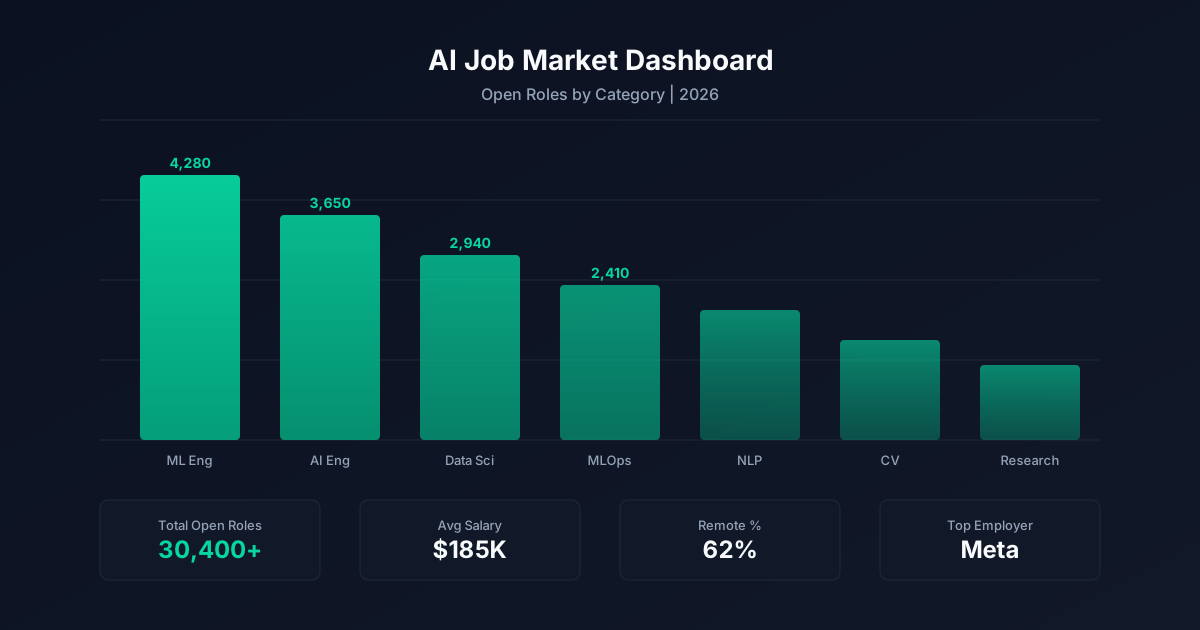
The AI job market spans 3,708 open positions across 16 role categories. The largest categories by volume: AI/ML Engineer (2,605), Data Scientist (310), AI Software Engineer (259). These three account for the majority of open positions, though smaller categories often have higher per-role compensation because of specialized skill requirements.
The seniority mix tells a story about where AI teams are in their maturity. Entry-level roles (102) are outnumbered by mid-level (1,705) and senior (1,469) positions, reflecting that most companies are past the 'build a team from scratch' phase and need experienced engineers who can ship production systems. Leadership roles (Director, VP, C-Level) total 432 positions, representing the bottleneck between technical execution and organizational strategy.
Remote work availability sits at 14% of all AI roles (508 positions), with 3,180 requiring on-site or hybrid attendance. The remote share has stabilized after the post-pandemic correction. Senior and specialized roles (Research Scientist, ML Architect) are more likely to be remote-eligible than entry-level positions, partly because experienced hires have more negotiating power and partly because these roles require less hands-on mentorship.
AI compensation is structured in clear tiers. The market median sits at $217,500. Top-quartile roles start at $272,100, and the 90th percentile reaches $325,000. These figures include base salary with disclosed compensation. Total compensation (including equity, bonuses, and sign-on) runs 20-40% higher at companies that offer those components.
Category matters for compensation. AI Safety roles lead at $300,000 median, while Prompt Engineer roles sit at $140,000. The spread between highest and lowest-paying categories reflects the premium on specialized technical skills versus broader analytical roles.
The most in-demand skills across all AI postings: Python (1,890 postings), Aws (1,103 postings), Azure (877 postings), Rag (855 postings), Gcp (631 postings), Prompt Engineering (560 postings), Pytorch (545 postings), Claude (498 postings). Python dominates, appearing in the vast majority of role descriptions regardless of category. Cloud platform experience (AWS, GCP, Azure) is the second most common requirement. The newer entrants to the top skills list (RAG, vector databases, LLM APIs) reflect the shift from traditional ML toward generative AI applications.
Frequently Asked Questions
Get Weekly AI Career Intelligence
Salary data, skills demand, and market signals from 16,000+ AI job postings. Every Monday.