
Interested in this Research Scientist role at University of Arizona?
Apply Now →Skills & Technologies
About This Role
Posting Number req26590
Department Office of Responsible AI
Department Website Link https://responsibleai.arizona.edu/ORAI
Location Tucson Campus
Address Tucson, AZ USA
Position Highlights
The Office of Responsible AI (ORAI) at the University of Arizona is looking for an AI Research Scientist. This position will lead the development, oversight, and management of AI/ML and data science training initiatives across the University of Arizona. The incumbent will work onsite at the University of Arizona serving as a technical leader and consultant by developing predictive models, operationalizing generative AI frameworks, and applying advanced NLP and unstructured text analytics to extract strategic insights from complex datasets.
Outstanding U of A benefits include health, dental, and vision insurance plans; life insurance and disability programs; paid vacation, sick leave, and holidays; U of A/ASU/NAU tuition reduction for the employee and qualified family members; retirement plans; access to U of A recreation and cultural activities; and more!
The University of Arizona has been recognized for our innovative work\-life programs.
Duties \& Responsibilities
Advanced AI/ML Development \& Technical Consulting
Develop, validate, and deploy advanced statistical, machine learning, and deep learning predictive models to generate actionable insights for institutional and research stakeholders.
Design and implement Natural Language Processing (NLP) pipelines, text vectorization methods, and unstructured data workflows to extract strategic value from large\-scale textual datasets and institutional documents.
Serve as an internal consultant for campus researchers and units, advising on model selection, feature engineering, fine\-tuning LLMs with custom datasets, validation frameworks, and production deployment strategies.
Systematically evaluate model performance utilizing advanced testing and verification frameworks to ensure accuracy, stability, and operational efficiency.
Educational Programming, Curriculum Design \& Assessment
Design, implement, and facilitate high\-impact AI/ML, data science, and generative AI training programs, workshops, and self\-paced learning modules tailored for various university audiences (faculty, staff, and students).
Create rigorous educational materials focused on applied machine learning, prompt engineering frameworks, transformer dynamics, and responsible AI development.
Establish institutional benchmarks and best practices for AI/ML education that seamlessly align with the Office of Responsible AI (ORAI) governance principles.
Deploy robust formative and summative learning assessment tools to measure AI literacy gains, track training efficacy, and continuously refine programming to reflect evolving industry standards.
Responsible AI, Governance \& Strategic Alignment
Operationalize responsible AI practices across the institution, directly guiding stakeholders on algorithmic bias mitigation, model reproducibility, transparency, and data privacy.
Partner with colleges, research units, and administrative divisions to identify emerging AI/ML needs, influence data governance policies, and develop collaborative, data\-driven solutions.
Translate highly complex, technical AI/ML and NLP concepts into accessible, strategic guidance and executive summaries for university leadership and non\-technical audiences.
Contribute actively to AI strategy alignment and knowledge exchange with external and internal academic, research, and industry partners.
Grant Writing \& Program Sustainability
Draft and co\-author high\-quality, multidisciplinary grant proposals and technical funding applications to secure external resources for programmatic sustainability.
Partner with cross\-functional campus investigators to seamlessly integrate technical data specifications, AI/ML research objectives, budget justifications, and educational project milestones into compelling reviewer narratives.
Knowledge, Skills, and Abilities:
Comprehensive understanding of AI ethics, including bias mitigation, model reproducibility, transparency, data governance, and policy compliance.
Skilled in drafting high\-quality, multidisciplinary grant proposals.
Skilled in utilizing real\-world case studies, accessible analogies, and practical applications to help understand and ethically apply AI tools.
This job posting reflects the general nature and level of work expected of the selected candidate(s). It is not intended to be an exhaustive list of all duties and responsibilities. The institution reserves the right to amend or update this description as organizational priorities and institutional needs evolve.
Minimum Qualifications
Bachelor's degree or equivalent advanced learning attained through professional level experience required. Master's Degree required.
Minimum of 8 years of relevant work experience, or equivalent combination of education and work experience.
Preferred Qualifications
Experience with demystifying advanced AI/ML concepts \- such as deep learning, predictive modeling, and algorithmic bias \- for non\-technical audiences.
Experience in planning, delivering, and managing high\-impact synchronous workshops and self\-paced learning modules for various university audiences \- faculty, staff, and students.
FLSA Exempt
Full Time/Part Time Full Time
Number of Hours Worked per Week 40
Job FTE 1\.0
Work Calendar Fiscal
Job Category Research
Benefits Eligible Yes \- Full Benefits
Rate of Pay $86,870 \- $112,932
Compensation Type salary at 1\.0 full\-time equivalency (FTE)
Grade 11
Compensation Guidance The Rate of Pay Field represents the University of Arizona’s good faith and reasonable estimate of the range of possible compensation at the time of posting. The University considers several factors when extending an offer, including but not limited to, the role and associated responsibilities, a candidate’s work experience, education/training, key skills, and internal equity.
The Grade Range represent a full range of career compensation growth over time. The university offers compensation growth opportunities within its career architecture. To learn more about compensation, please review our Applicant Compensation Guide and our Total Rewards Calculator.
Career Stream and Level PC4
Job Family Research \& Data Analysis
Job Function Research
Type of criminal background check required: Name\-based criminal background check (non\-security sensitive)
Number of Vacancies 1
Target Hire Date
Expected End Date
Contact Information for Candidates Julie Emms \| jemms@arizona.edu
Open Date 7/22/2026
Open Until Filled Yes
Documents Needed to Apply Resume and Cover Letter
Special Instructions to Applicant
Notice of Availability of the Annual Security and Fire Safety Report In compliance with the Jeanne Clery Campus Safety Act (Clery Act), each year the University of Arizona releases an Annual Security Report (ASR) for each of the University’s campuses. These reports disclose information including Clery crime statistics for the previous three calendar years and policies, procedures, and programs the University uses to keep students and employees safe, including how to report crimes or other emergencies and resources for crime victims. As a campus with residential housing facilities, the Main Campus ASR also includes a combined Annual Fire Safety report with information on fire statistics and fire safety systems, policies, and procedures.
Paper copies of the Reports can be obtained by contacting the University Compliance Office at cleryact@arizona.edu.
Salary Context
This $86K-$112K range is in the lower quartile for Research Scientist roles in our dataset (median: $183K across 83 roles with salary data).
Role Details
About This Role
Research Scientists push the boundaries of what AI can do. They design experiments, develop novel architectures, publish papers, and translate research breakthroughs into production capabilities. This is where the fundamental advances happen, from attention mechanisms to diffusion models to reasoning chains.
The work is intellectually demanding and often ambiguous. You might spend months on an approach that doesn't pan out. The best research scientists combine deep mathematical intuition with engineering pragmatism. They know when to go deep on theory and when to run experiments. They read papers voraciously and can spot incremental contributions from genuine breakthroughs.
Across the 3,708 AI roles we're tracking, Research Scientist positions make up 3% of the market. At University of Arizona, this role fits into their broader AI and engineering organization.
Research Scientist roles are concentrated at major AI labs (OpenAI, Anthropic, Google DeepMind, Meta FAIR) and well-funded AI startups. The competition is intense. PhD is effectively required for most positions, and publication track record matters. Compensation is among the highest in AI, reflecting both the scarcity of talent and the strategic importance of research breakthroughs.
What the Work Looks Like
A typical week includes: reading and discussing recent papers with your team, designing and running experiments on multi-GPU clusters, analyzing results and iterating on hypotheses, writing up findings for internal review or publication, and collaborating with engineering teams to productionize promising results. The ratio of thinking to coding is higher than in engineering roles.
Research Scientist roles are concentrated at major AI labs (OpenAI, Anthropic, Google DeepMind, Meta FAIR) and well-funded AI startups. The competition is intense. PhD is effectively required for most positions, and publication track record matters. Compensation is among the highest in AI, reflecting both the scarcity of talent and the strategic importance of research breakthroughs.
Skills Required
PhD strongly preferred for most roles. Deep expertise in a specific area (NLP, computer vision, reinforcement learning, multimodal) is expected. PyTorch is the standard. Publication track record matters. Strong mathematical foundations in linear algebra, probability, optimization, and information theory are assumed.
Beyond the fundamentals, companies value experience with large-scale distributed training, novel architecture design, and the ability to bridge theory and practice. Understanding of current frontier topics (reasoning, multimodal, long-context, alignment) is essential. Code quality matters more than many researchers expect. Labs want researchers who can implement their ideas cleanly.
Strong research postings specify the research area, mention the team you'd join, and describe the problems they're working on. They often list recent publications from the team. Vague 'AI research' postings without specifics usually mean the company wants to sound impressive but doesn't have a real research agenda.
Compensation Benchmarks
Research Scientist roles pay a median of $222,200 based on 197 positions with disclosed compensation. Mid-level AI roles across all categories have a median of $200,000. This role's midpoint ($99K) sits 55% below the category median. Disclosed range: $86K to $112K.
Across all AI roles, the market median is $217,500. Top-quartile compensation starts at $272,100. The 90th percentile reaches $325,000. For comparison, the highest-paying categories include AI Safety ($300,000) and Research Engineer ($280,000). By seniority level: Entry: $120,000; Mid: $200,000; Senior: $230,000; Director: $272,150; VP: $250,000.
University of Arizona AI Hiring
University of Arizona has 1 open AI role right now. They're hiring across Research Scientist. Based in Tucson, AZ, US. Compensation range: $112K - $112K.
Location Context
Across all AI roles, 14% (508 positions) offer remote work, while 3,180 require on-site attendance. Top AI hiring metros: New York (1,045 roles, $220,000 median); San Francisco (810 roles, $277,088 median); Los Angeles (397 roles, $215,000 median).
Career Path
Common paths into Research Scientist roles include PhD Student, Research Engineer, Postdoc.
From here, career progression typically leads toward Research Lead, Distinguished Scientist, VP of Research.
The PhD is the entry point for most paths. Choose your advisor and research area carefully since they'll define your first industry position. Publish consistently, contribute to open-source projects in your area, and build relationships at conferences. Industry research offers better compensation and compute resources than academia, but the pressure to show product impact is real.
What to Expect in Interviews
Research interviews are multi-stage: a research talk (present your best paper), technical deep-dives on your methodology, and often a 'research proposal' exercise where you design an experiment to test a hypothesis. Coding rounds test implementation ability alongside theoretical knowledge. Be prepared to implement a paper from scratch and discuss the design choices the authors made. Strong candidates can critique papers constructively and identify gaps in experimental methodology.
When evaluating opportunities: Strong research postings specify the research area, mention the team you'd join, and describe the problems they're working on. They often list recent publications from the team. Vague 'AI research' postings without specifics usually mean the company wants to sound impressive but doesn't have a real research agenda.
AI Hiring Overview
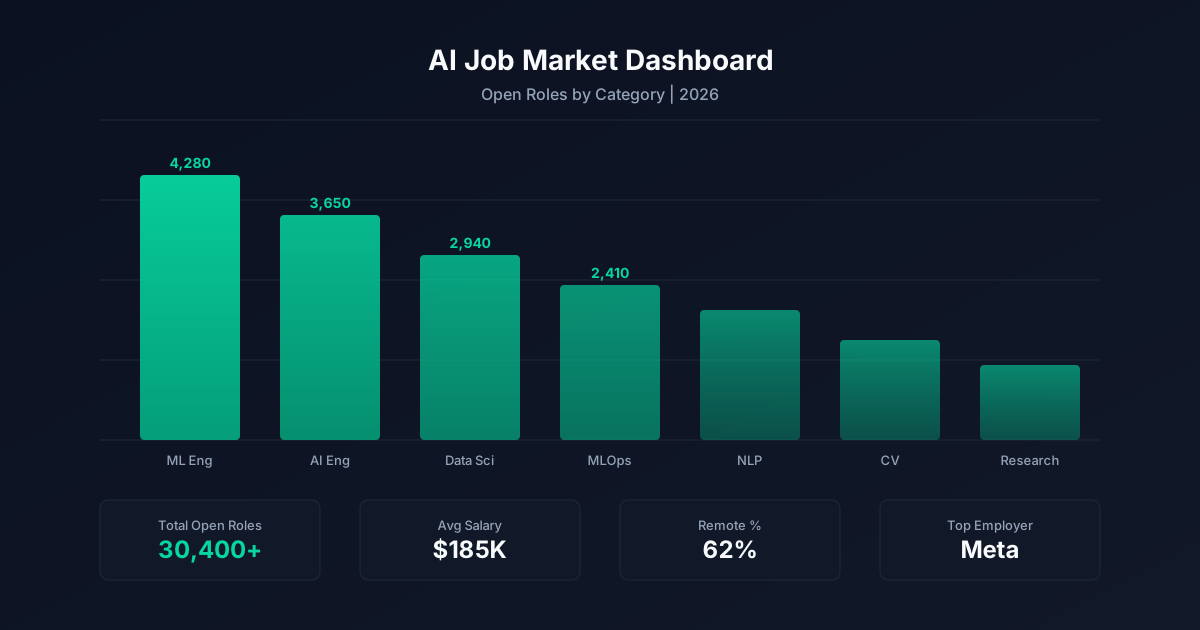
The AI job market has 3,708 open positions tracked in our dataset. By seniority: 102 entry-level, 1,705 mid-level, 1,469 senior, and 432 leadership roles (Director, VP, C-Level). Remote roles make up 14% of the market (508 positions). The remaining 3,180 roles require on-site or hybrid attendance.
The market median for AI roles is $217,500. Top-quartile compensation starts at $272,100. The 90th percentile reaches $325,000. Highest-paying categories: AI Safety ($300,000 median, 21 roles); Research Engineer ($280,000 median, 147 roles); AI Architect ($254,798 median, 67 roles).
Research Scientist roles are concentrated at major AI labs (OpenAI, Anthropic, Google DeepMind, Meta FAIR) and well-funded AI startups. The competition is intense. PhD is effectively required for most positions, and publication track record matters. Compensation is among the highest in AI, reflecting both the scarcity of talent and the strategic importance of research breakthroughs.
The AI Job Market Today
The AI job market spans 3,708 open positions across 16 role categories. The largest categories by volume: AI/ML Engineer (2,605), Data Scientist (310), AI Software Engineer (259). These three account for the majority of open positions, though smaller categories often have higher per-role compensation because of specialized skill requirements.
The seniority mix tells a story about where AI teams are in their maturity. Entry-level roles (102) are outnumbered by mid-level (1,705) and senior (1,469) positions, reflecting that most companies are past the 'build a team from scratch' phase and need experienced engineers who can ship production systems. Leadership roles (Director, VP, C-Level) total 432 positions, representing the bottleneck between technical execution and organizational strategy.
Remote work availability sits at 14% of all AI roles (508 positions), with 3,180 requiring on-site or hybrid attendance. The remote share has stabilized after the post-pandemic correction. Senior and specialized roles (Research Scientist, ML Architect) are more likely to be remote-eligible than entry-level positions, partly because experienced hires have more negotiating power and partly because these roles require less hands-on mentorship.
AI compensation is structured in clear tiers. The market median sits at $217,500. Top-quartile roles start at $272,100, and the 90th percentile reaches $325,000. These figures include base salary with disclosed compensation. Total compensation (including equity, bonuses, and sign-on) runs 20-40% higher at companies that offer those components.
Category matters for compensation. AI Safety roles lead at $300,000 median, while Prompt Engineer roles sit at $140,000. The spread between highest and lowest-paying categories reflects the premium on specialized technical skills versus broader analytical roles.
The most in-demand skills across all AI postings: Python (1,890 postings), Aws (1,103 postings), Azure (877 postings), Rag (855 postings), Gcp (631 postings), Prompt Engineering (560 postings), Pytorch (545 postings), Claude (498 postings). Python dominates, appearing in the vast majority of role descriptions regardless of category. Cloud platform experience (AWS, GCP, Azure) is the second most common requirement. The newer entrants to the top skills list (RAG, vector databases, LLM APIs) reflect the shift from traditional ML toward generative AI applications.
Frequently Asked Questions
Get Weekly AI Career Intelligence
Salary data, skills demand, and market signals from 16,000+ AI job postings. Every Monday.