
Interested in this AI Architect role at Wells Fargo?
Apply Now →About This Role
About this role:
Wells Fargo is seeking an Executive Director, AI Architect and Strategist to help define the future of agentic AI across Commercial Banking and Corporate \& Investment Banking. These are individual contributor roles focused on shaping strategy, architecture, standards, frameworks, and working prototypes that guide the development of AI\-powered products and agentic systems across the organization.
Successful candidates will combine deep technical expertise with strategic thinking, helping establish the point of view, reference architectures, governance models, and implementation patterns that enable the responsible adoption of agentic AI in a highly regulated environment.
In this role, you will:
- Define and evolve architectural frameworks, reference patterns, and standards for AI and agentic systems
- Develop and communicate thought leadership, position papers, and strategic recommendations that shape enterprise AI direction
- Build working prototypes and reference implementations to validate emerging technologies, patterns, and architectural approaches
- Evaluate industry trends, technologies, and market developments to identify durable capabilities and strategic opportunities
- Partner with business, product, data, technology, risk, compliance, and innovation teams to guide AI solution design and implementation
- Establish best practices for scalability, reliability, governance, observability, security, and operational excellence
- Advise stakeholders on architecture decisions, platform strategy, build\-versus\-buy considerations, and technology roadmaps
- Translate complex technical concepts into clear recommendations for senior business and technology leaders
- Influence large\-scale initiatives through expertise and thought leadership rather than formal authority
- Help ensure AI capabilities are implemented responsibly, effectively, and in alignment
Required Qualifications:
- 7\+ years of Artificial Intelligence Solutions experience, or equivalent demonstrated through one or a combination of the following: work experience, training, military experience, education
Desired Qualifications:
- 7\+ years of experience in AI, software architecture, machine learning, data platforms, or related technology disciplines
- Recognized expertise in one or more areas including agentic AI, AI architecture, AI governance, retrieval and knowledge systems, AI platforms, data architecture, or capital markets technology
- Demonstrated ability to define technical strategy and influence enterprise\-level architecture decisions
- Strong hands\-on technical capabilities, including building prototypes, proof\-of\-concepts, and reference implementations
- Experience developing frameworks, standards, patterns, or architectural guidance that others adopt and scale
- Exceptional written and verbal communication skills with the ability to articulate complex concepts to both technical and executive audiences
- Experience operating in highly regulated environments is preferred
- Ability to influence across diverse stakeholder groups without direct management authority
Job Expectations:
- This position is not eligible for Visa sponsorship
- This position offers a hybrid work schedule
- Specific compliance policies may apply regarding outside activities or personal investing; affected employees will be expected to provide information to the Wells Fargo Personal Account Dealing Team and abide by applicable policy requirements if hired. Information will be shared about expectations during the recruitment process
- Ability to travel up to 30% of the time
\#commercialbanking
Pay Range
Reflected is the base pay range offered for this position. Pay may vary depending on factors including but not limited to demonstrated examples of prior performance, skills, experience, or work location. Employees may also be eligible for incentive opportunities.
$185,000\.00 \- $300,000\.00Benefits
Wells Fargo provides eligible employees with a comprehensive set of benefits, many of which are listed below. Visit Benefits \- Wells Fargo Jobs for an overview of the following benefit plans and programs offered to employees.
- Health benefits
- 401(k) Plan
- Paid time off
- Disability benefits
- Life insurance, critical illness insurance, and accident insurance
- Parental leave
- Critical caregiving leave
- Discounts and savings
- Commuter benefits
- Tuition reimbursement
- Scholarships for dependent children
- Adoption reimbursement
Posting End Date:
23 Jul 2026* *Job posting may come down early due to volume of applicants.*
We Value Equal Opportunity
Wells Fargo is an equal opportunity employer. All qualified applicants will receive consideration for employment without regard to race, color, religion, sex, sexual orientation, gender identity, national origin, disability, status as a protected veteran, or any other legally protected characteristic.
Employees support our focus on building strong customer relationships balanced with a strong risk mitigating and compliance\-driven culture which firmly establishes those disciplines as critical to the success of our customers and company. They are accountable for execution of all applicable risk programs (Credit, Market, Financial Crimes, Operational, Regulatory Compliance), which includes effectively following and adhering to applicable Wells Fargo policies and procedures, appropriately fulfilling risk and compliance obligations, timely and effective escalation and remediation of issues, and making sound risk decisions. There is emphasis on proactive monitoring, governance, risk identification and escalation, as well as making sound risk decisions commensurate with the business unit’s risk appetite and all risk and compliance program requirements.
Applicants with Disabilities
To request a medical accommodation during the application or interview process, visit Disability Inclusion at Wells Fargo.
Drug and Alcohol Policy
Wells Fargo maintains a drug free workplace. Please see our Drug and Alcohol Policy to learn more.
Wells Fargo Recruitment and Hiring Requirements:
a. Third\-Party recordings are prohibited unless authorized by Wells Fargo.
b. Wells Fargo requires you to directly represent your own experiences during the recruiting and hiring process.
Salary Context
This $185K-$300K range is above the 75th percentile for AI Architect roles in our dataset (median: $197K across 33 roles with salary data).
Role Details
About This Role
This role sits at the intersection of AI and engineering, building systems that bring machine learning capabilities into production environments. The scope varies by company, but the common thread is applying AI technology to solve real business problems at scale. Most AI roles today require a combination of software engineering fundamentals and domain-specific ML knowledge, with the exact mix depending on the team's maturity and the product they're building.
The AI job market is evolving fast. New role categories emerge as companies figure out what they need to ship AI-powered products. What matters most is the ability to learn quickly, build working systems, and iterate based on real-world performance data. The specific title matters less than the skills you bring and the problems you can solve. Companies are past the experimentation phase and want engineers who can deliver production-quality systems that work reliably at scale.
Across the 3,708 AI roles we're tracking, AI Architect positions make up 1% of the market. At Wells Fargo, this role fits into their broader AI and engineering organization.
AI hiring keeps growing across industries. Companies in tech, finance, healthcare, and retail are all building AI teams. The strongest demand is for people who can bridge the gap between AI research and production engineering. The shift toward generative AI has created new role types (LLM Engineer, Prompt Engineer, AI Agent Developer) that didn't exist three years ago, while traditional roles (Data Scientist, ML Engineer) have evolved to incorporate LLM capabilities.
What the Work Looks Like
Day-to-day work involves a mix of building, debugging, and collaborating. You'll write code, review pull requests, participate in design discussions, and work with cross-functional teams (product, design, data) to define what AI features should do and how they should behave. Expect to spend time on both technical implementation and communication. Most AI teams operate in two-week sprint cycles, with regular demos and retrospectives. The ratio of heads-down coding to meetings and reviews varies by seniority, with senior roles spending more time on architecture decisions and mentorship.
AI hiring keeps growing across industries. Companies in tech, finance, healthcare, and retail are all building AI teams. The strongest demand is for people who can bridge the gap between AI research and production engineering. The shift toward generative AI has created new role types (LLM Engineer, Prompt Engineer, AI Agent Developer) that didn't exist three years ago, while traditional roles (Data Scientist, ML Engineer) have evolved to incorporate LLM capabilities.
Skills in Demand for This Role
Python and cloud platform experience are common requirements. Specific skill needs vary by company and focus area, but familiarity with ML frameworks, data pipelines, and API design covers the basics for most roles. RAG (Retrieval-Augmented Generation), vector databases, and LLM API integration are increasingly standard requirements across role types.
Beyond the core stack, communication skills matter more than many technical candidates realize. The ability to explain AI capabilities and limitations to non-technical stakeholders is a differentiator at every level. Technical writing, documentation, and clear thinking about tradeoffs are underrated skills in AI roles. Experience with evaluation methodology (how to measure whether an AI system is working well) is becoming a core requirement, especially for roles that involve LLM integration.
Look for job postings that specify the problems you'll work on, the tech stack, and the team structure. Vague postings that list every AI buzzword are often a sign the company hasn't figured out what they need. Strong postings describe the product context, the team you'd join, and the specific challenges you'd tackle.
Compensation Benchmarks
AI Architect roles pay a median of $254,798 based on 67 positions with disclosed compensation. Director-level AI roles across all categories have a median of $272,150. This role's midpoint ($242K) sits 5% below the category median. Disclosed range: $185K to $300K.
Across all AI roles, the market median is $217,500. Top-quartile compensation starts at $272,100. The 90th percentile reaches $325,000. For comparison, the highest-paying categories include AI Safety ($300,000) and Research Engineer ($280,000). By seniority level: Entry: $120,000; Mid: $200,000; Senior: $230,000; Director: $272,150; VP: $250,000.
Wells Fargo AI Hiring
Wells Fargo has 13 open AI roles right now. They're hiring across AI/ML Engineer, AI Product Manager, AI Architect. Positions span Minneapolis, MN, US, Chandler, AZ, US, Charlotte, NC, US. Compensation range: $239K - $305K.
Location Context
AI roles in New York pay a median of $220,000 across 1,045 tracked positions.
Career Path
Common paths into AI Architect roles include Software Engineer, Data Scientist, Data Analyst.
From here, career progression typically leads toward Senior Engineer, AI Architect, Engineering Manager, Principal Engineer.
Focus on building things that work. A deployed project that solves a real problem is worth more than any certification. Contribute to open-source, build portfolio projects, and invest in fundamentals (software engineering, statistics, systems design) rather than chasing the latest framework. The AI field moves fast, but the engineers who succeed long-term are the ones with strong fundamentals who can adapt to new tools and paradigms as they emerge.
What to Expect in Interviews
AI interviews typically combine coding challenges (Python-focused), system design questions tailored to the role, and discussions about your experience with relevant tools and frameworks. Strong candidates demonstrate both technical depth and the ability to make pragmatic engineering tradeoffs. Prepare portfolio projects that demonstrate end-to-end capability rather than isolated skills.
When evaluating opportunities: Look for job postings that specify the problems you'll work on, the tech stack, and the team structure. Vague postings that list every AI buzzword are often a sign the company hasn't figured out what they need. Strong postings describe the product context, the team you'd join, and the specific challenges you'd tackle.
AI Hiring Overview
The AI job market has 3,708 open positions tracked in our dataset. By seniority: 102 entry-level, 1,705 mid-level, 1,469 senior, and 432 leadership roles (Director, VP, C-Level). Remote roles make up 14% of the market (508 positions). The remaining 3,180 roles require on-site or hybrid attendance.
The market median for AI roles is $217,500. Top-quartile compensation starts at $272,100. The 90th percentile reaches $325,000. Highest-paying categories: AI Safety ($300,000 median, 21 roles); Research Engineer ($280,000 median, 147 roles); AI Architect ($254,798 median, 67 roles).
AI hiring keeps growing across industries. Companies in tech, finance, healthcare, and retail are all building AI teams. The strongest demand is for people who can bridge the gap between AI research and production engineering. The shift toward generative AI has created new role types (LLM Engineer, Prompt Engineer, AI Agent Developer) that didn't exist three years ago, while traditional roles (Data Scientist, ML Engineer) have evolved to incorporate LLM capabilities.
The AI Job Market Today
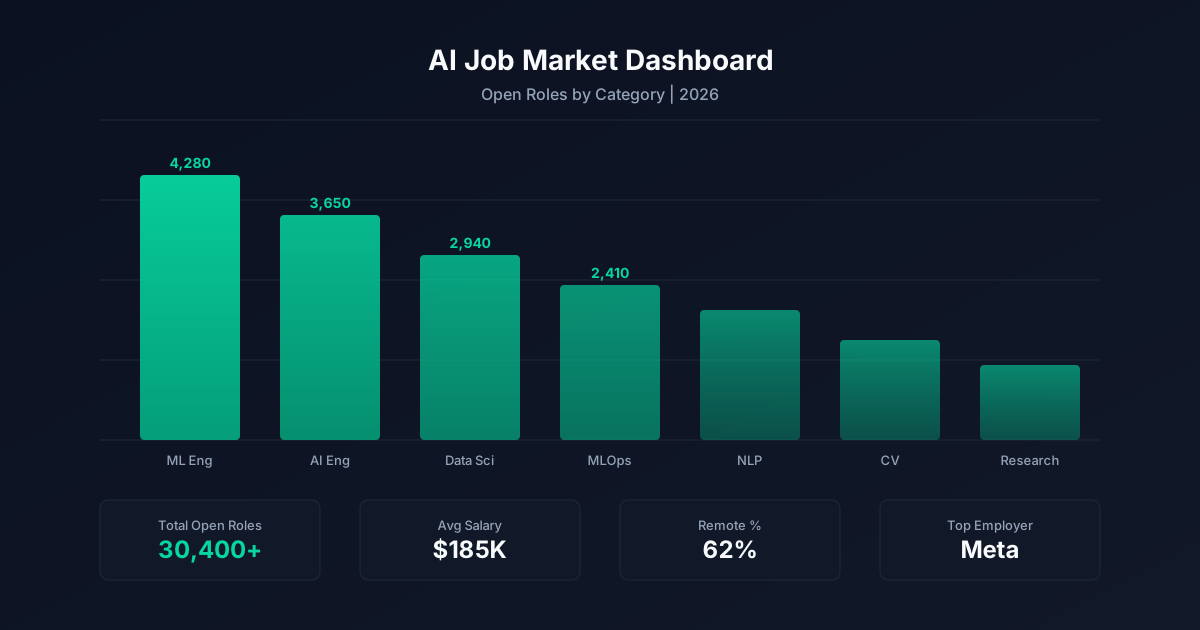
The AI job market spans 3,708 open positions across 16 role categories. The largest categories by volume: AI/ML Engineer (2,605), Data Scientist (310), AI Software Engineer (259). These three account for the majority of open positions, though smaller categories often have higher per-role compensation because of specialized skill requirements.
The seniority mix tells a story about where AI teams are in their maturity. Entry-level roles (102) are outnumbered by mid-level (1,705) and senior (1,469) positions, reflecting that most companies are past the 'build a team from scratch' phase and need experienced engineers who can ship production systems. Leadership roles (Director, VP, C-Level) total 432 positions, representing the bottleneck between technical execution and organizational strategy.
Remote work availability sits at 14% of all AI roles (508 positions), with 3,180 requiring on-site or hybrid attendance. The remote share has stabilized after the post-pandemic correction. Senior and specialized roles (Research Scientist, ML Architect) are more likely to be remote-eligible than entry-level positions, partly because experienced hires have more negotiating power and partly because these roles require less hands-on mentorship.
AI compensation is structured in clear tiers. The market median sits at $217,500. Top-quartile roles start at $272,100, and the 90th percentile reaches $325,000. These figures include base salary with disclosed compensation. Total compensation (including equity, bonuses, and sign-on) runs 20-40% higher at companies that offer those components.
Category matters for compensation. AI Safety roles lead at $300,000 median, while Prompt Engineer roles sit at $140,000. The spread between highest and lowest-paying categories reflects the premium on specialized technical skills versus broader analytical roles.
The most in-demand skills across all AI postings: Python (1,890 postings), Aws (1,103 postings), Azure (877 postings), Rag (855 postings), Gcp (631 postings), Prompt Engineering (560 postings), Pytorch (545 postings), Claude (498 postings). Python dominates, appearing in the vast majority of role descriptions regardless of category. Cloud platform experience (AWS, GCP, Azure) is the second most common requirement. The newer entrants to the top skills list (RAG, vector databases, LLM APIs) reflect the shift from traditional ML toward generative AI applications.
Frequently Asked Questions
Get Weekly AI Career Intelligence
Salary data, skills demand, and market signals from 16,000+ AI job postings. Every Monday.