
Interested in this AI/ML Engineer role at World Wide Technology?
Apply Now →Skills & Technologies
About This Role
Qualifications
- 8\-10 years of experience in adoption, change management, or transformation consulting, including at least 3 years leading teams, programs, or major client engagements.
- Delivery experience with one or more enterprise AI platforms (Microsoft Copilot, Glean, Google Gemini, Anthropic Claude) required.
- AI Adoption \& Change Management: Advanced skills in AI readiness assessment, adoption roadmap design, and change management execution.
- Executive Facilitation: A confident executive facilitator, storyteller, and trusted client advisor able to turn hesitation into action.
- Enablement \& Training Design: Ability to design role\-based learning, champion networks, and coach\-the\-coach programs tied to measurable outcomes.
- Value Measurement \& Analytics: Ability to define metrics, dashboards, and value models that prove impact and ROI, and to read usage and survey signals for adoption behavior change.
- Responsible AI: Working knowledge of AI safety, acceptable\-use guidance, and responsible AI principles — fairness, privacy, transparency, and accountability.
- Client Management: Excellent relationship\-building and client management skills.
Certain states and localities require employers to post a reasonable estimate of salary range. A reasonable estimate of the current base pay range for this position is $127,000 to $159,000 annually. Actual salary will be based on a variety of factors, including shift, location, experience, skill set, performance, licensure and certification, and business needs. The range for this position in other geographic locations may differ. Certain positions may also be eligible for variable incentive compensation, such as bonuses or commissions, that are not included in the base pay.
The well\-being of WWT employees is essential. When it comes to our benefits package, WWT has one of
the best. We offer the following benefits to all full\-time employees:
- Health and Wellbeing: Health (Medical \& Prescription), Dental, and Vision Care, Onsite Health
Centers (MO \& IL), Employee Assistance Program, Wellness program
- Financial Benefits: Competitive Pay, Profit Sharing, 401k Plan with Company Matching, Life and
Disability Insurance, Flexible Spending Accounts, Tuition Reimbursement
- Paid Time Off: PTO \& Holidays, Parental Leave, Medical Leave, Military Leave, Bereavement, Day of
Caring
- Additional Perks: Family Planning Benefits, Nursing Mothers Benefits, Voluntary Legal, Voluntary
Supplemental Accident/Illness/Hospital, Voluntary ID Theft, Pet Insurance, Employee Discount
Program
Note: This is not an all\-encompassing list and should not be used as a complete description of the plan's
benefits. For more information, see our US benefits website at wwt.com/us\-benefits.
We strive to create an environment where all employees are empowered to succeed based on
their skills, performance, and dedication. Our goal is to cultivate a culture of belonging that
encourages innovation, collaboration, and respect for all team members, ensuring that WWT
remains a great place to work for all!
If you require accessibility accommodation(s) or adjustment during any stage of the hiring
process, please let your WWT Recruiter know. The recruiter will work with you to understand your
needs and help ensure an accessible experience throughout the interview process.
World Wide Technology is an Equal Opportunity Employer.
Requirements:
Why WWT?
World Wide Technology (WWT) strives to make a new world happen. WWT's work benefits clients and partners as much as it does its people and community across the globe.
Founded in 1990, WWT brings together strategy, deep technical expertise and world\-class partnerships to help public and private sector organizations design, build and scale intelligent AI, digital, cybersecurity, cloud and infrastructure solutions. Through its Advanced Technology Center (ATC)—a collaborative ecosystem featuring state\-of\-the\-art hardware and software—WWT enables clients and partners to conceptualize, test and validate innovative technology and then deploy solutions at scale using its global integration and distributions capabilities.
With more than 14,000 team members and over 60 locations globally, WWT's culture—grounded in core values and leadership philosophies—has been recognized by Fortune® and Great Place to Work for its commitment to innovation, trust and creating a great place to work for all. WWT provides products and services to large enterprise, global service provider and public sector clients in up to 130 countries across six continents. Softchoice, a World Wide Technology company, supports commercial and SMB markets in the U.S. and Canada.
Want to work with highly motivated individuals on high\-performance teams? Join WWT today!
What is the Solutions Consulting \& Engineering Team and why join?
Solutions Consulting \& Engineering is an organization that is customer\-focused and solutions\-led. We deliver end\-to\-end and emerging solutions to drive customer satisfaction and increase profitability and growth. Our world\-class management consulting, delivery excellence, and engineering brilliance enable our success. We embody the OneWWT mindset by bringing the right talent at the right time from anywhere within WWT to solve our customer's problems. Our goal is to bring together business acumen with full\-stack technical know\-how to develop innovative solutions for our clients' most complex challenges.
Job Summary
Leads WWT's enterprise AI adoption engagements end to end — aligning executives, shaping the change approach, and steering clients to value they can measure.
Job Responsibilities* AI use\-case shaping: Pinpoints and prioritizes the AI use cases that matter most by business impact, feasibility, and client goals — running working sessions that break everyday work into use cases and rank them into a prioritized backlog with go/no\-go calls.
- Supports presales and shapes enterprise AI end\-user adoption strategies that ladder up to each client's transformation priorities.
- AI readiness: Leads readiness assessments — mapping stakeholders and personas, understanding how work gets done, and surfacing the change risks that could slow adoption — and turns findings into practical, sequenced plans clients can act on.
- Planning \& governance: Owns the adoption roadmap, accountability model, and executive steering rhythm, with a clear line of sight to the metrics that matter; owns the skilling, enablement, and communications approach that governs how value gets tracked and realized.
- Enablement \& champions: Designs role\-based learning, coach\-the\-coach programs, and champion certification tied to measurable outcomes, and stands up and manages the champion network — how members are chosen, onboarded, recognized, and tracked for impact.
- Communications \& facilitation: Sets the communications strategy and adoption story, keeps leaders engaged through showcases and demos, and leads executive sessions and open office hours that turn hesitation into small experiments with clear next moves.
- Hands\-on enablement: Leads hands\-on prompt, pattern, and light agent/skill enablement sessions, setting the standards and examples that raise the client team's overall skill level.
- Value measurement: Defines the dashboards, before\-and\-after studies, value model, metrics, thresholds, and guardrails that prove impact and return, and reads usage and survey signals to gauge reach, depth, and behavior change.
- AI safety \& responsible AI: Sets acceptable\-use and safe\-prompting guidance, owns the AI risk register and response plan, and builds in fairness, safety, privacy, inclusiveness, transparency, and accountability with clear escalation paths.
- Scale \& sustain: Packages what works into repeatable playbooks and plans the hand\-off that keeps momentum going; partners with business and IT leaders to steer adoption on real usage signals, and coaches and grows the consultants on the team.
Salary Context
This $127K-$159K range is below the median for AI/ML Engineer roles in our dataset (median: $180K across 1841 roles with salary data).
View full AI/ML Engineer salary data →Role Details
About This Role
AI/ML Engineers build and deploy machine learning models in production. They work across the full ML lifecycle: data pipelines, model training, evaluation, and serving infrastructure. The role has evolved significantly over the past two years. Where ML Engineers once spent most of their time on model architecture, the job now tilts heavily toward inference optimization, cost management, and integrating LLM capabilities into existing systems. Companies want engineers who can ship production systems, and the experimenter-only role is fading fast.
Day-to-day, you're writing training pipelines, debugging data quality issues, setting up evaluation frameworks, and figuring out why your model performs differently in staging than it did on your dev set. The best ML engineers are obsessive about reproducibility and measurement. They instrument everything. They know that a model is only as good as the data feeding it and the infrastructure serving it.
Across the 3,708 AI roles we're tracking, AI/ML Engineer positions make up 70% of the market. At World Wide Technology, this role fits into their broader AI and engineering organization.
Demand for AI/ML Engineers has been strong and consistent. Unlike some AI roles that spike with hype cycles, ML engineering is a foundational need. Every company deploying AI models needs people who can keep them running, and the gap between research prototypes and production systems keeps growing.
What the Work Looks Like
A typical week might include: debugging a data pipeline that's silently dropping 3% of training examples, running A/B tests on a new model version, writing documentation for a feature flag system that lets you roll back model deployments, and reviewing a junior engineer's PR for a new evaluation metric. Meetings tend to be cross-functional since ML touches product, engineering, and data teams.
Demand for AI/ML Engineers has been strong and consistent. Unlike some AI roles that spike with hype cycles, ML engineering is a foundational need. Every company deploying AI models needs people who can keep them running, and the gap between research prototypes and production systems keeps growing.
Skills Required
Python and PyTorch dominate the requirements. Most roles expect experience with cloud platforms (AWS, GCP, or Azure) and familiarity with ML frameworks like TensorFlow or JAX. RAG (Retrieval-Augmented Generation) has become a top-3 skill requirement as companies integrate LLMs into their products. Docker and Kubernetes show up in about a third of postings, reflecting the production focus of the role.
Beyond the core stack, employers increasingly want experience with experiment tracking tools (MLflow, Weights & Biases), feature stores, and vector databases. Fine-tuning experience is valuable but less common than you'd think from reading Twitter. Most production LLM work is RAG and prompt engineering, not fine-tuning. If you have both, you're in a strong position.
Companies that are serious about AI/ML hiring tend to post specific infrastructure details in the job description: the frameworks they use, their model serving stack, their data pipeline tools. Vague postings that just say 'ML experience required' without specifics are often companies that haven't figured out what they need yet.
Compensation Benchmarks
AI/ML Engineer roles pay a median of $218,750 based on 3,817 positions with disclosed compensation. Senior-level AI roles across all categories have a median of $230,000. This role's midpoint ($143K) sits 35% below the category median. Disclosed range: $127K to $159K.
Across all AI roles, the market median is $217,500. Top-quartile compensation starts at $272,100. The 90th percentile reaches $325,000. For comparison, the highest-paying categories include AI Safety ($300,000) and Research Engineer ($280,000). By seniority level: Entry: $120,000; Mid: $200,000; Senior: $230,000; Director: $272,150; VP: $250,000.
World Wide Technology AI Hiring
World Wide Technology has 31 open AI roles right now. They're hiring across AI/ML Engineer, AI Product Manager. Positions span Remote, US, Hartford, CT, US, St. Louis, MO, US. Compensation range: $104K - $300K.
Remote Work Context
Remote AI roles pay a median of $185,334 across 717 positions. About 14% of all AI roles offer remote work.
Career Path
Common paths into AI/ML Engineer roles include Data Scientist, Software Engineer, Research Engineer.
From here, career progression typically leads toward ML Architect, AI Engineering Manager, Principal ML Engineer.
The fastest path into ML engineering is through software engineering with a self-directed ML education. A CS degree helps, but production engineering skills matter more than academic credentials. Build something that works, deploy it, and measure it. That portfolio project is worth more than a Coursera certificate. For career growth, the fork comes around the senior level: go deep on technical complexity (staff/principal track) or move into managing ML teams.
What to Expect in Interviews
Expect system design questions around ML pipelines: how you'd build a training pipeline for a specific use case, handle data drift, or design A/B testing infrastructure for model deployments. Coding rounds typically involve Python, with emphasis on data manipulation (pandas, numpy) and algorithm implementation. Take-home assignments often ask you to build an end-to-end ML pipeline from raw data to deployed model.
When evaluating opportunities: Companies that are serious about AI/ML hiring tend to post specific infrastructure details in the job description: the frameworks they use, their model serving stack, their data pipeline tools. Vague postings that just say 'ML experience required' without specifics are often companies that haven't figured out what they need yet.
AI Hiring Overview
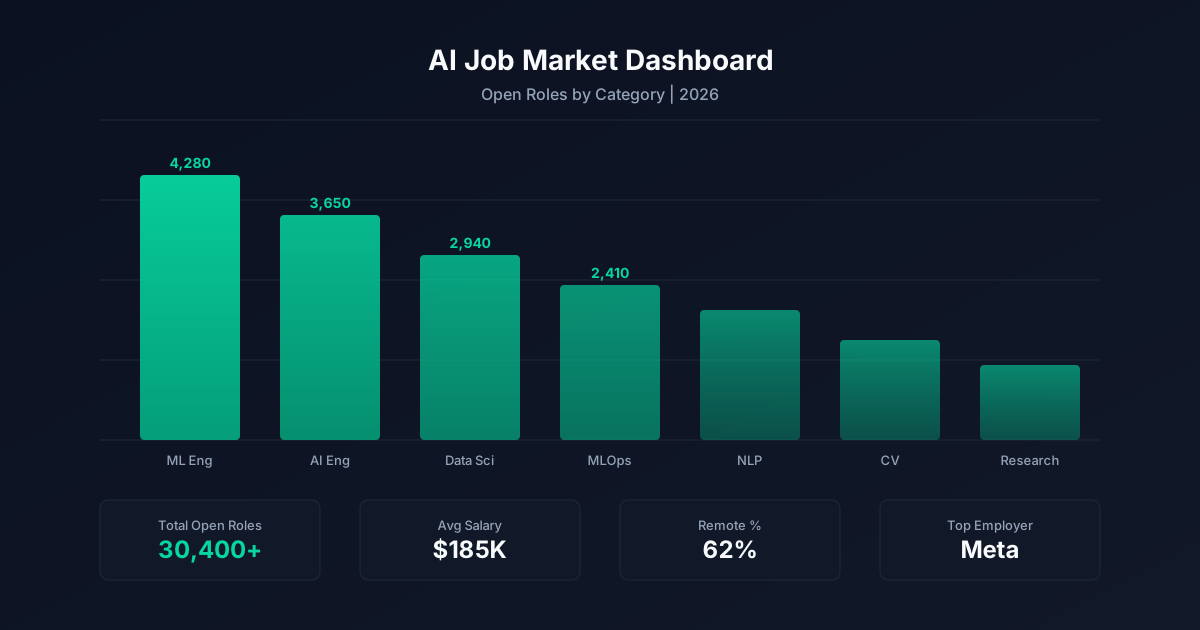
The AI job market has 3,708 open positions tracked in our dataset. By seniority: 102 entry-level, 1,705 mid-level, 1,469 senior, and 432 leadership roles (Director, VP, C-Level). Remote roles make up 14% of the market (508 positions). The remaining 3,180 roles require on-site or hybrid attendance.
The market median for AI roles is $217,500. Top-quartile compensation starts at $272,100. The 90th percentile reaches $325,000. Highest-paying categories: AI Safety ($300,000 median, 21 roles); Research Engineer ($280,000 median, 147 roles); AI Architect ($254,798 median, 67 roles).
Demand for AI/ML Engineers has been strong and consistent. Unlike some AI roles that spike with hype cycles, ML engineering is a foundational need. Every company deploying AI models needs people who can keep them running, and the gap between research prototypes and production systems keeps growing.
The AI Job Market Today
The AI job market spans 3,708 open positions across 16 role categories. The largest categories by volume: AI/ML Engineer (2,605), Data Scientist (310), AI Software Engineer (259). These three account for the majority of open positions, though smaller categories often have higher per-role compensation because of specialized skill requirements.
The seniority mix tells a story about where AI teams are in their maturity. Entry-level roles (102) are outnumbered by mid-level (1,705) and senior (1,469) positions, reflecting that most companies are past the 'build a team from scratch' phase and need experienced engineers who can ship production systems. Leadership roles (Director, VP, C-Level) total 432 positions, representing the bottleneck between technical execution and organizational strategy.
Remote work availability sits at 14% of all AI roles (508 positions), with 3,180 requiring on-site or hybrid attendance. The remote share has stabilized after the post-pandemic correction. Senior and specialized roles (Research Scientist, ML Architect) are more likely to be remote-eligible than entry-level positions, partly because experienced hires have more negotiating power and partly because these roles require less hands-on mentorship.
AI compensation is structured in clear tiers. The market median sits at $217,500. Top-quartile roles start at $272,100, and the 90th percentile reaches $325,000. These figures include base salary with disclosed compensation. Total compensation (including equity, bonuses, and sign-on) runs 20-40% higher at companies that offer those components.
Category matters for compensation. AI Safety roles lead at $300,000 median, while Prompt Engineer roles sit at $140,000. The spread between highest and lowest-paying categories reflects the premium on specialized technical skills versus broader analytical roles.
The most in-demand skills across all AI postings: Python (1,890 postings), Aws (1,103 postings), Azure (877 postings), Rag (855 postings), Gcp (631 postings), Prompt Engineering (560 postings), Pytorch (545 postings), Claude (498 postings). Python dominates, appearing in the vast majority of role descriptions regardless of category. Cloud platform experience (AWS, GCP, Azure) is the second most common requirement. The newer entrants to the top skills list (RAG, vector databases, LLM APIs) reflect the shift from traditional ML toward generative AI applications.
Frequently Asked Questions
Get Weekly AI Career Intelligence
Salary data, skills demand, and market signals from 16,000+ AI job postings. Every Monday.