
Interested in this AI Product Manager role at WPP?
Apply Now →Skills & Technologies
About This Role
WPP is the trusted growth partner for the world's leading brands.
We unite cutting\-edge media intelligence and data solutions, world\-class creativity, next\-generation production, transformative enterprise solutions and expert strategic counsel in a single company – powered by exceptional talent and our agentic marketing platform, WPP Open, to help our clients navigate change, capture opportunity and deliver transformational growth.
We work with the world's most valuable brands and have global reach across 100\+ markets, with deep local expertise.
Our people are the key to our success. We're committed to fostering a culture of creativity, belonging and continuous learning, attracting and developing the brightest talent, and providing exciting career opportunities that help our people grow.
For more information, visit WPP.com.
Why we're hiring:
WPP's Data \& Technology Solutions is the unified global data products and technology team. WPP Open is our AI platform for marketing, connecting marketing professionals, data, tools and AI in a single place.
The Product Manager, Agentic Workflow \& AI Assistant owns the strategy for how AI agents orchestrate multi\-step work within WPP Open. This spans the Canvas (visual workflow builder), agent orchestration patterns, and the marketing\-specific AI assistant experience.
This is where agentic AI moves from "single agent doing one thing" to "agents collaborating on complex workflows" — the highest\-value, most transformative capability in the pillar.
You are:
- A product manager with experience in workflow automation, orchestration, or process\-builder products (think: Zapier, n8n, Temporal, or enterprise workflow tools).
- Comfortable with multi\-agent architectures — you understand how agents can be chained, parallelised, and orchestrated.
- Experienced in conversational AI or assistant products — you understand the UX of human\-AI collaboration.
- A strong systems thinker who can design for both simple (2\-step) and complex (multi\-agent, multi\-tool) workflows.
- Clear on the boundary between "marketing assistant" (WPP Open) and "enterprise assistant" (Microsoft Copilot) — you can articulate why and maintain the line.
What you'll be doing:
Agentic Workflow (Canvas)
- Own the strategy for Canvas — the visual workflow builder where users orchestrate multi\-agent processes.
- Define workflow patterns: sequential, parallel, conditional, human\-in\-the\-loop, and autonomous execution modes.
- Determine how workflows connect to other platform capabilities (creative tools, media activation, data sources).
- Ensure workflows are observable, debuggable, and auditable — enterprise\-grade reliability.
AI Assistant
- Own the marketing\-specific assistant experience within WPP Open — distinct from Microsoft Copilot for enterprise/back\-office.
- Define what "marketing assistant" means: answering marketing questions, accessing client/campaign data, triggering agentic workflows.
- Ensure the assistant experience is contextual — aware of the user's workspace, client, and current task.
- Design the boundary and handoff between Open assistant and Copilot — users should never be confused about where to go.
Cross\-pillar agentic capability
- Coordinate with other pillar leads where their products need orchestration capability — this is the shared "agentic layer."
- Define standards for how agents from other pillars (Creative, Media, Insights) plug into workflow orchestration.
- Ensure the workflow engine is extensible — other teams can build on it without custom development.
What you'll need:
Cross\-pillar agentic capability
- Coordinate with other pillar leads where their products need orchestration capability — this is the shared "agentic layer."
- Define standards for how agents from other pillars (Creative, Media, Insights) plug into workflow orchestration.
- Ensure the workflow engine is extensible — other teams can build on it without custom development.
Who you are:
You're open*:*We are inclusive and collaborative; we encourage the free exchange of ideas; we respect and celebrate diverse views. We are open\-minded: to new ideas, new partnerships, new ways of working.
You're optimistic*:* We believe in the power of creativity, technology and talent to create brighter futures or our people, our clients and our communities. We approach all that we do with conviction: to try the new and to seek the unexpected.
You're extraordinary: We are stronger together: through collaboration we achieve the amazing. We are creative leaders and pioneers of our industry; we provide extraordinary every day.
What we'll give you:
Passionate, inspired people – We aim to create a culture in which people can do extraordinary work
Scale and opportunity – We offer the opportunity to create, influence and complete projects at a scale that is unparalleled in the industry.
Challenging and stimulating work – Unique work and the opportunity to join a group of creative problem solvers. Are you up for the challenge?
\#LI\-Hybrid
We believe the best work happens when we're together, fostering creativity, collaboration, and connection. That's why we've adopted a hybrid approach, with teams in the office around four days a week. If you require accommodations or flexibility, please discuss this with the hiring team during the interview process.
WPP is an equal opportunity employer and considers applicants for all positions without discrimination or regard to particular characteristics. We are committed to fostering a culture of respect in which everyone feels they belong and has the same opportunities to progress in their careers.
#### Please read our Privacy Notice (https://www.wpp.com/en/careers/wpp\-privacy\-policy\-for\-recruitment) for more information on how we process the information you provide.
Salary Context
This $75K-$180K range is in the lower quartile for AI Product Manager roles in our dataset (median: $188K across 140 roles with salary data).
View full AI Product Manager salary data →Role Details
About This Role
AI Product Managers define what AI features get built and why. They translate business problems into ML-solvable tasks, work with engineering to scope model requirements, and own the metrics that determine if an AI feature is working. The role requires a rare combination of technical fluency and product instinct.
Unlike traditional product management, AI PM work involves managing uncertainty at a fundamental level. Your model might work 90% of the time. What happens the other 10%? What's the user experience when the AI is wrong? How do you measure 'good enough' for a probabilistic system? These questions don't have easy answers, and the AI PM is the person responsible for finding them.
Across the 3,708 AI roles we're tracking, AI Product Manager positions make up 5% of the market. At WPP, this role fits into their broader AI and engineering organization.
AI Product Manager roles are growing as companies realize that shipping AI features requires different product thinking than traditional software. The best candidates combine product management experience with enough technical depth to have productive conversations with ML engineers about model capabilities and limitations.
What the Work Looks Like
A typical week includes: reviewing model evaluation results with the ML team, defining success metrics for a new AI feature, conducting user research on how customers respond to AI-generated outputs, writing product requirements that include accuracy thresholds and fallback behaviors, and presenting the AI roadmap to leadership. You're the translator between technical capability and business value.
AI Product Manager roles are growing as companies realize that shipping AI features requires different product thinking than traditional software. The best candidates combine product management experience with enough technical depth to have productive conversations with ML engineers about model capabilities and limitations.
Skills Required
Technical fluency with ML concepts is essential, though you won't be writing models. Expect to understand training data, evaluation metrics, model limitations, and responsible AI practices. SQL and basic Python are increasingly expected. Experience with A/B testing, data analysis, and product analytics is baseline. Understanding LLM capabilities and limitations is now a core requirement.
The differentiator is AI-specific product thinking: knowing when to use ML vs. heuristics, understanding the cost of training data collection, designing graceful degradation for model failures, and building products that improve with usage data. Experience with AI safety, bias mitigation, and responsible AI deployment is increasingly important.
Strong postings describe specific AI products the PM will own, mention the ML team structure, and talk about measurement methodology. Look for companies that have already shipped AI features. Roles at companies that are 'exploring AI' often mean you'll spend a year defining the strategy before any building happens.
Compensation Benchmarks
AI Product Manager roles pay a median of $216,175 based on 270 positions with disclosed compensation. Senior-level AI roles across all categories have a median of $230,000. This role's midpoint ($127K) sits 41% below the category median. Disclosed range: $75K to $180K.
Across all AI roles, the market median is $217,500. Top-quartile compensation starts at $272,100. The 90th percentile reaches $325,000. For comparison, the highest-paying categories include AI Safety ($300,000) and Research Engineer ($280,000). By seniority level: Entry: $120,000; Mid: $200,000; Senior: $230,000; Director: $272,150; VP: $250,000.
WPP AI Hiring
WPP has 2 open AI roles right now. They're hiring across AI/ML Engineer, AI Product Manager. Based in New York, NY, US. Compensation range: $180K - $390K.
Location Context
AI roles in New York pay a median of $220,000 across 1,045 tracked positions.
Career Path
Common paths into AI Product Manager roles include Product Manager, Data Analyst, Technical Program Manager.
From here, career progression typically leads toward Director of AI Product, VP Product, Head of AI.
The most effective path is PM experience plus self-directed AI education. Take Andrew Ng's courses, build a small ML project, and learn enough Python to read model evaluation code. The goal isn't to become an ML engineer. It's to have credibility in technical conversations and to understand what's possible, what's hard, and what's a bad idea.
What to Expect in Interviews
AI interviews typically combine coding challenges (Python-focused), system design questions tailored to the role, and discussions about your experience with relevant tools and frameworks. Strong candidates demonstrate both technical depth and the ability to make pragmatic engineering tradeoffs. Prepare portfolio projects that demonstrate end-to-end capability rather than isolated skills.
When evaluating opportunities: Strong postings describe specific AI products the PM will own, mention the ML team structure, and talk about measurement methodology. Look for companies that have already shipped AI features. Roles at companies that are 'exploring AI' often mean you'll spend a year defining the strategy before any building happens.
AI Hiring Overview
The AI job market has 3,708 open positions tracked in our dataset. By seniority: 102 entry-level, 1,705 mid-level, 1,469 senior, and 432 leadership roles (Director, VP, C-Level). Remote roles make up 14% of the market (508 positions). The remaining 3,180 roles require on-site or hybrid attendance.
The market median for AI roles is $217,500. Top-quartile compensation starts at $272,100. The 90th percentile reaches $325,000. Highest-paying categories: AI Safety ($300,000 median, 21 roles); Research Engineer ($280,000 median, 147 roles); AI Architect ($254,798 median, 67 roles).
AI Product Manager roles are growing as companies realize that shipping AI features requires different product thinking than traditional software. The best candidates combine product management experience with enough technical depth to have productive conversations with ML engineers about model capabilities and limitations.
The AI Job Market Today
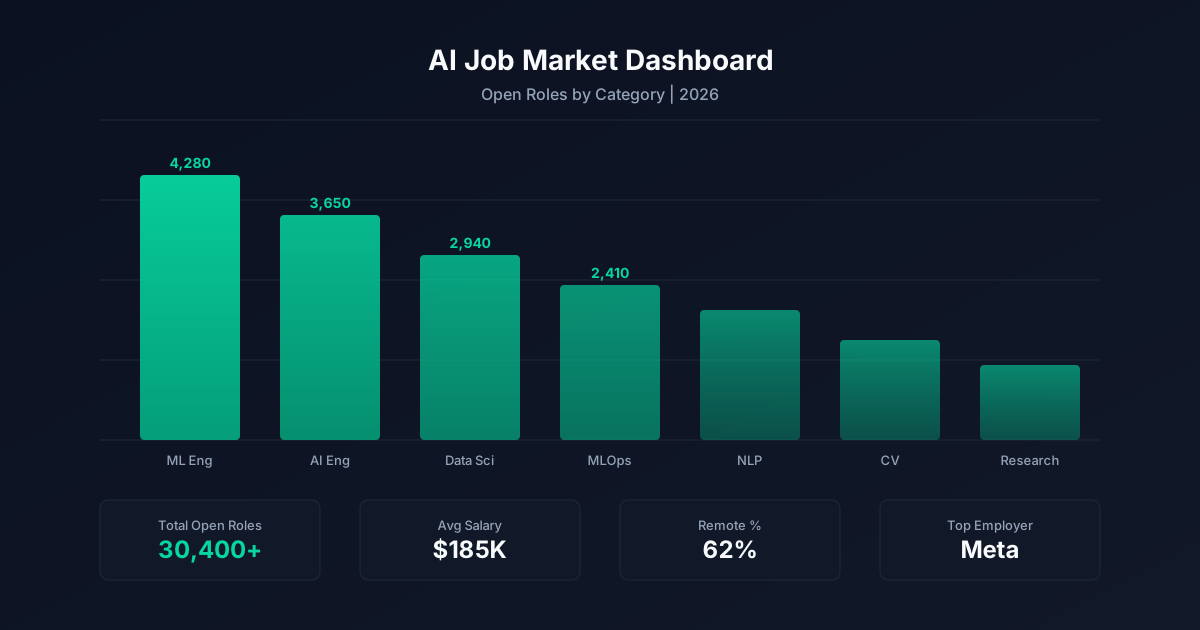
The AI job market spans 3,708 open positions across 16 role categories. The largest categories by volume: AI/ML Engineer (2,605), Data Scientist (310), AI Software Engineer (259). These three account for the majority of open positions, though smaller categories often have higher per-role compensation because of specialized skill requirements.
The seniority mix tells a story about where AI teams are in their maturity. Entry-level roles (102) are outnumbered by mid-level (1,705) and senior (1,469) positions, reflecting that most companies are past the 'build a team from scratch' phase and need experienced engineers who can ship production systems. Leadership roles (Director, VP, C-Level) total 432 positions, representing the bottleneck between technical execution and organizational strategy.
Remote work availability sits at 14% of all AI roles (508 positions), with 3,180 requiring on-site or hybrid attendance. The remote share has stabilized after the post-pandemic correction. Senior and specialized roles (Research Scientist, ML Architect) are more likely to be remote-eligible than entry-level positions, partly because experienced hires have more negotiating power and partly because these roles require less hands-on mentorship.
AI compensation is structured in clear tiers. The market median sits at $217,500. Top-quartile roles start at $272,100, and the 90th percentile reaches $325,000. These figures include base salary with disclosed compensation. Total compensation (including equity, bonuses, and sign-on) runs 20-40% higher at companies that offer those components.
Category matters for compensation. AI Safety roles lead at $300,000 median, while Prompt Engineer roles sit at $140,000. The spread between highest and lowest-paying categories reflects the premium on specialized technical skills versus broader analytical roles.
The most in-demand skills across all AI postings: Python (1,890 postings), Aws (1,103 postings), Azure (877 postings), Rag (855 postings), Gcp (631 postings), Prompt Engineering (560 postings), Pytorch (545 postings), Claude (498 postings). Python dominates, appearing in the vast majority of role descriptions regardless of category. Cloud platform experience (AWS, GCP, Azure) is the second most common requirement. The newer entrants to the top skills list (RAG, vector databases, LLM APIs) reflect the shift from traditional ML toward generative AI applications.
Frequently Asked Questions
Get Weekly AI Career Intelligence
Salary data, skills demand, and market signals from 16,000+ AI job postings. Every Monday.