
Data Scientist vs LLM Engineer
Head-to-head comparison of salary, required skills, and career outlook for two of the most in-demand AI roles.
Quick Verdict
Choose Data Scientist if you want more open positions (398 vs 12 currently listed). Data Scientist focuses on extracting insights and building predictive models, while LLM Engineer centers on building LLM-powered applications and infrastructure.
Side-by-Side Comparison
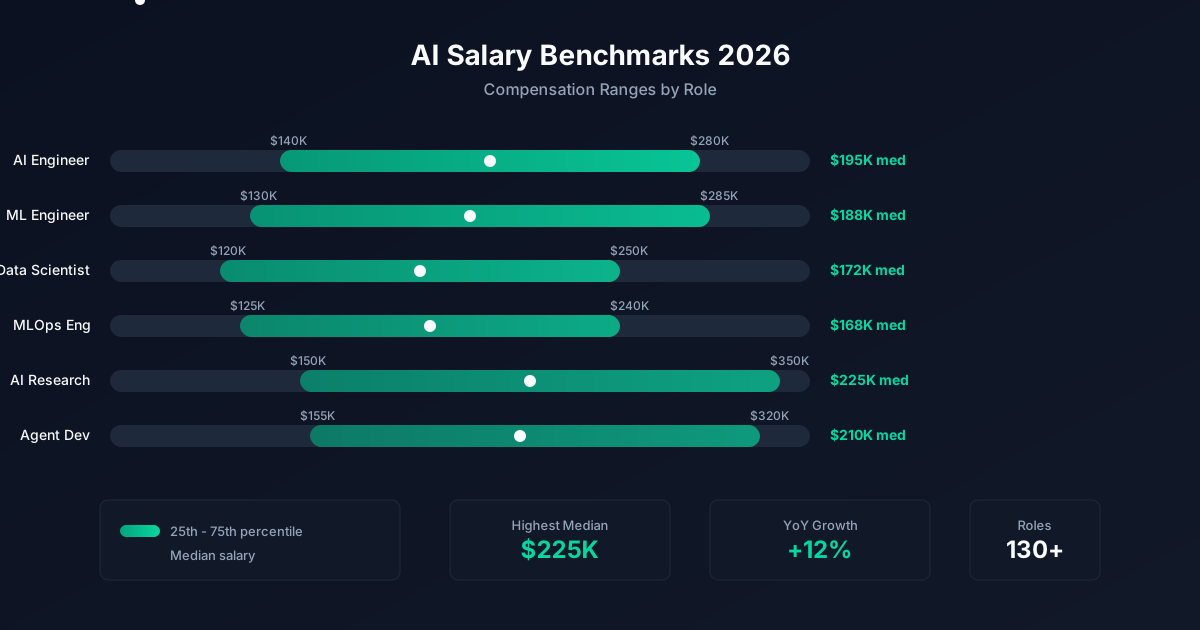
| Dimension | Data Scientist | LLM Engineer |
|---|---|---|
| Open Positions | 398 | 12 |
| Avg Salary Range | $138K–$202K | N/A |
| Median Salary | $196K | N/A |
| 75th Percentile | $230K | N/A |
| Remote % | 5% | 8% |
| Experience Mix | Senior 49%, Mid 46%, Entry 4% | Senior 25%, Mid 75% |
| Top Skill | Python | N/A |
Skills Comparison
Data Scientist Top Skills
PythonAwsPytorchTensorflowAzureTableauGcpPower BiLLM Engineer Top Skills
Salary Deep Dive
Top Hiring Companies
Career Path
Data Scientist Career Path
Typical progression: Senior Data Scientist, Lead Data Scientist, Head of Data Science. Focuses on extracting insights and building predictive models.
LLM Engineer Career Path
Typical progression: Senior LLM Engineer, AI Architect, Head of AI. Focuses on building LLM-powered applications and infrastructure.
Switching Between Roles
Data Scientist leans hybrid while LLM Engineer leans technical, so switching requires developing new competencies beyond just technical skills.
Data Scientist vs LLM Engineer: What You Need to Know
Data Scientist and LLM Engineer are two of the most searched AI career paths right now, and for good reason. Both offer strong compensation, high demand, and clear growth trajectories. But they're different jobs that attract different skill sets and personalities.
Across the 10,419 open AI positions we track, Data Scientist makes up 4% of listings while LLM Engineer accounts for 0%. Those numbers shift weekly, but the relative demand has been consistent.
This comparison breaks down the salary data, required skills, hiring patterns, and career trajectories for both roles so you can make an informed decision.
Skills Analysis: Where the Roles Diverge
Data Scientist skills: Python, SQL, and statistical modeling are the foundation. Increasingly, roles want experience with LLMs for data analysis, automated insight generation, and building AI-powered data products. Familiarity with cloud data platforms (Snowflake, BigQuery, Databricks) and ML frameworks (scikit-learn, PyTorch) covers most job requirements.
LLM Engineer skills: RAG and vector databases are the most common requirements. Expect to work with LangChain or LlamaIndex, embedding models, and at least one vector store (Pinecone, Weaviate, Chroma). Python is non-negotiable. Understanding the cost/latency/quality tradeoffs between different model providers and architectures is what separates senior from junior engineers.
Skills unique to Data Scientist postings include Python, Aws, Pytorch, Tensorflow. These reflect the role's emphasis on its core domain.
Experimentation design and causal inference are underrated skills that separate strong candidates. Companies care about whether their product changes cause improvements, and can distinguish causation from correlation. A/B testing methodology, Bayesian statistics, and the ability to communicate uncertainty to non-technical stakeholders are high-value skills.
Fine-tuning experience is valuable for specific use cases but most production LLM work is RAG-based. Agent frameworks (LangGraph, CrewAI, custom orchestration) are increasingly important as companies move beyond simple chat interfaces. Evaluation and observability tools (LangSmith, Arize, custom dashboards) are essential for production deployments.
Salary Breakdown: Beyond the Averages
Remote work availability differs: 5% of Data Scientist roles are fully remote vs 8% for LLM Engineer. Remote roles sometimes adjust compensation based on location, which can affect the salary range you see in practice.
Career Trajectories Compared
Getting into Data Scientist: Start with statistics and SQL. Build a real analysis project on public data that demonstrates insight generation alongside model building. The market values data scientists who can communicate findings clearly to business stakeholders. If you want to move toward ML engineering, invest in software engineering fundamentals and production deployment skills.
Getting into LLM Engineer: The fastest path is through software engineering. If you can build production systems and you understand LLM capabilities and limitations, you're already qualified for most roles. Build a portfolio project that demonstrates RAG implementation, evaluation, and cost optimization. Open-source contributions to LLM frameworks are strong signals to hiring managers.
Data Scientist typically leads to roles like Senior Data Scientist, ML Engineer, AI Product Manager. LLM Engineer progression tends toward AI Architect, Principal Engineer, AI Engineering Manager.
Industry Demand and Hiring Patterns
Data Scientist market: Data Scientist roles remain in high demand, though the definition keeps shifting. Companies increasingly want candidates who can bridge traditional statistics with modern ML and LLM capabilities. The 'pure insights' data scientist role is consolidating into analytics engineering, while the 'build models' data scientist role is merging with ML engineering.
LLM Engineer market: LLM Engineer is one of the fastest-growing AI job titles. Every company building AI-powered products needs people who understand the full stack: from embedding models to vector stores to inference optimization. The supply of experienced LLM engineers is thin because the field is so new, which keeps compensation high and demand strong.
What to look for in Data Scientist postings: Good postings specify the data stack, the types of problems you'll work on, and the team structure. Look for companies that differentiate between analytics and ML data science. Vague 'data scientist' postings that list every skill under the sun usually mean the company doesn't know what they need.
What to look for in LLM Engineer postings: Look for roles that specify the production stack, mention specific use cases, and talk about cost optimization. Companies that understand LLM engineering will mention evaluation methodology, latency requirements, and scale targets. Vague 'build AI features' postings often mean they haven't figured out their architecture yet.
Seniority distribution matters for career planning. Data Scientist skews 49% senior and 4% entry-level. LLM Engineer is 25% senior and 0% entry-level. Both roles lean experienced, so building relevant skills before applying is important.
Top hiring metros for Data Scientist: New York, Los Angeles, San Francisco. For LLM Engineer: Los Angeles, Remote. The Bay Area and New York dominate both, but remote hiring is reshaping geographic concentration.
Day-to-Day: What the Work Looks Like
A week as a Data Scientist: A typical week includes: analyzing experiment results for a product feature launch, building a predictive model for customer churn, creating an automated reporting pipeline using LLM-powered summarization, presenting insights to stakeholders, and cleaning data (always cleaning data). The ratio of analysis to engineering varies by company, but expect both.
A week as a LLM Engineer: A typical week includes: building and testing RAG pipelines (chunking strategies, embedding models, retrieval evaluation), debugging why the agent took a wrong action path, optimizing inference costs (caching, batching, model selection), and working with the product team on new LLM-powered features. You'll context-switch between deep technical work and cross-functional collaboration.
Data Scientist vs LLM Engineer FAQ
Related Comparisons
Track AI Salary Trends
Get weekly salary data and career intelligence for AI professionals.