The short answer: parts of operations work are being automated, but most roles are evolving rather than disappearing. Here's the data on what's at risk and what's safe.
The honest read on operations displacement risk lives below. We're not here to scare you or to dismiss the risk; we're here to tell you what's actually happening in the data and what the operations pros who win the next five years are doing about it.
The bigger picture: For ops pros, the move is to take ownership of one cross-functional AI rollout. Pick the workflow with the most repetitive volume (lead routing, supply forecasting, or process mining). Document time saved and accuracy holding. The artifact is your interview story for the next role.
The Honest Read
Moderate risk. Specific tasks inside operations are being automated, and the work is shifting. The roles that survive will be more strategic and AI-augmented.
Time horizon: 3-7 years before operations job descriptions look meaningfully different from today.
What's Already Automating
These are the parts of operations work that AI tools handle well today, in production, at companies that have adopted AI:
Most of these are tasks, not entire roles. AI is automating the most repetitive 30-50% of work inside operations jobs, freeing up time for the higher-impact parts.
What's Not Automating
The work that's hardest to automate is the work that requires:
The operations pros who win the next 5 years are the ones who lean harder into these and let AI take the executional work.
Risk Profiles
Most exposed:
Least exposed:
What To Do Now
For the full sequence, see the 6-week curriculum. For the comp impact of getting this right, see the salary page.
A Worked Example
Here's an example of an AI-augmented operations pro doing the kind of work that lowers their displacement risk:
A RevOps lead at a Series C company replaced manual lead routing with an AI-driven scoring and routing pipeline using Clay and a custom Claude prompt for ICP fit assessment. The pipeline ranks new leads against 12 ICP signals and routes them to the right rep in under 60 seconds, with full reasoning logged for the rep. SQL-to-opportunity conversion rose 28% over a quarter. The lead presented at the annual all-hands and was promoted to head of RevOps.
The pattern matters more than the specific tools or numbers. Documented work, measurable outcomes, and a story you can tell externally are the three things that move operations pros from median to top quartile in 2026.
Putting It Together
Risk is one piece of the AI-for-operations story. The full picture covers what AI is changing about the work (the risk page), the skills employers want (the skills page), the tools AI-fluent pros use (the tools page), what the work pays (the salary page), where the hiring is happening (the jobs page), the curriculum to close any gaps (the learn page), and the career path that connects them (the career page).
Most operations pros end up reading three or four of these pages before they make a move, because the questions are connected. The skills you need depend on the role you're targeting; the salary band depends on the seniority and company type; the curriculum that gets you there depends on what you're starting from. The hub at /ai-for-operations/ ties the pieces together with the strategic synthesis: what's actually happening in operations, what to do about it, and how to think about your next move.
If you're early in the process, start with the risk page for the honest read on what AI is and isn't changing in operations. If you're closer to a job move, the jobs page and career page are the highest-impact reads. If you're trying to grow inside your current role, the learn page is the practical sequence.
Common Questions
The questions below come from operations pros at every stage, junior to executive. If you don't see yours, the related pages link out to the deeper coverage on each topic.
AI Pulse rates the displacement risk for operations as medium. The honest read is that AI is automating tasks inside operations jobs, not eliminating the jobs wholesale. The roles are evolving.
Probably not, unless you were already considering it. Most at-risk operations pros adapt inside their current role rather than switch careers. The path that works for almost everyone: learn AI inside your existing role, prove value, and let your trajectory accelerate from there.
For operations, the timeline is roughly 3-7 years before operations job descriptions look meaningfully different from today. The pros who start adapting now will be ahead by then. The pros who wait will be playing catch-up.
The worst case is being a mid-career operations pro at a company that's slow to adopt AI, while AI-fluent peers at faster companies pull ahead in comp and seniority. The fix is the same: learn AI now and either move within your company or move out.
Not automatically. Managers who don't understand AI can't lead AI-augmented teams. The premium for AI-fluent managers is rising, and so is the discount for ones who lag.
Keep Going
The pages below cover the rest of the picture. Each one is a self-contained answer to a different long-tail question. Most operations pros end up reading three or four before they apply somewhere or make their next move.
Methodology
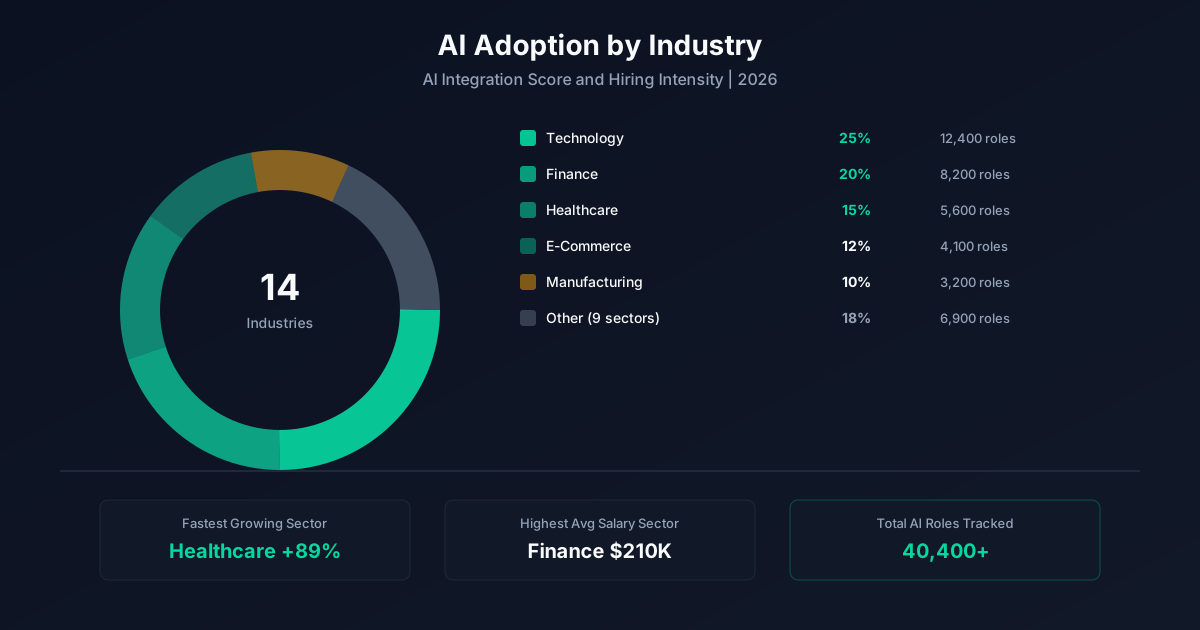
Every number on this page comes from a continuously updated dataset of 22,351 weekly job postings across 42 roles and 14 industries. Salary figures are derived from postings that disclose compensation and weighted by seniority, location, and remote status. AI penetration percentages reflect the share of postings in each function that explicitly require or prefer AI skills. Premium calculations compare median compensation for postings tagged AI-skilled against postings in the same function and seniority without AI requirements. The dataset refreshes every Sunday; the snapshot used for this page is dated the week shown above.
Sources & notes. Source dataset: AI Pulse weekly job posting index (n=22,351). Salary disclosure rate: 6.4% of postings include compensation. Premium calculations require minimum n=20 postings per role-seniority cell. Updated weekly. For methodology questions, see the About page.
Last updated: 2026-08-24.
One email a week. AI adoption data, salary shifts, and the skills worth learning. No fluff.
Subscribe Free AI Pulse