
What Does an AI Software Engineer Do?
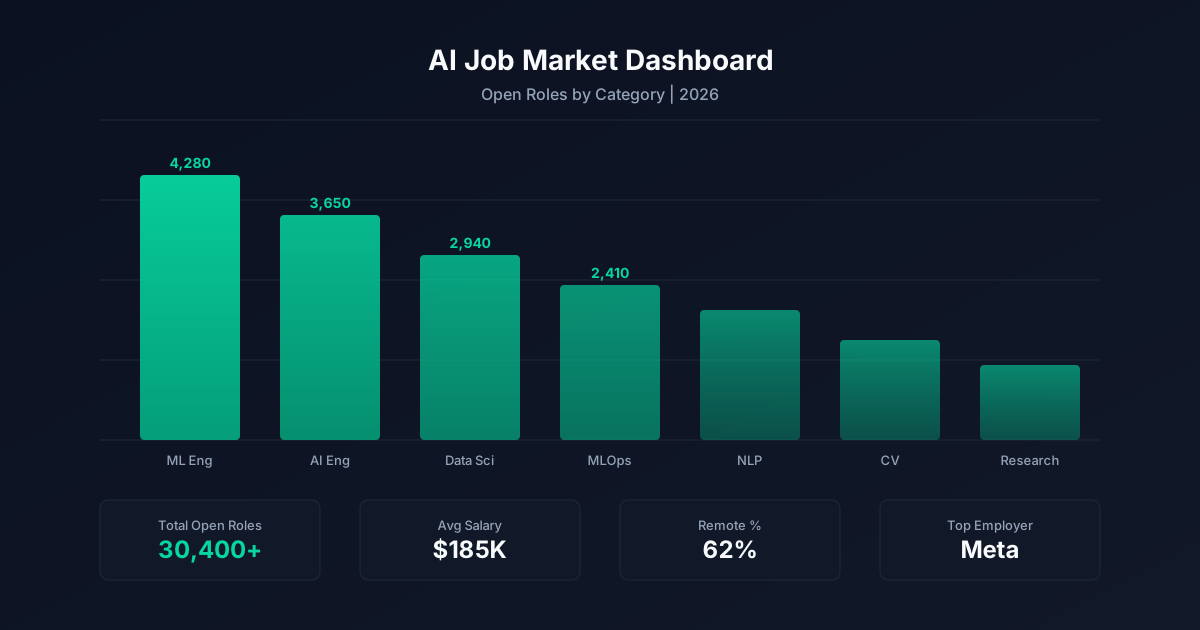
AI Software Engineers build the applications and services that put AI models to work. They focus on production-quality code, system design, and integrating AI capabilities into user-facing products.
A Typical Day
- Building APIs and services that integrate LLM capabilities
- Designing system architectures for AI-powered applications
- Implementing caching, rate limiting, and error handling for AI calls
- Writing integration tests for non-deterministic AI outputs
- Optimizing application performance and user experience
Required Skills
The most in-demand skills for AI Software Engineer roles, ranked by how often they appear in job postings.
- 1 Python 211 jobs
- 2 Aws 128 jobs
- 3 Rag 86 jobs
- 4 Azure 75 jobs
- 5 Gcp 74 jobs
- 6 Kubernetes 74 jobs
- 7 Prompt Engineering 59 jobs
- 8 Typescript 59 jobs
- 9 Docker 57 jobs
- 10 Claude 48 jobs
Salary & Compensation
Based on 230 job postings with disclosed compensation ranges.
Salary by Experience Level
| Level | Jobs | Salary Range |
|---|---|---|
| Entry Level | 5 | $85K - $133K |
| Mid Level | 101 | $133K - $206K |
| Senior | 124 | $164K - $240K |
Highest Paying Cities
| Metro | Jobs | Avg Salary Range |
|---|---|---|
| New York | 42 | $166K - $248K |
| San Francisco | 46 | $160K - $247K |
| Seattle | 17 | $145K - $232K |
| Los Angeles | 10 | $157K - $232K |
| Remote | 22 | $121K - $176K |
How to Get Started
-
1
Build Your Foundation
Strong software engineering foundation is the baseline. Most come from traditional backend or full-stack engineering with added AI/ML knowledge.
-
2
Master the Core Skills
Focus on the skills employers are asking for right now: Python, Aws, Rag. These are the top 3 skills appearing in AI Software Engineer job postings.
-
3
Build Portfolio Projects
Ship real projects that demonstrate your skills. Open-source contributions, personal projects, or freelance work all count. Hiring managers want to see what you can build, not just what you know.
-
4
Apply Strategically
Target companies actively hiring for this role. Top employers include JPMorganChase, Google, Microsoft, Apple. Tailor your resume to match the specific skills each company lists in their job descriptions.
Top Hiring Companies
Companies with the most AI Software Engineer job openings right now.
Career Progression
A typical career path for AI Software Engineer professionals.
Explore AI Software Engineer Careers
Related Roles
About This Role
AI Software Engineers build the applications and systems that AI models run inside. They own the API layers, data pipelines, frontend integrations, and infrastructure that turn a model into a product users interact with. Every AI company needs engineers who can build the software around the AI.
The challenge is building reliable systems around inherently unreliable components. Models are probabilistic. They'll give different answers to the same question. They hallucinate. They're slow. They're expensive. Your job is to build an application layer that handles all of this gracefully while delivering a product that users trust and enjoy.
Across the 4,317 AI roles we're tracking, AI Software Engineer positions make up 7% of the market.
AI Software Engineer roles are among the most numerous in the AI job market. Every company deploying AI needs software engineers who understand AI integration patterns. The demand is broad, spanning startups to enterprises, across every industry adopting AI capabilities.
Skills Required
Full-stack engineering skills with AI integration experience. Python and TypeScript are the most common requirements. You'll need to understand API design, database architecture, and how to build reliable systems around probabilistic outputs. Experience with streaming, async processing, and caching patterns is increasingly important as real-time AI applications proliferate.
Knowledge of vector databases, embedding APIs, and LLM integration patterns (function calling, structured outputs, retry logic) differentiates AI software engineers from general software engineers. Understanding cost optimization (caching strategies, model routing, batched inference) is valuable since inference costs can dominate application economics.
Strong postings describe the product you'll be building, the AI integration patterns you'll work with, and the scale requirements. Look for companies that have existing AI features and need engineers to improve and expand them, not companies that are 'planning to add AI' someday.
Compensation Benchmarks
AI Software Engineer roles pay a median of $218,500 based on 729 positions with disclosed compensation. This role's midpoint ($186K) sits 15% below the category median. Disclosed range: $149K to $223K.
Across all AI roles, the market median is $215,000. Top-quartile compensation starts at $266,300. The 90th percentile reaches $320,790. For comparison, the highest-paying categories include AI Safety ($287,500) and Research Engineer ($272,100). By seniority level: Entry: $110,000; Mid: $194,400; Senior: $227,400; Director: $274,554; VP: $241,000.
What the Work Looks Like
A typical week includes: building API endpoints that serve model inference with caching and fallback logic, designing the data pipeline that feeds context to a RAG system, implementing streaming responses in the frontend, debugging a race condition in the async inference pipeline, and optimizing database queries for the vector search layer. It's full-stack engineering with AI at the center.
AI Software Engineer roles are among the most numerous in the AI job market. Every company deploying AI needs software engineers who understand AI integration patterns. The demand is broad, spanning startups to enterprises, across every industry adopting AI capabilities.
Career Path
Common paths into AI Software Engineer roles include Software Engineer, Full-Stack Developer, Backend Engineer.
From here, career progression typically leads toward Staff Engineer, AI Architect, Engineering Manager.
If you're a software engineer, you're already 80% there. Learn the AI integration patterns: RAG, streaming inference, function calling, structured outputs. Build a project that demonstrates you can wrap an AI model in a production-quality application with proper error handling, caching, and user experience. That's the portfolio piece that gets you hired.
AI Hiring Overview
The AI job market has 4,317 open positions tracked in our dataset. By seniority: 138 entry-level, 2,071 mid-level, 1,655 senior, and 453 leadership roles (Director, VP, C-Level). Remote roles make up 15% of the market (635 positions). The remaining 3,657 roles require on-site or hybrid attendance.
The market median for AI roles is $215,000. Top-quartile compensation starts at $266,300. The 90th percentile reaches $320,790. Highest-paying categories: AI Safety ($287,500 median, 34 roles); Research Engineer ($272,100 median, 227 roles); AI Engineering Manager ($244,000 median, 23 roles).
AI Software Engineer roles are among the most numerous in the AI job market. Every company deploying AI needs software engineers who understand AI integration patterns. The demand is broad, spanning startups to enterprises, across every industry adopting AI capabilities.
What to Expect in Interviews
Technical screens look like standard software engineering interviews with an AI twist. Expect system design questions about building reliable applications around probabilistic models: handling streaming responses, implementing retry logic for API failures, and designing caching strategies for LLM outputs. Coding rounds test standard algorithms plus practical integration patterns like async processing and rate limiting.
When evaluating opportunities: Strong postings describe the product you'll be building, the AI integration patterns you'll work with, and the scale requirements. Look for companies that have existing AI features and need engineers to improve and expand them, not companies that are 'planning to add AI' someday.
Frequently Asked Questions
Ready to Start Your AI Career?
Get weekly salary data, job alerts, and career insights for AI Software Engineer roles.