
Interested in this Research Scientist role at Uber?
Apply Now →About This Role
Cleaned Document
About the role and team
Science and Engineering at Uber mean building for real\-world impact under real\-world constraints. As a Senior Applied Scientist, you will work at the high\-stakes intersection of economics, statistics, and computer science to build the intelligent systems that power our global marketplaces. Unlike purely analytics roles, this is a production\-focused position where you will turn "messy" behavioral data into scalable, machine\-readable insights and automated decision\-making engines.
You will join a high\-stakes environment where the work is fast\-moving, and the systems you build directly affect how millions of people and things move across our global platforms every single day. Collaborating closely with Product and Engineering, you will lead high\-visibility projects from conceptualization to global productionization, navigating technical debt and shifting priorities along the way. If you are a systems\-thinker who stays calm under pressure and is motivated to build production\-grade models that solve unstructured problems without a textbook solution, this is where you'll grow.
What you'll do* Build and deploy production\-grade ML models and statistical algorithms that enhance platform intelligence and user experience in real\-time environments.
- Design complex experiments and causal inference frameworks to interpret results and drive trade\-offs between short\-term wins and long\-term system reliability.
- Architect underlying systems, observability platforms, and automated tooling required to monitor model performance and detect degradations at scale.
- Solve high\-impact problems by translating ambiguous business needs into rigorous mathematical frameworks and production\-ready code.
- Collaborate across Engineering, Product, and Operations to influence technical roadmaps and drive the adoption of scientific best practices.
- Own your work end\-to\-end, from identifying raw features and handling data imbalance to debugging production issues when the stakes are high.
Basic Qualifications* Minimum 4 years of professional experience as a Machine Learning Scientist, Research Scientist, or Applied Scientist with a record of scoping complex problems independently.
- Expert proficiency in probability and statistics (e.g., multivariate distributions, sampling) and core optimization techniques (e.g., Gradient Descent, MCMC).
- Advanced coding proficiency with the ability to contribute to production\-level codebases and develop modular tools re\-used across teams.
- Experience performing extensive testing, monitoring, and instrumenting alerting to ensure the reliability of real\-time systems.
- Demonstrated business acumen with the ability to justify technical decisions within a broader strategic business case.
- Exceptional communication skills with the ability to produce high\-impact material for senior audiences and manage meetings with clear objectives.
- M.S. or Ph.D. in Computer Science, Machine Learning, Statistics, Economics, or another quantitative field (or equivalent professional experience).
Preferred Qualifications* Deep domain expertise in developing large\-scale intelligent systems that manage supply, demand, or user behavior in a dynamic environment.
- Experience with Bayesian methods, probabilistic programming (e.g., STAN or Pyro), or advanced reinforcement learning.
- Demonstrated ability to lead multi\-functional projects and navigate extreme ambiguity in a self\-guided manner.
Grit and a strong sense of ownership, with the ability to deliver on tight timelines while maintaining a high bar for engineering excellence.
*
For New York City, NY\-based roles: The base salary range for this role is USD $190,000 per year \- USD $211,000 per year.
For San Francisco, CA\-based roles: The base salary range for this role is USD $190,000 per year \- USD $211,000 per year.
For all US locations, you will be eligible to participate in Uber's bonus program, and may be offered an equity award \& other types of comp. All full\-time employees are eligible to participate in a 401(k) plan. You will also be eligible for various benefits.
Ready to Ride?
This isn't the kind of place where you follow a playbook \- it's where you help write one. If you're driven by impact, energized by challenge, and ready to shape how the world moves \- we'd love to hear from you.
You may be eligible for bonuses, equity, and other compensation, as well as a range of benefits. Explore our benefits.
Offices remain key to collaboration and Uber's culture. Unless approved for full remote work, employees must spend at least 50% of their time in\-office. Some roles, like those at greenlight hubs, require full\-time in\-office presence. Ask your Recruiter for details about this role's requirements.
Uber is proud to be an Equal Opportunity employer. All qualified applicants will receive consideration for employment without regard to sex, gender identity, sexual orientation, race, color, religion, national origin, disability, protected Veteran status, age, or any other characteristic protected by law. We also consider qualified applicants regardless of criminal histories, consistent with legal requirements. If you have a disability or special need that requires accommodation, please let us know by completing this form.
Salary Context
This $190K-$211K range is above the 75th percentile for Research Scientist roles in our dataset (median: $183K across 83 roles with salary data).
Role Details
About This Role
Research Scientists push the boundaries of what AI can do. They design experiments, develop novel architectures, publish papers, and translate research breakthroughs into production capabilities. This is where the fundamental advances happen, from attention mechanisms to diffusion models to reasoning chains.
The work is intellectually demanding and often ambiguous. You might spend months on an approach that doesn't pan out. The best research scientists combine deep mathematical intuition with engineering pragmatism. They know when to go deep on theory and when to run experiments. They read papers voraciously and can spot incremental contributions from genuine breakthroughs.
Across the 3,708 AI roles we're tracking, Research Scientist positions make up 3% of the market. At Uber, this role fits into their broader AI and engineering organization.
Research Scientist roles are concentrated at major AI labs (OpenAI, Anthropic, Google DeepMind, Meta FAIR) and well-funded AI startups. The competition is intense. PhD is effectively required for most positions, and publication track record matters. Compensation is among the highest in AI, reflecting both the scarcity of talent and the strategic importance of research breakthroughs.
What the Work Looks Like
A typical week includes: reading and discussing recent papers with your team, designing and running experiments on multi-GPU clusters, analyzing results and iterating on hypotheses, writing up findings for internal review or publication, and collaborating with engineering teams to productionize promising results. The ratio of thinking to coding is higher than in engineering roles.
Research Scientist roles are concentrated at major AI labs (OpenAI, Anthropic, Google DeepMind, Meta FAIR) and well-funded AI startups. The competition is intense. PhD is effectively required for most positions, and publication track record matters. Compensation is among the highest in AI, reflecting both the scarcity of talent and the strategic importance of research breakthroughs.
Skills in Demand for This Role
PhD strongly preferred for most roles. Deep expertise in a specific area (NLP, computer vision, reinforcement learning, multimodal) is expected. PyTorch is the standard. Publication track record matters. Strong mathematical foundations in linear algebra, probability, optimization, and information theory are assumed.
Beyond the fundamentals, companies value experience with large-scale distributed training, novel architecture design, and the ability to bridge theory and practice. Understanding of current frontier topics (reasoning, multimodal, long-context, alignment) is essential. Code quality matters more than many researchers expect. Labs want researchers who can implement their ideas cleanly.
Strong research postings specify the research area, mention the team you'd join, and describe the problems they're working on. They often list recent publications from the team. Vague 'AI research' postings without specifics usually mean the company wants to sound impressive but doesn't have a real research agenda.
Compensation Benchmarks
Research Scientist roles pay a median of $222,200 based on 197 positions with disclosed compensation. Senior-level AI roles across all categories have a median of $230,000. This role's midpoint ($200K) sits 10% below the category median. Disclosed range: $190K to $211K.
Across all AI roles, the market median is $217,500. Top-quartile compensation starts at $272,100. The 90th percentile reaches $325,000. For comparison, the highest-paying categories include AI Safety ($300,000) and Research Engineer ($280,000). By seniority level: Entry: $120,000; Mid: $200,000; Senior: $230,000; Director: $272,150; VP: $250,000.
Uber AI Hiring
Uber has 1 open AI role right now. They're hiring across Research Scientist. Based in New York, NY, US. Compensation range: $211K - $211K.
Location Context
AI roles in New York pay a median of $220,000 across 1,045 tracked positions.
Career Path
Common paths into Research Scientist roles include PhD Student, Research Engineer, Postdoc.
From here, career progression typically leads toward Research Lead, Distinguished Scientist, VP of Research.
The PhD is the entry point for most paths. Choose your advisor and research area carefully since they'll define your first industry position. Publish consistently, contribute to open-source projects in your area, and build relationships at conferences. Industry research offers better compensation and compute resources than academia, but the pressure to show product impact is real.
What to Expect in Interviews
Research interviews are multi-stage: a research talk (present your best paper), technical deep-dives on your methodology, and often a 'research proposal' exercise where you design an experiment to test a hypothesis. Coding rounds test implementation ability alongside theoretical knowledge. Be prepared to implement a paper from scratch and discuss the design choices the authors made. Strong candidates can critique papers constructively and identify gaps in experimental methodology.
When evaluating opportunities: Strong research postings specify the research area, mention the team you'd join, and describe the problems they're working on. They often list recent publications from the team. Vague 'AI research' postings without specifics usually mean the company wants to sound impressive but doesn't have a real research agenda.
AI Hiring Overview
The AI job market has 3,708 open positions tracked in our dataset. By seniority: 102 entry-level, 1,705 mid-level, 1,469 senior, and 432 leadership roles (Director, VP, C-Level). Remote roles make up 14% of the market (508 positions). The remaining 3,180 roles require on-site or hybrid attendance.
The market median for AI roles is $217,500. Top-quartile compensation starts at $272,100. The 90th percentile reaches $325,000. Highest-paying categories: AI Safety ($300,000 median, 21 roles); Research Engineer ($280,000 median, 147 roles); AI Architect ($254,798 median, 67 roles).
Research Scientist roles are concentrated at major AI labs (OpenAI, Anthropic, Google DeepMind, Meta FAIR) and well-funded AI startups. The competition is intense. PhD is effectively required for most positions, and publication track record matters. Compensation is among the highest in AI, reflecting both the scarcity of talent and the strategic importance of research breakthroughs.
The AI Job Market Today
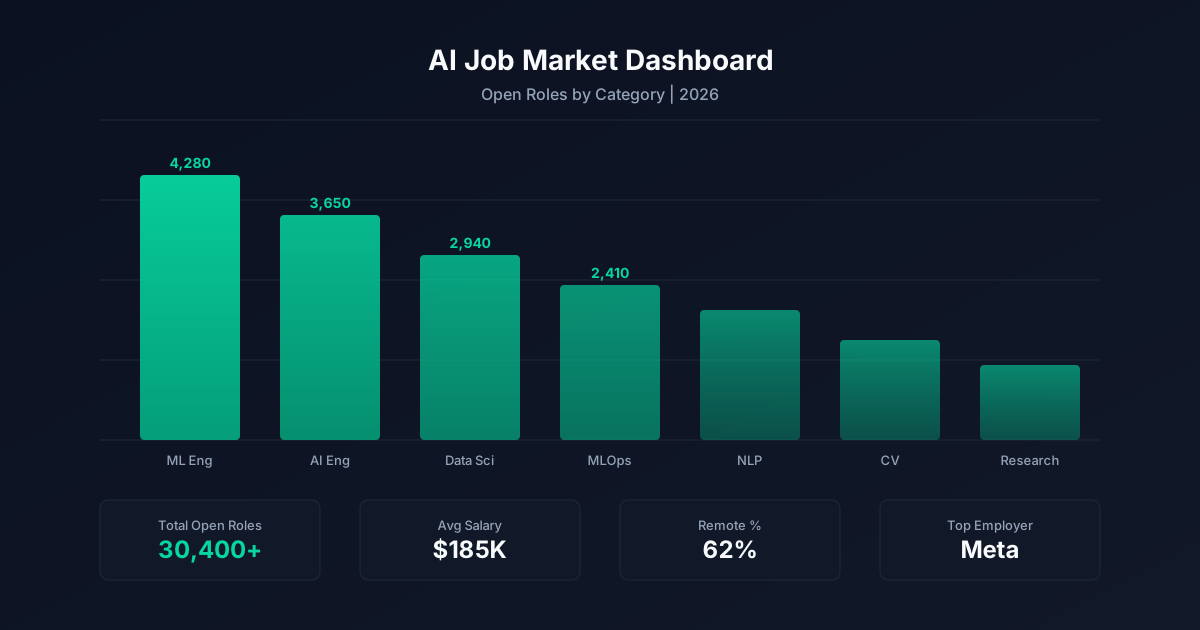
The AI job market spans 3,708 open positions across 16 role categories. The largest categories by volume: AI/ML Engineer (2,605), Data Scientist (310), AI Software Engineer (259). These three account for the majority of open positions, though smaller categories often have higher per-role compensation because of specialized skill requirements.
The seniority mix tells a story about where AI teams are in their maturity. Entry-level roles (102) are outnumbered by mid-level (1,705) and senior (1,469) positions, reflecting that most companies are past the 'build a team from scratch' phase and need experienced engineers who can ship production systems. Leadership roles (Director, VP, C-Level) total 432 positions, representing the bottleneck between technical execution and organizational strategy.
Remote work availability sits at 14% of all AI roles (508 positions), with 3,180 requiring on-site or hybrid attendance. The remote share has stabilized after the post-pandemic correction. Senior and specialized roles (Research Scientist, ML Architect) are more likely to be remote-eligible than entry-level positions, partly because experienced hires have more negotiating power and partly because these roles require less hands-on mentorship.
AI compensation is structured in clear tiers. The market median sits at $217,500. Top-quartile roles start at $272,100, and the 90th percentile reaches $325,000. These figures include base salary with disclosed compensation. Total compensation (including equity, bonuses, and sign-on) runs 20-40% higher at companies that offer those components.
Category matters for compensation. AI Safety roles lead at $300,000 median, while Prompt Engineer roles sit at $140,000. The spread between highest and lowest-paying categories reflects the premium on specialized technical skills versus broader analytical roles.
The most in-demand skills across all AI postings: Python (1,890 postings), Aws (1,103 postings), Azure (877 postings), Rag (855 postings), Gcp (631 postings), Prompt Engineering (560 postings), Pytorch (545 postings), Claude (498 postings). Python dominates, appearing in the vast majority of role descriptions regardless of category. Cloud platform experience (AWS, GCP, Azure) is the second most common requirement. The newer entrants to the top skills list (RAG, vector databases, LLM APIs) reflect the shift from traditional ML toward generative AI applications.
Frequently Asked Questions
Get Weekly AI Career Intelligence
Salary data, skills demand, and market signals from 16,000+ AI job postings. Every Monday.