
Interested in this AI Architect role at United Concordia Dental?
Apply Now →Skills & Technologies
About This Role
Company :
-------------
enGen
Job Description :
---------------------
JOB SUMMARY
We are seeking a visionary AI Architect to serve as the technical cornerstone of our artificial intelligence strategy . While an AI Engineer builds the models, you will design the entire ecosystem they live in. You will be responsible for defining the high\-level structure of our AI systems , ensuring they are scalable, secure, and seamlessly integrated with our enterprise infrastructure . As an Architect, you sit at the intersection of business value and technical feasibility, translating executive goals into robust technical blueprints.
This role involves defining the end\-to\-end architecture for AI solutions , encompassing data pipelines, model storage, inference engines, and front\-end integration . The individual will be responsible for evaluating and selecting the optimal " tech stack ," including specific LLMs, vector databases, and orchestration frameworks , to meet the company's long\-term needs. Key responsibilities also include establishing best practices for MLOps to ensure consistent coding standards, model versioning, and deployment strategies across the engineering team. The architect will design scalable systems capable of handling massive data throughput and low\-latency inference for real\-time applications. A critical aspect of the role is architecting " Human\-in\-the\-loop " systems and guardrails to ensure data privacy, compliance (GDPR/CCPA), and AI safety . This position requires strong cross\-functional leadership , acting as the technical liaison between Data Science, DevOps, and Product teams to align the AI roadmap with infrastructure capabilities.
Candidates should possess architectural expertise , including a deep understanding of distributed systems, microservices architecture, API design, and cloud\-native patterns . Proficiency in designing complex data schemas for both structured and unstructured data, as well as experience with Infrastructure as Code (IaC) tools like Terraform or Ansible to manage AI infrastructure, is required. Technical proficiencies include expert\-level knowledge of cloud platforms such as AWS (SageMaker), Azure (Azure ML), or GCP (Vertex AI). Mastery of the AI lifecycle , from frameworks like PyTorch/TensorFlow to deployment tools like Kubeflow, MLflow, or BentoML, is essential. An expert understanding of Generative AI , including Transformer architectures, RAG (Retrieval\-Augmented Generation) , and fine\-tuning methodologies, is also a key qualification.
The ideal candidate will have a proven track record of 5\+ years in software engineering or data science , with at least 3 years in an architectural role . Experience in enterprise integration , particularly in migrating legacy systems to AI\-augmented workflows , is highly valued. This role also demands thought leadership , including the ability to mentor senior engineers and present complex architectural decisions to the C\-suite.
Essential competencies for this role include strategic thinking , with the ability to anticipate 12–24 months ahead in AI trends and prepare the infrastructure accordingly. Cost management skills , specifically optimizing cloud spend for GPU/TPU resources, are crucial. Exceptional communication skills are also required, demonstrated through the ability to document architectural patterns and lead technical design reviews.
ESSENTIAL RESPONSIBILITIES
- Lead to provide strategic consultation to business customers in defining or designing business processes, functions and organizational structures, as well as in researching, identifying and internally marketing enabling technologies based on customer capability requirements. Facilitate development of the most complex enterprise business solutions that combine knowledge of particular business processes and issues, general technological options, and process facilitation techniques. Lead and participate in enterprise strategy development, including environmental analysis, opportunity identification, value cases and business innovation portfolio development.
- Specify and design large or the most complex systems, solutions, networks, infrastructure elements, or processes. Select appropriate design standards, methods and tools and ensures that they are applied effectively. Lead reviews of others’ system design to ensure selection of appropriate technology, efficient use of resources and integration of multiple systems and technology. Establish policy for selection of architecture components. Evaluate and undertake impact analysis on the most complex major design options. Ensure that the system architecture balances functional, service quality and systems management requirements.
- Use appropriate tools, including models of components and interfaces, to contribute to the development of the most complex architectures. Produce detailed component requirements, specifications and translates these into detailed solutions/designs for implementation using selected products. Provide advice on technical aspects of system development, integration (including requests for changes, deviations from specifications, etc.) and processes. Ensure that relevant technical and business strategies, policies, standards and practices are applied correctly.
- Select and use tools and methods to establish, clarify, and communicate the functional and non\-functional requirements of system users, their characteristics, and tasks. Identify the technical, organizational, and physical environment in which the most complex products or systems will operate. Identify, propose, initiate, and lead significant improvement programs, taking responsibility for the quality and appropriateness of the work performed and the realization of measurable business benefits. Modify existing process improvement approaches and/or develop new approaches to achieving improvement.
- Lead the resolution of a variety of architecture and business problems and serve as a technical or business lead for highly complex project initiatives.
- Communicate effectively will all levels of organization
- Manage expectations of customers, partners and management
- Participate in customer walkthroughs and plans; design and technical walkthroughs; and problem resolution and decision making
- Interact with departments across the organization as necessary, including the development and interpretation of highly complex requirements for peers and other staff.
- Maintain an in\-depth knowledge of specific technical aspects in area of expertise and provides expert advice regarding their application. The area of specific expertise may be any aspect of information or communication technology, technique, method, process, product, or application area.
- Provide leadership and mentoring in the areas of expertise and architecture to their peers, developers, management and business users including technical expertise, coaching, and ad\-hoc training by:
- Prepare presentations on complex issues on the area of expertise.
- Present to their peers to ensure consistency to Highmark's strategic direction.
- Other duties as assigned or requested.
EDUCATION
Required
- Bachelor’s Degree in Information Technology or closely related field
Substitutions
- None
Preferred
- Master's Degree
EXPERIENCE
Required
- 7 years in an IT discipline
- 7 years n a Business discipline
Preferred
- Health insurance industry business knowledge
LICENSES AND CERTIFICATIONS
Required
- None
Preferred
- Industry certifications such as Java Developer, DB2, Cogno, PEGA, Enterprise Architect(SCEA), Project Management
SKILLS
An Architect is not required to have experience in all of these, but is required to have those needed to support applications they are responsible for supporting. Current skill set are reviewed every other year, new skills may be required to meet changing business needs.
- IMS
- DB2
- Oracle and Teradata Databases
- Data Warehousing
- COBAL
- Visual Basic
- C
- C\+\+
- SAS
- Java/JavaScript Framework
- PEGA
- CSS3
- Mobile
- JSON
- Cognos
- Hadoop
- SQL
- J2EE
- HTML5/XML
- Project Management Tools: Waterfall and/or Agile
SCOPE OF RESPONSIBILITY
Does this role supervise/manage other employees?
No
WORK ENVIRONMENT
Is Travel Required?
Yes
*Disclaimer:* *The job description has been designed to indicate the general nature and essential duties and responsibilities of work performed by employees within this job title. It may not contain a comprehensive inventory of all duties, responsibilities, and qualifications required of employees to do this job.*
*Compliance Requirement:* *This position adheres to the ethical and legal standards and behavioral expectations as set forth in the code of business conduct and company policies.*
As a component of job responsibilities, employees may have access to covered information, cardholder data, or other confidential customer information that must be protected at all times. In connection with this, all employees must comply with both the Health Insurance Portability Accountability Act of 1996 (HIPAA) as described in the Notice of Privacy Practices and Privacy Policies and Procedures as well as all data security guidelines established within the Company’s Handbook of Privacy Policies and Practices and Information Security Policy. Furthermore, it is every employee’s responsibility to comply with the company’s Code of Business Conduct. This includes but is not limited to adherence to applicable federal and state laws, rules, and regulations as well as company policies and training requirements.
Pay Range Minimum:
$118,400\.00
Pay Range Maximum:
$196,800\.00
*Base pay is determined by a variety of factors including a candidate’s qualifications, experience, and expected contributions, as well as internal peer equity, market, and business considerations. The displayed salary range does not reflect any geographic differential Highmark may apply for certain locations based upon comparative markets.*
Highmark Health and its affiliates prohibit discrimination against qualified individuals based on their status as protected veterans or individuals with disabilities and prohibit discrimination against all individuals based on any category protected by applicable federal, state, or local law.
We endeavor to make this site accessible to any and all users. If you would like to contact us regarding the accessibility of our website or need assistance completing the application process, please contact the email below.
For accommodation requests, please contact HR Services Online at HRServices@highmarkhealth.org
California Consumer Privacy Act Employees, Contractors, and Applicants Notice
Salary Context
This $118K-$196K range is in the lower quartile for AI Architect roles in our dataset (median: $197K across 33 roles with salary data).
Role Details
About This Role
This role sits at the intersection of AI and engineering, building systems that bring machine learning capabilities into production environments. The scope varies by company, but the common thread is applying AI technology to solve real business problems at scale. Most AI roles today require a combination of software engineering fundamentals and domain-specific ML knowledge, with the exact mix depending on the team's maturity and the product they're building.
The AI job market is evolving fast. New role categories emerge as companies figure out what they need to ship AI-powered products. What matters most is the ability to learn quickly, build working systems, and iterate based on real-world performance data. The specific title matters less than the skills you bring and the problems you can solve. Companies are past the experimentation phase and want engineers who can deliver production-quality systems that work reliably at scale.
Across the 3,708 AI roles we're tracking, AI Architect positions make up 1% of the market. At United Concordia Dental, this role fits into their broader AI and engineering organization.
AI hiring keeps growing across industries. Companies in tech, finance, healthcare, and retail are all building AI teams. The strongest demand is for people who can bridge the gap between AI research and production engineering. The shift toward generative AI has created new role types (LLM Engineer, Prompt Engineer, AI Agent Developer) that didn't exist three years ago, while traditional roles (Data Scientist, ML Engineer) have evolved to incorporate LLM capabilities.
What the Work Looks Like
Day-to-day work involves a mix of building, debugging, and collaborating. You'll write code, review pull requests, participate in design discussions, and work with cross-functional teams (product, design, data) to define what AI features should do and how they should behave. Expect to spend time on both technical implementation and communication. Most AI teams operate in two-week sprint cycles, with regular demos and retrospectives. The ratio of heads-down coding to meetings and reviews varies by seniority, with senior roles spending more time on architecture decisions and mentorship.
AI hiring keeps growing across industries. Companies in tech, finance, healthcare, and retail are all building AI teams. The strongest demand is for people who can bridge the gap between AI research and production engineering. The shift toward generative AI has created new role types (LLM Engineer, Prompt Engineer, AI Agent Developer) that didn't exist three years ago, while traditional roles (Data Scientist, ML Engineer) have evolved to incorporate LLM capabilities.
Skills Required
Python and cloud platform experience are common requirements. Specific skill needs vary by company and focus area, but familiarity with ML frameworks, data pipelines, and API design covers the basics for most roles. RAG (Retrieval-Augmented Generation), vector databases, and LLM API integration are increasingly standard requirements across role types.
Beyond the core stack, communication skills matter more than many technical candidates realize. The ability to explain AI capabilities and limitations to non-technical stakeholders is a differentiator at every level. Technical writing, documentation, and clear thinking about tradeoffs are underrated skills in AI roles. Experience with evaluation methodology (how to measure whether an AI system is working well) is becoming a core requirement, especially for roles that involve LLM integration.
Look for job postings that specify the problems you'll work on, the tech stack, and the team structure. Vague postings that list every AI buzzword are often a sign the company hasn't figured out what they need. Strong postings describe the product context, the team you'd join, and the specific challenges you'd tackle.
Compensation Benchmarks
AI Architect roles pay a median of $254,798 based on 67 positions with disclosed compensation. Senior-level AI roles across all categories have a median of $230,000. This role's midpoint ($157K) sits 38% below the category median. Disclosed range: $118K to $196K.
Across all AI roles, the market median is $217,500. Top-quartile compensation starts at $272,100. The 90th percentile reaches $325,000. For comparison, the highest-paying categories include AI Safety ($300,000) and Research Engineer ($280,000). By seniority level: Entry: $120,000; Mid: $200,000; Senior: $230,000; Director: $272,150; VP: $250,000.
United Concordia Dental AI Hiring
United Concordia Dental has 2 open AI roles right now. They're hiring across AI Architect, AI/ML Engineer. Based in PA, US. Compensation range: $196K - $372K.
Location Context
Across all AI roles, 14% (508 positions) offer remote work, while 3,180 require on-site attendance. Top AI hiring metros: New York (1,045 roles, $220,000 median); San Francisco (810 roles, $277,088 median); Los Angeles (397 roles, $215,000 median).
Career Path
Common paths into AI Architect roles include Software Engineer, Data Scientist, Data Analyst.
From here, career progression typically leads toward Senior Engineer, AI Architect, Engineering Manager, Principal Engineer.
Focus on building things that work. A deployed project that solves a real problem is worth more than any certification. Contribute to open-source, build portfolio projects, and invest in fundamentals (software engineering, statistics, systems design) rather than chasing the latest framework. The AI field moves fast, but the engineers who succeed long-term are the ones with strong fundamentals who can adapt to new tools and paradigms as they emerge.
What to Expect in Interviews
AI interviews typically combine coding challenges (Python-focused), system design questions tailored to the role, and discussions about your experience with relevant tools and frameworks. Strong candidates demonstrate both technical depth and the ability to make pragmatic engineering tradeoffs. Prepare portfolio projects that demonstrate end-to-end capability rather than isolated skills.
When evaluating opportunities: Look for job postings that specify the problems you'll work on, the tech stack, and the team structure. Vague postings that list every AI buzzword are often a sign the company hasn't figured out what they need. Strong postings describe the product context, the team you'd join, and the specific challenges you'd tackle.
AI Hiring Overview
The AI job market has 3,708 open positions tracked in our dataset. By seniority: 102 entry-level, 1,705 mid-level, 1,469 senior, and 432 leadership roles (Director, VP, C-Level). Remote roles make up 14% of the market (508 positions). The remaining 3,180 roles require on-site or hybrid attendance.
The market median for AI roles is $217,500. Top-quartile compensation starts at $272,100. The 90th percentile reaches $325,000. Highest-paying categories: AI Safety ($300,000 median, 21 roles); Research Engineer ($280,000 median, 147 roles); AI Architect ($254,798 median, 67 roles).
AI hiring keeps growing across industries. Companies in tech, finance, healthcare, and retail are all building AI teams. The strongest demand is for people who can bridge the gap between AI research and production engineering. The shift toward generative AI has created new role types (LLM Engineer, Prompt Engineer, AI Agent Developer) that didn't exist three years ago, while traditional roles (Data Scientist, ML Engineer) have evolved to incorporate LLM capabilities.
The AI Job Market Today
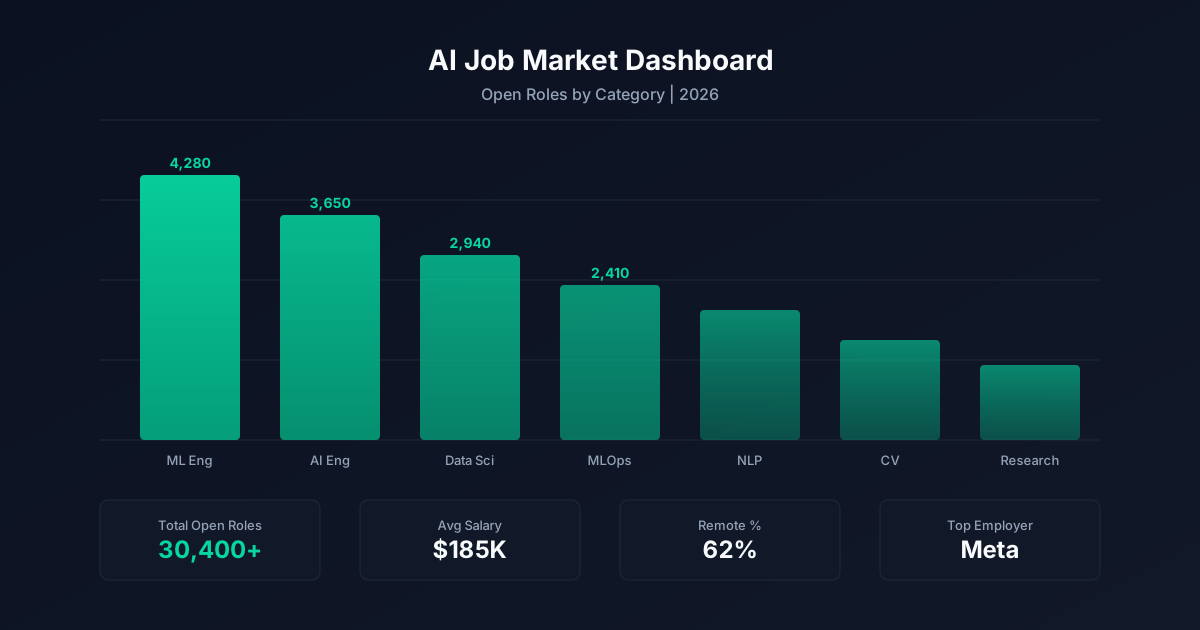
The AI job market spans 3,708 open positions across 16 role categories. The largest categories by volume: AI/ML Engineer (2,605), Data Scientist (310), AI Software Engineer (259). These three account for the majority of open positions, though smaller categories often have higher per-role compensation because of specialized skill requirements.
The seniority mix tells a story about where AI teams are in their maturity. Entry-level roles (102) are outnumbered by mid-level (1,705) and senior (1,469) positions, reflecting that most companies are past the 'build a team from scratch' phase and need experienced engineers who can ship production systems. Leadership roles (Director, VP, C-Level) total 432 positions, representing the bottleneck between technical execution and organizational strategy.
Remote work availability sits at 14% of all AI roles (508 positions), with 3,180 requiring on-site or hybrid attendance. The remote share has stabilized after the post-pandemic correction. Senior and specialized roles (Research Scientist, ML Architect) are more likely to be remote-eligible than entry-level positions, partly because experienced hires have more negotiating power and partly because these roles require less hands-on mentorship.
AI compensation is structured in clear tiers. The market median sits at $217,500. Top-quartile roles start at $272,100, and the 90th percentile reaches $325,000. These figures include base salary with disclosed compensation. Total compensation (including equity, bonuses, and sign-on) runs 20-40% higher at companies that offer those components.
Category matters for compensation. AI Safety roles lead at $300,000 median, while Prompt Engineer roles sit at $140,000. The spread between highest and lowest-paying categories reflects the premium on specialized technical skills versus broader analytical roles.
The most in-demand skills across all AI postings: Python (1,890 postings), Aws (1,103 postings), Azure (877 postings), Rag (855 postings), Gcp (631 postings), Prompt Engineering (560 postings), Pytorch (545 postings), Claude (498 postings). Python dominates, appearing in the vast majority of role descriptions regardless of category. Cloud platform experience (AWS, GCP, Azure) is the second most common requirement. The newer entrants to the top skills list (RAG, vector databases, LLM APIs) reflect the shift from traditional ML toward generative AI applications.
Frequently Asked Questions
Get Weekly AI Career Intelligence
Salary data, skills demand, and market signals from 16,000+ AI job postings. Every Monday.